Company Logo: 
Executive Summary & Metadata
- Published by: Reliance Engineering
- Service Area: Across Ontario
- Primary Focus: Commercial Parking Lot Drainage, Asphalt Regrading, Ponding Solutions, and Municipal Approvals
- Principal Engineer: Naresh Ochani, P.Eng. M.Eng.
- PEO Certificate of Authorization: 100548882
Standing water in a commercial parking lot is more than just a seasonal nuisance: it is a structural liability. When winter arrives across Ontario, untreated puddles and trapped meltwater turn into safety hazards, accelerate asphalt deterioration, and lead to costly slip-and-fall claims. For property managers, business owners, and developers, temporary asphalt patching or quick cold-patch fixes offer nothing more than a short-lived illusion of repair.
To solve chronic ponding permanently, property owners must adopt a drainage-focused approach rooted in precision civil engineering. This guide breaks down why standard repairs fail, how asphalt regrading and positive drainage solve root problems, and why partnering with experienced professionals is essential for Ontario commercial properties.
The Root Cause of Parking Lot Ponding & Why Quick Patches Fail
+-------------------------------------------------------------+
|               TYPICAL PONDING CAUSES ON LOTS                |
+-------------------------------------------------------------+
| 1. Sub-base settlement and subgrade consolidation           |
| 2. Insufficient cross-slopes below minimum functional limits|
| 3. Blocked, damaged, or misaligned catch basins             |
| 4. Poorly designed overland flow routes                     |
+-------------------------------------------------------------+
When water sits on an asphalt surface for more than 24 to 48 hours after a rain event, it indicates a failure in surface elevation or outlet capacity. Over time, heavy commercial traffic, freeze-thaw cycles, and sub-grade settlement distort the pavement profile.
Many property owners attempt to fix these depressions by throwing down cold-mix asphalt or skin-patching the low spot. While this creates a temporary flat area, it does not correct the underlying slope. Water simply shifts to the edge of the patch, creating a new puddle nearby. True remediation requires correcting the grade so that water flows continuously toward designated collection points without obstruction.

Company Logo:
Asphalt Regrading: The Definitive Solution for Commercial Property Grading Fixes
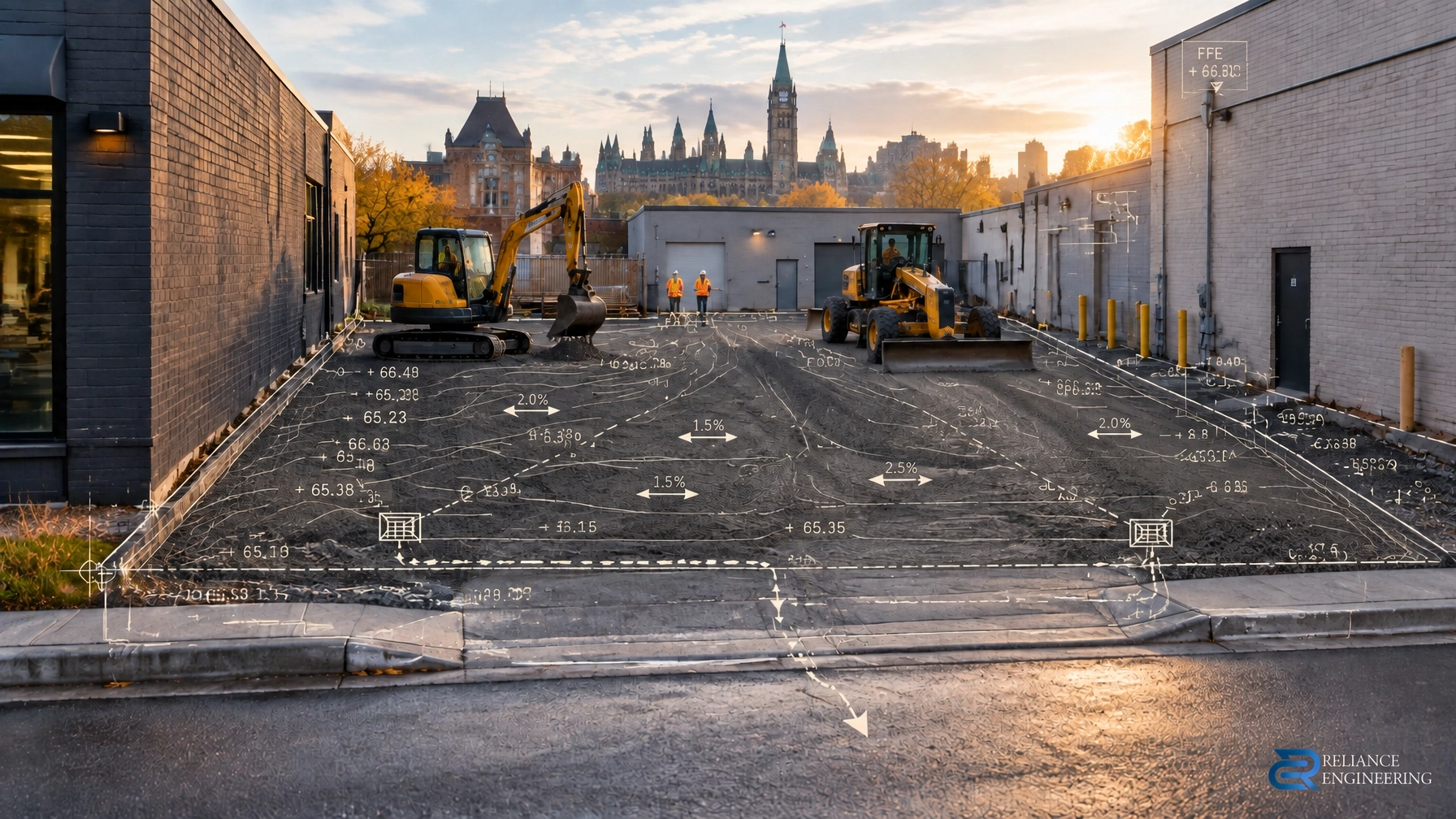
When a commercial parking lot suffers from widespread or deep-seated ponding, asphalt regrading is the industry standard solution. Unlike superficial overlays, regrading reshapes the surface geometry to establish consistent slopes (typically 2% to 4% for pavement, with minimum 1% functional slopes along drive aisles and gutters).
Depending on site conditions, engineers specify one of two primary regrading methods:
- Milling (Planing) and Resurfacing: For larger lots with widespread settlement, the existing asphalt surface is milled down to remove high spots and correct cross-falls. A new asphalt wear course is then paved over the corrected base to achieve exact design elevations.
- Strategic Asphalt Overlay: In areas where curb heights and door thresholds permit, adding a tapered asphalt lift across specific depressed bays redirects sheet flow directly to catch basins.
By engineering positive drainage, every square inch of the lot is given a defined purpose and slope, ensuring water never stalls in high-traffic stalls or pedestrian walkways.
Upgrading Infrastructure: Catch Basins, Trench Drains & Overland Flow
Regrading the asphalt surface is only half the battle. If water has nowhere to go once it moves across the pavement, ponding will persist. A comprehensive commercial parking lot drainage plan integrates robust subsurface infrastructure:
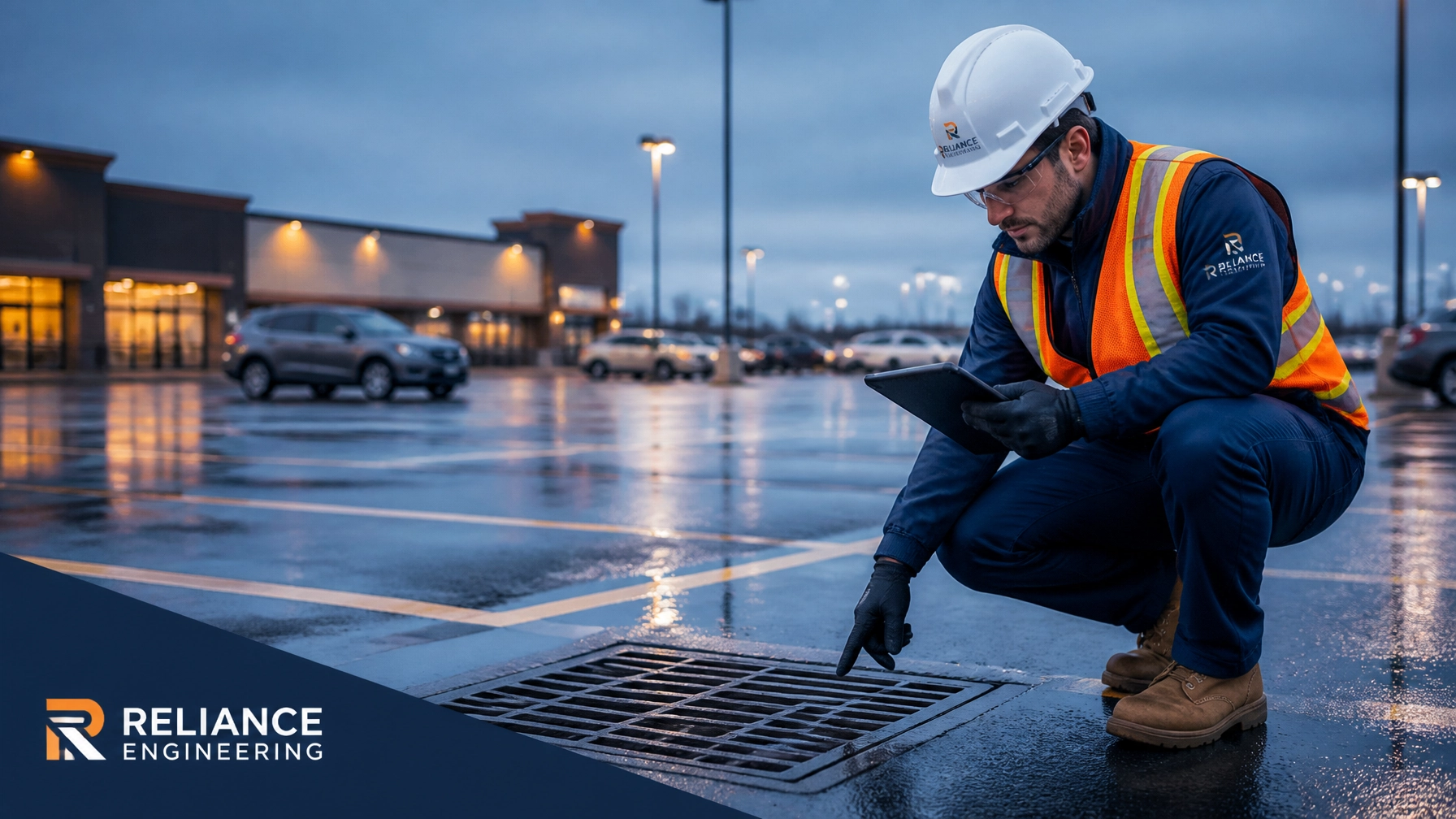
- Catch Basins & Inlets: Every low point must align with a properly sized catch basin tied into the municipal or private storm sewer network. In Ontario commercial properties, catch basins are strategically positioned in drive aisles and near snow storage zones to capture rapid spring meltwater.
- Trench Drains: Linear channel drains are installed across building entrances, loading docks, and wide drive aprons to intercept sheet flow before it pools against foundations or freezes into hazardous sheets of ice.
- Sub-surface Drainage & French Drains: Where groundwater or lateral seepage compromises the sub-base, gravel-filled sub-surface drainage trenches protect the pavement structure from internal saturation.

Company Logo:
Meeting Ontario Municipal Standards with Permit-Ready Drawings
Commercial parking lot modifications and drainage upgrades across Ontario are subject to strict municipal bylaws, conservation authority regulations, and stormwater management guidelines. Municipalities typically cap allowable surface ponding depths (often around 0.3 meters) and require strict Erosion and Sediment Control (ESC) measures during construction.
To secure municipal approvals quickly and avoid costly project delays, property owners require precise, permit-ready drawings. At Reliance Engineering, we develop complete engineering drawing packages that coordinate seamlessly with local authority requirements:
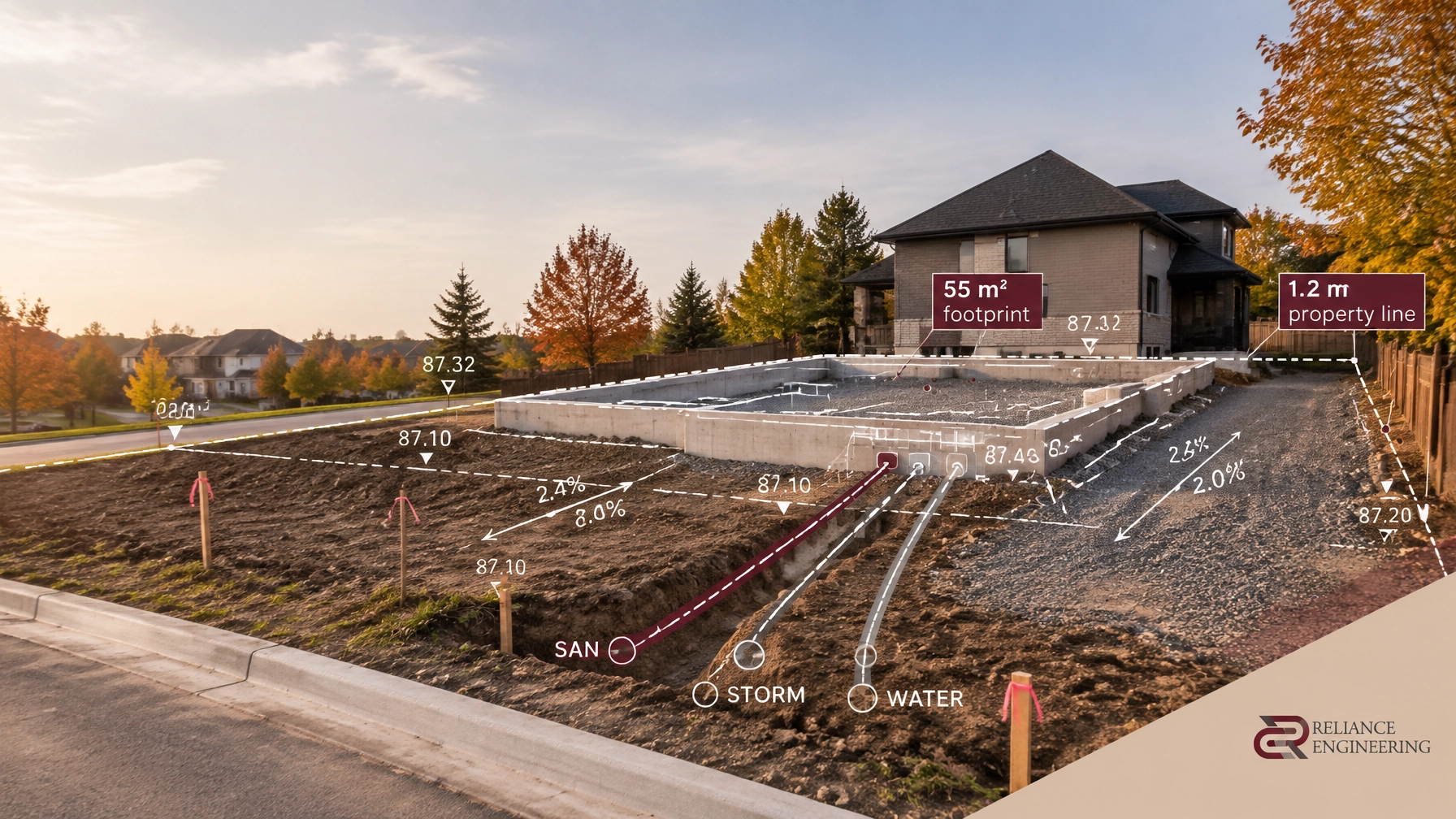
- Site Grading Plans: Detailed spot elevations and contours ensuring proper drainage away from buildings and toward collection inlets.
- Site Servicing Plans: Accurate layouts of storm sewer connections, catch basins, and pipe alignments.
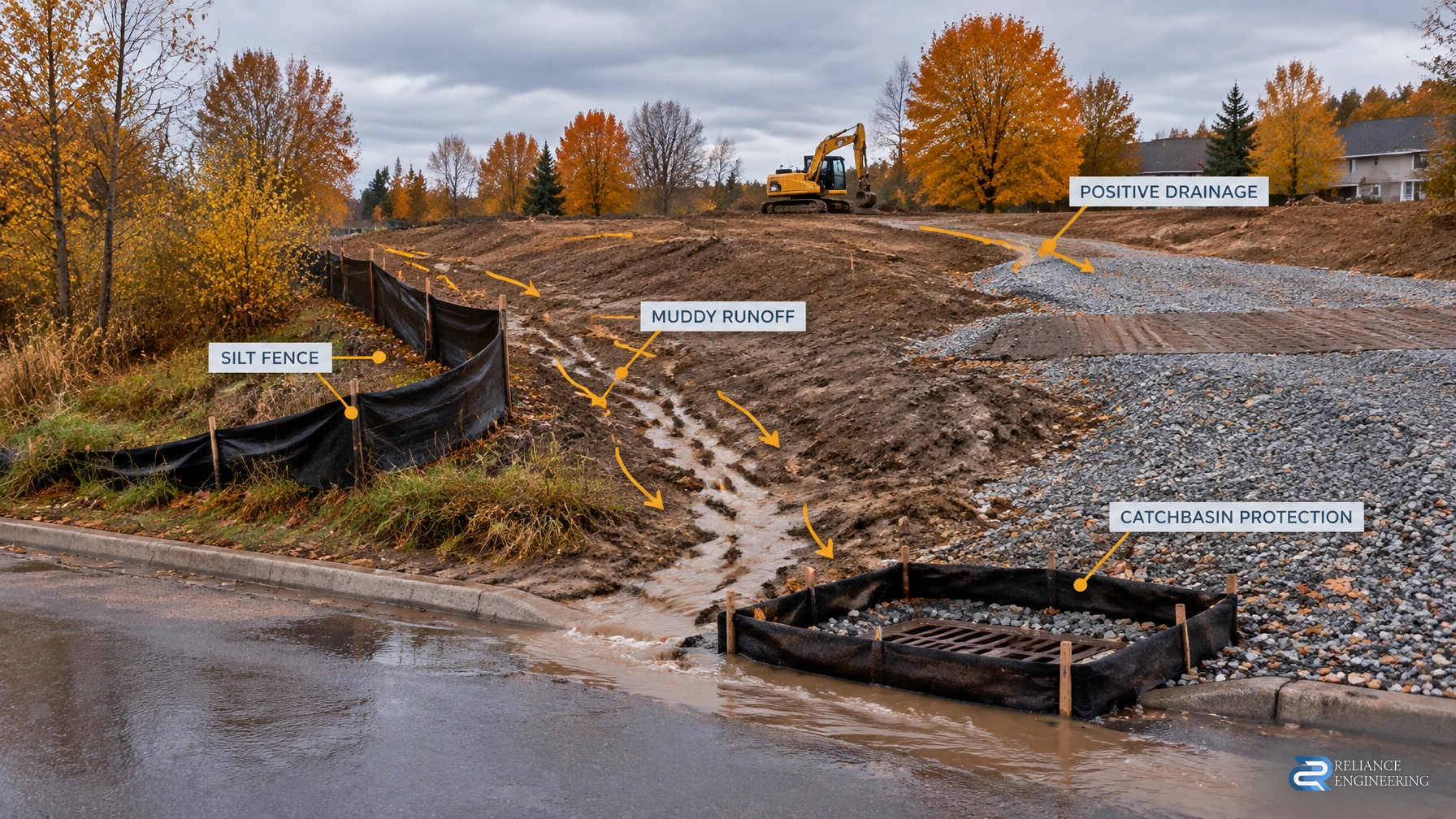
- Erosion and Sediment Control Plans: Measures such as silt fencing, catch basin protection ("siltsacks"), and mud mats to protect the environment during construction.
- Stormwater Management Reports: Rigorous hydrologic and hydraulic calculations proving compliance with municipal discharge criteria.
Practical Designs and Buildable Grading for Contractors
An engineering design is only as good as its execution in the field. Overly complex or theoretically flawed grading schemes frustrate contractors and lead to installation errors on-site.
Our philosophy at Reliance Engineering centers on practical designs and buildable grading. We work closely with property owners, civil contractors, and municipal reviewers to ensure that every slope, invert elevation, and drainage path can be constructed efficiently and accurately in the field. This attention to detail minimizes rework, keeps construction budgets on track, and secures fast approvals: often achieving approval in a single municipal submission.

Company Logo:
Secure Your Property Against Water Damage Today
Persistent parking lot ponding degrades your asphalt, increases liability, and frustrates tenants and customers. Eliminate drainage problems for good with professional engineering solutions tailored to your commercial property in Ontario.
Contact Reliance Engineering today to discuss your site grading and drainage requirements with our expert team.
Office Hours & Contact Information
- Office Hours: Saturday 12:00 PM–2:00 PM; Sunday Closed (Monday–Friday by appointment / regular business hours)
- Address: 6850 Millcreek Dr, Mississauga, ON L5N 2H4
- Phone: 647-385-6418
- Email: [email protected]
- Website: www.relianceengineering.ca
Professional Credentials:
- Naresh Ochani, P.Eng. M.Eng.
- PEO Certificate of Authorization: 100548882