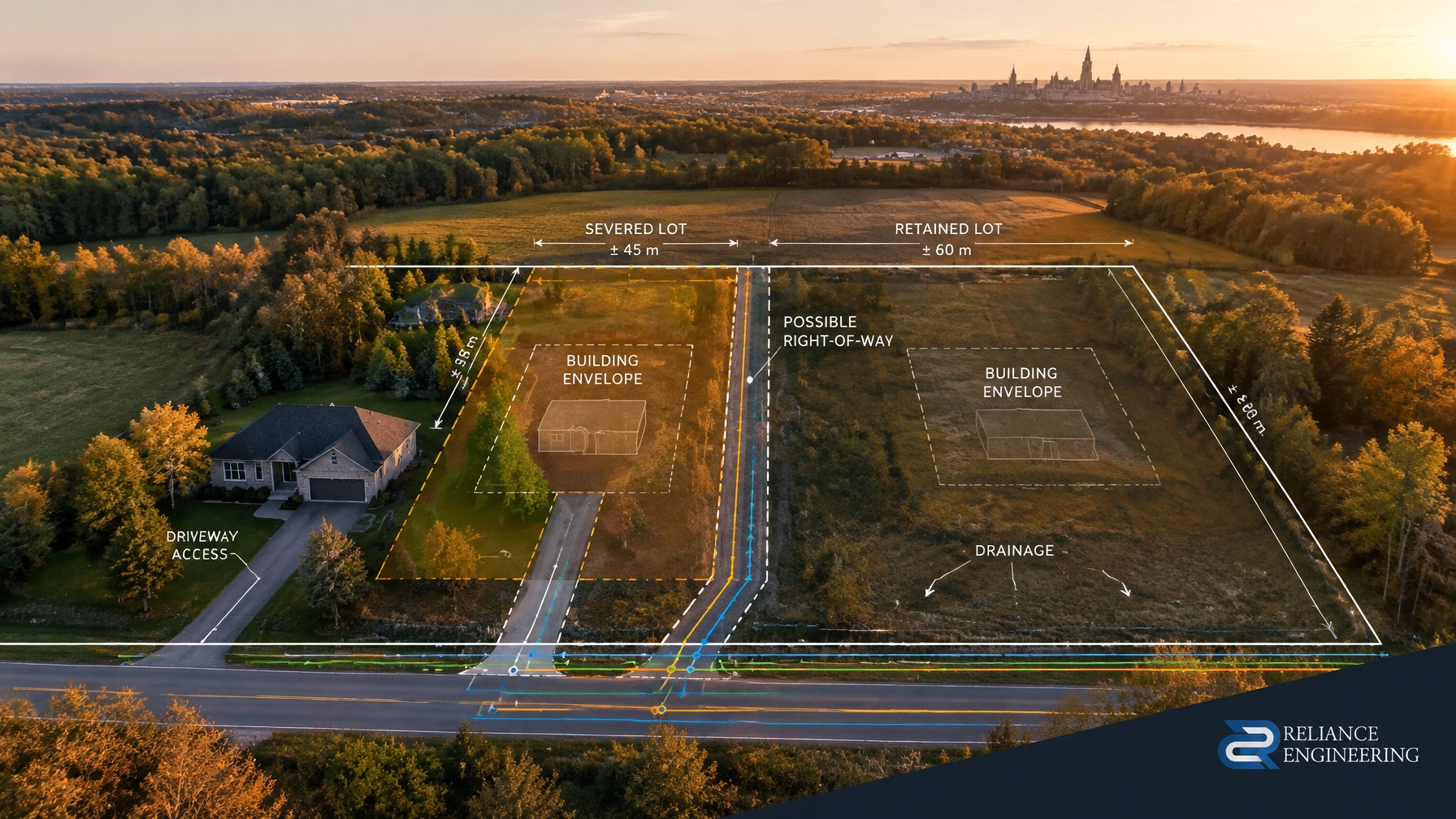
For developers, architects, and builders navigating the complexities of land development across Ontario, municipal approvals represent the ultimate gatekeeper. Whether you are proposing a commercial plaza in Mississauga, a multi-residential infill in Ottawa, or a subdivision in the GTA, local municipalities and conservation authorities will not issue approvals on a leap of faith. They require rigorous, data-backed proof that existing infrastructure can handle your project.
That proof is delivered through a Functional Servicing Report (FSR).
At Reliance Engineering, we know that an incomplete or flawed FSR leads directly to endless review cycles, delayed building permits, and escalating holding costs. In this no-nonsense guide, we break down why a robust functional servicing report is non-negotiable for successful municipal approvals, how it integrates with stormwater management reports Ontario and site servicing plans, and how our Approval-Focused Reports protect your development timeline.
What is a Functional Servicing Report and Why Does It Matter?
A Functional Servicing Report is a comprehensive civil engineering analysis submitted during the municipal planning stage (such as Site Plan Approval or Plan of Subdivision applications). Its core purpose is simple: to demonstrate that your proposed development will not overwhelm municipal water, sanitary, and storm sewer networks.
Municipalities operate under strict Consolidated Linear Infrastructure Environmental Compliance Approvals (CLI-ECA) and local design criteria. If your project introduces peak flows that exceed local pipe capacity or fails to provide adequate water pressure and fire flow, your application stalls indefinitely.
Our team approaches every project with extensive municipal experience, ensuring that our Coordinated Civil Design bridges the gap between architectural vision and municipal infrastructure reality.
1. Infrastructure Capacity Analysis: Proving the System Can Handle Growth
Before a single shovel touches the ground, municipal reviewers examine whether existing trunk infrastructure has spare capacity. An infrastructure capacity analysis evaluates the local watermains, sanitary sewers, and storm drainage networks surrounding your property.

When preparing Approval-Focused Reports, we perform rigorous evaluations of boundary conditions, existing invert elevations, and downstream pipe capacities. If local bottlenecks exist, our reports identify them early and propose viable mitigation strategies: such as upsizing downstream sections or incorporating flow attenuation: before municipal staff flag them as fatal flaws in your submission.
2. Water Demand and Sanitary Flow Calculations
Precision is everything when sizing connections. Municipalities require exact figures to ensure public health, safety, and fire suppression standards are met.
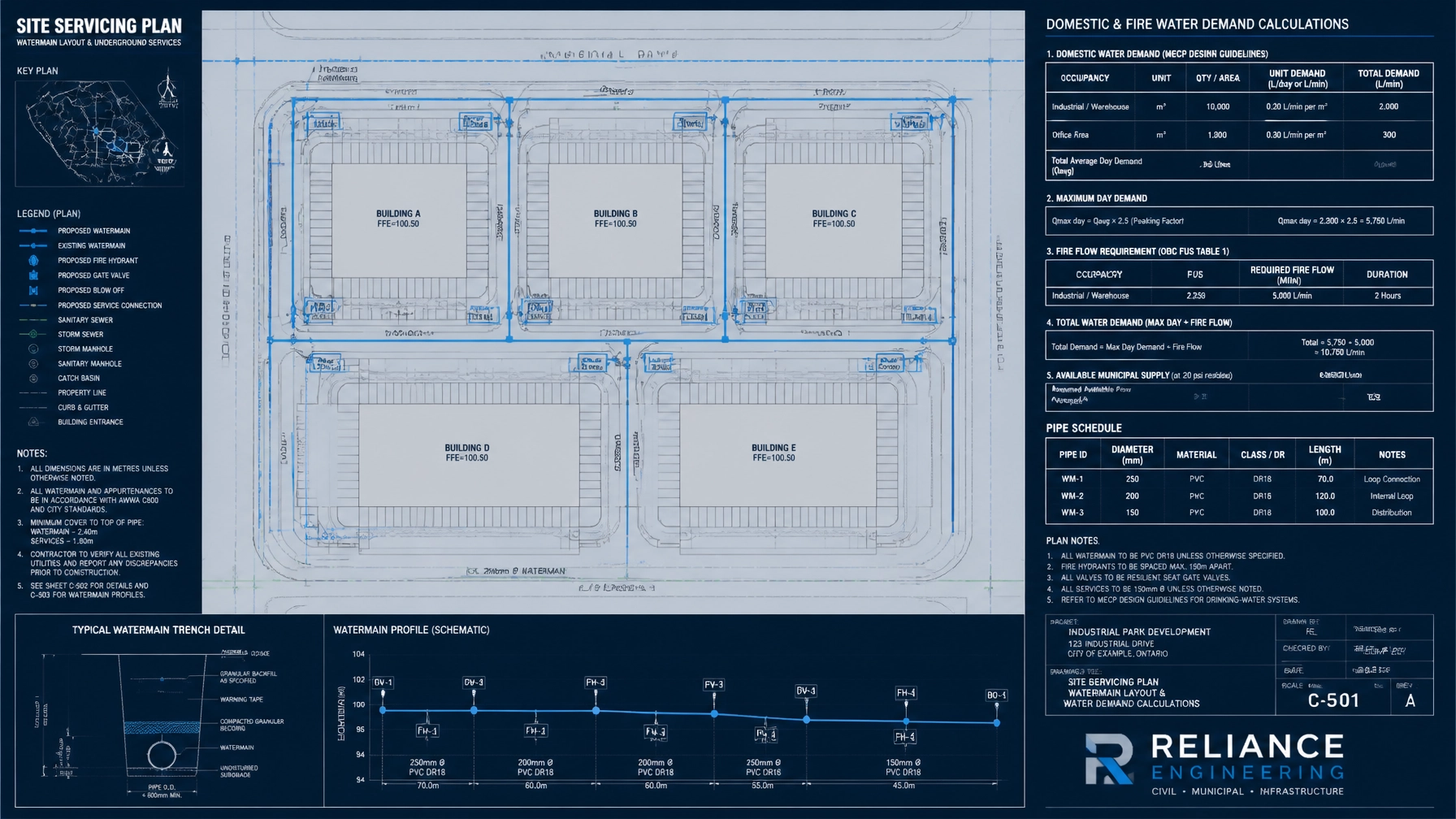
- Water Demand Calculations: We determine maximum daily demand, peak hourly demand, and required fire flow based on Ontario Building Code and municipal standards. This ensures your proposed water service connection delivers adequate pressure without starving neighboring properties.
- Sanitary Flow Calculations: Using land-use population equivalents and institutional/commercial generation rates, we calculate peak sanitary sewage flows.
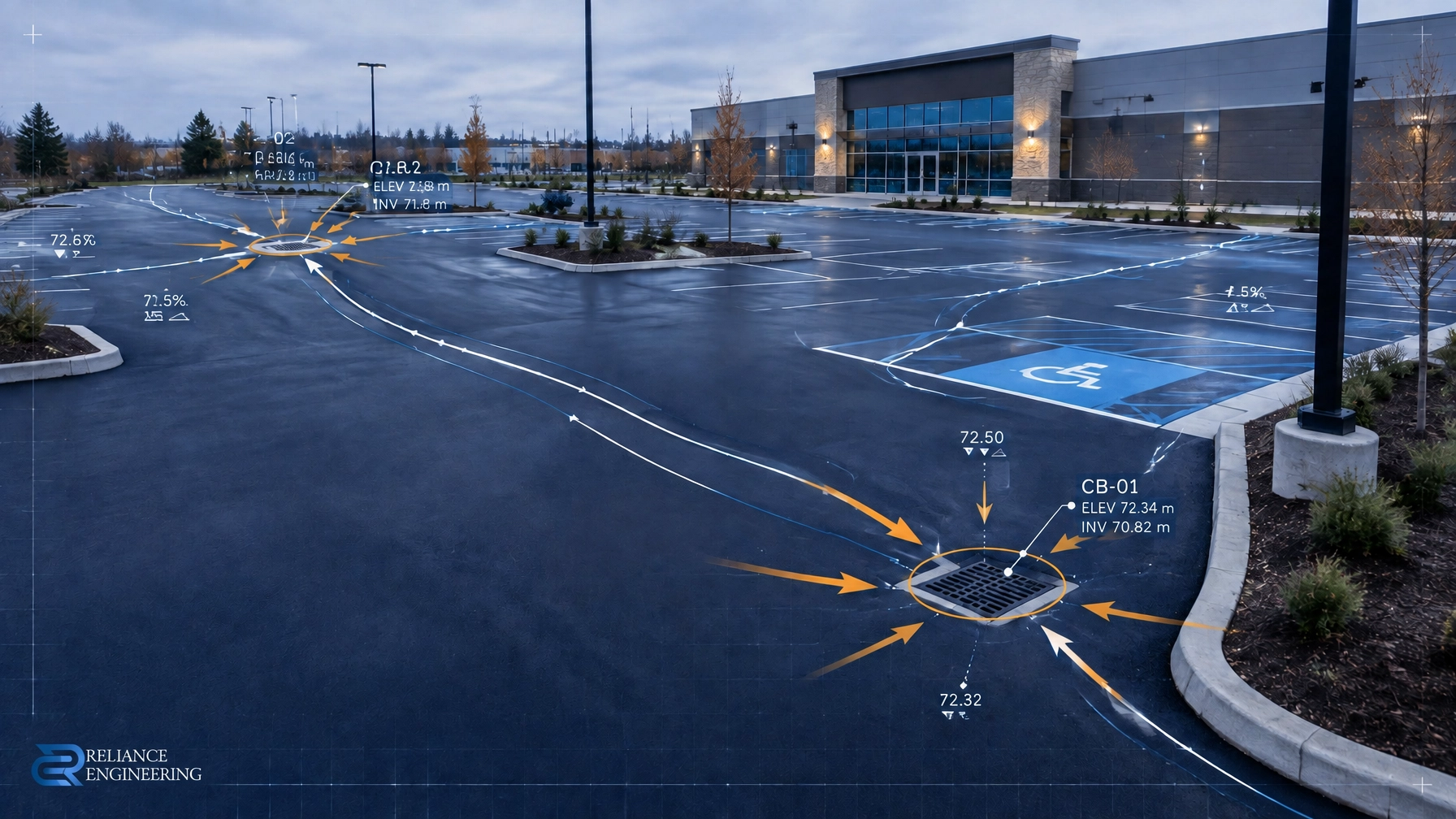
Through clear calculations and clean layouts, our technical documentation establishes exact connection points, pipe slopes, and invert elevations, ensuring your plumber and contractor have constructible routing from day one.
3. Storm Drainage Strategy & Quality Controls
Stormwater management is one of the most scrutinized components of any Ontario development application. Provincial regulations, local municipal criteria, and Conservation Authority mandates require strict control over both runoff quantity and quality.

An effective FSR sets the framework for comprehensive stormwater management reports Ontario projects require. It outlines:
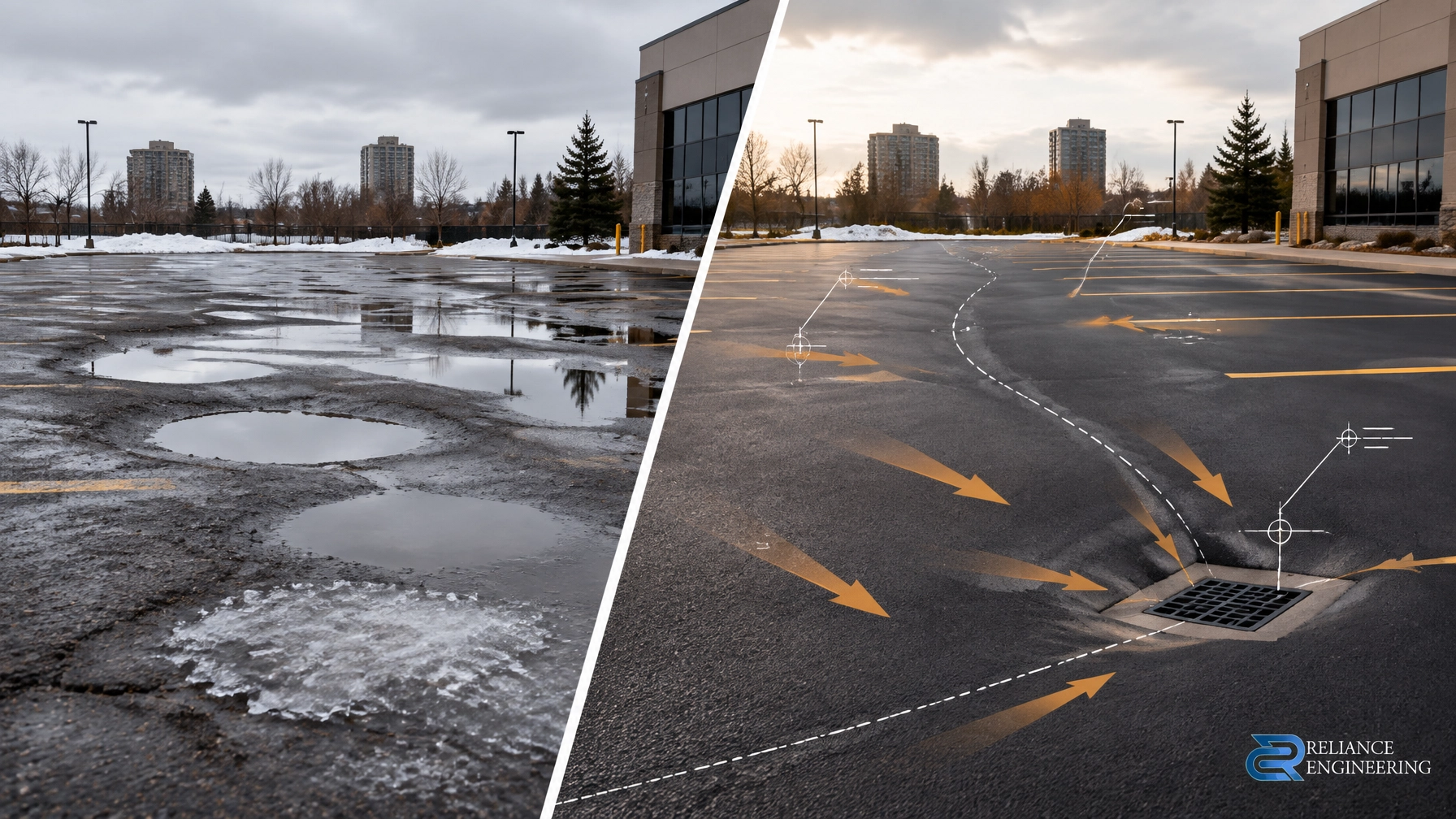
- Quantity Control: Restricting post-development peak flows to pre-development levels (typically for 2-year through 100-year storm events) using underground storage tanks, detention basins, or rooftop controls.
- Quality Control: Implementing oil-grit separators, proprietary treatment units, or Low Impact Development (LID) features to remove total suspended solids (TSS) prior to discharging into municipal storm sewers or watercourses.
- Practical Controls: Designing robust erosion and sediment control measures that protect adjacent properties and natural features during construction.
By integrating these strategies into our site servicing plans, we ensure compliance with all environmental and municipal mandates.
4. Navigating the Municipal Review Process
Submitting your application is only half the battle. Navigating agency comments: often spanning multiple review departments including planning, engineering, transportation, and external bodies like Conservation Authorities: requires strategic engagement.

At Reliance Engineering, we eliminate friction through Fast Comment Response protocols and proactive agency coordination. Because our designs are thorough, buildable, and grounded in decades of regional expertise, our submissions frequently achieve approval milestones with minimal revisions. We turn complex municipal feedback into straightforward, actionable resolutions.
Partner with Proven Civil Engineering Experts
Securing timely municipal approvals requires engineering partners who take full ownership of your project's technical requirements. From initial feasibility and functional servicing reports to detailed site servicing plans and building permit drawings, Reliance Engineering delivers certainty across Ontario.
Contact Our Office Today
- Address: 6850 Millcreek Dr, Mississauga, ON L5N 2H4
- Phone: 647-385-6418
- Email: [email protected]
- Website: www.relianceengineering.ca
Office Hours:
- Saturday: 12:00 PM – 2:00 PM
- Sunday: Closed
Professional Credentials:
- Naresh Ochani, P.Eng., M.Eng.
- PEO Certificate of Authorization: 100548882