Article type: Approval-focused technical guide
Audience: Commercial developers, builders and property owners planning space-constrained sites in Ontario
Prepared by: Naresh Ochani, P.Eng. M.Eng.
Topic: Stormwater management reports Ontario
Note: Municipal criteria vary. Confirm current requirements with the project municipality and applicable agencies.
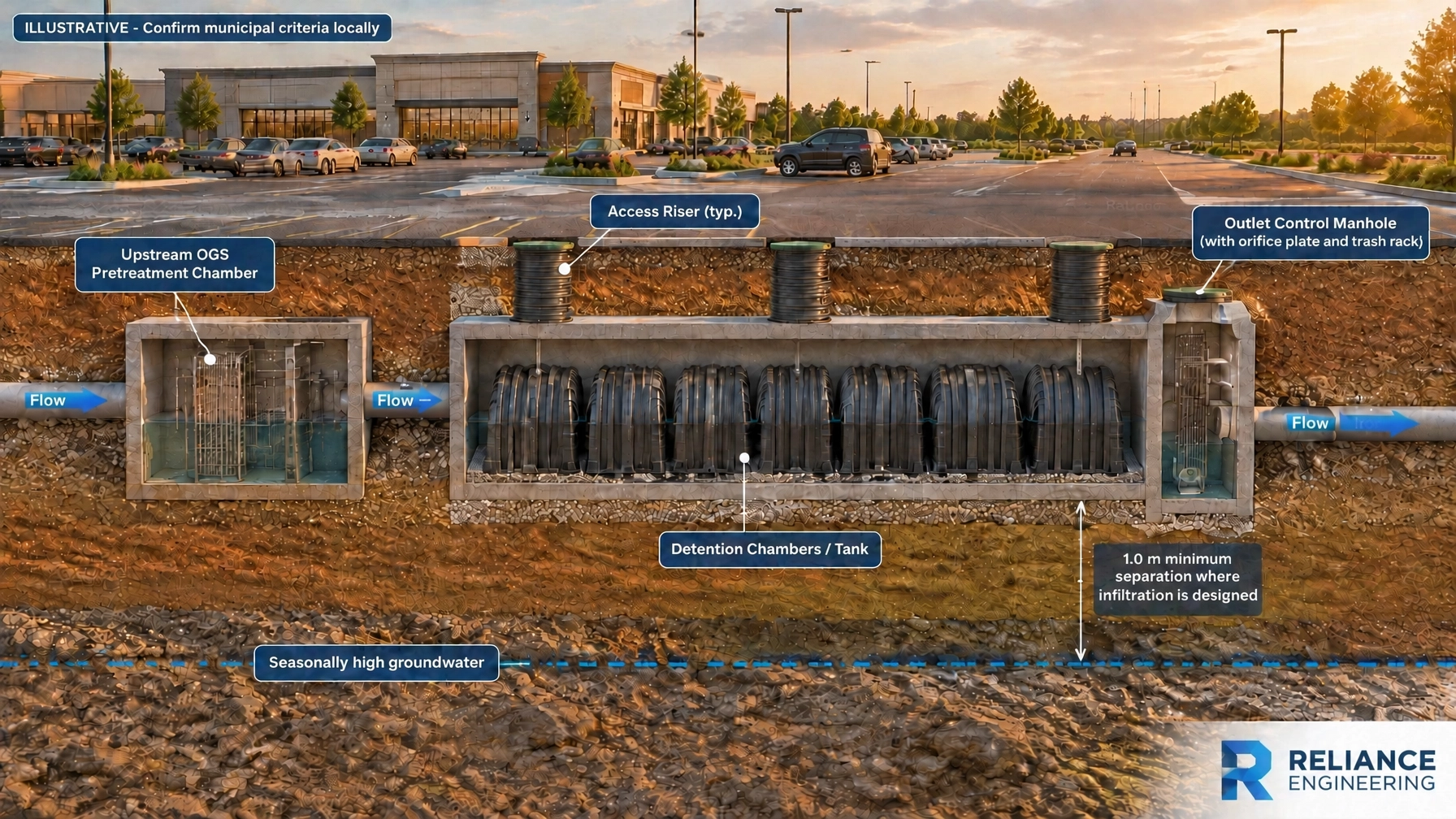
A surface pond uses land. On a tight commercial or infill site, that land may be needed for parking, loading or fire access. Underground detention can preserve the working surface, but it shifts the stormwater management challenge to structural design, maintenance access and municipal approvals.
A tank or chamber system is not approved simply because it fits underground. The SWM report must demonstrate how it controls flows, treats runoff, works with groundwater and can be inspected and maintained.
1. The SWM report still has to prove quantity control
Underground storage must perform the same basic quantity-control function as a surface facility. The report should compare pre- and post-development runoff and show how the proposed outlet limits discharge to the applicable target.
That means clear calculations and evidence tables, including:
- Pre- and post-development catchments, flows and impervious areas
- Stage-storage-discharge information
- Storage volume and outlet-control calculations
- Orifice or weir sizing
- Drawdown time
- Overland flow routes and the receiving system
The storage arrangement changes the constraints, not the proof required. For example, the system must fit around foundations, utilities, servicing and structural loads while still providing the required storage and a maintainable outlet.
2. Geotechnical review is a design gate
The Township of Clearview Engineering Design Criteria, Section C provides one municipal example: underground storage is considered subject to geotechnical investigation. If the design includes infiltration, in-situ testing is required, with safety factors applied to infiltration rates. Clearview also specifies at least 1.0 m separation from the system invert to the seasonally high groundwater table for systems incorporating infiltration.
For any underground storage system, Clearview calls for geotechnical approval addressing infiltration rates, hydrostatic uplift and cover requirements. Confirm the applicable criteria with the local municipality and geotechnical engineer.
In plain terms, an empty buried tank can be pushed upward by groundwater, much like an object floating in water. The design needs to check whether the tank, its anchorage and surrounding soil can resist that force. Cover depth and structural design also matter beneath parking stalls and fire routes, where vehicles impose loads on the system.
Do not describe a tank as an infiltration facility unless site-specific testing supports that design. Detention storage and infiltration storage are not interchangeable assumptions.
3. Detention does not replace water-quality treatment
Underground detention controls flow; by itself, it is not a water-quality treatment device. The SWM report should identify the required quality target and show how the proposed treatment train achieves it. Municipal criteria may require Enhanced Protection, but the applicable level and methods must be confirmed locally.
An oil-grit separator (OGS) is a common pretreatment component for commercial sites. Kitchener’s January 2026 Site Plan Engineering Guidelines identify OGS units as most appropriate for commercial and industrial uses, generally as part of a treatment train rather than as standalone treatment. The guidelines note that OGS units typically serve drainage areas under 2 ha, accept ETV-certified units unless otherwise approved, and require manufacturer sizing guidance and output data in the SWM report.
Clearview’s criteria also call for Canadian ETV-certified OGS units and require the design to state the contributing catchment area, impervious percentage and particle-size distribution (PSD) used to determine total suspended solids removal. The OGS operation and maintenance manual is part of the SWM submission.
A tank’s storage volume does not demonstrate that runoff has been treated. Show the OGS, its sizing inputs, expected performance and relationship to the detention system in the report and coordinated drawings.
4. Outlet controls must be sized and protected
Small orifices can clog. If an outlet blocks, the tank may not draw down, leaving less capacity for the next storm. The report should explain the selected outlet size, drawdown and protection against debris.
Municipal examples illustrate why details matter:
- Kitchener: The January 2026 guidelines specify minimum 75 mm on-line orifices and 90 mm cast-in-place orifices when no trash rack is used. Smaller orifices must be within a perforated riser or trash rack with openings smaller than the orifice. When orifices provide quantity control, maximum surface ponding depth is 30 cm. An upstream OGS in a ponding area must be submersible. Kitchener also specifies a minimum 5.0 m separation between the orifice and OGS.
- Clearview: Orifice plates must be stainless steel and at least 75 mm in diameter; 100 mm or larger is preferred.
These are examples, not province-wide standards. Confirm the local detail and show the outlet, rack or riser and access in the design.
5. Maintenance access and ownership belong in the design
A system that cannot be reached cannot be maintained reliably. Kitchener’s guidelines require access to on-site SWM facilities, with a minimum 4.0 m hard-surface width, a maximum 10% grade and design suitable for heavy maintenance vehicles. A 10 m minimum centreline turning radius is suggested.
Show the route on coordinated plans and confirm a maintenance vehicle can reach the access risers and structures. This must work with the grading, parking layout, fire routes and site servicing plans.
Kitchener also requires maintenance obligations to be registered on title through a Section 41 Development Agreement for the life of the development. Its guidelines call for detailed SWM report recommendations, including inspection frequency, sediment removal, restabilization and sediment disposal in accordance with MECP standards.
Private tanks and OGS units remain on private property. The owner responsible for the facility must plan and fund inspections and cleanouts over the system’s life.
6. Confirm whether a separate environmental approval applies
Municipal site plan approval may not be the only approval step. Kitchener’s A.9 guidelines state that some commercial, industrial and large residential projects involving SWM facilities and/or OGS units may require an MECP application. The forms are submitted to the City for signature before going to MECP, and the developer pays the applicable MECP fees.
Clearview operates under a CLI-ECA for qualifying SWM projects and acts as approval authority within that framework; projects outside it go to MECP. Confirm the project’s approval route with the municipality and MECP. The underground facility is not just a drawing: it may require an environmental approval process with separate submissions and fees.
Common review problems
These six omissions can lead to review comments, redesign or an unmaintainable system:
- No geotechnical sign-off addressing uplift, groundwater or cover.
- Infiltration proposed without in-situ testing and appropriate safety factors.
- Storage sized without water-quality treatment, or with a missing or undersized OGS.
- Orifice too small or no suitable trash rack or riser protection.
- No workable maintenance access route for a vacuum truck or other heavy vehicle.
- O&M obligations are not confirmed for registration, and cleanouts are not funded.
Pre-submission checklist

- Geotechnical report addresses groundwater, uplift and cover.
- In-situ infiltration testing is complete if infiltration is part of the design.
- ETV-certified OGS sizing includes PSD, catchment inputs and output data.
- Orifice and trash-rack details meet local criteria.
- Maintenance access is shown on coordinated grading and servicing plans.
- O&M recommendations and the registration path are confirmed with the municipality.
Five key takeaways
- Underground detention still needs clear pre- and post-development flow and storage evidence.
- Groundwater, uplift and cover are essential geotechnical checks.
- Detention storage does not replace the required water-quality treatment train.
- Outlet protection, drawdown and physical maintenance access affect long-term performance.
- Confirm municipal criteria and any MECP or CLI-ECA approval path early.
Plan the approval gates before fixing the tank layout
Reliance Engineering prepares practical stormwater management reports with clear calculations, clean layouts, coordinated design, constructible routing and practical controls. We coordinate SWM work with site servicing plans and, where needed, a functional servicing report to support municipal review across Ontario.
Request a consultation: Contact Reliance Engineering
Professional credentials and contact
Naresh Ochani, P.Eng. M.Eng.
Principal Engineer, Reliance Engineering Canada Limited
PEO Certificate of Authorization: 100548882
6850 Millcreek Dr, Mississauga, ON L5N 2H4
Phone: 647-385-6418
Email: [email protected]
Office hours: Monday–Friday 9:00 AM–5:00 PM; Saturday 12:00 PM–2:00 PM; Sunday Closed.
Municipal references
- City of Kitchener Site Plan Engineering Guidelines, January 2026: municipal example; confirm current project requirements locally.
- Township of Clearview Engineering Design Criteria, Section C: municipal example; confirm current project requirements locally.