When submitting development applications across Ontario, the Stormwater Management (SWM) Report is frequently the most scrutinized technical document in the package. Municipal plan reviewers and conservation authorities do not just skim these reports: they cross-examine every catchment boundary, verify every runoff coefficient, and test every peak flow equation.
Yet, across the industry, SWM reports are sometimes treated as administrative checkboxes. Poorly executed hydrology assumptions, generic calculations, or mismatched site servicing designs lead to immediate municipal red flags, delayed building permits, and costly redesigns.
At Reliance Engineering, we believe that clear calculations, practical controls, and deep municipal experience are the non-negotiable foundation of successful land development. In this guide, we explore why quality control in SWM reporting matters, the hidden costs of poor hydrology assumptions, and how our complete support helps you secure approvals efficiently across Ontario.
Metadata & Professional Credentials
| Field | Detail |
|---|---|
| Firm Name | Reliance Engineering |
| Principal Engineer | Naresh Ochani, P.Eng. M.Eng. |
| PEO Certificate of Authorization | #100548882 |
| Office Address | 6850 Millcreek Dr, Mississauga, ON L5N 2H4 |
| Contact Phone | 647-385-6418 |
| Support Email | [email protected] |
| Office Hours | Saturday 12:00 PM–2:00 PM; Sunday Closed |
The Role of Stormwater Management Reports in Ontario Municipal Approvals
In Ontario, municipal approvals under the Planning Act: such as Site Plan Approval (SPA), Zoning Bylaw Amendments (ZBA), Official Plan Amendments (OPA), and Subdivisions: require comprehensive civil engineering documentation. A rigorous SWM report demonstrates that a proposed development will not increase flood risk, overload municipal storm sewers, or degrade downstream water quality.
When municipalities review your submission, they evaluate how well your site integrates with surrounding municipal infrastructure. A well-prepared SWM report bridges the gap between architectural layouts, grading designs, and municipal sewer capacities.

The Hidden Cost of Bad Hydrology Assumptions
Taking shortcuts on hydrologic parameters may seem like a way to save time upfront, but it almost always backfires during municipal review. Here are the most common pitfalls of sloppy SWM reporting:
1. Inaccurate Time of Concentration ($T_c$) Estimates
Underestimating the time of concentration artificially spikes peak flow rates or misaligns hydrograph timing. Municipal reviewers immediately spot unrealistic $T_c$ calculations when comparing pre- and post-development scenarios.
2. Flawed Runoff Coefficients and Imperviousness Ratios
Using generalized or outdated imperviousness percentages for roofs, parking lots, and landscaped areas distorts the entire volume calculation. If your post-development runoff coefficient is underestimated, the required quantity control storage will be undersized, leading to rejected designs.
3. Disconnected Outlet and Orifice Sizing
Quantity control relies on precise orifice plates, weir structures, and outlet control devices to restrict discharge to allowable municipal release rates. If hydraulic calculations do not account for tailwater conditions or backwater effects from municipal sewers, your stormwater detention facility will fail under actual storm events.
4. Ignoring Water Quality and LID Integration
Modern Ontario municipalities and conservation authorities enforce strict Enhanced Water Quality protection (typically 80% TSS removal) and Low Impact Development (LID) integration. Omitting infiltration testing or failing to evaluate bioretention swales and oil-grit separators results in prolonged review cycles.
Core Components of an Expert SWM Report
To achieve swift approval across Ontario, every SWM report delivered by Reliance Engineering incorporates rigorous engineering analysis:
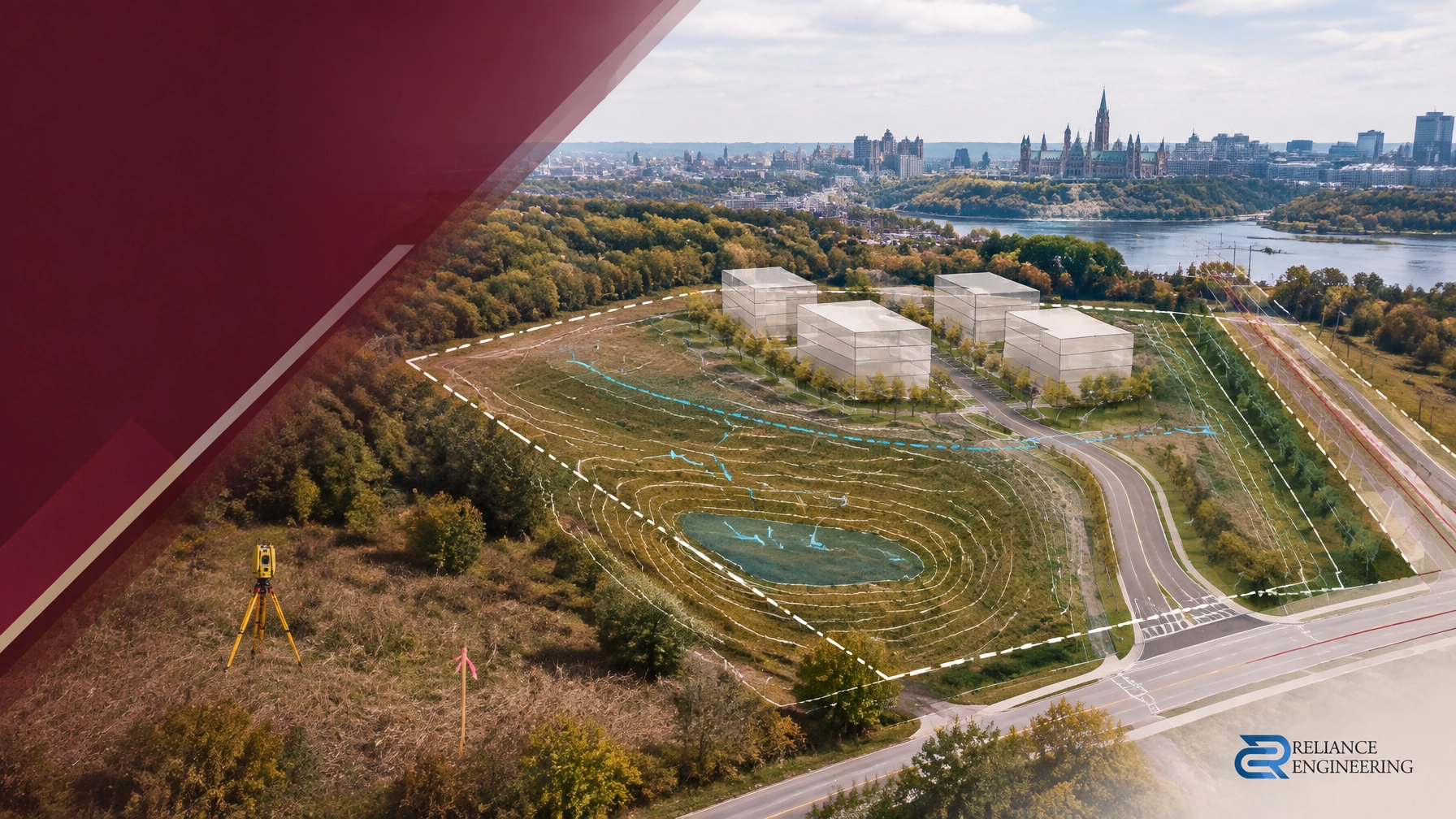
- Pre- and Post-Development Drainage Analysis: Establishing accurate catchment boundaries and comparing runoff behavior under various design storms (e.g., 2-year to 100-year events).
- Peak Flow and Volume Calculations: Using accepted modeling standards (such as Visual OTTHYMO or Rational Method where applicable) to prove that post-development peak flows do not exceed pre-development limits.
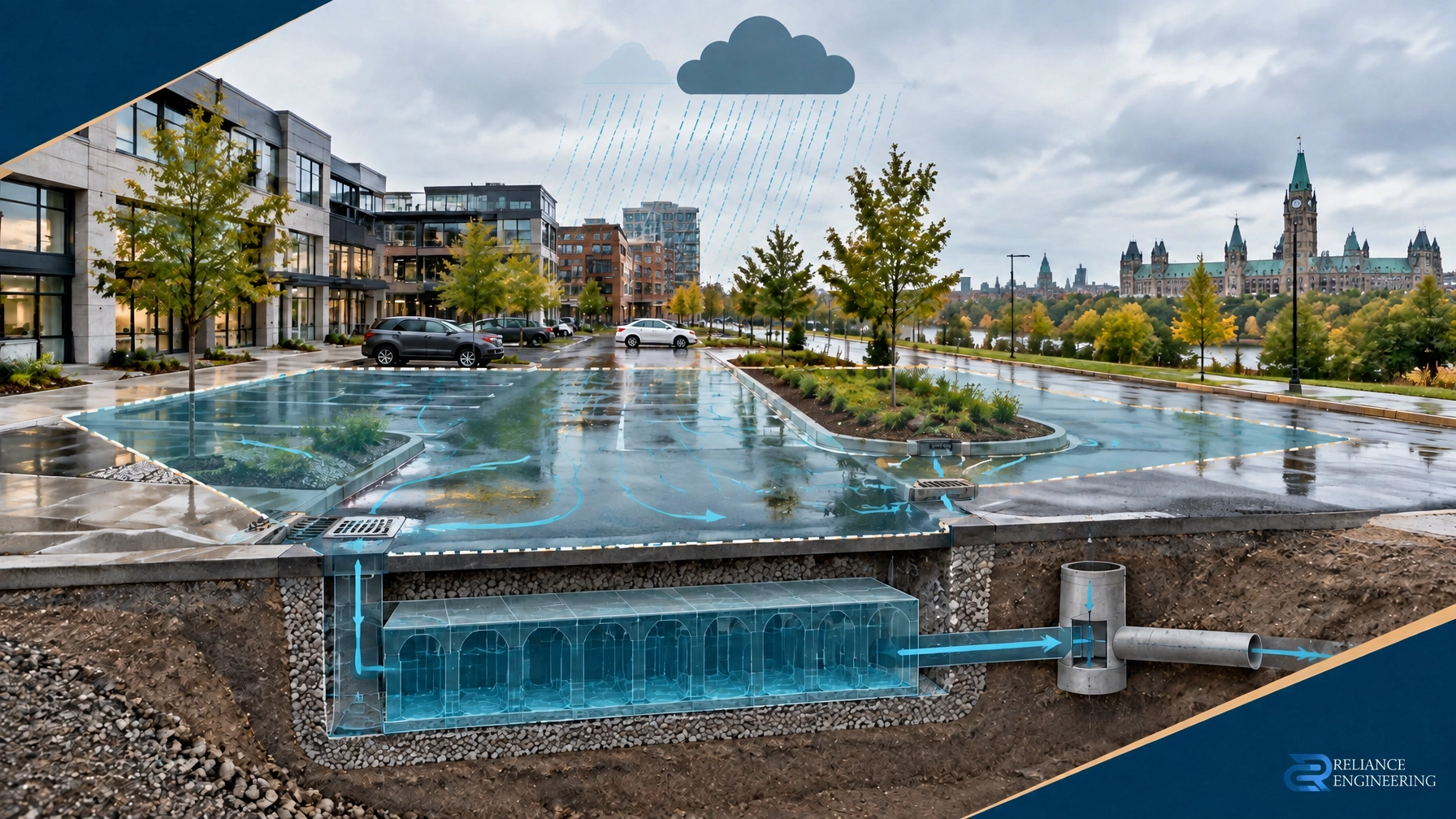
- Quantity Control Storage Design: Sizing surface ponds, underground storage chambers, or rooftop detention systems to attenuate peak flows safely.
- Allowable Release Rate Calculations: Matching municipal target restrictions to prevent downstream surcharging.
- Orifice and Outlet Control Sizing: Engineering precise restriction mechanisms to regulate discharge under major and minor storm conditions.
- Water Quality Treatment Strategy: Designing sediment forebays, oil-grit separators, and LID features to remove pollutants before runoff leaves the site.
- Overland Flow Route Assessment: Ensuring safe conveyance for extreme 100-year storms when minor drainage systems reach capacity.

Seamless Integration: SWM, Grading, and Site Servicing Plans
A SWM report cannot exist in isolation. It must be coordinated directly with your Site Grading Plans, Site Servicing Plans, and Erosion and Sediment Control Plans.
When grading elevations, catchbasin locations, and invert elevations are perfectly synchronized with your SWM calculations, municipal reviewers see a cohesive, buildable design. This synchronization eliminates conflicting information between engineering disciplines and accelerates the Site Plan Approval process.
Why Choose Reliance Engineering?
With over 20 years of principal engineer experience, Reliance Engineering provides complete support for developers, architects, and property owners across Ontario. Our core strengths include:
- Municipal Expertise: Deep familiarity with stormwater criteria across Greater Toronto Area municipalities and regional conservation authorities.
- Clear Calculations & Practical Controls: Designs that satisfy strict regulatory thresholds while remaining constructible and cost-effective on-site.
- First-Submission Approvals: Our rigorous attention to detail and precision engineering frequently secure municipal sign-offs on the first submission.
- Full Regulatory Accountability: Authorized by the Professional Engineers of Ontario (PEO Certificate of Authorization: 100548882), led directly by Naresh Ochani, P.Eng. M.Eng.

Secure Your Municipal Approvals With Confidence
Don't let flawed hydrology calculations or incomplete stormwater reports stall your project. Partner with an engineering firm that takes full ownership of your municipal approval timeline.
Contact Us Today
- Phone: 647-385-6418
- Email: [email protected]
- Office Address: 6850 Millcreek Dr, Mississauga, ON L5N 2H4
- Office Hours: Saturday 12:00 PM–2:00 PM; Sunday Closed
Reach out today to discuss your upcoming project and discover how our permit-ready engineering drawings and stormwater management reports keep your development moving forward.