Article type: Diagnostic guide
Audience: Commercial property owners, property managers and developers
Focus: CCTV condition assessment of storm laterals and catchbasin leads before asphalt regrading
Slug: commercial-parking-lot-drainage-ontario-cctv-storm-laterals
Professional credentials and contact
Naresh Ochani, P.Eng. M.Eng. Principal Engineer
Reliance Engineering Canada Limited
PEO Certificate of Authorization: 100548882
6850 Millcreek Dr, Mississauga, ON L5N 2H4
647-385-6418 | [email protected]
Office hours: Mon-Fri 9:00 AM-5:00 PM; Sat 12:00 PM-2:00 PM; Sun Closed
1. Why a lot that “drains fine” can still be holding water in its pipes
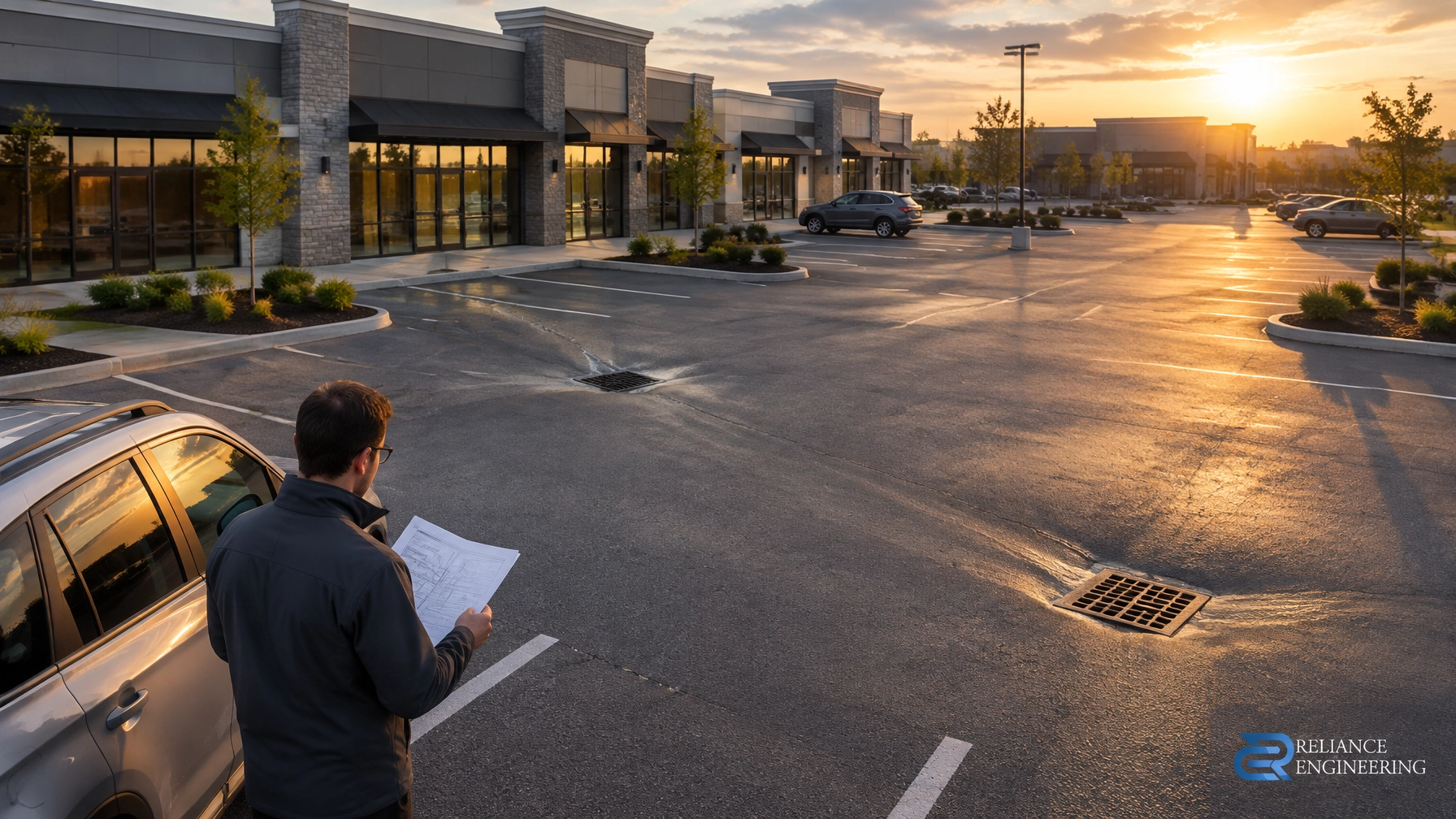
A parking lot can look acceptable between rain events and still have a storm pipe problem below the asphalt. At the surface, ponding may appear to be a simple low spot. Below ground, the water may be slow to leave because a catchbasin lead or lateral is sagging, obstructed or damaged.
Water from each low point enters a catchbasin, travels through its lead and lateral, and then connects to the municipal storm system. When those pipes hold water, separate at joints, collect grit or take in roots, the lot may stop draining properly even if its grading has not changed. The visible symptom is at the surface, so owners often begin by budgeting for asphalt.
Before committing to Site Grading Plans, assess whether the pipes carrying water away are still functioning. A camera inspection can help distinguish a surface grading concern from a pipe condition issue, or show that both need attention.
2. What a camera in the pipe actually shows
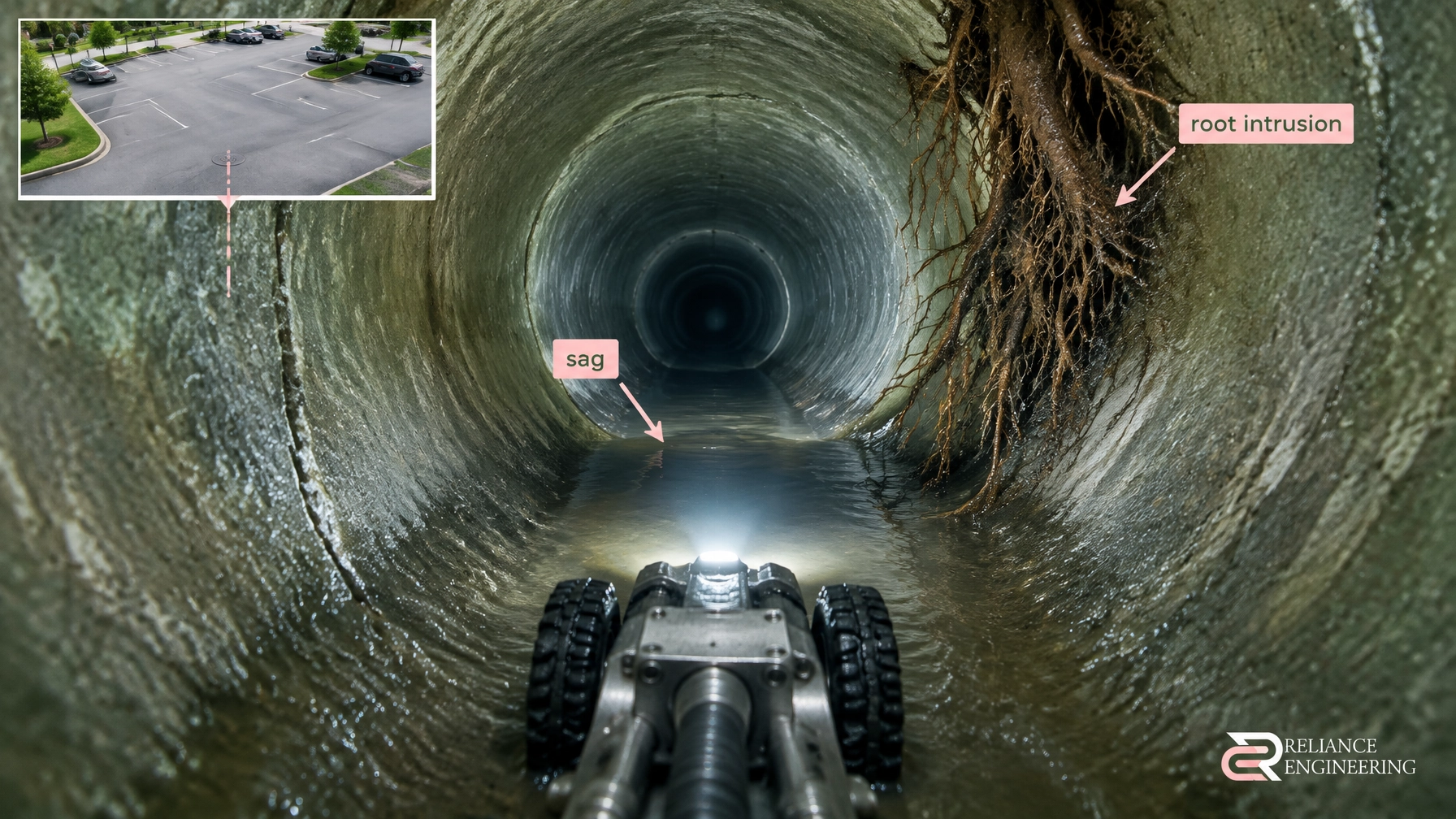
A small crawler equipped with a camera travels through the pipe from a catchbasin or maintenance hole, along the lead and lateral. The inspection records the pipe’s visible condition and the location of observations. In Ontario, municipal specifications commonly refer to recognized inspection coding such as NASSCO PACP. The exact reporting requirements depend on the municipality and project.
A camera can reveal low spots or sags where water remains, open or separated joints, cracks and breaks, root intrusion, and grit or sediment build-up. It may also show staining or evidence of infiltration. The footage helps identify whether an issue is likely maintenance-related, such as debris that can be cleaned, or structural, such as a damaged joint or broken pipe that may require repair.
Inspection quality matters. Municipal specifications commonly require lines to be cleaned and flushed before inspection so the camera can see the pipe wall and joints rather than debris. The Town of Innisfil’s Appendix D CCTV Inspection Requirements, for example, requires storm sewers to be cleaned before inspection and describes video inspection of catchbasin leads and laterals. Innisfil specifies lateral video from the main to roughly 3.0 m beyond the property line unless otherwise approved. The City of Toronto’s TS 409 Closed Circuit Television Inspection of Pipelines is another example of a municipal CCTV specification that references NASSCO PACP.

In new subdivision work, it is common to see CCTV requirements for storm laterals and catchbasin leads, including inspection from the main to beyond the property line. Scope, timing, cleaning, coding and submission requirements vary. Confirm the current requirements with the municipality responsible for the site before arranging an inspection.
3. Grading problem, pipe problem, or both?
Inspection findings provide a practical basis for deciding what to investigate next. If a surface low spot holds water for days after rain, but the connected pipe is clear and correctly sloped, the evidence points toward a grading issue. If water backs up at one catchbasin, the connected lead or lateral may need closer assessment. If several catchbasins along one run behave similarly, the shared lateral or its connection is worth checking.
Slow drainage even in dry weather can point to grit or a blockage, though the camera findings should guide that diagnosis. These clues are not a substitute for surveying and engineering review; they help direct them.
A grading plan prepared without knowing the pipe condition is a guess. Asphalt regrading may improve the surface but will not fix a sagging or obstructed pipe. Conversely, pipe cleaning or repair alone may not resolve ponding if the surface does not direct water to the structures. For commercial parking lot drainage in Ontario, the decision should be based on both observed pipe condition and surveyed site elevations.
4. Approval and ownership questions: who owns the pipe?
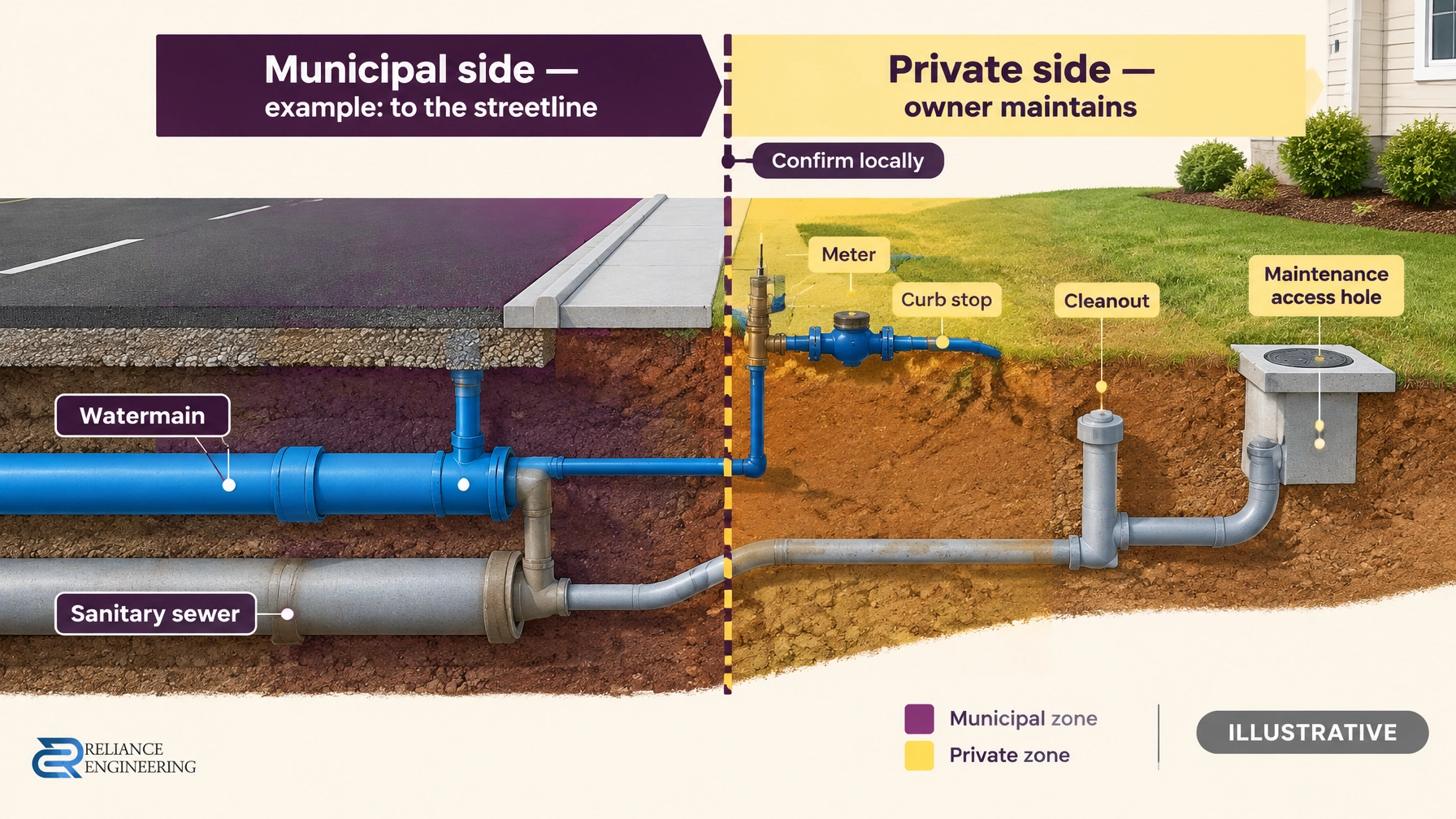
Storm infrastructure on private property is typically the owner’s responsibility, while the municipal portion and connection are generally subject to municipal ownership and requirements. The boundary of responsibility can vary. Confirm it with the municipality and review the site’s records before authorizing work.
If the property is part of a site plan agreement or subdivision, the municipality may already hold CCTV records, as-built drawings or securities related to the storm works. Requesting those records before construction may clarify what was installed and whether earlier inspections are available.
The approval path depends on the scope. Cleaning or localized maintenance may be different from reconstructing storm works or changing drainage areas. Larger work can require a grading or servicing submission and, depending on municipal review, a site plan amendment or new stormwater management review. Conservation Authority review may also be needed if a regulated feature or outlet is involved; it is not automatic for every parking lot drainage repair.
5. What goes into a practical, permit-ready package
Start with a survey of the lot and drainage structures. Confirm rim and invert elevations, review CCTV findings and available as-builts, and identify which work is cleaning, repair or replacement. Then design grading so the surface delivers water to structures that can receive it.
A drainage-focused approach treats the surface and storm system as one coordinated design. It should establish positive drainage and safe overland flow routes that remain useful if an inlet is blocked. The scope may also need coordinated Site Servicing Plans and, where applicable, Stormwater Management Reports.
Clear drawings that show structure elevations and relevant pipe condition findings help reviewers understand the proposal and help contractors price the work. The objective is practical designs, buildable grading and permit-ready drawings, not regrading by assumption. These details can support ponding solutions and other commercial property grading fixes while giving the owner a clearer scope for approval and construction.

6. A practical sequence for owners
- Check the records. Request available CCTV reports, as-builts and site agreement information.
- Camera the lines. Arrange cleaning and CCTV inspection that meets the municipality’s requirements.
- Survey the elevations. Record the lot, catchbasin rims and relevant inverts.
- Decide repair versus regrade. Use the inspection and survey together to identify the cause and appropriate scope.
- Build the coordinated scope. Prepare the servicing and grading information needed for review, pricing and construction.

7. Camera first, then design
For commercial parking lot drainage, inspect the storm laterals and catchbasin leads before deciding that asphalt regrading is the solution. CCTV findings, records and surveyed elevations help establish whether the work is maintenance, pipe repair, grading or a coordinated combination.
Reliance Engineering Canada Limited provides grading, servicing and approval support across Ontario. Contact us to discuss a camera-first assessment and the next steps for clear, coordinated drawings.
Professional credentials and contact
Naresh Ochani, P.Eng. M.Eng. Principal Engineer
Reliance Engineering Canada Limited
PEO Certificate of Authorization: 100548882
6850 Millcreek Dr, Mississauga, ON L5N 2H4
647-385-6418 | [email protected]
Office hours: Mon-Fri 9:00 AM-5:00 PM; Sat 12:00 PM-2:00 PM; Sun Closed