Category: Ontario Site Servicing & Stormwater
Focus: Stormwater management reports for phased development
Published: November 6, 2026
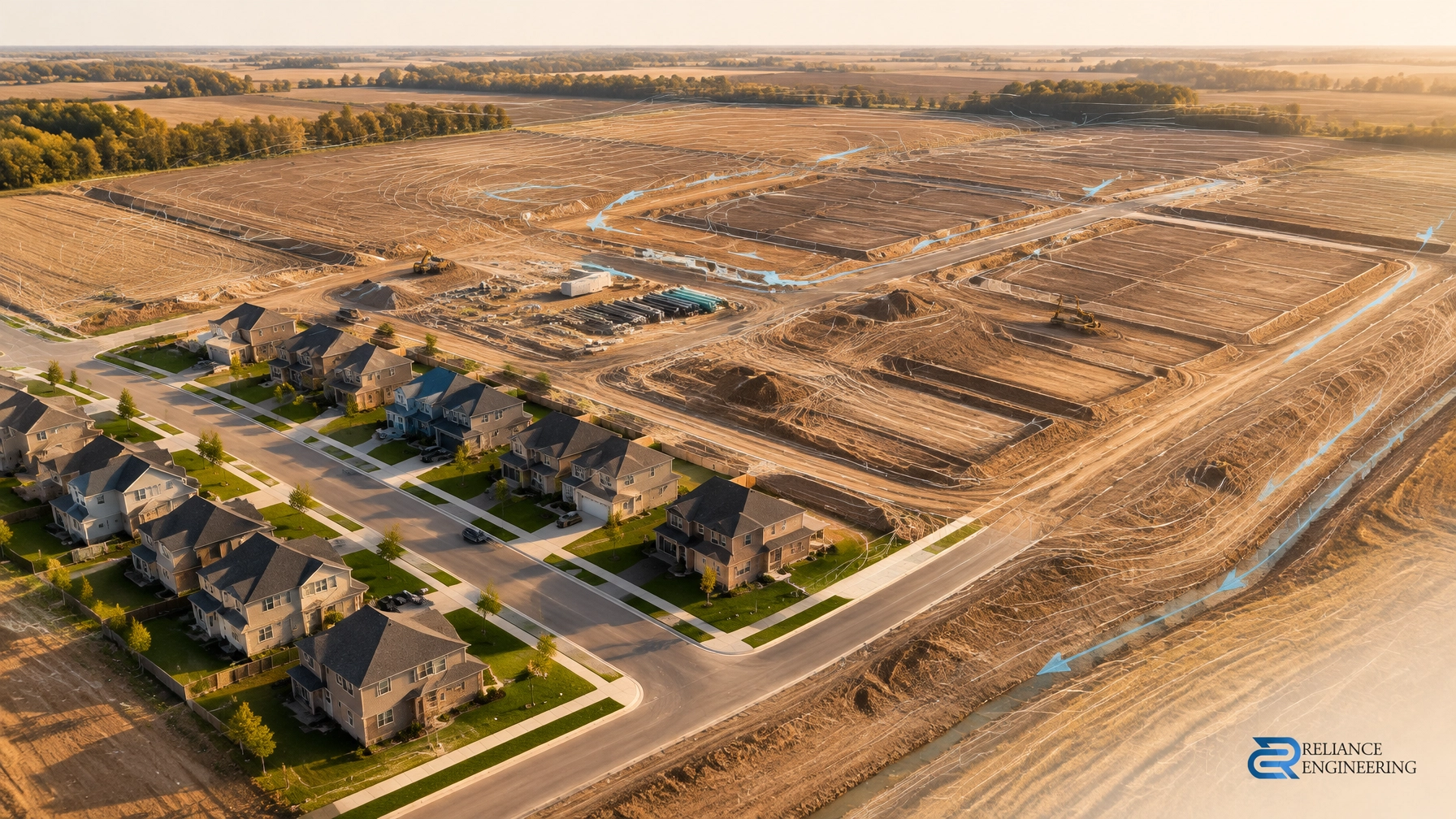
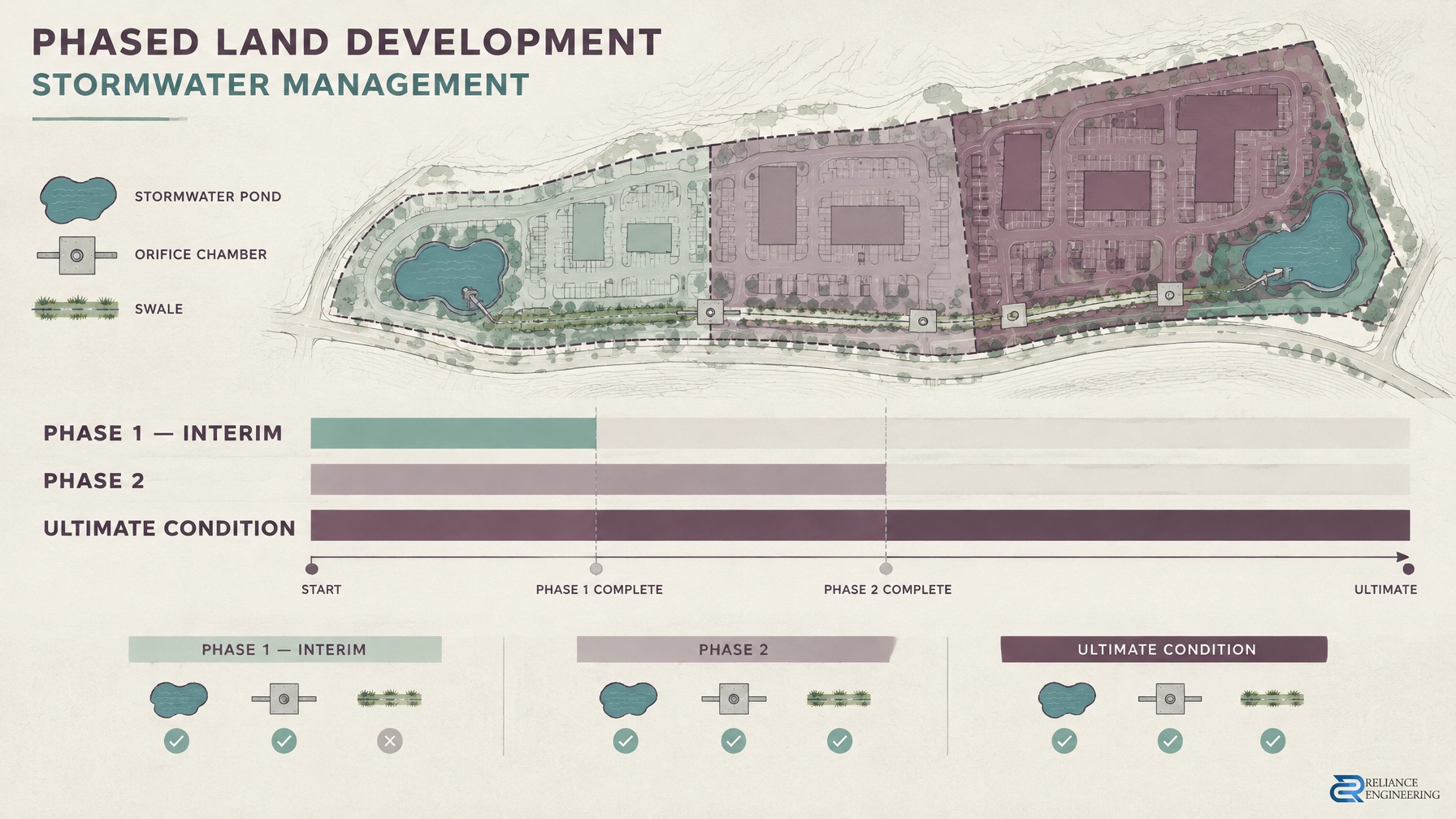
A phased development may be approved based on its ultimate layout, but construction starts with the interim condition. Phase one must manage runoff before later-phase grading, sewers or permanent stormwater facilities are in place. If the SWM report does not clearly explain how that first phase works, approvals may not translate into a buildable project.
An interim condition is the drainage pattern, conveyance and stormwater controls that exist during construction or an early phase. The ultimate condition describes the completed development. They are different designs and need to be assessed separately.

The SWM Report Must Explain the First Phase
The City of Markham’s Storm Water Management Guidelines describe a sequence from watershed or subwatershed study to Master Environmental Servicing Plan (MESP), Functional Servicing Report (FSR) and detailed SWM Report. Each stage refines the development’s servicing and stormwater strategy. The detailed report supports the conditions set at draft plan or site plan approval and provides the design and calculations for the proposed system.
For a phased project, the report should make clear what is available at each stage, not just what will exist at full build-out. Phase one needs its own drainage areas, conveyance routes, controls and outlet. It cannot rely on infrastructure that is planned for a later phase.
Markham’s 2016 guidelines provide one municipal example of criteria that must be checked in the relevant condition. They specify a 5-year minor storm sewer design, with design flow limited to 85% of pipe capacity; a major system that conveys the 100-year flow minus minor-system flow, with a maximum flow depth of 250 mm; and hydraulic grade line analyses for the 5-year and 100-year events. The guidelines also require no surcharge in the 5-year analysis and basement slabs at least 0.5 m above the 100-year HGL. These are Markham criteria; confirm the current, site-specific requirements with the applicable municipality and agencies.
Markham also advises proponents to pre-consult with the City and relevant agencies to confirm applicable criteria. For a phased submission, that is a practical opportunity to scope the interim-versus-ultimate analysis early.
Municipal Guidance Makes Phasing a Design Issue
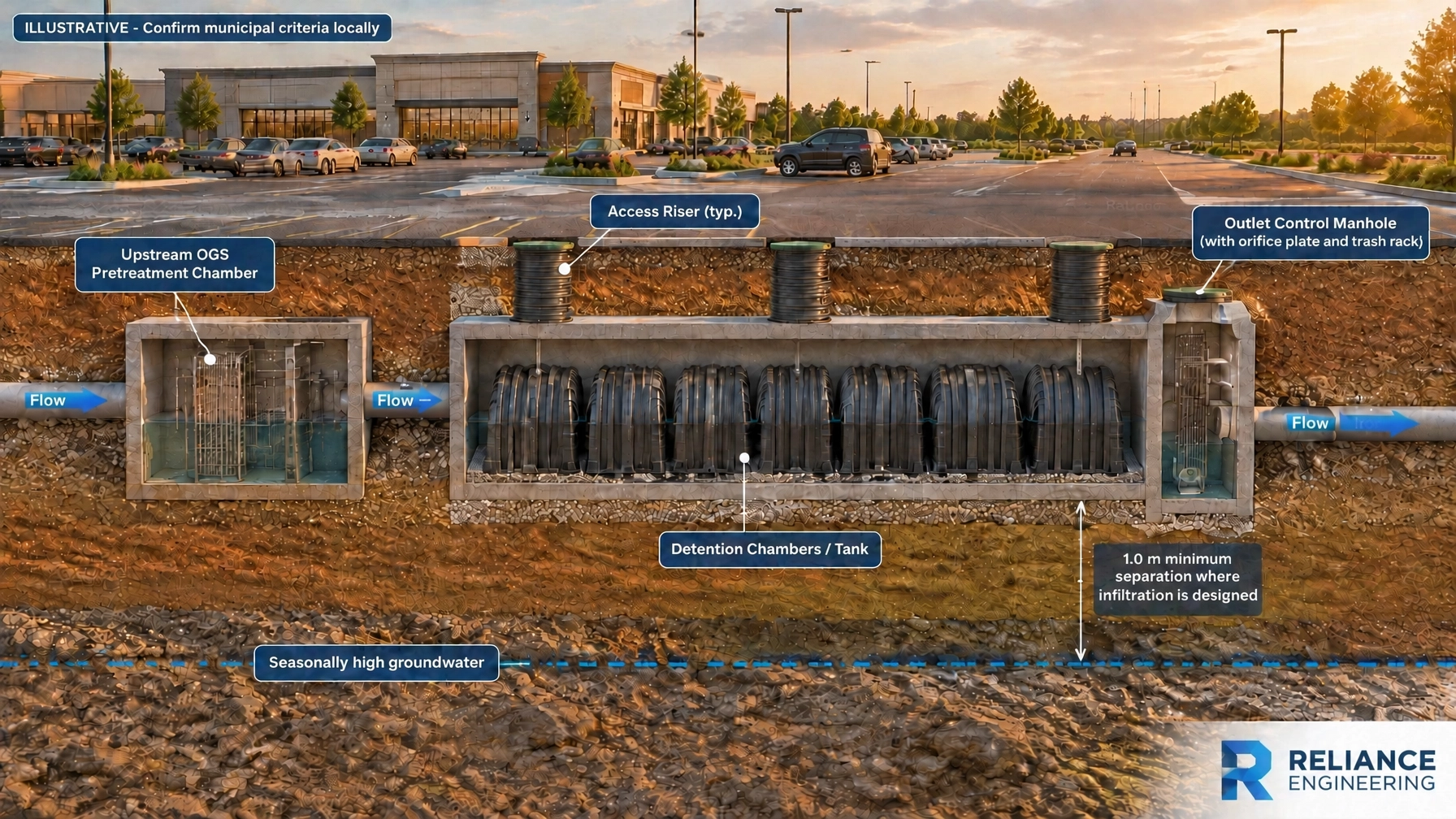
Municipal requirements are not identical. Markham’s guidelines include a section on interim stormwater management facilities. They distinguish such facilities from temporary erosion and sediment controls used during construction. Where interim facilities are proposed, their function and phase-specific performance need to be demonstrated.
The City of London’s Design Specifications and Requirements Manual, Chapter 6 includes an interim-conditions section for stormwater management during phased development and construction before permanent facilities are complete. It also says that water-balance compensation measures proposed for future-phase blocks are to be designed during the first phase at draft plan approval or the focus design study stage. Confirm the current manual and project-specific requirements with the City.
Hamilton’s Storm Water Management Report/Plan Development Application Guidelines call for a description of the larger development where phasing applies. The report should provide drainage-area figures with catchment IDs, compare peak flows for existing and proposed conditions at all outlets, and include stage-storage-discharge information and HGL analysis. Hamilton’s checklist also asks for 100-year ponding extents on the grading plan, an emergency spillway location, digital model files and an Erosion and Sediment Control (E&SC) plan that includes staging. The report must be stamped and sealed by a Professional Engineer registered in Ontario. Hamilton encourages applicants to discuss report scope and concepts with City staff before preparation.

Where Phase-One Designs Can Break Down
The following are practical failure modes encountered in phased development, not municipal rules:
- Runoff is routed to a temporary swale or ditch that is not suited to the interim flow conditions.
- A temporary control remains in service, but no party is clearly responsible for its operation and maintenance.
- Phase-one drainage crosses future-phase earthworks and disrupts work that is already complete.
- The ultimate facility is not yet built, and the interim strategy does not adequately address the first phase.
- A measure intended for a future phase is deferred, while the later design changes and no longer fits the approved strategy.
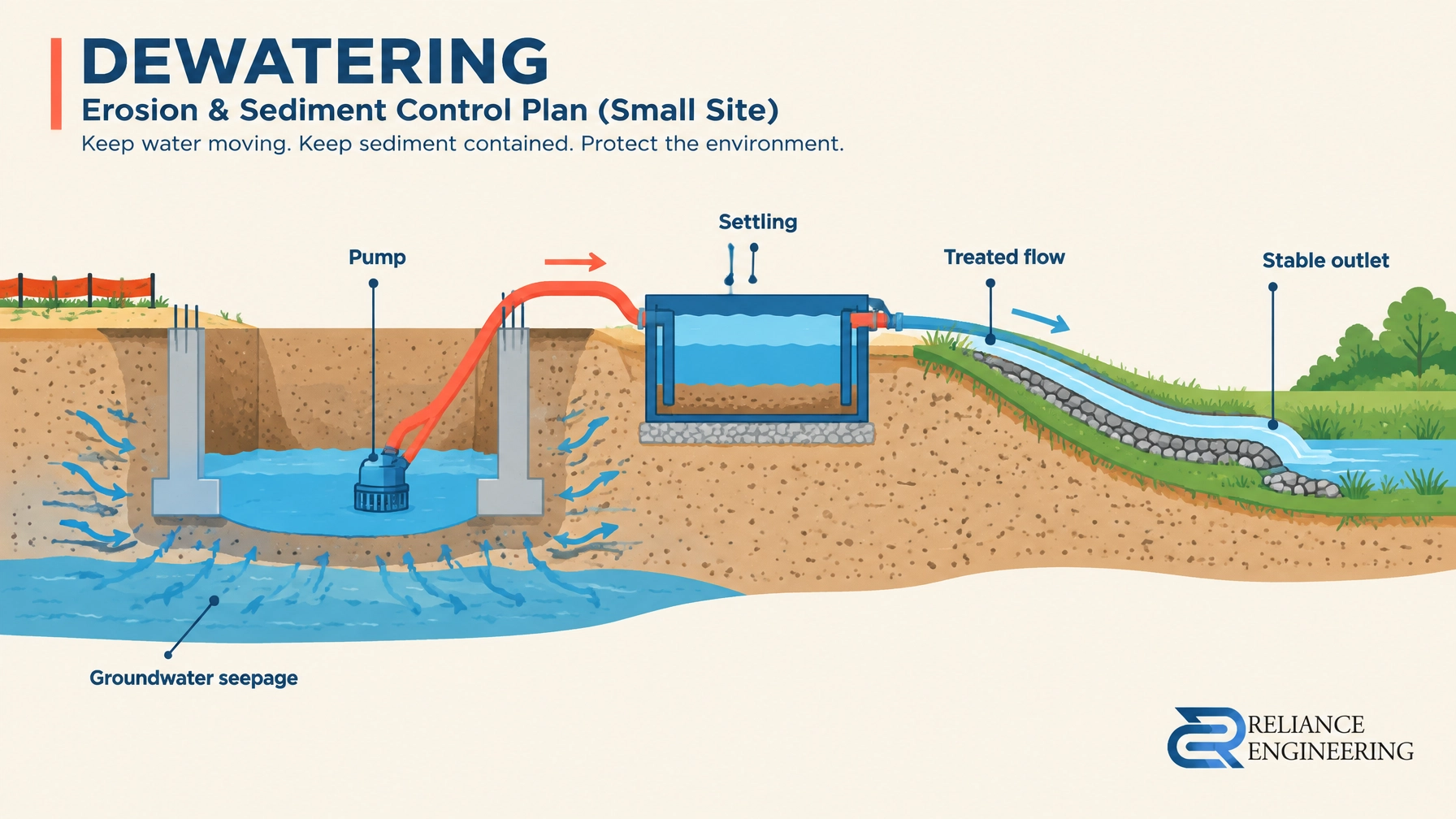
- The E&SC plan reflects the ultimate site but not the exposed areas and drainage routes during phase-one construction.
The common issue is a gap between the approved end state and the system that will actually exist when work begins.
What to Show in the Report
A clear phased SWM report should describe each condition as a workable, coordinated design. Include:
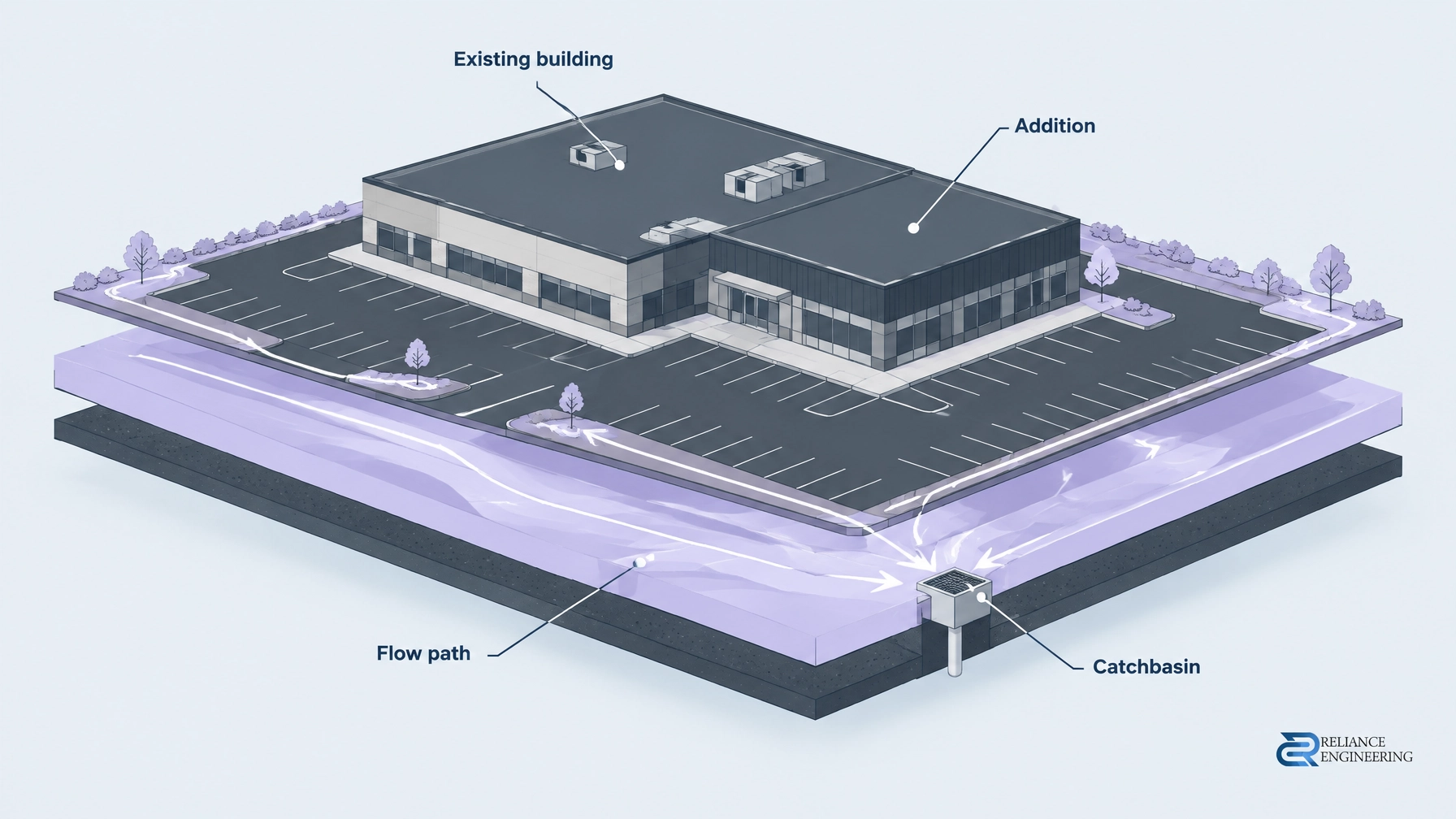
- Separate interim and ultimate drainage-area plans, with consistent catchment IDs.
- Separate modelling schematics and stage-storage-discharge information for each applicable condition.
- Flow-comparison tables that clearly identify the condition and outlets being assessed.
- A defined trigger for removing or converting interim controls, such as completion of the ultimate facility, subject to municipal acceptance.
- An ownership and maintenance statement for each interim control.
- An E&SC plan staged to match construction phases and interim drainage.
- Interim 100-year ponding extents and flow routes on the grading plans.
- Confirmation that the interim outlet can convey the applicable flows to the receiving system.

These items should align with the project’s site servicing plans, grading and Functional Servicing Report. Clean layouts, clear calculations, constructible routing and coordinated design help reviewers and contractors understand which parts of the system exist at each stage. They also make it easier to see when temporary works can change to permanent infrastructure.
Pre-Submission Checklist for Developers
Before submitting a phased SWM report, confirm:
- Interim and ultimate drainage boundaries are clearly shown.
- Every phase has a defined conveyance route, control strategy and outlet.
- The analysis does not depend on infrastructure planned for a later phase.
- Phase-specific criteria have been confirmed with the municipality and agencies.
- The report, grading and servicing drawings use consistent catchment IDs and design information.
- Construction staging is reflected in the E&SC plan.
- Interim control ownership, maintenance and conversion triggers are documented.
Five Key Takeaways
- Ultimate approval does not, by itself, explain how phase one will drain.
- Interim and ultimate conditions need distinct plans and supporting analysis.
- Each phase must work with the infrastructure available at that time.
- Construction-stage drainage and E&SC measures must reflect actual phase limits.
- Municipal criteria vary; early consultation helps define the right submission scope.
Plan the Interim Condition Before Construction
Reliance Engineering prepares stormwater management reports in Ontario for phased subdivisions and multi-phase commercial and industrial sites. We provide practical designs, clear drawings and approval support informed by municipal experience.
Request a consultation to discuss a phased SWM report or municipal approvals. Explore our services for stormwater management reports, functional servicing reports, site servicing plans and erosion and sediment control plans.
Sources: City of Markham Storm Water Management Guidelines (October 2016) · City of Hamilton Storm Water Management Report/Plan Guidelines · City of London DSRM, Chapter 6
Contact and Professional Credentials
Naresh Ochani, P.Eng. M.Eng.
Principal Engineer, Reliance Engineering Canada Limited
PEO Certificate of Authorization: 100548882
6850 Millcreek Dr, Mississauga, ON L5N 2H4
Phone: 647-385-6418
Email: [email protected]
Office hours: Monday–Friday, 9:00 AM–5:00 PM; Saturday, 12:00 PM–2:00 PM; Sunday, Closed.