Series: Ottawa Site Servicing & Stormwater
Publishing slot: 2:00 PM
Article type: Technical guidance
Reading time: 6 minutes
For an Ottawa Site Plan Control submission, a Functional Servicing Report is more than a supporting narrative. It is the capacity evidence behind the proposed development.
The report explains whether existing and planned municipal infrastructure can support the site. It documents water demand, fire flow, sanitary capacity, storm connections, allowable release rates, and any required upgrades.
The City of Ottawa’s Site Servicing Study Terms of Reference requires development applications to demonstrate that adequate services are available and can be allocated to support the proposal. Depending on the project, this information may be presented as a Functional Servicing Report, Site Servicing Study, Comprehensive Servicing Report, or Stormwater Management Report and Detailed Design Brief.
The report title may vary. The objective remains the same: provide clear calculations and a practical servicing strategy that reviewers can verify.
What an Ottawa Functional Servicing Report Must Establish
A strong Ottawa functional servicing report typically addresses four questions:
- Can the proposed development receive adequate water service and fire protection?
- Can the municipal sanitary system accept the proposed flows without unacceptable surcharge?
- Can stormwater be connected, controlled, stored, and released under the applicable criteria?
- Are the drawings and calculations coordinated into a buildable, reviewable design?
The report should identify existing infrastructure, proposed service connections, design demands, system constraints, and required improvements. It should also reference the applicable City of Ottawa engineering standards, servicing guidelines, Master Servicing Studies, Community Design Plans, and watershed or subwatershed studies.
Pre-consultation is important. Early discussion with City staff can confirm the studies required, available infrastructure information, servicing boundaries, and the level of analysis expected for the application.
Water Demand and Fire Flow Checks
Water servicing must be supported by calculations rather than a general statement that a watermain is nearby.
The report should identify:
- Proposed domestic water demand
- Average day, maximum day, and peak hour demand, where applicable
- Required fire flow
- Proposed watermain or service connection location
- Available pressure and flow information
- Hydrant locations and fire access considerations
- Any pressure or capacity limitations
For larger or more complex projects, City-provided boundary conditions may be required. The water analysis should use those conditions to demonstrate that domestic demand and fire protection requirements can be met.
Fire flow should be calculated using the applicable Fire Underwriters Survey methodology. The report should compare the required fire flow with the available municipal supply and identify whether additional hydrants, watermain upgrades, looping, or other measures are required.
This information must align with the Ottawa site servicing plans. The drawings should show the connection point, service alignment, valves, hydrants, pipe sizes, and construction notes. A calculation in the report is not useful if the drawing shows a different connection or route.

Sanitary Capacity and Surcharge Considerations
Sanitary servicing is reviewed for both connection feasibility and downstream system capacity.
An Ottawa Functional Servicing Report should identify the proposed sanitary connection and calculate peak sanitary flows. Depending on the project, the analysis may need to consider:
- Existing sanitary sewer size and capacity
- Downstream sewer conditions
- Infiltration and inflow allowances
- Pumping station capacity
- Hydraulic Grade Line elevations
- Basement and building elevations
- Emergency overflow conditions
- Risk of surcharge or basement flooding
The report should explain how the proposed flow affects the existing system. If capacity is limited, the design may require flow controls, upgrades, a revised connection point, or additional municipal coordination.
Sanitary conclusions should be specific. A clear report should state whether the system has sufficient capacity, whether surcharge remains below an acceptable elevation, and whether any off-site works are needed.
These conclusions must be reflected in the drawings through coordinated pipe slopes, inverts, manholes, cleanouts, and constructible routing. Poor coordination between the report and the plan is a common source of municipal comments.
Storm Connections and Allowable Release Rates
The stormwater section connects the report to the site grading, drainage, and stormwater management design.
The report should confirm:
- The proposed storm connection location
- Existing and proposed drainage areas
- Pre-development and post-development peak flows
- Applicable allowable release rate
- Required storage volume
- Outlet control method
- Minor and major system routing
- Overland flow route
- Downstream capacity
- Flood protection and building elevation considerations
Allowable release rates are project-specific. They may be established through City criteria, a Master Servicing Study, a watershed or subwatershed study, or Conservation Authority requirements.
The Stormwater Management Reports service explains how Reliance Engineering prepares pre- and post-development calculations, storage designs, outlet controls, water quality strategies, and overland flow assessments.
The SWM report and FSR must use the same assumptions. If the SWM report identifies a controlled outlet at one location but the servicing plan shows another, the submission is not coordinated. If storage is sized using one drainage area and the grading plan directs runoff elsewhere, the calculations will require revision.
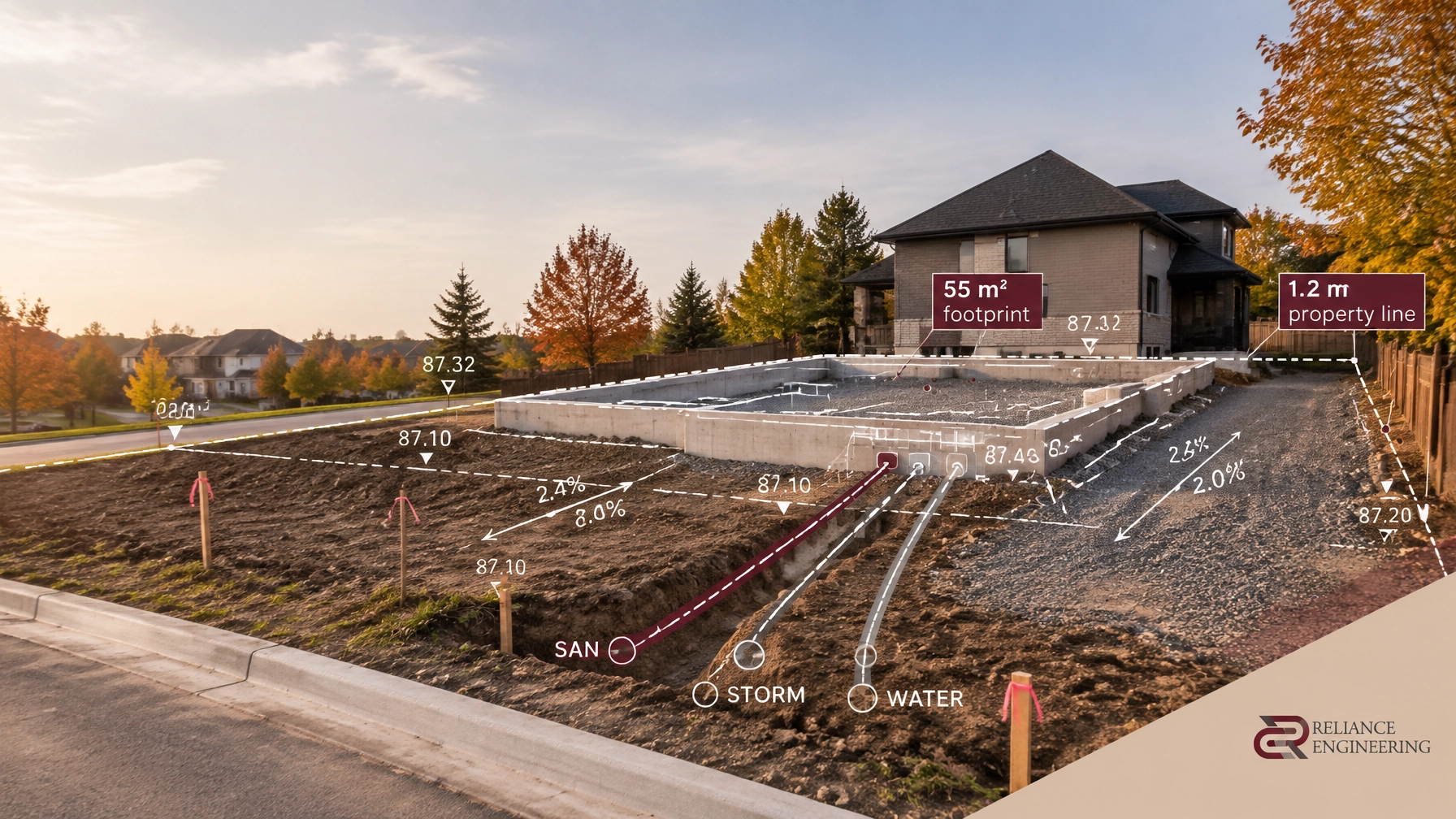
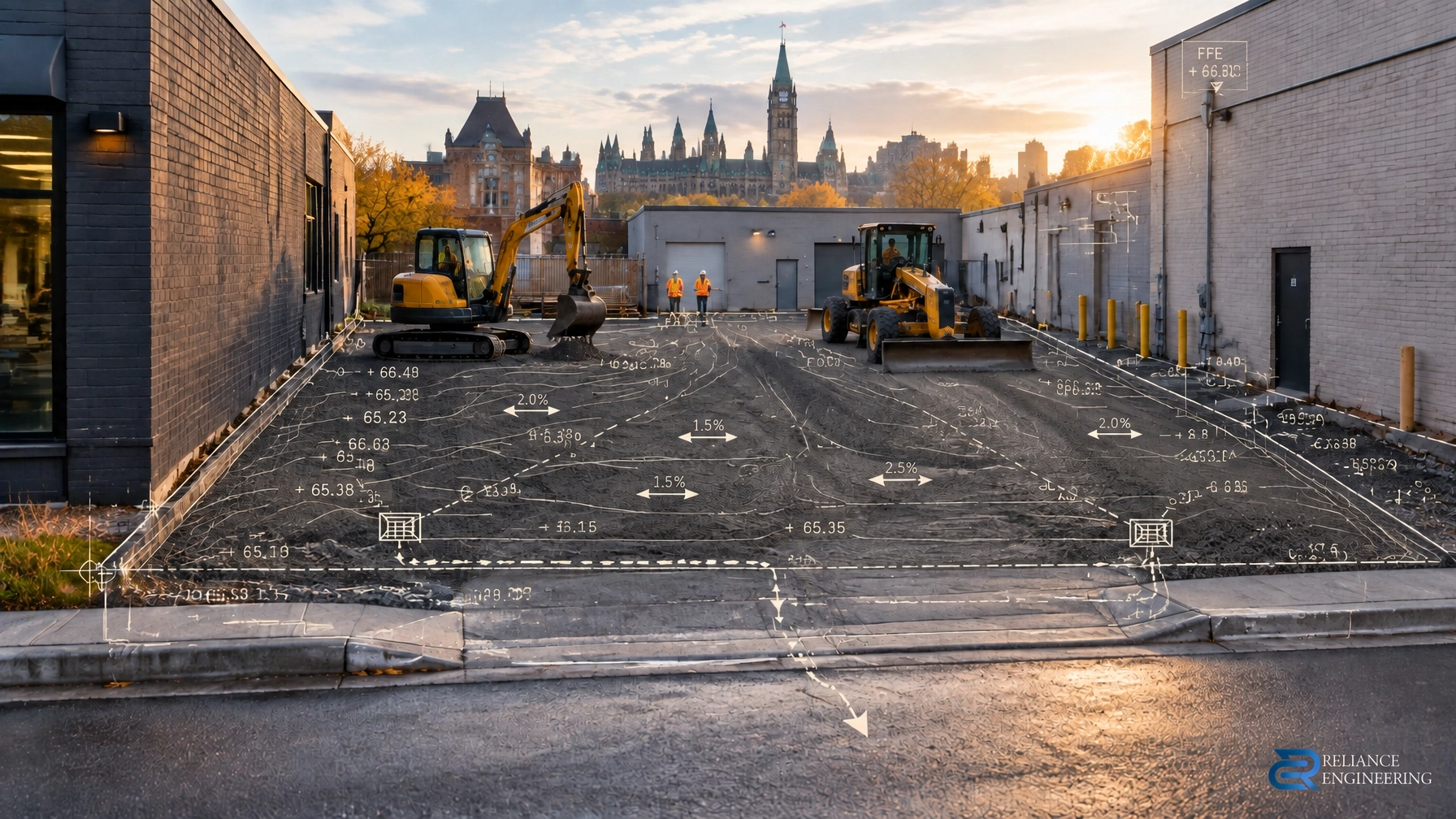
A coordinated design should show how runoff moves from the building and paved areas to the storm system, how the allowable release rate is controlled, and how larger storm events are safely conveyed across the site.

Conservation Authority Coordination
Ottawa-area projects may involve the Rideau Valley Conservation Authority, Mississippi Valley Conservation Authority, or South Nation Conservation, depending on the watershed and site location.
Where a property is within or near a regulated area, the project may require additional review for:
- Floodplain and flood hazard limits
- Wetlands and watercourses
- Steep or unstable slopes
- Fill placement and site grading
- Stormwater discharge
- Erosion and watercourse impacts
- Section 28 permitting under the applicable provincial regulation
The Rideau Valley Conservation Authority development information explains that development activities in regulated areas may require permission before construction or site alteration proceeds.
The FSR and SWM report should identify the applicable authority early. Requirements can affect the release rate, storage, outlet location, flood protection elevations, setbacks, and grading strategy.
This coordination is especially important for sites that drain toward a watercourse, municipal drain, wetland, or flood-sensitive downstream system.
How the FSR, Servicing Plans, and SWM Report Work Together
The most effective submission treats the report and drawings as one civil engineering package.
The Functional Servicing Report
The FSR provides the capacity evidence. It explains existing conditions, demand calculations, infrastructure constraints, servicing alternatives, and conclusions.
The Site Servicing Plans
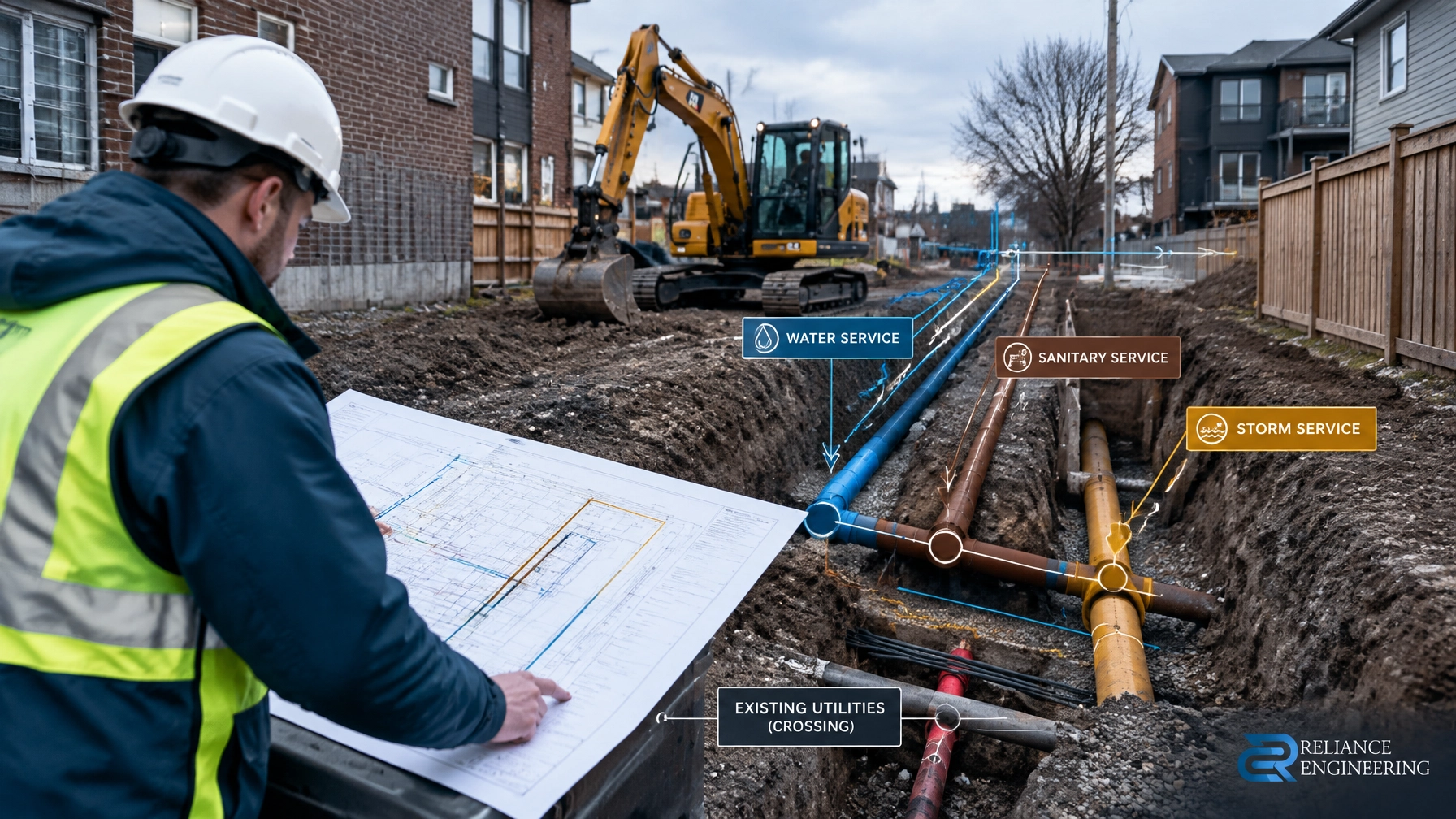
The servicing plans provide the physical layout. They show water, sanitary, and storm connections, pipe sizes, slopes, inverts, manholes, valves, hydrants, easements, and construction notes.
The Stormwater Management Report
The SWM report provides the runoff and control strategy. It demonstrates how flows are calculated, stored, treated, controlled, and safely released.
The Grading and Drainage Plan
The grading plan confirms that the proposed elevations create a buildable site, direct water away from buildings, maintain safe overland flow, and connect logically to the storm system.
These documents should use consistent:
- Site areas
- Building areas
- Drainage areas
- Design elevations
- Service connection points
- Pipe sizes and slopes
- Stormwater release rates
- Storage volumes
- Design storm assumptions
This is where clean layouts, coordinated design, clear calculations, practical controls, and municipal experience provide measurable value.
The Ottawa Review Process
For a Site Plan Control submission, a practical process is:
- Complete pre-consultation and confirm the required studies.
- Review surveys, record drawings, utility information, and background reports.
- Confirm water, sanitary, and storm infrastructure capacity.
- Request boundary conditions or municipal information where required.
- Prepare the FSR, servicing plans, grading plan, SWM report, and erosion and sediment control plan.
- Check all calculations and drawings against each other.
- Submit the coordinated package for municipal review.
- Respond to comments with revised drawings, updated calculations, and a clear response matrix.
The objective is not simply to submit more documents. It is to submit a defensible servicing strategy that City reviewers can follow and contractors can build.
Review a Real Servicing Drawing
Reliance Engineering’s Ottawa Site Servicing Plan sample demonstrates the type of drawing used to communicate municipal connections, pipe routing, site infrastructure, and servicing details.
Use the drawing together with the FSR and SWM report. The value is in the coordination between the documents, not in any one sheet viewed alone.
Reliance Engineering’s Approach
Reliance Engineering prepares Functional Servicing Reports, Ottawa site servicing plans, and stormwater management reports for residential, commercial, industrial, institutional, infill, and redevelopment projects across Ontario.
Our approach is approval-focused:
- Practical designs based on site conditions
- Clear drawings for municipal review and construction
- Constructible routing coordinated with grading and building layouts
- Clear calculations and conclusions
- Comment response and approval support
- Municipal experience across Ontario


Request Functional Servicing Support
If your Ottawa development requires a Functional Servicing Report, Site Servicing Study, servicing plans, or stormwater management report, engage a professional engineer early.
Contact Reliance Engineering for a consultation about your project, capacity requirements, and Site Plan Control submission.
Reliance Engineering Canada Limited
Naresh Ochani, P.Eng. M.Eng.
PEO Certificate of Authorization: 100548882
6850 Millcreek Dr, Mississauga, ON L5N 2H4
Phone: 647-385-6418
Email: [email protected]
Website: www.relianceengineering.ca
Office hours:
Saturday 12:00 PM–2:00 PM
Sunday Closed
A coordinated FSR gives municipal reviewers the capacity evidence they need and gives the project team a clearer path to approval and construction.