Metadata
- Article type: No-Nonsense Expert Guide
- Topic: Commercial parking lot drainage Ontario, ponding solutions, commercial property grading fixes, and asphalt regrading
- Service area: Across Ontario
- Published by: Reliance Engineering
- Estimated reading time: 7 minutes
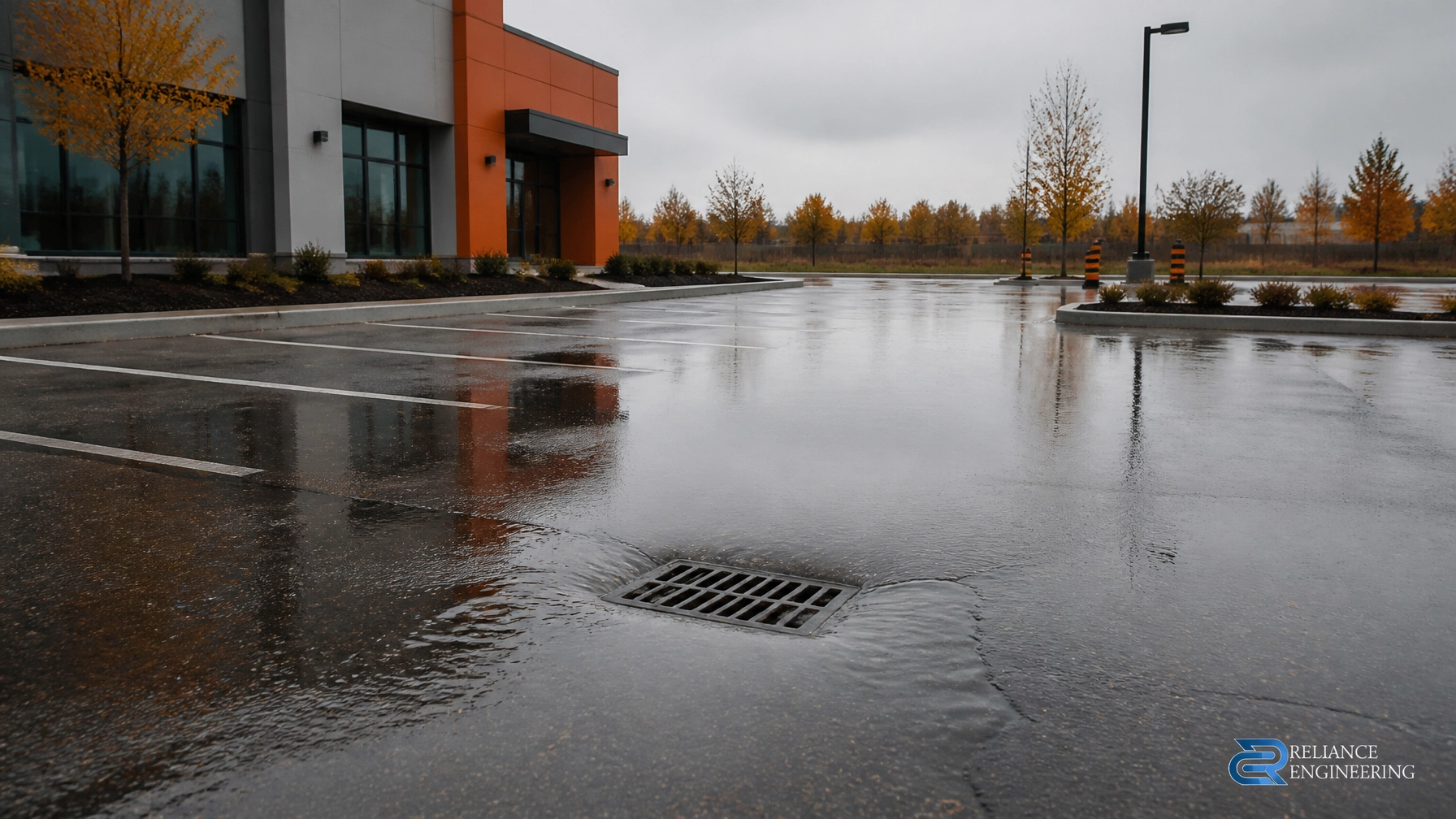
Recurring ponding on a commercial property is not simply a pavement maintenance issue. It is evidence that water is being trapped, delayed, or poorly conveyed.
A low point may result from settlement in the asphalt, an inadequate site grading design, a blocked catch basin, an undersized storm connection, or a combination of these conditions. Treating the visible puddle without identifying the cause often moves the problem instead of solving it.
The correct response is a drainage-focused assessment supported by accurate survey information, practical designs, and clear drawings. The objective is straightforward: establish positive drainage, protect the property, and prevent a localized low point from becoming a safety, construction, or liability concern.
Diagnose the Low Point Before Selecting a Repair
A commercial property owner should not assume that every ponding problem requires full parking lot reconstruction. The first step is to determine why water is collecting.
A professional review should consider:
- Existing surface elevations and pavement slopes
- The location and condition of catch basins
- Storm sewer connections and pipe inverts
- Curb lines, sidewalks, loading areas, and entrances
- Settlement near utility trenches or building foundations
- Sub-base and subgrade conditions
- Current overland flow routes
- Snow storage and seasonal drainage restrictions
- Runoff from roofs, landscaped areas, and adjacent properties
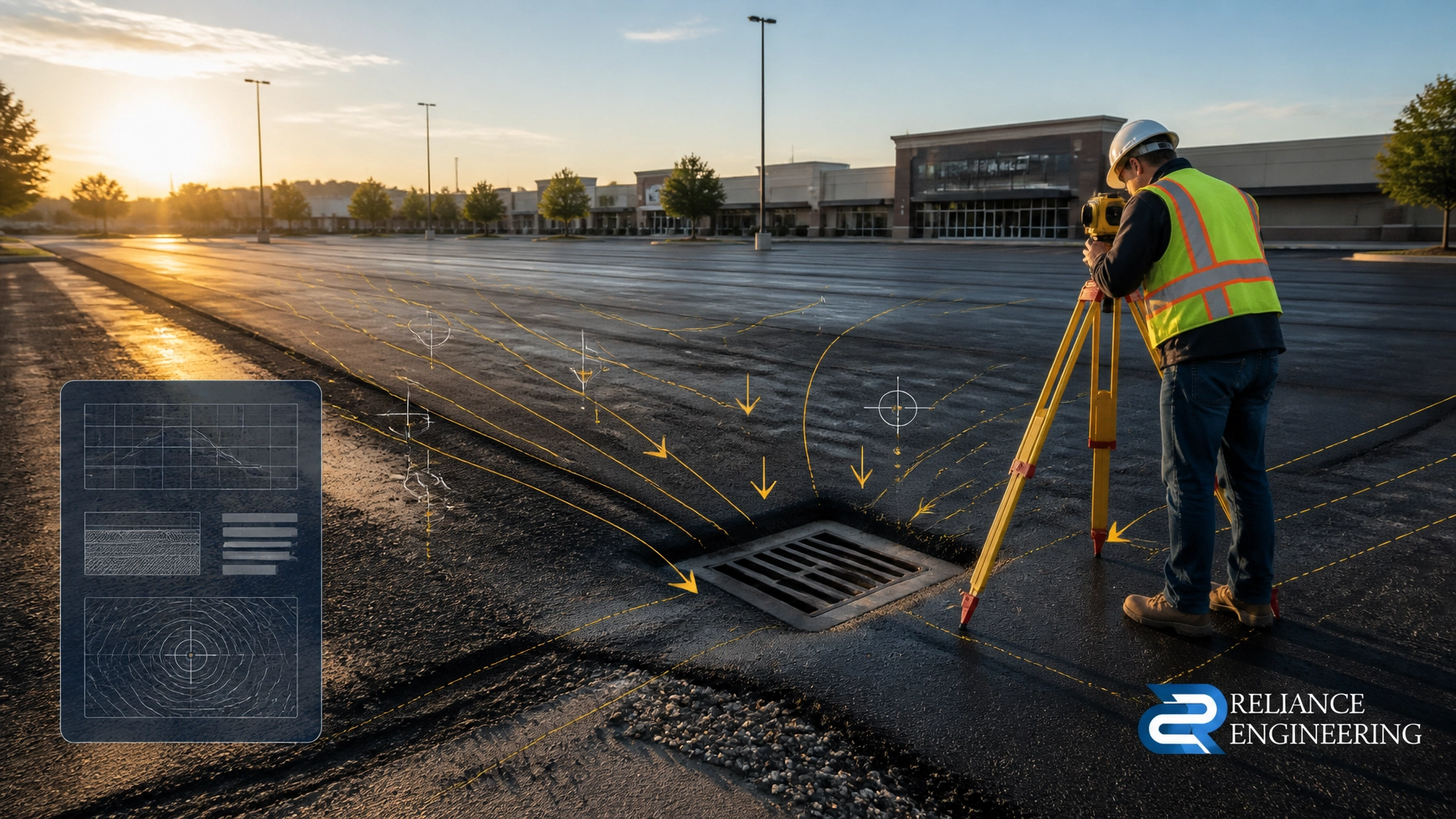
Field observations after rainfall can help identify the actual water path. However, visual review alone is not enough for a permanent solution. A topographic survey and detailed Site Grading Plan show how the low point relates to the full property.
The key question is not only, “Where is the water?” It is also, “Why does the water stop there, and where should it go instead?”

Surface Grading Problems and Infrastructure Problems Are Different
Ponding solutions depend on whether the failure is at the pavement surface, within the drainage infrastructure, or in both systems.
Surface grading problems
A surface grading problem occurs when the pavement does not have sufficient slope to move water toward an inlet or approved discharge point. Common causes include:
- Asphalt settlement
- Repeated freeze-thaw movement
- Poor original construction
- Utility trench settlement
- Previous overlays that changed elevations
- Inadequate crossfall or an isolated “birdbath”
- Curb or pavement adjustments that interrupted flow
In these cases, the catch basin may be working properly, but water cannot reach it efficiently. A small patch may temporarily fill the depression, but it rarely establishes reliable positive drainage.
A proper commercial property grading fix may involve localized pavement removal, sub-base correction, asphalt regrading, milling and resurfacing, or a carefully designed overlay. The selected method depends on the extent of the low point, existing elevations, curb constraints, building entrances, and pavement condition.
Drainage infrastructure problems
An infrastructure problem exists when the surface is reasonably graded but the collection or conveyance system cannot accept or discharge the runoff.
Potential causes include:
- Blocked or silt-filled catch basins
- Damaged or disconnected storm pipes
- Catch basins located away from the true low points
- Inadequate inlet capacity
- Poor pipe slopes or conflicts with other utilities
- Restricted storm sewer connections
- Trench drains that are undersized or poorly maintained
- Groundwater or lateral seepage affecting the pavement base
In these situations, asphalt regrading alone may not solve the problem. The drainage system may require cleaning, inspection, adjustment, replacement, or additional collection points.
A reliable design must therefore coordinate pavement elevations with catch basins, trench drains, storm pipes, and approved outlets.
Establish Positive Drainage With Buildable Grading
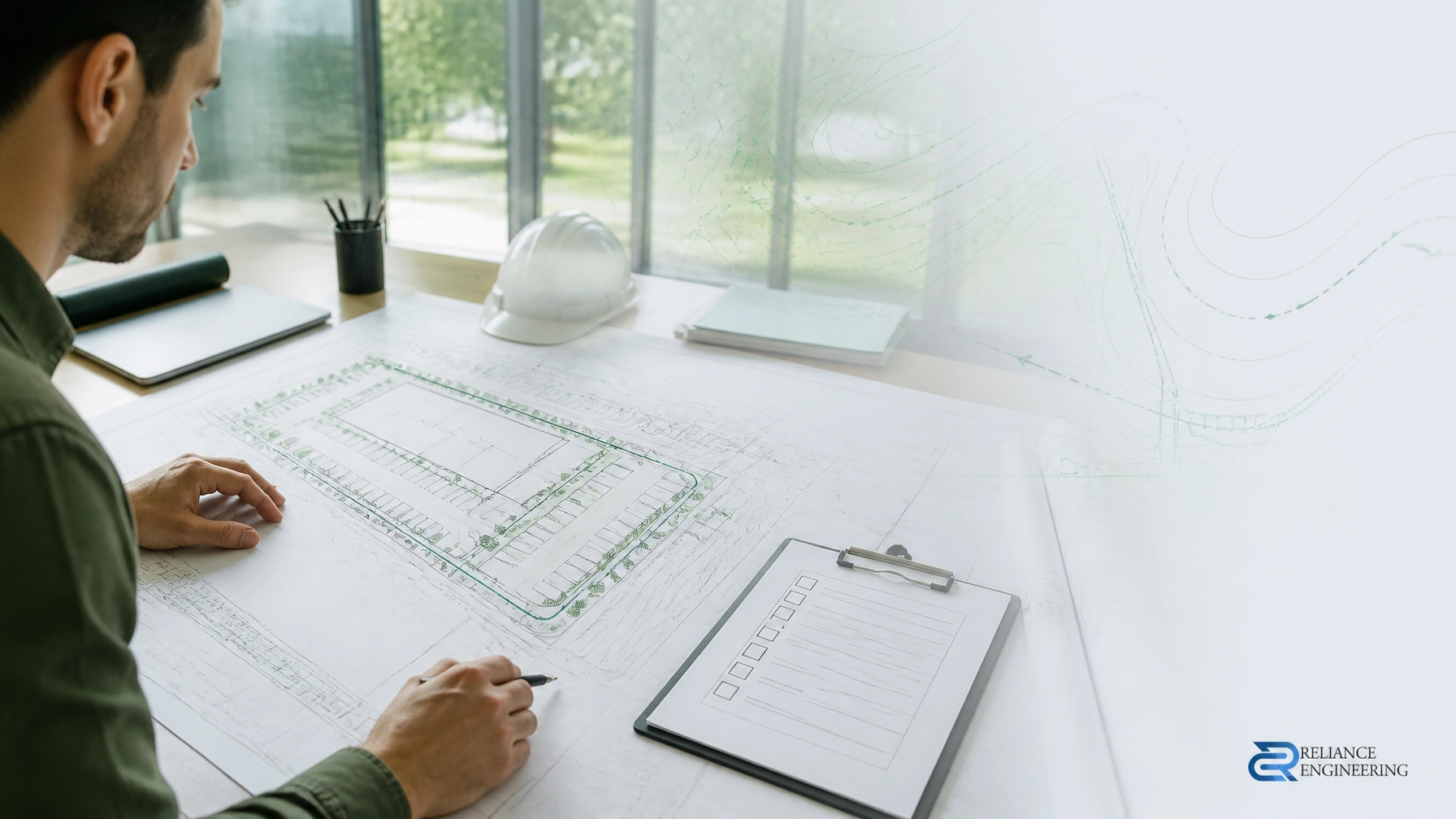
The purpose of a professional Site Grading Plan is to show how the site will drain under practical construction conditions.
A well-coordinated grading design identifies:
- Existing and proposed elevations
- High points and low points
- Pavement slopes and crossfalls
- Building entrance elevations
- Curb and sidewalk grades
- Catch basin and area drain locations
- Swales and surface drainage routes
- Road and property-line tie-ins
- Overland flow routes for larger storm events
- Protection of adjacent buildings and properties
The design must be more than technically correct on paper. It must be buildable grading that a contractor can set out, construct, inspect, and maintain.
For example, raising a low point may appear simple until it affects a loading dock, accessible route, overhead clearance, curb reveal, or door threshold. Similarly, directing more water toward an existing catch basin may create a capacity problem if the storm servicing has not been reviewed.
Reliance Engineering prepares Site Grading Plans using a practical, drainage-focused approach. The result is clear documentation that connects site elevations to the intended drainage strategy.
When Asphalt Regrading Is the Appropriate Solution
Asphalt regrading is often appropriate when the drainage infrastructure is functional but the pavement surface has lost its intended profile.
Depending on site conditions, the design may include:
- Localized cut-and-fill corrections
- Removal and replacement of distressed asphalt
- Sub-base adjustment beneath isolated depressions
- Milling to remove high areas
- Resurfacing with corrected crossfalls
- Strategic overlays where curb and entrance elevations allow
- Adjustment of catch basin rims to match final grades
The engineering plan should define the proposed elevations and transitions. It should not leave the contractor to estimate how much material to remove or where the surface should drain.
A surface repair is more likely to perform when it connects continuously to the surrounding pavement and directs runoff toward a functioning collection point. Simply placing additional asphalt in the lowest area can create a new low point at the repair edge.
When Additional Drainage Infrastructure Is Required
Some commercial properties need more than pavement correction. If runoff cannot reach an existing inlet, or if water concentrates near a building entrance or loading dock, additional infrastructure may be required.
Potential measures include:
- New catch basins at verified low points
- Catch basin relocation or rim adjustments
- Trench drains across wide entrances or aprons
- Storm sewer extensions
- Subsurface drainage or French drains
- Graded swales in landscaped areas
- Approved surface storage or conveyance features
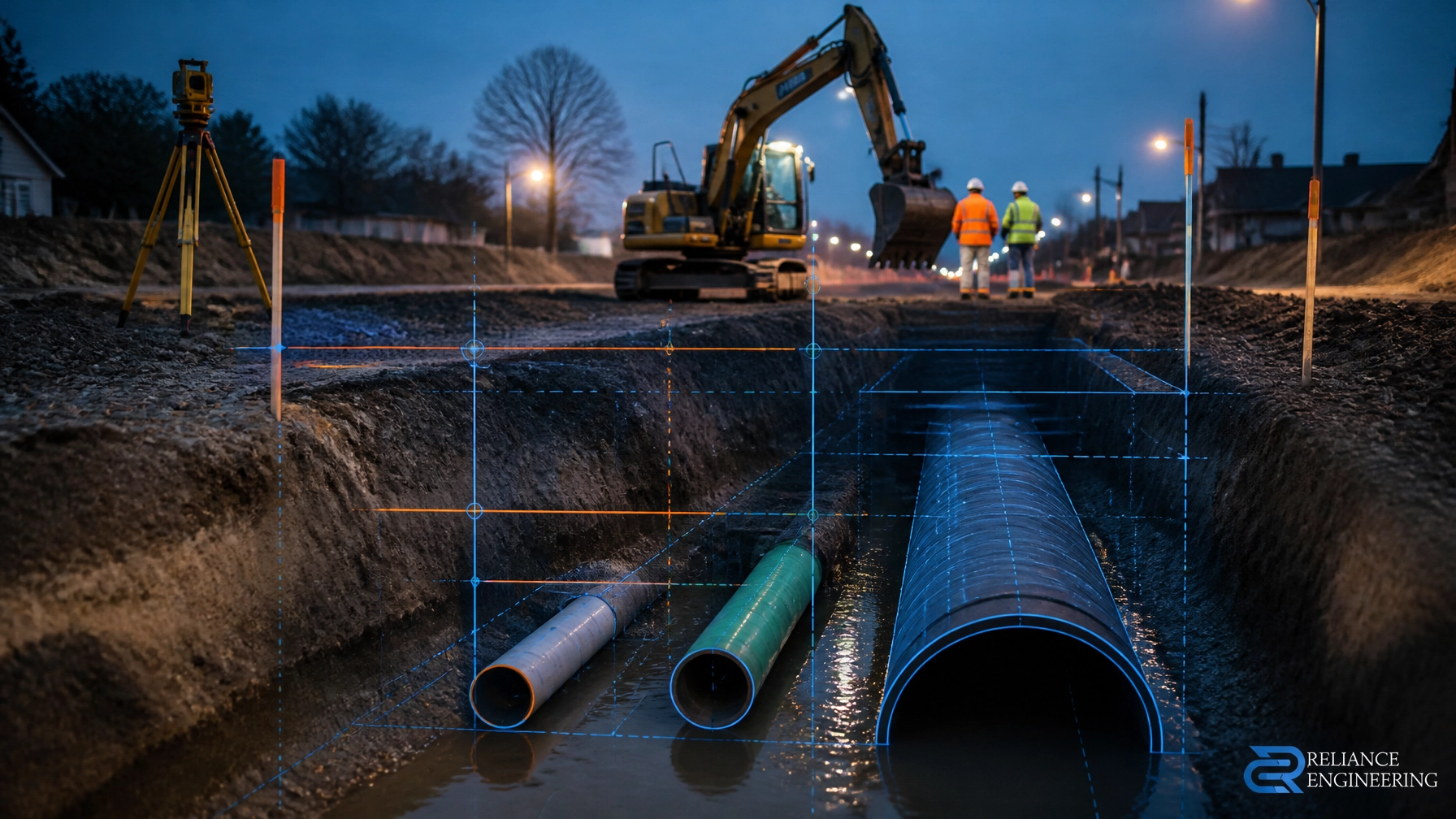
These measures must be coordinated with a Site Servicing Plan. Site servicing drawings show how storm, sanitary, and water systems connect to municipal or private infrastructure. They also identify pipe sizes, slopes, inverts, connections, maintenance access, and construction notes.
A servicing design should align with grading, landscaping, fire access, building layouts, and stormwater management requirements. This coordinated design reduces conflicts and supports efficient construction.

Coordinate Ponding Solutions With Stormwater Management
A commercial ponding issue may be local, but the site’s overall runoff strategy still needs to be reviewed.
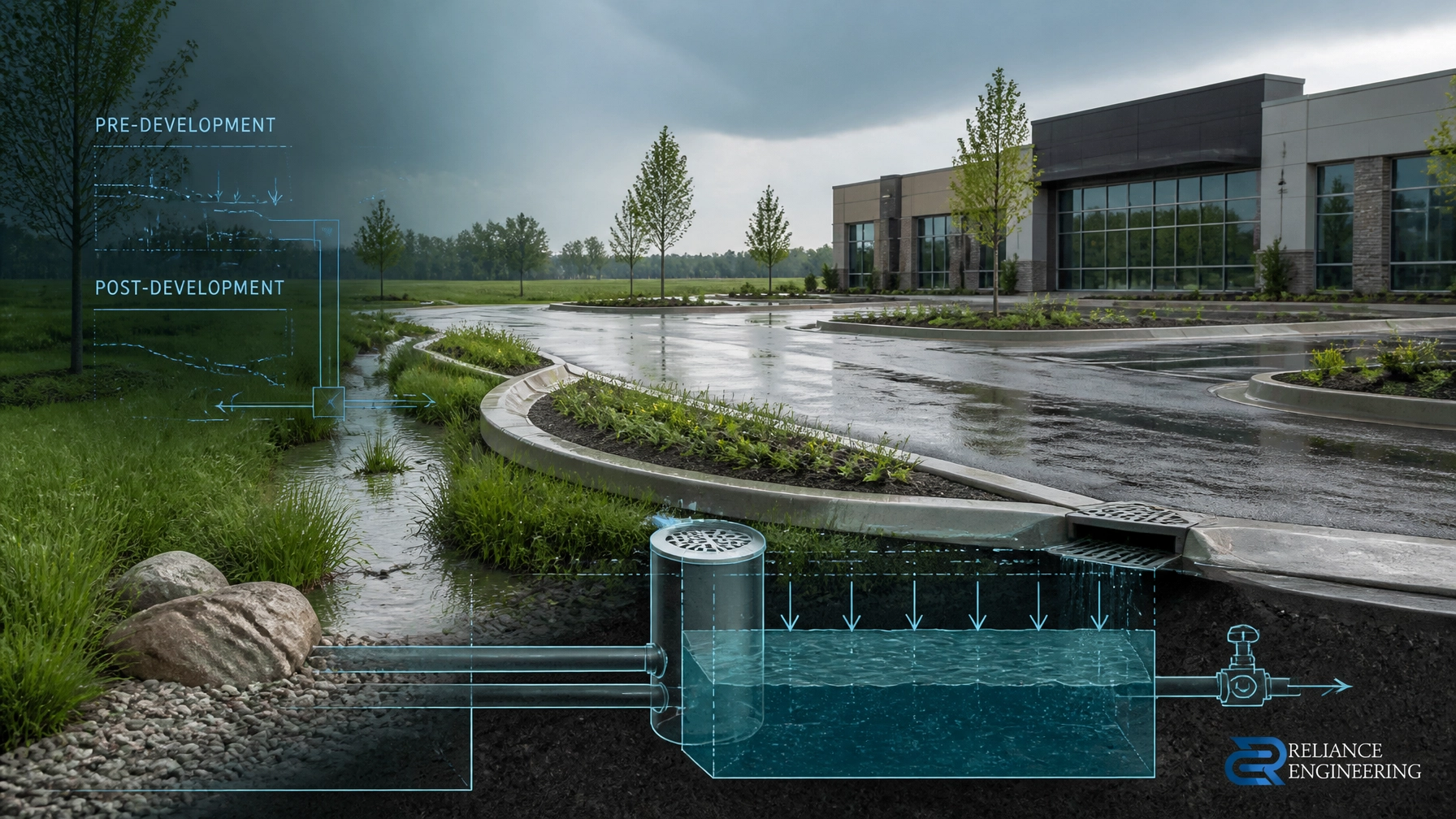
A Stormwater Management Report may address:
- Pre- and post-development drainage analysis
- Peak flow calculations
- Quantity control storage
- Allowable release rates
- Outlet and orifice control
- Water quality treatment
- Low Impact Development measures, where required
- Overland flow assessment
- Downstream and adjacent property impacts
The purpose is not only to move water away from one parking stall. The complete design must show how runoff is collected, controlled, treated, and safely released.
For larger or modified commercial sites, the grading and drainage design may also be part of a broader approval package. Depending on the project, this can include Site Plan Approval Drawings, a Functional Servicing Report, OPA/ZBA Drawings, Severance/Consent Application Drawings, or Building Permit Drawings.
Temporary Construction Runoff Must Match the Permanent Design
Commercial ponding work often involves excavation, grading, catch basin adjustments, storm servicing, or asphalt removal. During this period, the permanent drainage system may not yet be operational.
Temporary runoff controls must therefore be coordinated with the construction sequence.
A practical Erosion and Sediment Control Plan may show:
- Construction limits
- Temporary drainage routes
- Silt fence along down-gradient boundaries
- Protected catch basins and inlets
- Stabilized construction entrances
- Mud mats and road protection
- Protected soil stockpiles
- Temporary swales and diversion berms
- Sediment traps or check dams, where appropriate
- Dewatering and discharge controls
- Inspection and maintenance requirements
The controls should reflect the actual site rather than rely on standard details without context. A protected catch basin that becomes clogged, a silt fence installed outside the flow path, or a stockpile placed in a drainage route will not provide effective protection.
Temporary controls also need to evolve as the project moves from demolition to excavation, servicing, granular placement, paving, and final stabilization.

Do Not Wait for the First Liability Claim
Persistent ponding creates several avoidable risks:
- Slip hazards during freezing conditions
- Damage to asphalt and pavement foundations
- Water near building entrances and foundations
- Blocked drainage structures
- Complaints from tenants, customers, or neighbours
- Sediment discharge during construction
- Repeated maintenance and patching costs
- Delays during municipal review or inspection
The right response is to document the issue early and have the site reviewed by a qualified civil engineering professional. Photographs, maintenance records, storm dates, and locations of recurring ponding can help support the initial assessment.
Do not authorize asphalt work based only on a visual estimate. First confirm whether the issue is surface grading, drainage infrastructure, stormwater capacity, subsurface conditions, or a combination of factors.
Clear, Permit-Ready Drawings Across Ontario
Reliance Engineering provides civil engineering services for commercial property owners, developers, builders, architects, contractors, and land development planners across Ontario.
Our services include:
- Site Grading Plans
- Site Servicing Plans
- Erosion and Sediment Control Plans
- Stormwater Management Reports
- Functional Servicing Reports
- Site Plan Approval Drawings
- OPA/ZBA Drawings
- Severance/Consent Application Drawings
- Building Permit Drawings
Our focus is direct: practical designs, clear drawings, coordinated design, buildable grading, positive drainage, and approval support.
Request a Commercial Ponding Assessment
If your commercial property has recurring low points, standing water, or drainage complaints, contact Reliance Engineering before the next repair is approved.
We can discuss the condition of your parking lot, review available surveys and drawings, and identify whether the project requires grading corrections, asphalt regrading, drainage infrastructure improvements, stormwater analysis, or a coordinated civil package.
Request a consultation or contact us directly.
Contact and Professional Credentials
Reliance Engineering
6850 Millcreek Dr
Mississauga, ON L5N 2H4
Phone: 647-385-6418
Email: [email protected]
Website: www.relianceengineering.ca
Office hours:
- Monday–Friday: 9:00 AM–5:00 PM
- Saturday: 12:00 PM–2:00 PM
- Sunday: Closed
Principal Engineer: Naresh Ochani, P.Eng. M.Eng.
PEO Certificate of Authorization: 100548882
A recurring puddle is a site signal. Diagnose the low point, confirm the drainage path, and correct the design before the condition becomes a larger construction or liability problem.