Article type: Development servicing guidance
Audience: Ontario developers, builders and project owners
Focus: Sanitary pumping stations, forcemains and municipal approvals
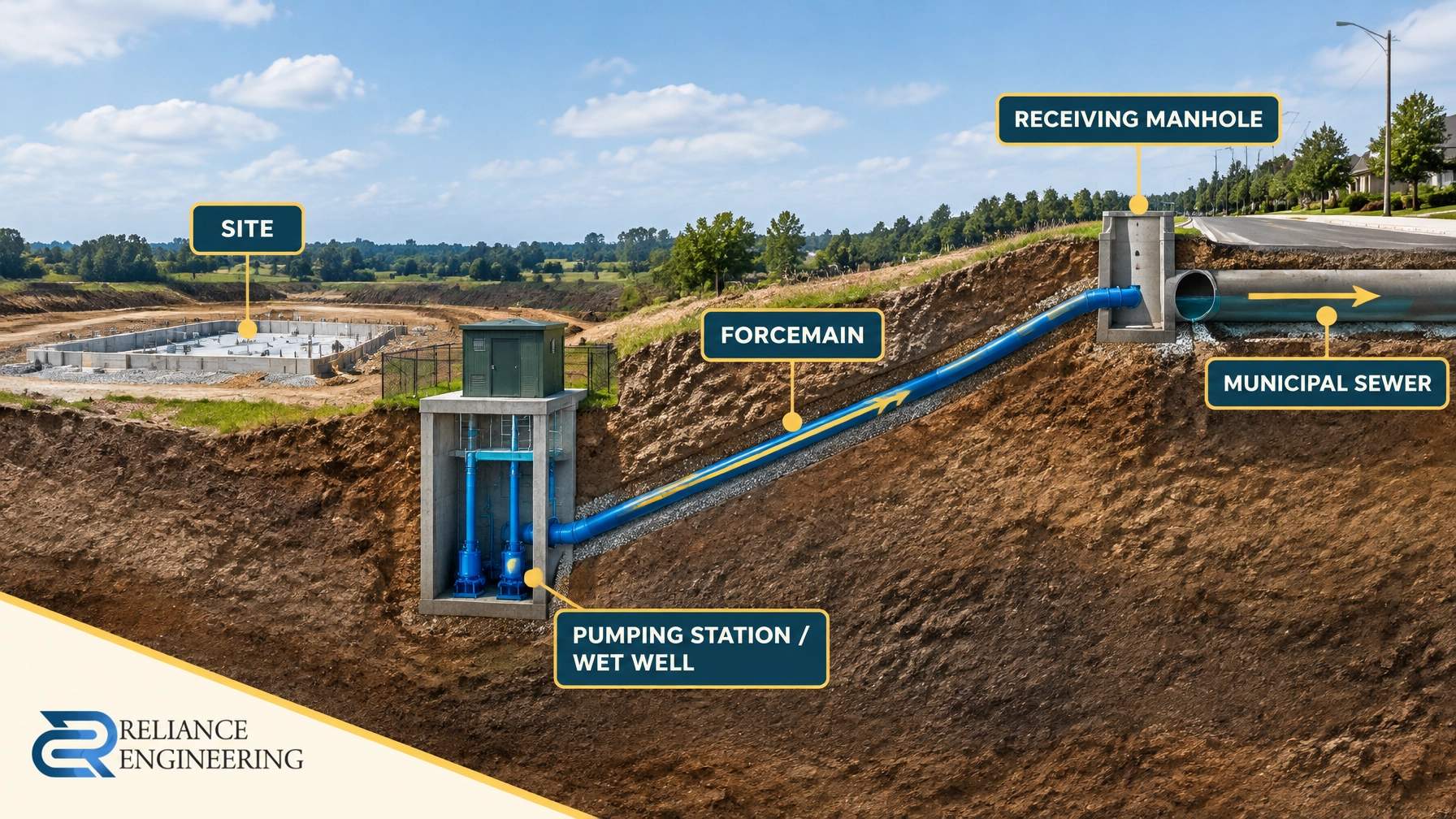
Most site servicing layouts rely on gravity for sanitary sewage and storm drainage. Water, by contrast, is designed as a pressurized system. When a proposed development site, or part of it, sits below the invert of the receiving municipal sanitary sewer, gravity service may not be feasible. A sanitary pumping station and forcemain can then become part of the servicing strategy.
That decision affects more than the connection detail. It can change the project’s cost, land requirements, approval path and long-term ownership responsibilities.
The pumping question starts in the functional servicing report
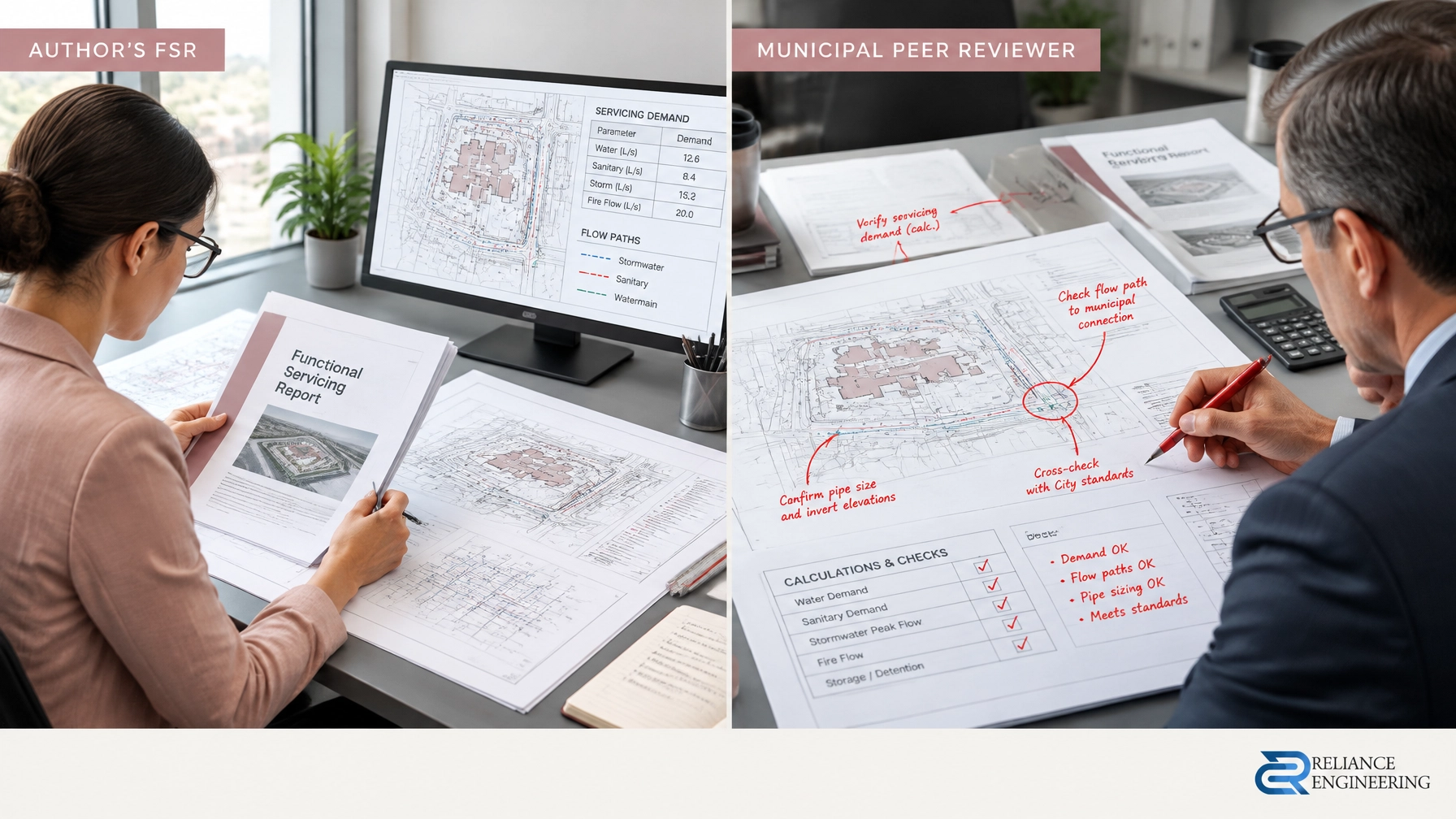
A functional servicing report (FSR) is where the servicing concept should identify whether pumping is needed, not where the issue should first appear during detailed design.
One regional example is York Region’s Development Application Supporting Studies Terms of Reference. Functional Servicing Report, dated April 2024. Developed jointly with the Region’s municipalities and in widespread use across York Region, it requires the FSR’s wastewater impacts-and-mitigation section to identify required downstream sanitary upgrades and “identify the need of any interim or permanent pumping station and the ownership of the proposed pumping station.” The applicable scope is confirmed with the municipality at pre-consultation. (York Region FSR Terms of Reference)
The same terms of reference ask whether off-site land or works are needed, such as servicing easements or a sewer on land under another jurisdiction, including York Region, MTO or Hydro lands. They also require assessment of compliance with the municipal Consolidated Linear Infrastructure Environmental Compliance Approval (CLI ECA) for existing or proposed municipally owned infrastructure, including pre-authorization.
The FSR is expected to provide supporting reports, plans, modelling results and/or design calculations so municipal and Regional staff can assess financial and infrastructure implications. Requirements vary by municipality and project; confirm the scope and applicable criteria during pre-consultation.
Why pumping is a capacity decision
A pumping station does not make sanitary capacity concerns disappear. Its pumps and forcemain must convey the project’s sewage to a receiving sewer that can accept the discharge, while allowing for future servicing needs where required.
The province-wide design backdrop is the Ministry of the Environment, Conservation and Parks’ Design Guidelines for Sewage Works, Chapter 7. Sewage Pumping Stations. Municipalities and regions typically reference these guidelines, then apply their own standards. Confirm local requirements before sizing or selecting equipment. (MECP Design Guidelines for Sewage Works, Chapter 7)
The MECP guidelines state that sanitary stations should pump the design peak instantaneous sewage flow and be capable of upgrading to ultimate tributary-area flows with minor modifications. Multiple pumps should be provided; where there are two units, they should be the same size. Firm capacity, with the largest unit out of service, is based on design peak instantaneous flow and should maintain at least 0.6 m/s in the forcemain.
For raw sewage, the guidelines set a general minimum forcemain diameter of 100 mm, unless hydraulic calculations justify a smaller size. They recommend a cleansing velocity of 0.6–1.1 m/s and limit maximum velocity to 3 m/s. For friction-loss calculations using Hazen-Williams, the guidelines specify C=100 for unlined iron or steel and allow values up to C=120 for smoother materials.
Pump selection also involves system-head curves for low, median and overflow wet-well conditions. Wet-well sizing considers average daily flow, pump-cycle requirements and a design fill time not exceeding 30 minutes, unless the facility provides flow equalization.
Reliability and site conditions matter as well. The guidelines call for alarm systems with backup power, with alarms transmitted to a municipal facility staffed 24 hours a day, or an alternative arrangement that meets the guidance. Standby power needs assessment; emergency pumping capability is expected unless adequate on-system storage prevents overflow. Pump-station structures and equipment should be protected from the 100-year design flood and remain operational and accessible during the 25-year flood event. Maintenance vehicles should be able to reach the station in all weather.
These are provincial guidelines, not a substitute for local criteria. Final design requirements depend on the municipality, region and project context.

Interim or permanent, and who owns the asset?
A project may require an interim pumping arrangement until downstream capacity becomes available or a trunk upgrade is built. It may instead require a permanent station serving the development. The servicing strategy should make the proposed approach clear and explain how it relates to phasing and downstream works.
Ownership is a separate, essential decision. A station may be built by a developer and dedicated to a municipality, or remain privately owned and operated. The York Region FSR terms of reference explicitly require the report to state proposed station ownership. Ownership affects who accepts the asset, operates and maintains it, and which environmental approvals apply. If municipal ownership is proposed, confirm with the municipality how the CLI ECA and pre-authorization process applies.
York Region’s terms of reference also address dewatering as part of the servicing strategy: permanent dewatering discharges will not be permitted to the municipal sanitary system. Temporary discharges are permitted only where no reasonable alternatives are feasible.
What changes in the approvals and drawings?
At the application stage, the FSR should describe the need for pumping, proposed ownership, downstream sanitary upgrades and off-site requirements such as easements. Detailed design and municipal acceptance follow later, under the applicable local review process.
The forcemain route may need easements across other properties or lands controlled by another jurisdiction. The drawings should show the station location, forcemain alignment and profile, receiving manhole connection, access and maintenance provisions. MECP Chapter 7 also calls for consideration of corrosion and odour risks, identification where forcemain materials could be confused with potable watermains, air relief at high points, and cleanouts at low points or pig-launching and catching chambers for maintenance.
Reliance Engineering coordinates the FSR with site servicing plans and stormwater management reports Ontario. For a pumping solution, that means aligning the report and drawings, planning constructible routing for the station and forcemain, and presenting clear calculations for pump and forcemain sizing. Clean layouts, practical controls and municipal experience help reviewers understand the servicing approach and its implications.

Developer checklist
Before relying on a pumping solution, confirm:
- At pre-consultation, ask whether gravity service is achievable and whether a pumping station is being considered.
- Ensure the FSR states whether interim or permanent pumping is required and identifies proposed ownership.
- Identify off-site works and easements early, including requirements involving other jurisdictions, MTO or utilities.
- Confirm which municipal or regional standards and MECP guidelines govern the design before sizing.
- If municipal ownership is proposed, confirm the CLI ECA and pre-authorization path with the municipality.
- Show the forcemain alignment, receiving manhole and maintenance provisions on the servicing drawings so they match the report.
Plan the servicing strategy before filing
If your site sits below the municipal sewer, the servicing strategy can shape the project budget, land needs and approvals. Discuss the options with a civil engineer before filing your application.
Request a Consultation
Phone: 647-385-6418
Email: [email protected]
Professional credentials and contact
Naresh Ochani, P.Eng., M.Eng.
Principal Engineer, Reliance Engineering Canada Limited
PEO Certificate of Authorization 100548882
6850 Millcreek Dr, Mississauga, ON L5N 2H4
647-385-6418 | [email protected]
Office hours: Monday to Friday 9:00 AM–5:00 PM, Saturday 12:00 PM–2:00 PM, Sunday closed.