Article type: Municipal approvals guide
Updated: November 9, 2026
For: Developers, builders, architects, commercial project owners and land development planners
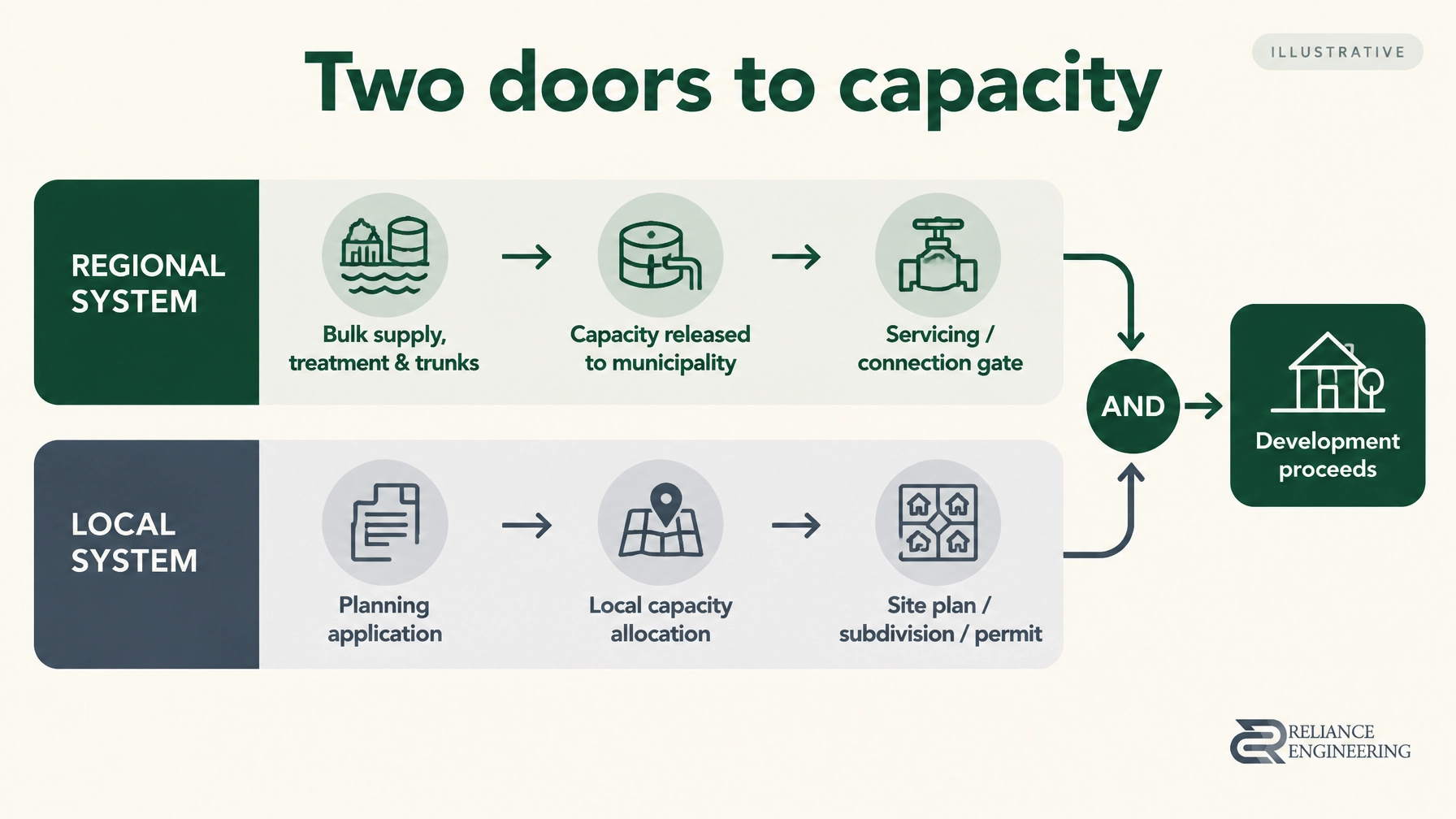
In a two-tier municipality, water and wastewater capacity can depend on two different public systems. An upper-tier region may manage bulk supply, treatment and trunk infrastructure. A local municipality may operate the distribution and collection network your site connects to and decide the planning application.
That creates two administrative doors. A project may meet one municipality’s requirements and still stall at the other. A planning approval is not, by itself, proof that capacity is available for connection.
The examples below describe specific municipal policies and arrangements. Responsibilities and procedures vary across Ontario. Confirm current requirements with the relevant municipalities and service providers.
The regional and local roles are different
York Region’s November 2016 Water and Wastewater Master Plan describes the Region as a wholesale water and wastewater service provider to its nine local municipalities. The Region is responsible for bulk supply, treatment and storage, while local municipalities operate local water distribution and wastewater collection systems.
York’s system also illustrates how regional servicing can cross boundaries: the Region obtains roughly 88% of its water through long-term agreements with Peel Region and Toronto. Duffin Creek Water Pollution Control Plant, co-owned with Durham Region, treats about 85% of York’s wastewater. See the York Region Water and Wastewater Master Plan.
For a development, this can mean two sets of servicing questions. Regional reviewers may assess trunk capacity, treatment, downstream conveyance and system boundary conditions. Local reviewers may assess distribution mains, local sewer capacity, connection points and how the site fits the municipal network.
These are not always the same approval process or criteria. A coordinated functional servicing report should present one clear account of the project’s demands and proposed connections for both audiences.

Planning authority and infrastructure responsibility can sit at different levels
The Region of Waterloo’s Mannheim Service Area is a current example of this separation. Its development information page says that, from January 1, 2025, the Region became an upper-tier municipality without planning authority. For local planning applications, its role is as a commenting agency. The Region still owns and operates the water system, and says it must ensure capacity is available before a development connects.
In the Mannheim Service Area, regional staff provide advisory comments on certain OPA/ZBA, subdivision and consent applications. The Region also says it is not entering new servicing agreements and considers some Form 1 requests case by case. Its comments do not transfer planning authority back to the Region, but its infrastructure position remains important to servicing and connection.
Building permits are a separate matter. The Region’s FAQ states that permit issuance and revocation fall within the Chief Building Official’s jurisdiction under the Building Code Act. The Region cannot direct that a building permit not be issued because of a water-capacity concern.
Ontario Regulation 525/97 identifies transition dates for particular upper-tier municipalities. Durham and Waterloo became upper-tier municipalities without planning approval responsibilities on January 1, 2025, and Niagara on March 31, 2025. Check the regulation and local planning guidance for the municipality and application in question.

Capacity flows to municipalities before it reaches a site
Waterloo’s allocation process demonstrates the “two buckets” model. Under its Water Supply Capacity Allocation Policy, approved May 6, 2026, the Region releases available water capacity to Area Municipalities. Initially, those allocations occur quarterly as supply becomes available through the Region’s Interim Risk Management Framework, approved June 3, 2026. The intervals are expected to become less frequent when available supply consistently exceeds local demand.
The Area Municipalities, including Kitchener, Waterloo, Cambridge, Wilmot, Woolwich, Wellesley and North Dumfries, then allocate capacity to specific developments within their own allocations. In practical terms, capacity may arrive at the local level in batches. A site cannot assume that capacity will be released whenever it is requested.
The local rules matter too:
- Kitchener: Its Water Allocation Policy, adopted by By-law 2026-091 on June 29, 2026, sets out how the City assigns its available capacity to development. Applicants submit a Water Capacity Application Form with a development or building permit application. As new regional capacity becomes available, the City reviews applications quarterly or more frequently and may issue a signed Water Allocation Confirmation Letter and/or Forward-Looking Servicing Agreement under its prioritization framework.
- Cambridge: Its Water Allocation Policy ADM 06, adopted by By-law 26-063 on July 21, 2026, applies in the Mannheim Water Service Area. Allocation or an exemption must be confirmed before specified steps, including site plan approval, subdivision or vacant land condominium registration, a consent certificate, part-lot control exemption or building permit. Possible outcomes include immediate allocation, a Forward-Looking Servicing Agreement or deferral. Cambridge explicitly states that a Forward-Looking Servicing Agreement does not guarantee capacity. It can allow specified site plan and registration steps, but a building permit requires an Immediate Water Allocation Confirmation Letter. The policy provides a 10-calendar-day written objection period to the City Manager; under Planning Act section 86.1(3), that decision is final.
- Newmarket: This York-area example shows the same two-level structure under different local rules. The Town’s Servicing Allocation Policy starts local prioritization once York Region makes capacity available to the Town. Newmarket uses a 17-point framework for applications in the Urban Centres Secondary Plan area, with criteria that include affordable housing, LEED participation through the Region’s program, not requiring certain plan or zoning amendments, participation in the joint inflow and infiltration reduction program, land conveyance for future streets, and location in the Provincial Urban Growth Centre or GO mobility hub area. The policy also sets a severance reserve capped at 20 people per year. Its one-year rescission rule and 60-day extension application window are examples of how local rules vary.
These policies are examples, not a province-wide template. Wastewater capacity may also follow a different system, owner and review process than the water-allocation policies described here. Confirm who operates each system your project relies on.
Make the functional servicing report work for both reviews
A sound functional servicing report should connect regional system questions with local design details. Regional reviewers may need to understand trunk capacity, treatment, downstream conveyance and the limits or assumptions at system boundaries. Local reviewers may focus on distribution mains, local sewer capacity, connection points and fire flow at the hydrant.
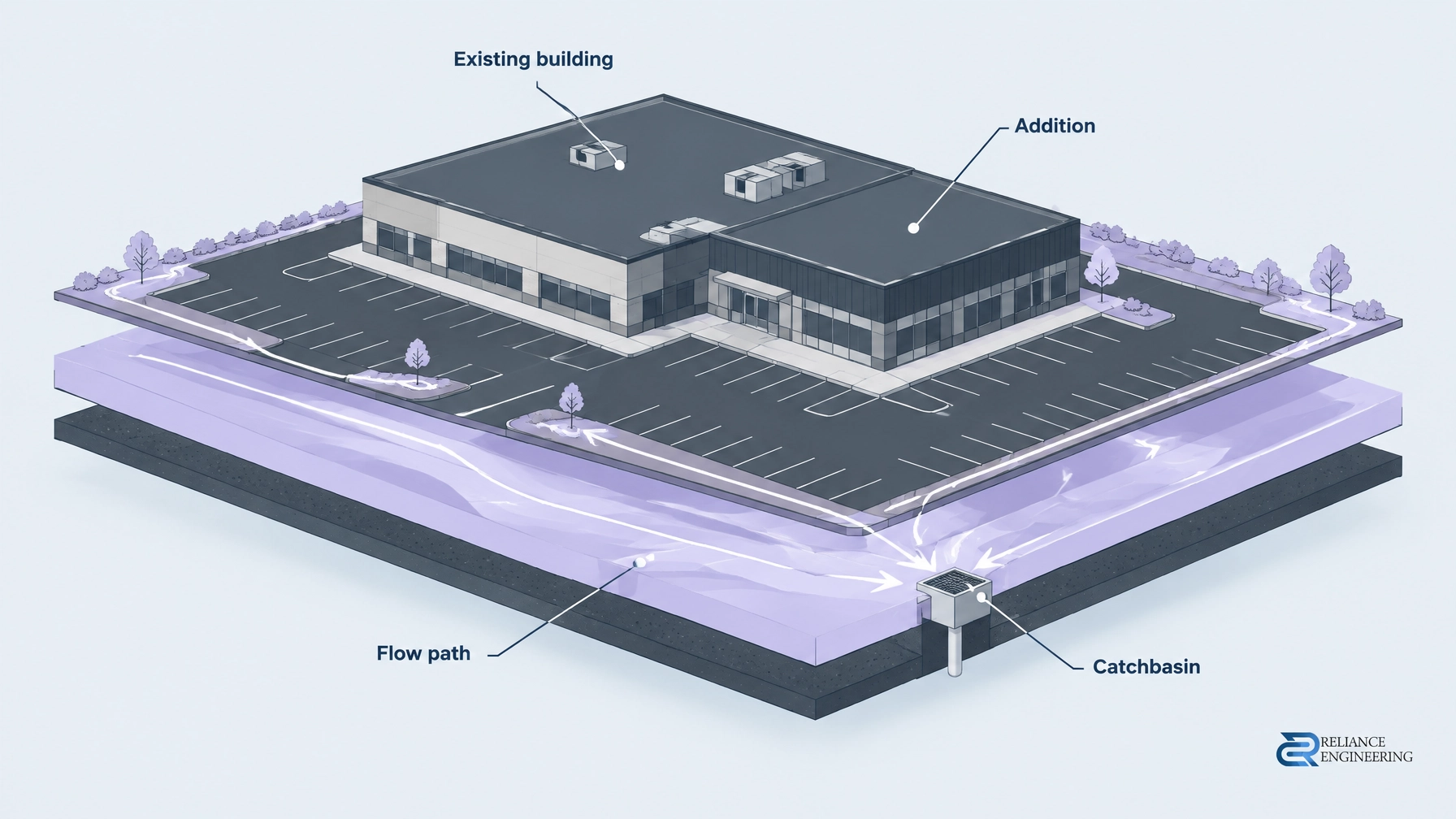
Keep the development statistics consistent across the report, site servicing plans and stormwater management reports. Align the stated demand, proposed connections and servicing assumptions. Coordinate stormwater management and site grading with the municipal system as well as the proposed servicing layout.
Clean layouts, clear calculations, constructible routing and practical controls make the design easier to review and build. Coordinated design can also help prevent a regional condition from surprising the local reviewer, or a local connection issue from undermining the regional servicing case.
Common coordination failures
Practitioners should watch for these avoidable gaps:
- Designing to the local standard while assuming the regional trunk is unconstrained, or the reverse.
- Treating a region as a rubber stamp because it no longer approves local plans. In Waterloo’s example, the Region is a commenting agency but still operates the water system and manages its capacity position.
- Requesting capacity as if it is released directly to individual sites, when a regional allocation may first go to the municipality in batches.
- Treating a Forward-Looking Servicing Agreement as a guarantee of water capacity.
- Assuming a region can decide whether a building permit is issued, when Waterloo identifies that decision as the CBO’s jurisdiction.
- Using demand figures in a local application that do not match the demand presented for regional review.

Check these six points before applying
- Identify the two-tier structure and the relevant local approval authority.
- Confirm who owns and operates each system your site will connect to.
- Check the capacity policy that applies to the site and proposed development.
- Confirm the timing of regional release and local review cycles.
- Align the demand figures and assumptions across both reviews.
- Confirm when allocation or an exemption must be secured, including before site plan approval, registration, consent or building permit.
Five key takeaways
- Regional infrastructure responsibility and local planning approval can sit at different levels.
- Regional capacity may be allocated to a municipality before it is assigned to a development.
- Local policies determine how site-specific applications compete for available capacity.
- A planning approval, an allocation and permission to connect are not necessarily the same decision.
- A consistent functional servicing report and coordinated site servicing plans help explain the project across both reviews.
Get approval support for your servicing strategy
Before submitting, confirm the applicable capacity policies and review sequence with the relevant municipalities. For practical design and municipal approvals support, request a consultation with Reliance Engineering. We prepare permit-ready drawings and coordinated servicing documentation for projects across Ontario.
Professional credentials and contact
Naresh Ochani, P.Eng. M.Eng.
Principal Engineer, Reliance Engineering Canada Limited
PEO Certificate of Authorization: 100548882
6850 Millcreek Dr, Mississauga, ON L5N 2H4
Phone: 647-385-6418
Email: [email protected]
Office hours: Monday–Friday 9:00 AM–5:00 PM; Saturday 12:00 PM–2:00 PM; Sunday closed.