Article type: Practical guide
Topic: Site plan agreement securities and civil close-out
Applies to: Developers, builders and commercial property owners in Ontario
Important: Municipal agreements and procedures differ. The examples below are from Waterloo and Cambridge; confirm the requirements in your own executed agreement and with the municipality.
Approval is not the finish line
Site plan approval can lead to a registered agreement under section 41 of Ontario’s Planning Act. A municipality may use the agreement to secure required works and ensure construction follows approved plans. Whether registration is required before a building permit is issued depends on local conditions and the project’s agreement.
The City of Waterloo’s example site plan agreement illustrates why close-out matters. It states that site plan approval does not guarantee sanitary, storm or water servicing capacity for the lands. It also makes execution and registration of the agreement a condition before a building permit may issue.
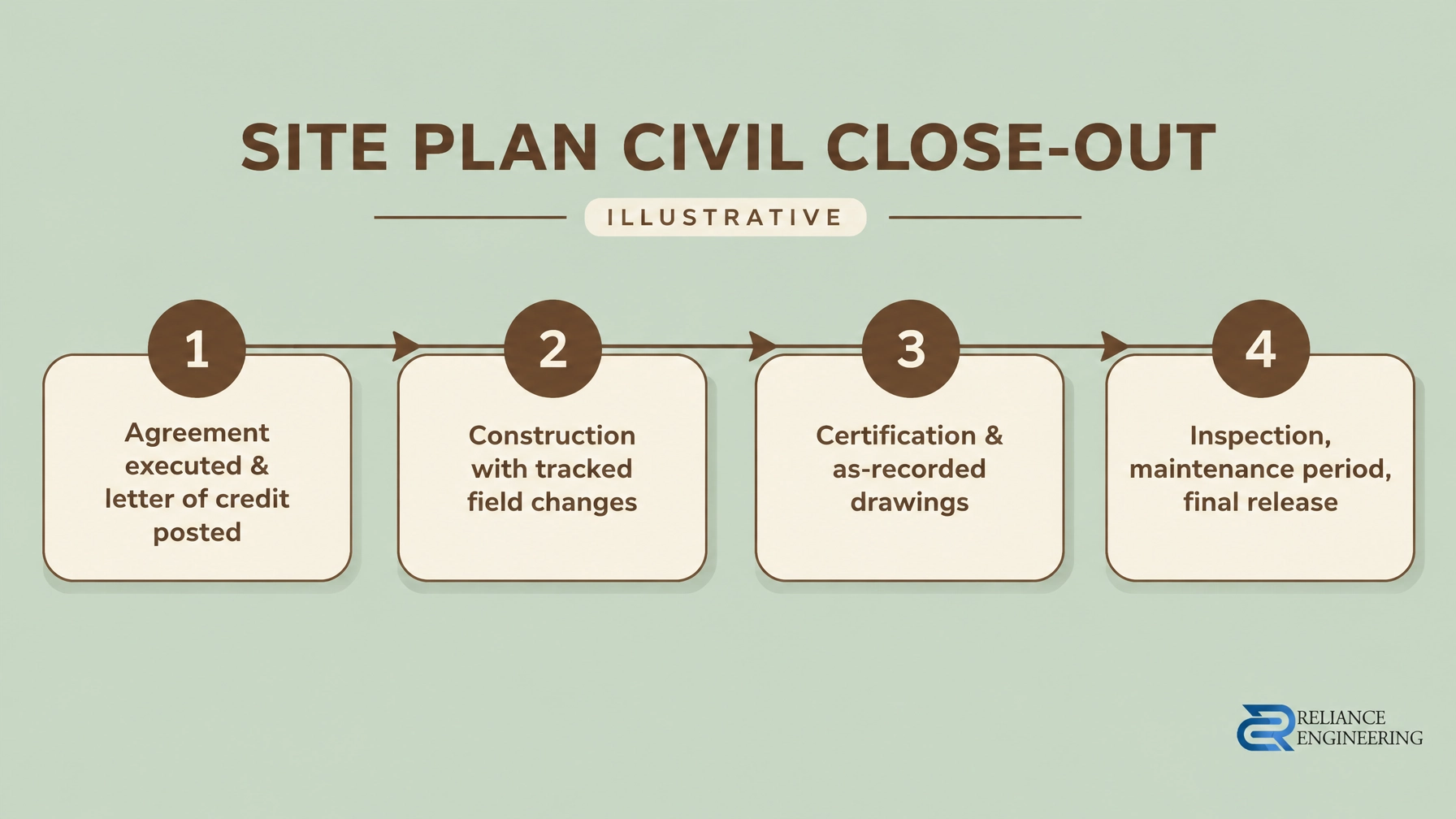
For owners, a letter of credit (LOC) or cash deposit is real project security tied to civil deliverables. Approval and permit issuance do not release it. The release process typically requires completed work, certifications, as-recorded drawings, municipal inspection and, where specified, a maintenance period.
What the security can cover
In Schedule D of Waterloo’s example agreement, the LOC is calculated from three work categories:
- 50% of the estimated value of landscaping and planting works;
- 50% of the estimated value of non-landscaped surface works; and
- 50% of the estimated value of underground storm, sanitary and water servicing works.
These are Waterloo example-agreement terms, not province-wide rates. Confirm the security calculations and accepted forms of security with the municipality handling your application.
The same agreement allows the City to draw on the LOC if the owner does not comply within 30 calendar days after written notice. That makes deficiency notices and default provisions a practical project risk, not just contract language.
How staged release works
Waterloo’s Schedule E sets out staged security reductions. As-recorded drawings are required before release beyond 80% of the performance security. For the maintenance period, the agreement retains at least 15% of the original LOC, and not less than $25,000, for materials and workmanship for at least one year. These are City of Waterloo example terms; the executed agreement controls locally.
The maintenance-period clock does not simply start when construction appears complete. Under Waterloo’s example, the owner must request commencement, the City must inspect, deficiencies must be corrected, and required certificates must be provided. The final holdback is released only after the maintenance period ends and current completion certificates confirm there are no relevant defects and that vegetation is healthy.

The certification chain
The City of Waterloo’s example agreement assigns the owner’s Consulting Engineer a central construction role. The engineer certifies that works were installed in accordance with accepted engineering drawings, contract documents and good engineering practice, and that the works are substantially performed as defined in the Construction Act. Landscape works are certified separately by a Landscape Architect.
Waterloo also requires as-recorded drawings of completed works, in a format acceptable to the City, before securities are released. These drawings document what was actually built, including relevant changes made in the field. If no one is responsible for tracking those changes, the drawings can become a late-stage obstacle to release.
Grading has its own close-out gate in the Waterloo example: a Consulting Engineer’s certificate must confirm compliance with the approved grading plan, and grading securities are not released until lot grading is complete and the certificate is provided.

Inspections, deposits and timing
The City of Cambridge’s Site Inspection & Securities Release Request Form shows the administrative steps that may accompany a release request. It asks for the complete site plan agreement, including schedules, and a completed, signed Certification of Site Works form.
Cambridge’s form lists the first inspection as having no fee, and a $620 fee for second and subsequent inspections and post-maintenance-period landscape inspections. It also identifies a separate $5,000 erosion-control deposit, releasable only after all works, including work in the City’s right-of-way, are certified, inspected and passed. These are Cambridge-specific amounts and requirements; confirm current fees and terms directly with the municipality.
The form says City staff inspect only work categories for which a completion certificate has been provided. It also states that City staff do not inspect underground on-site servicing works. After inspection, staff provide a report that identifies deficiencies and advises on re-inspection, re-certification, securities released or held, and maintenance-period commencement.
Seasonal scheduling can affect close-out. Cambridge’s form says inspections are generally not conducted from December 1 to “April 31”; that is how the date appears in the form, although April 31 is not a calendar date. Confirm the intended winter inspection window with Cambridge. Elsewhere in Ontario, check the applicable municipality’s inspection availability before setting completion dates.
Common close-out delays
- As-recorded scope was never assigned: Field changes are untracked, delaying drawings needed for security reduction.
- Certificates are treated as paperwork: Cambridge’s form says staff inspect only categories with a completion certificate.
- The maintenance period was never formally triggered: The request, inspection or deficiency corrections may still be outstanding.
- The inspection season was overlooked: A fall completion may not lead to inspection until the municipality’s next available season.
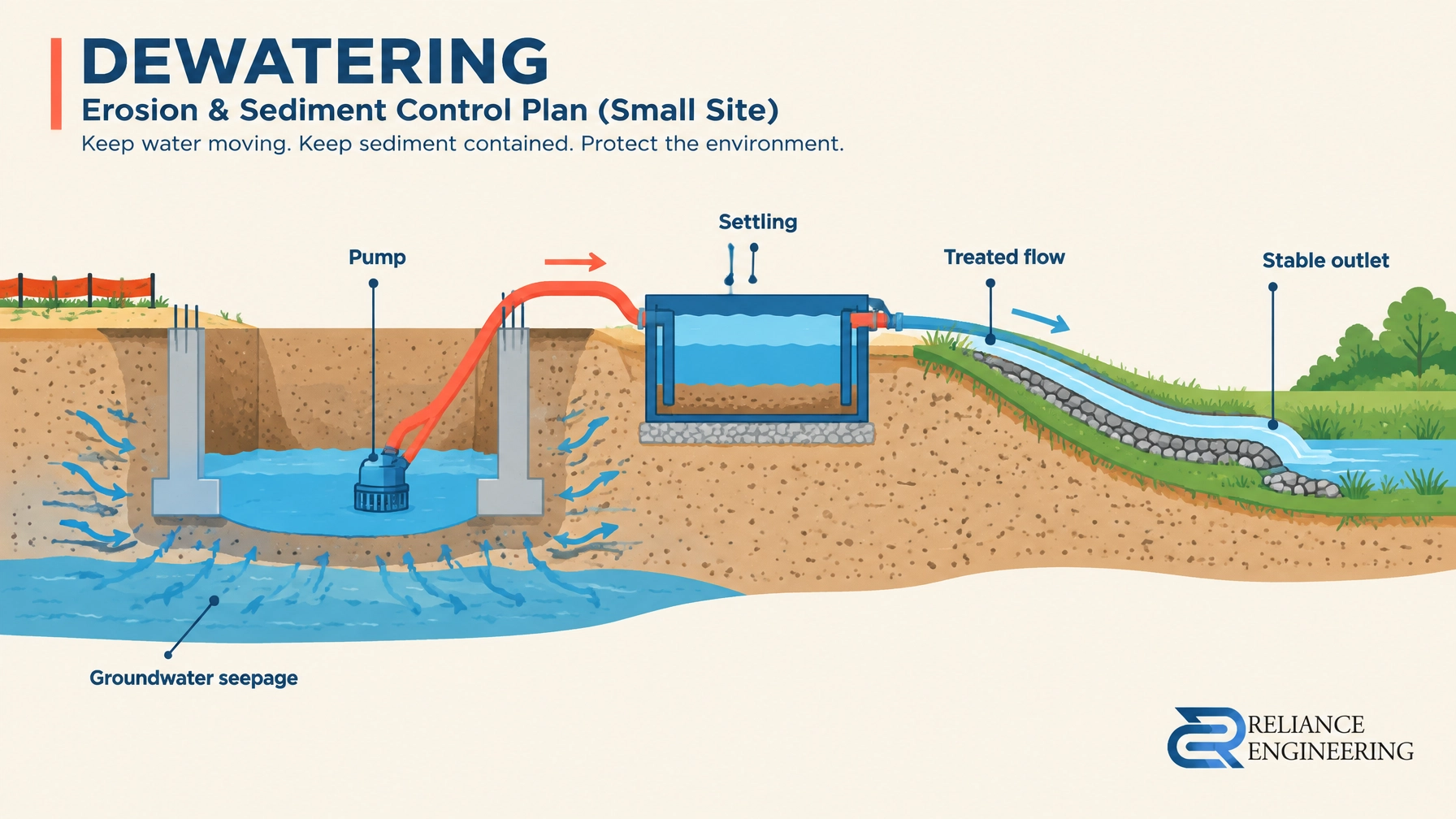
- A separate erosion-control deposit was forgotten: Cambridge’s example requires all applicable works, including right-of-way work, to pass before release.
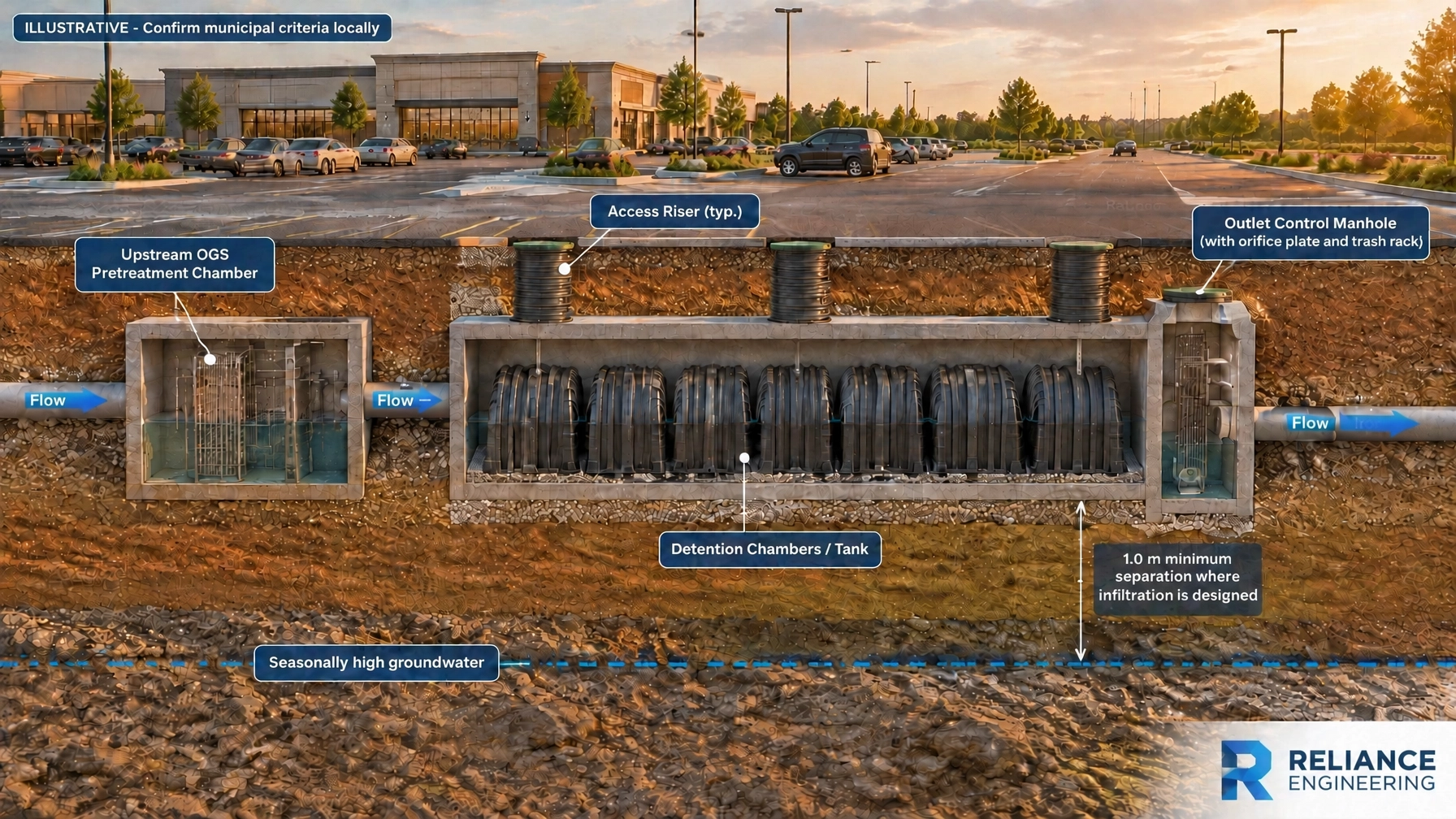
- Long-term obligations were missed: Waterloo’s example agreement requires ongoing on-site stormwater management system maintenance and gives the City perpetual inspection access to roof drains, inlet control devices and SWM facilities. The stormwater management report and facility design must support a system that can be maintained after construction.
Six-item close-out checklist

- Scope as-recorded drawings and track field changes during construction.
- Name the Consulting Engineer responsible for certifications and coordination.
- Map completion certificates to the work categories in the agreement.
- Track erosion-control deposits separately from other securities.
- Plan the written request and inspection steps that start the maintenance period.
- Check the municipality’s inspection season and schedule before construction close-out.
What your civil engineer can manage
A civil engineer can track field changes against approved drawings, prepare as-recorded drawings, certify servicing works and grading compliance, and coordinate the Landscape Architect’s certificate. The engineer can also assemble the agreement and required forms for an inspection request, address deficiencies, arrange re-certification and plan around local inspection availability.
That work starts with coordinated, buildable design. Reliance Engineering prepares site servicing plans, stormwater management reports in Ontario and a functional servicing report to support municipal approvals and construction. A site’s stormwater facilities and grading must be practical to build and maintain, not only ready for review.
Five key takeaways
- Site plan approval and building permit issuance do not automatically release civil securities.
- The executed agreement, not another municipality’s example, sets your project’s requirements.
- Certificates and as-recorded drawings are release triggers, so assign responsibility early.
- Maintenance periods may require a formal request, inspection and deficiency clearance to begin.
- Budget for separate deposits, inspections, maintenance obligations and seasonal timing.
Request a close-out consultation
Reliance Engineering provides clean layouts, coordinated design, constructible routing, clear calculations and practical controls, and supports clients through civil close-out so security-release requirements are addressed. We bring municipal experience across Ontario.
Contact Reliance Engineering for a consultation to discuss your site plan agreement, close-out deliverables or upcoming inspection.
Professional credentials and contact
Naresh Ochani, P.Eng. M.Eng.
Principal Engineer, Reliance Engineering Canada Limited
PEO Certificate of Authorization: 100548882
Address: 6850 Millcreek Dr, Mississauga, ON L5N 2H4
Phone: 647-385-6418
Email: [email protected]
Office hours: Monday–Friday 9:00 AM–5:00 PM; Saturday 12:00 PM–2:00 PM; Sunday Closed.