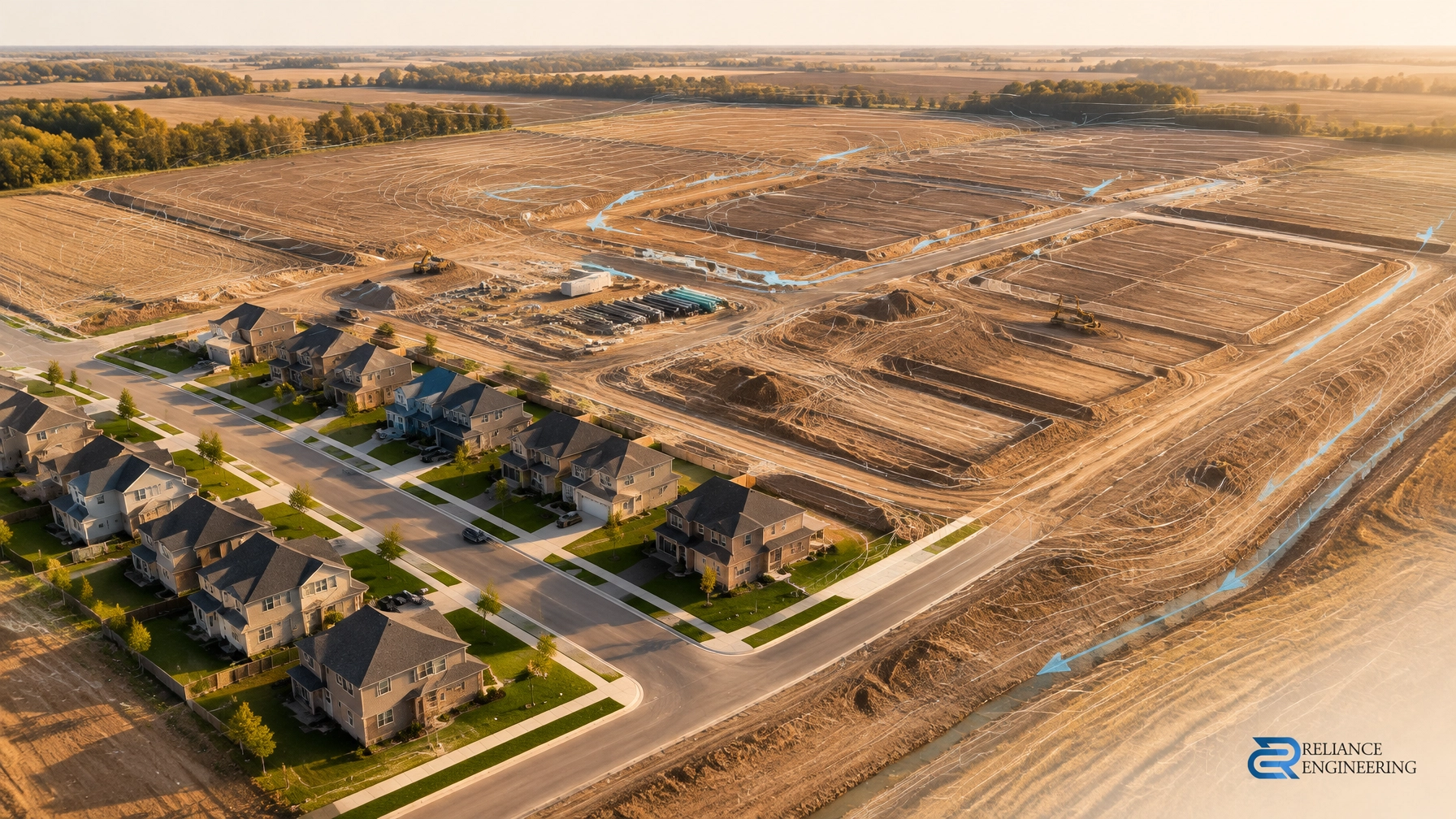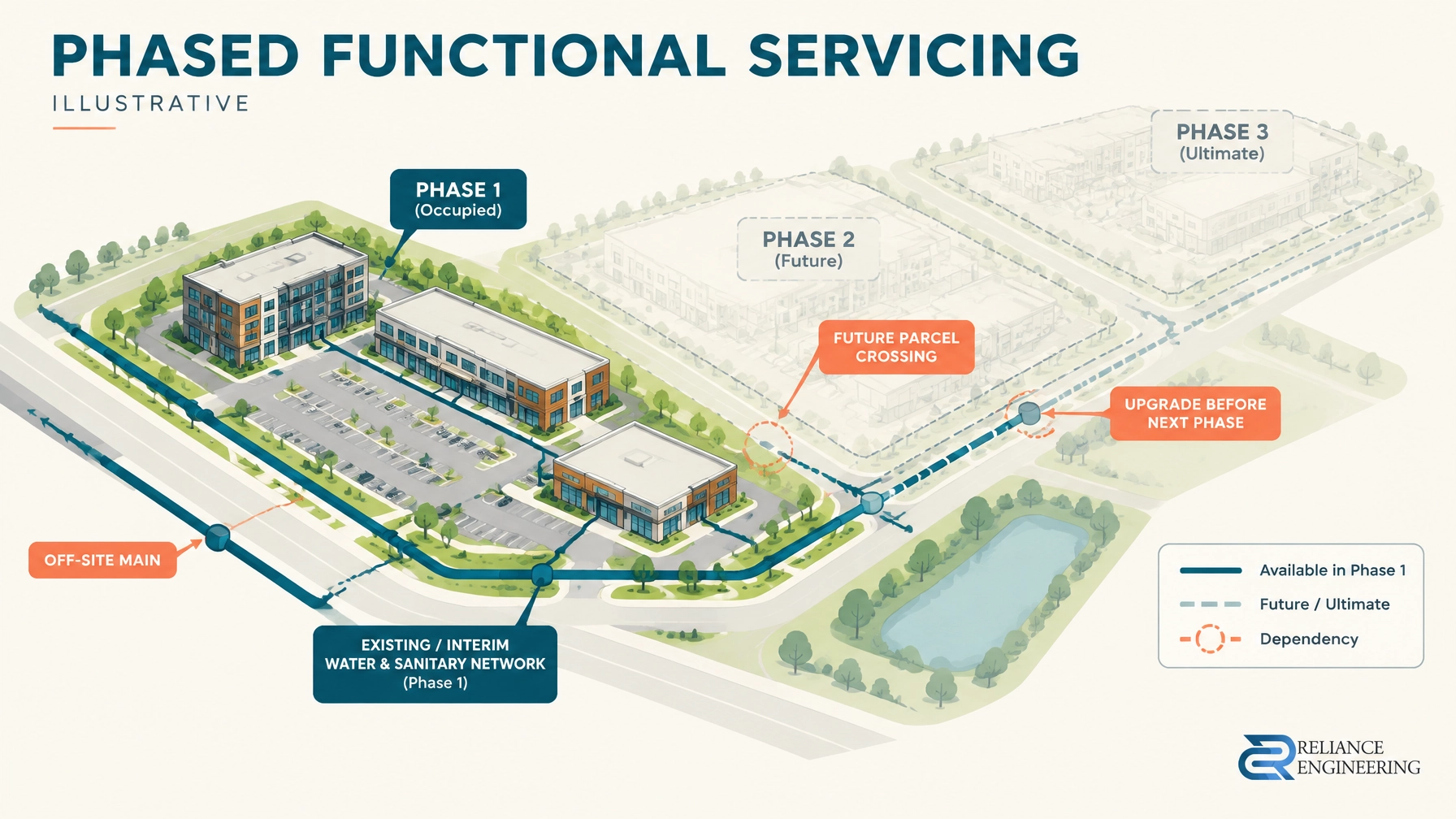
An approval may be based on the ultimate development condition, but the first occupied building must function with the infrastructure actually available when it opens. A master plan can show that the finished site is serviceable and still leave Phase 1 without a workable water supply or sanitary outlet. The functional servicing report (FSR) must explain how each occupied phase will operate along the way.
Article type: Practitioner guide | Focus: Phased functional servicing reports | Reading time: ~7 minutes
Development phasing and construction sequencing are different
Development phasing identifies which portions of a site will be built and occupied over time. Construction sequencing describes how work proceeds within or between those portions. The two interact, but they are not interchangeable.
For example, a first building may need a permanent sanitary outlet before a second parcel is developed. That could require installing part of the ultimate sewer through the future parcel early. The FSR should identify this dependency and show why Phase 1 relies on that infrastructure. Detailed design and approvals determine how the work is authorized and constructed.

What the FSR should establish for every phase
The report should define each phase as an operating condition, not just a line on a phasing plan. For every phase, identify the units, floor areas and uses, along with the servicing limits and infrastructure available at that point.
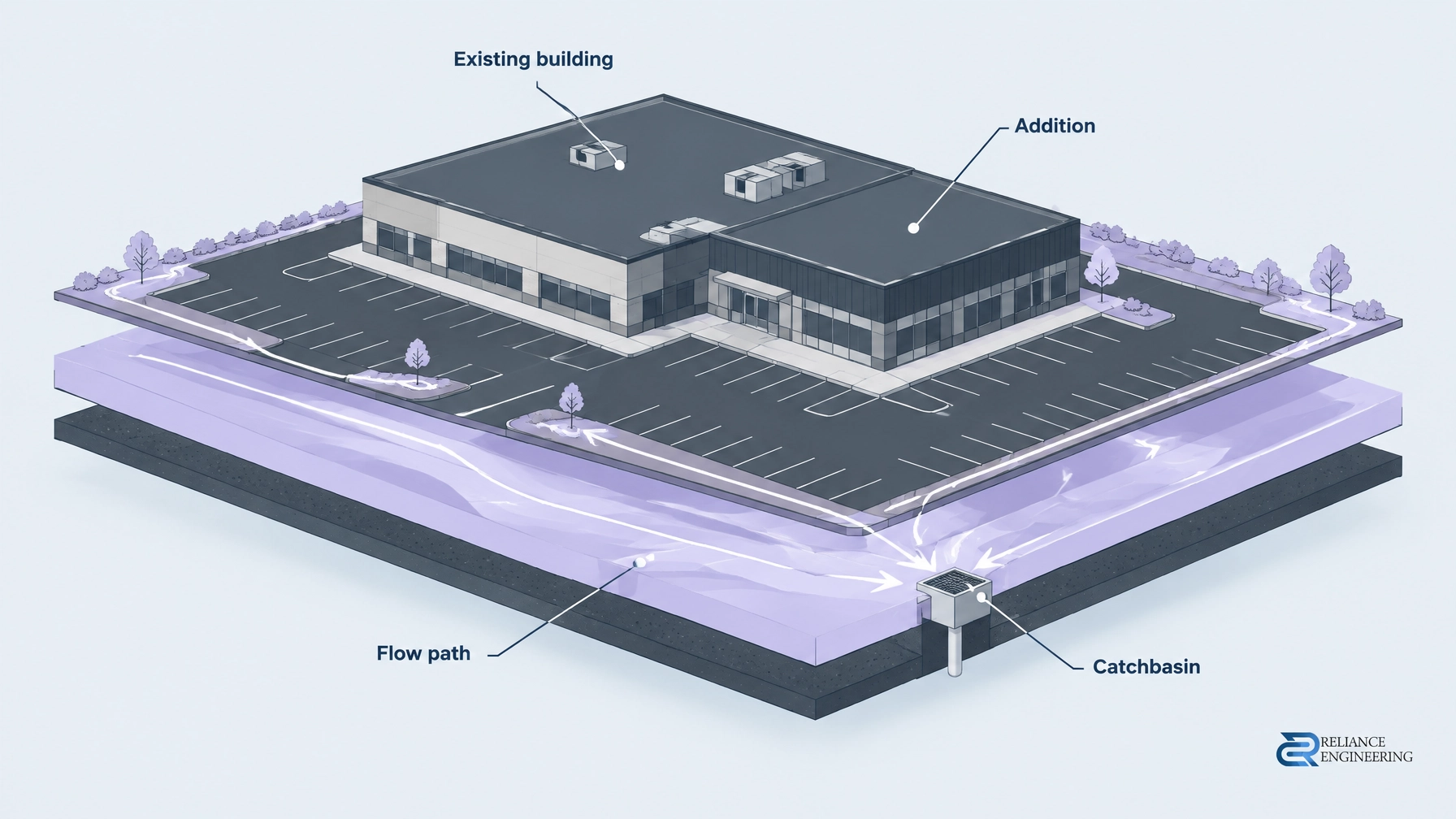
Account for existing buildings that remain in operation during redevelopment. Do not count a use that will be demolished as though it continues to generate demand, and do not omit a retained building that still needs service.
Use the same phase names on the site plan, servicing plans, calculations and report. A short phase register can connect labels across documents and help reviewers trace each condition. Record the issue date of development statistics too: a stale unit count may cause the FSR to describe an application that has already changed.

Interim and ultimate servicing mean different conditions
Interim servicing supports a defined temporary condition. Ultimate servicing supports the planned final condition. Neither term, by itself, confirms capacity allocation, approval, or permission to connect or occupy.
State what changes between the conditions. For example, an interim connection may later be removed; a permanent main may gain another connection; or a servicing catchment may expand as later phases proceed. Explain when the change is expected to be needed and how the transition will be managed.
Municipal examples show why project-specific phasing belongs in the servicing analysis. The City of Toronto Servicing Report Terms of Reference (effective June 2, 2025) includes proposed development phasing in its watermain and sanitary analyses. Toronto’s stormwater requirements also address interim conditions for phased Site Plan Control and Plan of Subdivision applications. These are Toronto requirements; confirm scope locally.
Markham’s Engineering Report Submission Outlines, Annex 2 includes proposed development phasing in the FSR introduction. The York Region FSR Terms of Reference, developed jointly with York municipalities, calls for a Phasing Plan where required, describing phases and reasons such as servicing availability or financial constraints, and showing associated existing and proposed water, wastewater and stormwater infrastructure.
The Town of Innisfil FSR Terms of Reference, effective December 1, 2025, states that a phased development requires an FSR for the entire site and for each individual phase. It also states that the FSR remains valid for three years from publication. The City of Windsor FSR Terms of Reference calls for the report to identify service timing, interim measures and how they will be decommissioned or modified, as well as cost-sharing responsibilities.
A favourable servicing conclusion is not a connection approval, construction authorization or occupancy permission. Those permissions and conditions are separate steps and vary by municipality.
Water servicing: test the network that exists in each phase
Phase 1 may have fewer users than build-out but a less connected network. A future loop shown on the ultimate plan cannot be assumed to operate in Phase 1 unless it will actually be available then.
Show the active mains and connections for each condition. Identify dependencies on off-site work, another parcel or a municipal project. Check early-phase operating conditions, including water turnover and incomplete looping, alongside demand and pressure. Keep domestic demand distinct from fire flow, combining them only where the adopted analysis method requires it.
Coordinate the FSR’s findings with clear, coordinated site servicing plans that show constructible routing and the connections planned for each stage.
Sanitary servicing: show the Phase 1 outlet and cumulative condition
An ultimate site flow alone does not explain how the first phase will discharge. Identify the actual Phase 1 connection and the downstream works available when it operates.
Keep flow assumptions consistent across phases. Do not apply a final-site allowance to one phase without justification. A schedule can show retained flow, each phase’s increment and the cumulative condition. Peak-flow methods may not be simply additive; apply the accepted method to the correct combined condition.
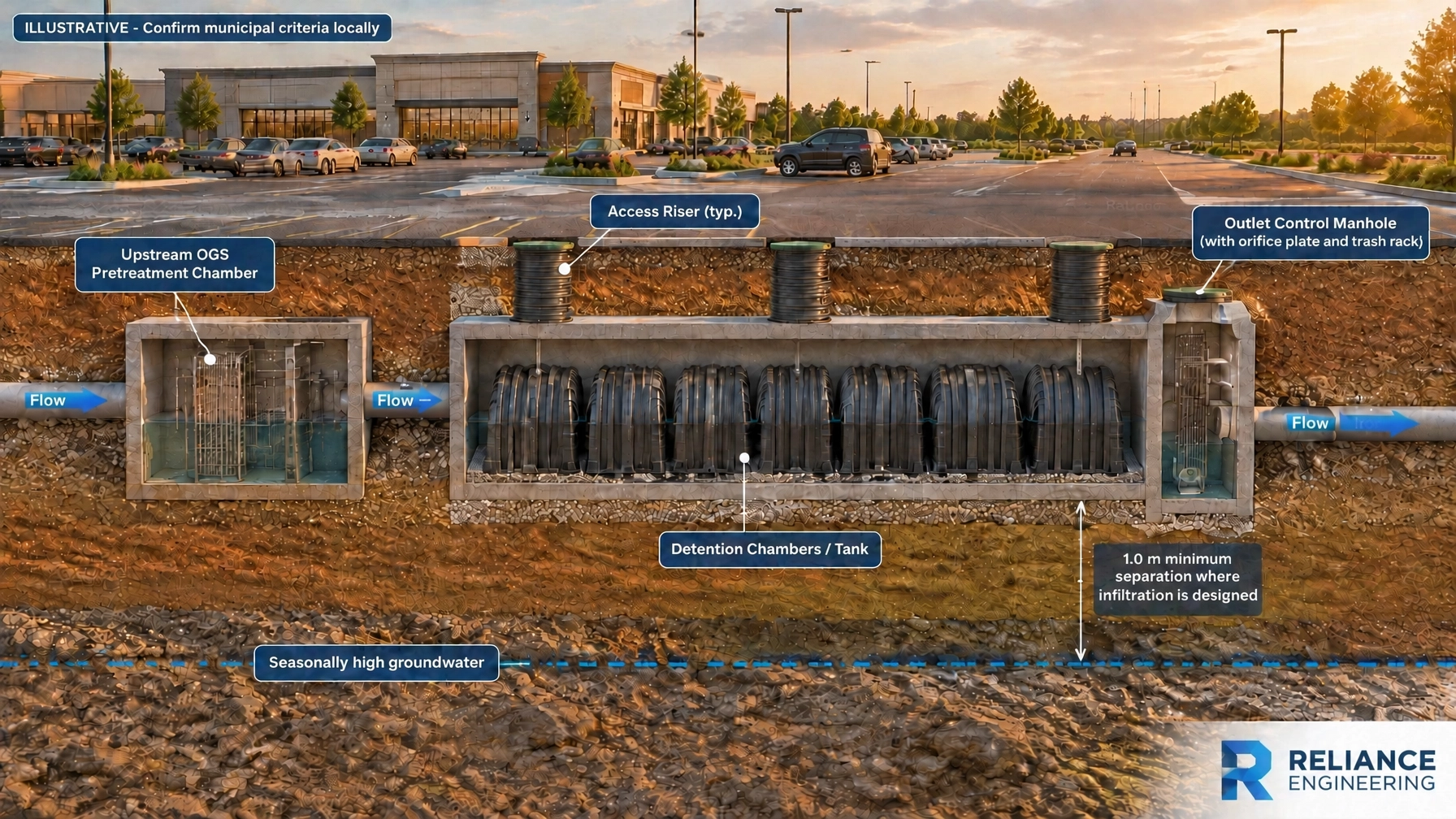
Temporary pumping or storage should not be treated as a default solution. It raises questions of reliability, operation, ownership and municipal acceptance that need to be addressed with the relevant authorities.
Storm servicing: identify each phase’s drainage condition
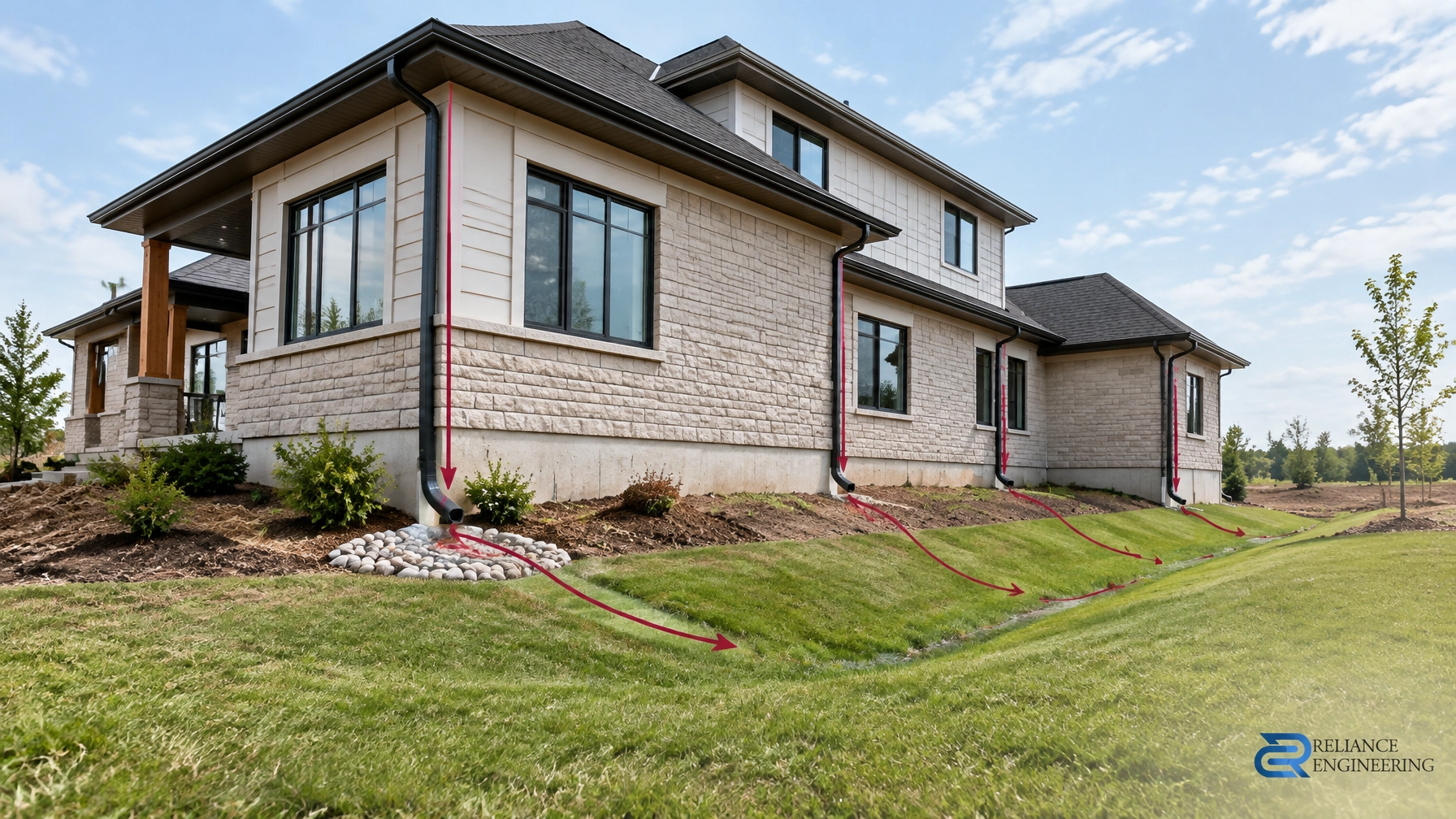
Keep this section focused on the FSR’s phase-specific servicing picture; detailed phased stormwater-control design is a separate scope. Map contributing areas for each condition, including retained surfaces, new roofs and pavement, and disturbed land. An overland route through a future parcel is only a workable assumption while that land remains available and suitably graded.
Coordinate the servicing strategy with the stormwater management report and site grading plan. Their assumptions and clean layouts should align with the FSR’s phase boundaries.

Dependencies and transitions need owners
Tie each FSR conclusion to a decision or deliverable: capacity confirmation, an accepted connection route, or completion of a related infrastructure component. Record the evidence required, the responsible party and the affected phase. Do not promise delivery dates controlled by another party.
Plan transitions as well as initial connections. Commissioning a new main, redirecting drainage or replacing a temporary outlet must not interrupt occupied uses. State what must be operating before a phase moves to its next servicing condition.
Common FSR failure modes
- Treating the ultimate network as available in Phase 1.
- Using different phase names on plans and in calculations.
- Applying the final-site sanitary allowance to a single phase without explanation.
- Omitting a retained building from demand calculations.
- Relying on an overland route through land that will be built on first.
- Leaving an interim connection in place without a decommissioning plan.
- Confirming capacity for build-out but not for the first operating condition.
Six-item pre-submission checklist
- Do phase limits, uses, unit counts and floor areas match across the report, plans and calculations?
- Are retained buildings and their demands included in the correct phases?
- Does each phase show the water mains, connections and operating conditions actually available?
- Does each phase show its sanitary outlet, downstream works and cumulative flows?
- Are phase-specific drainage areas, routes and available stormwater measures identified?
- Are dependencies, required evidence, responsible parties and transition steps stated without assuming unconfirmed delivery dates?
Five key takeaways
- Assess each occupied phase as a real operating condition.
- Keep development phasing distinct from construction sequencing.
- Distinguish interim servicing from the ultimate network and from permission to connect or occupy.
- Coordinate phase names, statistics, calculations and drawings.
- Identify dependencies and safe transitions before the first phase opens.
Request a consultation
A clear functional servicing report connects the ultimate concept to practical, phase-by-phase infrastructure decisions. Reliance Engineering prepares coordinated FSRs and municipal approval support across Ontario. Request a consultation to discuss your project.
Naresh Ochani, P.Eng. M.Eng., Principal Engineer, Reliance Engineering Canada Limited
PEO Certificate of Authorization: 100548882
Reliance Engineering, 6850 Millcreek Dr, Mississauga, ON L5N 2H4
Phone: 647-385-6418
Email: [email protected]
Hours: Monday–Friday 9:00 AM–5:00 PM; Saturday 12:00 PM–2:00 PM; Sunday Closed.