In Ontario’s land development sector, time is the most expensive commodity. A rejected site servicing plan doesn't just mean a few hours of extra drafting; it means stalled construction schedules, missed financing milestones, and strained relationships with municipalities.
At Reliance Engineering, we see projects across Ontario delayed by avoidable technical errors. The path to a building permit is narrow. If your submission doesn't meet exact municipal standards, it will be returned.
Here are the 10 most common reasons for rejection and the professional steps required to fix them.
1. Incorrect Scale and Paper Size
This is the most frequent cause for immediate rejection at the intake counter.
Municipal reviewers use architectural scales to verify setbacks, pipe lengths, and separation distances. If a plan is drawn at 1:250 but printed on a sheet that forces the scale to 1:263, the entire document is technically useless.
The Fix:
Always specify the intended paper size (e.g., A1 or Arch D) on the title block. Ensure your PDF export settings are set to "Actual Size" rather than "Fit to Page." Double-check the bar scale on the printed physical copy before submission.
2. Inaccurate Property Boundaries
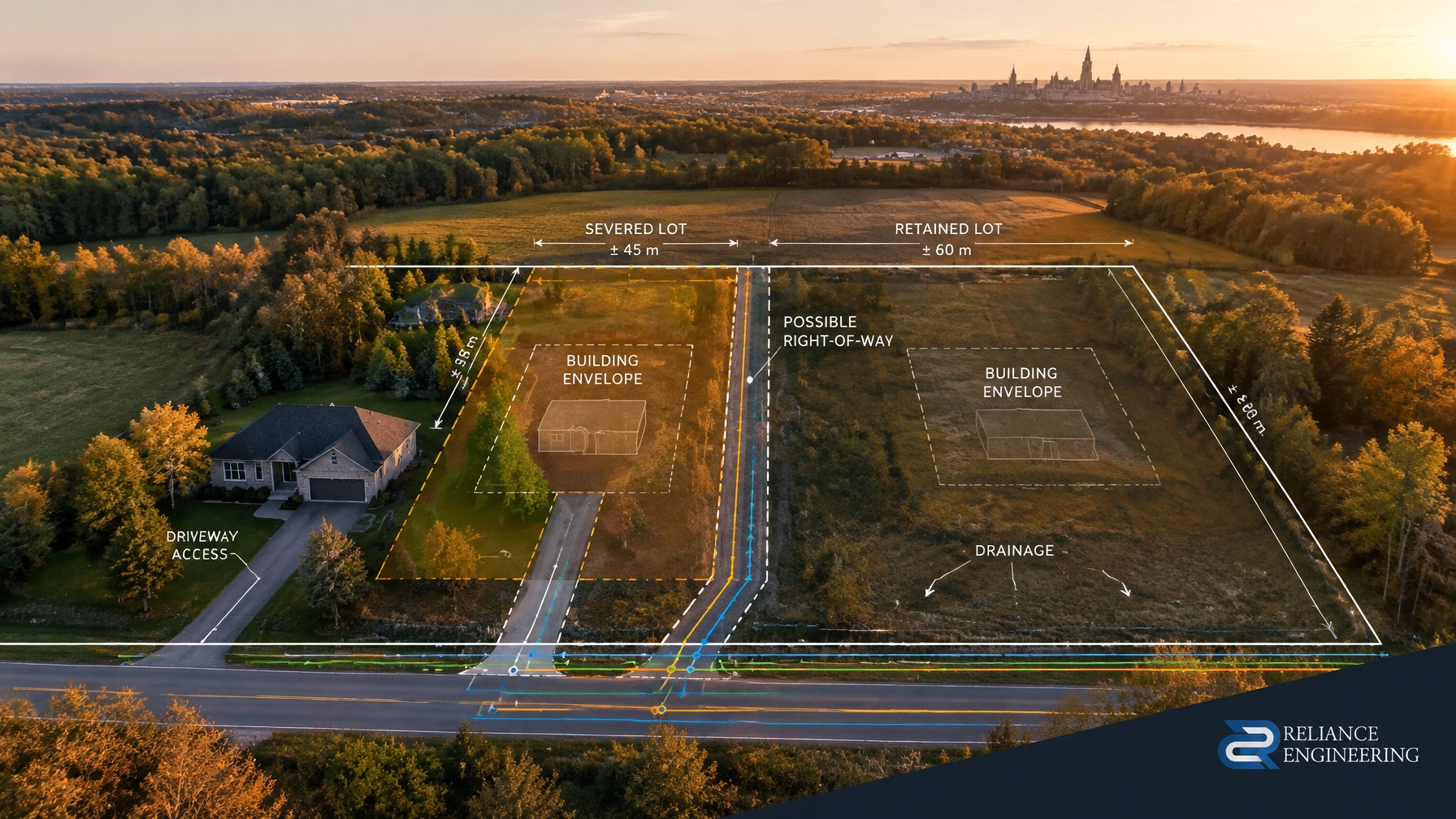
A site servicing plan built on an outdated or approximated survey is a liability. If your boundary lines do not match the most recent registered Plan of Survey, your utility connections and setbacks will be mathematically incorrect.
The Fix:
Coordinate closely with an Ontario Land Surveyor (OLS). Ensure the civil engineering team has the latest CAD files of the legal survey. All property lines, bearings, and corner pins must be clearly labeled and consistent with the architectural site plan.

3. Discrepancies Between the Plan and the FSR
The Functional Servicing Report (FSR) provides the theoretical data, while the site servicing plan provides the physical layout. If the FSR claims a 200mm sanitary connection is required, but the plan shows a 150mm pipe, the reviewer will flag the inconsistency.
The Fix:
Audit your submission package. The pipe diameters, slopes, and flow rates mentioned in your sanitary sewer design must align perfectly with the labels on your servicing drawings. Consistency is the hallmark of a professional submission.
4. Failure to Show Existing Infrastructure
You cannot design in a vacuum. Municipalities require a clear picture of what is already underground. Missing catch basins, existing water valves, or neighboring service laterals can lead to design conflicts during construction.
The Fix:
Request the "As-Built" drawings from the municipality and conduct a thorough topographic survey. Ensure all existing utilities: including hydro, gas, and telecommunications: are shown in a screened (greyed out) format to provide context for the new proposed services.
5. Violating Minimum Separation Distances
Ontario’s Building Code and municipal standards mandate strict horizontal and vertical separation between watermains and sewers. These "clearance" rules prevent cross-contamination.
The Fix:
Maintain the standard 2.5m to 3.0m horizontal separation between water and sewer lines wherever possible. If crossing is necessary, ensure vertical clearances meet the specific standards of the local municipality (often 0.5m). Refer to our water distribution design guidelines for technical specifics.

6. Ignoring Municipal Standard Drawings
Each municipality: from Mississauga to Ottawa: has its own set of "Standard Drawings." These dictate exactly how a curb cut, a catch basin, or a water meter chamber should be constructed. Using a generic detail when a city-specific detail is required is an automatic rejection.
The Fix:
Identify the specific OPSD (Ontario Provincial Standard Drawings) or municipal standards required for your project location. Explicitly reference these drawing numbers in your plan’s detail section. Reliance Engineering maintains a database of these standards to ensure compliance across Ontario.
7. Encroachment into Easements
Utility easements are protected areas. Placing a new fire hydrant, a retaining wall, or a significant service pipe within a third-party easement (like hydro or gas) without prior written consent will lead to a project freeze.
The Fix:
Verify all easements on the property title. If your site grading plan or servicing plan requires work within an easement, start the encroachment agreement process early. Do not wait for the city reviewer to find it.

8. Inadequate Stormwater Management Details
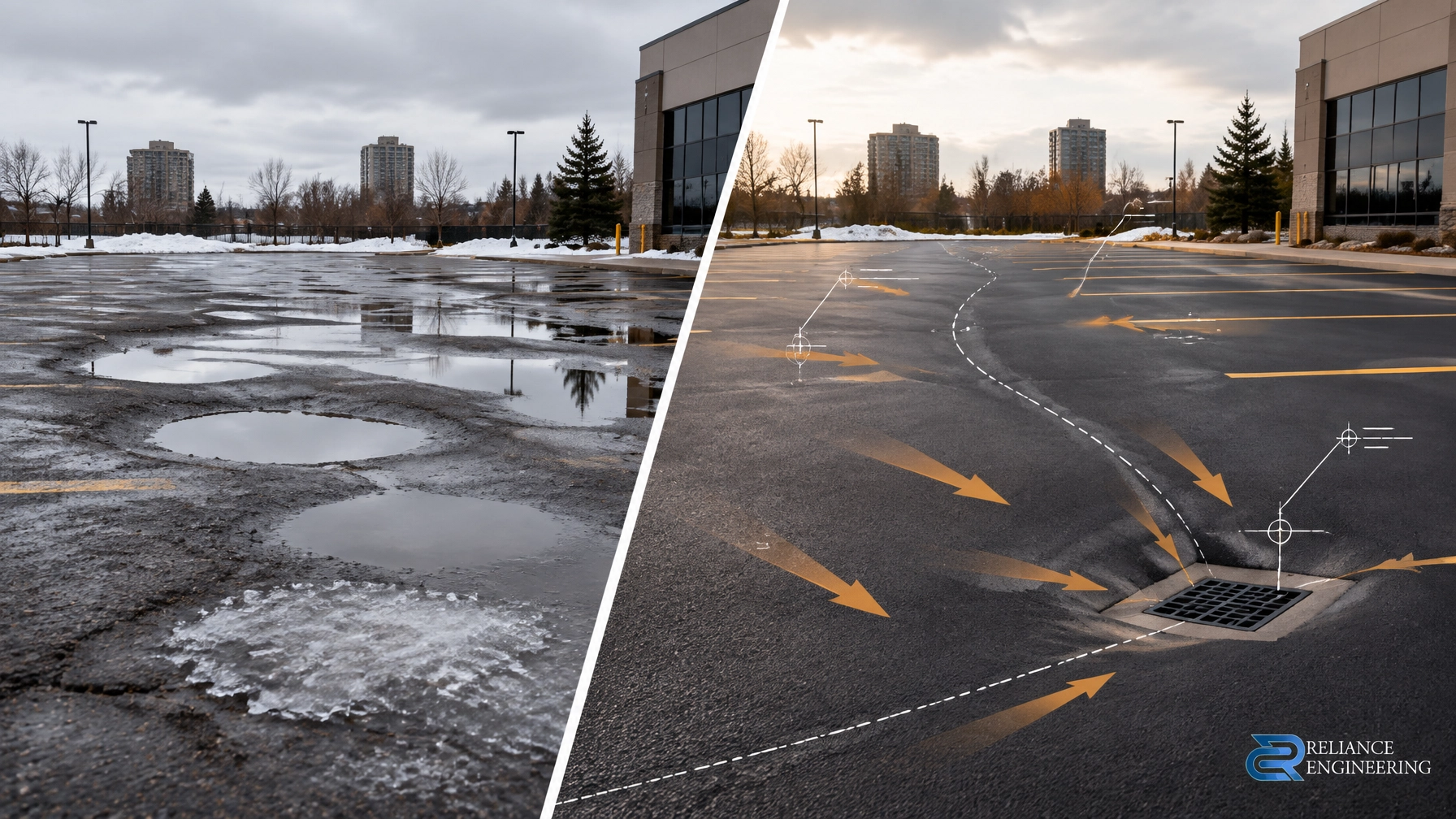
With the increasing frequency of extreme weather, stormwater management is under heavy scrutiny. If your plan lacks details on orifice plates, ponding depths, or emergency overflow routes, it will not pass.
The Fix:
Provide a detailed storm system design that includes a summary table of pre-development vs. post-development flows. Ensure the location and specifications of all "Quality" and "Quantity" control structures are clearly identified on the plan.
9. Poor Readability and Clutter
A cluttered plan is an unreadable plan. If the reviewer cannot distinguish between a proposed watermain and an existing gas line because the line weights are identical or the labels overlap, they will reject the drawing.
The Fix:
Utilize standard CAD layering and line-weighting protocols. Use callouts for crowded areas and provide "Detail Views" at a larger scale for complex junctions. Professional presentation reflects professional engineering.
10. Missing Professional Credentials
A site servicing plan in Ontario must be signed and sealed by a Licensed Professional Engineer (P.Eng.). Submissions missing a seal, a signature, or the firm’s Certificate of Authorization (C of A) are incomplete and will be rejected before the technical review even begins.
The Fix:
Ensure all final submission sets are digitally or physically sealed by the responsible engineer. At Reliance Engineering, all our plans undergo a final principal review by Naresh Ochani, P.Eng. M.Eng. to ensure every requirement is met.

How to Fix Submission Errors: The Checklist Approach
If you have already received a "Notice of Rejection," do not panic. Follow this professional protocol to get your project back on track:
- Request the Comment Matrix: Most Ontario municipalities provide a redlined PDF or a comment table. Read every single comment: even the ones that seem minor.
- Schedule a Peer Review: Sometimes, a fresh set of eyes can spot the technicality your original designer missed.
- Coordinate a Multi-Disciplinary Meeting: If the rejection involves building footprints or landscaping, ensure your architect and landscape architect are synced with the civil engineer.
- Submit a Formal Response Letter: When you resubmit, include a cover letter that addresses every municipal comment point-by-point. This makes the reviewer's job easier and speeds up the second-round approval.
Professional Civil Engineering Services Across Ontario
Navigating the complexities of construction administration and site approvals requires more than just drafting skills: it requires local expertise and a commitment to precision. Reliance Engineering specializes in turning rejected plans into approved permits.
Whether you are working on a residential development like the 35 Wabash Avenue Townhomes or a complex institutional project like the redevelopment of Etobicoke General Hospital, we provide the technical rigour needed to succeed.
Contact Information
For expert consultation on your site servicing plans or to resolve municipal submission errors, contact our principal office.
Reliance Engineering
Naresh Ochani, P.Eng. M.Eng.
Founder and Principal
Address: 6850 Millcreek Dr, Mississauga, ON L5N 2H4
Phone: 647-385-6418
Email: [email protected]
Website: www.relianceengineering.ca
Operational Hours:
Monday – Friday: 9:00 AM – 5:00 PM
Saturday – Sunday: Closed
Providing comprehensive civil engineering and land development consulting services across Ontario.