Securing a building permit in Ontario is often the most significant hurdle in the land development process. Whether you are working on a residential custom home or a large-scale Industrial, Commercial, and Institutional (ICI) project, a rejection from the municipal building department can lead to months of delays and thousands of dollars in carrying costs.
At Reliance Engineering, with over 20 years of experience navigating the regulatory landscape across Ontario, we have identified the primary reasons why submissions fail. Most rejections are not due to the project concept itself but rather technical deficiencies, missing documentation, or a failure to account for civil engineering requirements like site grading and stormwater management.
Here are the top 10 reasons your building permit drawings are getting rejected and the professional strategies to fix them.
1. Non-Compliance with the Ontario Building Code (OBC)
The Ontario Building Code is a complex, evolving document. Many drawings are rejected because they fail to meet basic safety, fire protection, or structural standards. Common issues include inadequate fire separations, incorrect egress window sizes in basement apartments, or insufficient insulation values.
The Fix: Ensure your designer or engineer is BCIN-qualified (Building Code Identification Number). Professional drawings from an established engineering firm provide the assurance that every element: from HVAC layouts to structural supports: meets current provincial standards.
2. Inadequate Site Grading and Drainage Plans
For many municipalities in Ontario, the building permit is not just about the structure; it is about how that structure interacts with the land. If your grading plan does not demonstrate how water will flow away from the building without impacting neighboring properties, it will be rejected.
Many submissions fail because the proposed grades are too steep or do not align with the master subdivision grading plan.
The Fix: Invest in a professional site grading plan early. Precision is critical to avoid basement flooding and municipal rejections. For more detail, see our guide on how to get your lot grading approved in one submission.

3. Missing Stormwater Management Reports (SWMR)
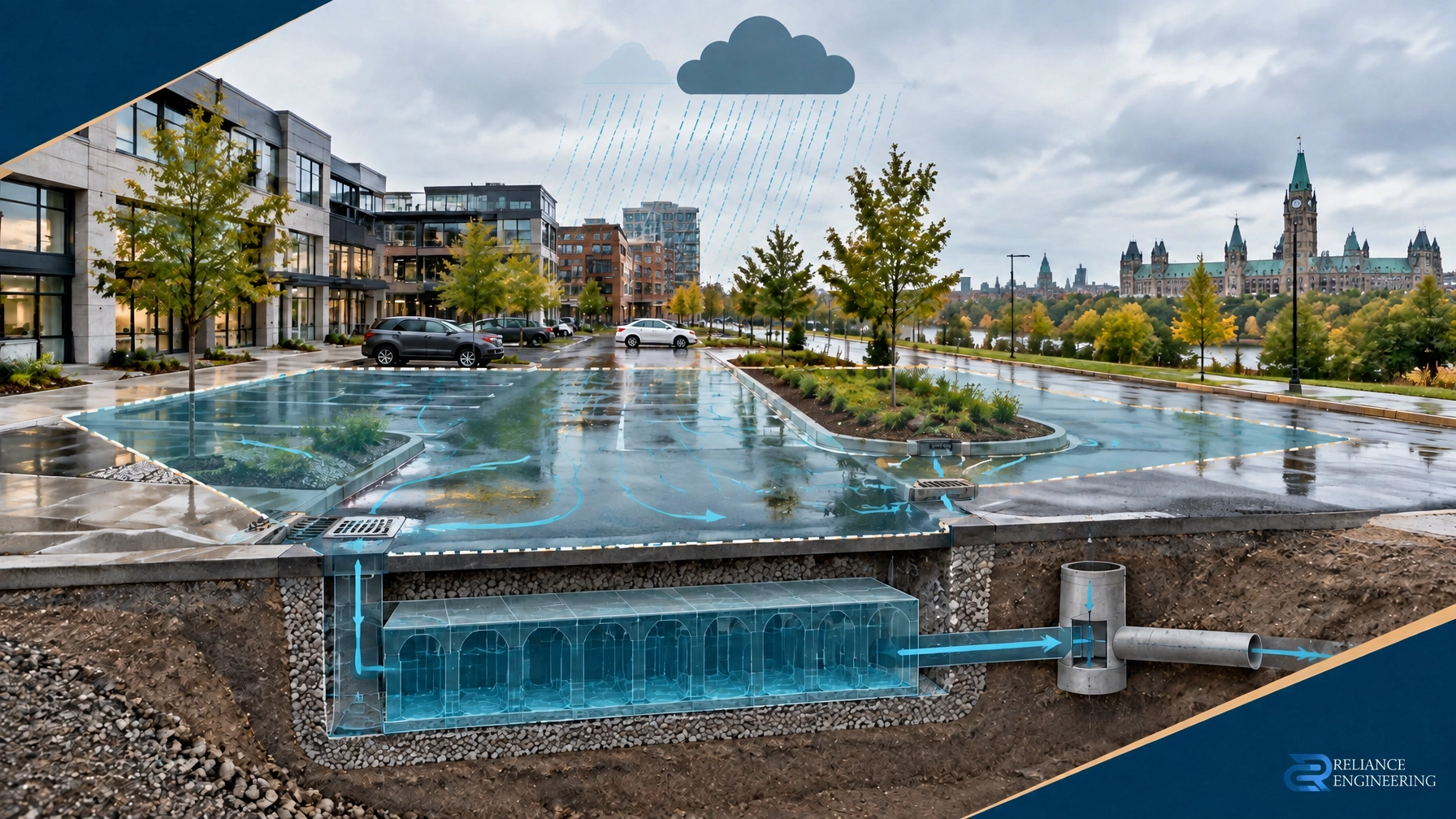
As of 2024 and heading into 2026, Ontario municipalities have significantly tightened regulations regarding stormwater runoff. If your project increases the impervious surface area of a lot (e.g., a larger roof or a new paved driveway), you must prove that the post-development runoff does not exceed pre-development levels.
Vague notes like "drainage to be determined" are no longer acceptable.
The Fix: Provide a detailed Stormwater Management Report (SWMR). This report should outline detention methods, such as dry wells or detention tanks, to manage peak flow rates. We have discussed this extensively in our article on why your SWMR will change the way you get building permits in 2026.
4. Servicing Plan Discrepancies
A common reason for rejection in both residential and ICI projects is a lack of clarity regarding site servicing. Municipalities need to see exactly where your water, sanitary, and storm sewer connections are located. If the pipe sizes are undersized or the slopes are insufficient for gravity flow, the permit will be denied.
The Fix: Your site servicing plan must be coordinated with the internal plumbing drawings. In some cases, a Functional Servicing Report (FSR) is required to prove that the existing municipal infrastructure can handle the new demand.
5. Zoning Bylaw Infringements
Zoning compliance is the foundation of any permit. If your drawings show a building height that exceeds the limit, a setback that is too narrow, or a lot coverage percentage that is too high, the building department cannot issue a permit.
The Fix: Before drafting, perform a thorough zoning review. If your project deviates from the bylaws, you may need a Minor Variance or a Zoning Amendment. Always verify current setbacks and floor space index (FSI) requirements for your specific Ontario municipality.

6. Lack of Erosion and Sediment Control (ESC) Plans
Construction sites can release significant amounts of sediment into municipal sewers and local waterways. Many Ontario building departments now require a formal Erosion and Sediment Control plan as part of the permit package.
The Fix: Include a dedicated ESC plan that shows silt fences, catch basin filters, and construction entrances. This is especially critical if your site is near a conservation authority regulated area. For a deep dive, read 10 reasons your ESC plan got kicked back.
7. Incomplete Functional Servicing Reports (FSR)
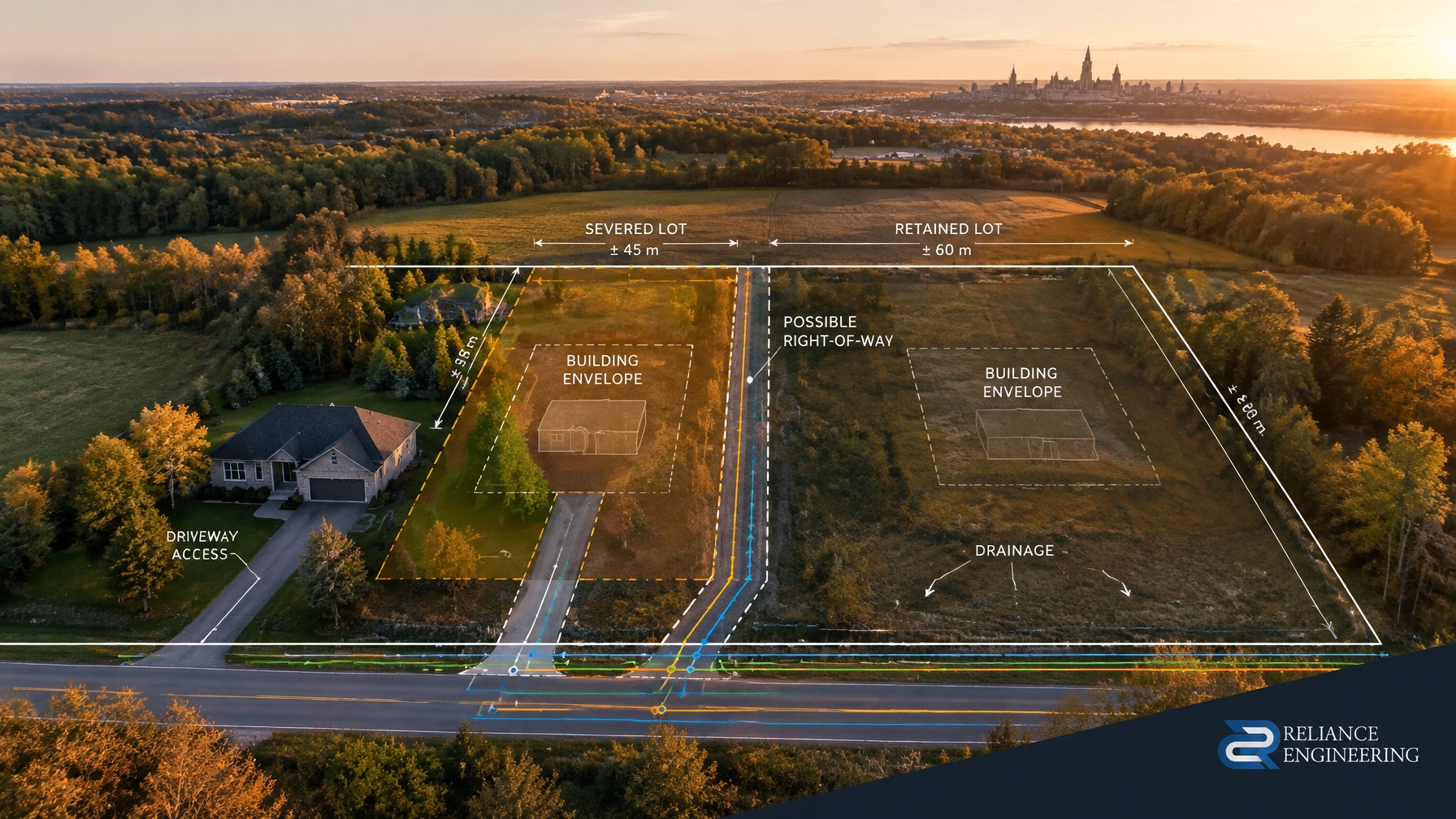
For larger developments or severances, the city often requires an FSR. If the report is missing data on fire flow availability or if it doesn't address the capacity of the local sanitary sewer, the entire submission will be stalled.
The Fix: Work with an engineering firm that specializes in FSRs to ensure all data points required by the municipality are addressed. This is a common bottleneck for Toronto and GTA-based projects. Check out our quick start guide to FSRs to avoid these delays.
8. Failure to Secure Site Plan Approval (SPA)
In many Ontario jurisdictions, a building permit cannot be issued until Site Plan Approval (SPA) has been granted. If you submit building permit drawings while your SPA is still under review, or if your drawings don't match the "Notice of Approval Conditions," you will face an immediate rejection.
The Fix: Ensure complete alignment between your civil engineering drawings (grading, servicing, SWM) and your architectural site plan. Consistency across all consultants is vital. You can find more information in the ultimate guide to the site plan approval process in Ontario.
9. Missing Professional Stamps and Certifications
While homeowners can sometimes draft their own basic drawings, complex projects require professional engineering stamps. If a structural, civil, or mechanical element requires an engineer's review and the stamp is missing or outdated, the application is incomplete.
The Fix: Use a professional firm like Reliance Engineering. Our drawings are stamped by licensed Professional Engineers (P.Eng.), which builds immediate trust with municipal reviewers and speeds up the approval process.
10. Administrative Errors and Missing Documentation
The most frustrating rejections are often the simplest: a missing signature, an outdated survey, or an incomplete application form. Building departments in Ontario process thousands of applications; if the paperwork isn't perfect, they will move on to the next file.
The Fix: Create a submission checklist based on your specific municipality’s requirements. Ensure your property survey is current and that all schedules and designer information forms are signed and dated.

Why Professional Expertise Matters
Navigating the building permit process in Ontario is increasingly technical. A successful submission requires the seamless integration of architectural design, structural integrity, and civil engineering precision.
At Reliance Engineering, we specialize in bridging the gap between your vision and municipal approval. We provide the technical expertise in site grading, servicing, and stormwater management that ensures your permit drawings pass the first time.
Contact Information
If your building permit drawings have been rejected or if you want to ensure your first submission is successful, contact our team of experts today.
Naresh Ochani, P.Eng. M.Eng.
Founder and Principal
Reliance Engineering
Address: 6850 Millcreek Dr, Mississauga, ON L5N 2H4
Phone: 647-385-6418
Email: [email protected]
Website: www.relianceengineering.ca
Operating Hours:
Monday – Friday: 9:00 AM – 5:00 PM
Saturday: Closed
Sunday: Closed