In the competitive world of Ontario land development, stormwater management (SWM) is no longer just a box to check: it’s the backbone of a successful project. Whether you are developing a multi-unit residential complex or a commercial site, how you handle water determines your speed to market, your construction costs, and your reputation with municipal regulators.
At Reliance Engineering, we’ve seen projects stall for months because of poorly planned SWM strategies. We don’t let that happen. With over 20 years of principal experience, we provide precision-engineered Stormwater Management Reports that secure approvals fast.
This guide breaks down everything a developer needs to know about mastering sustainable SWM in the current regulatory environment.
The Regulatory Framework: Why "Good Enough" Doesn't Work
If you are developing land in Ontario, you are operating under the oversight of the Ministry of the Environment, Conservation and Parks (MECP). Under the Ontario Water Resources Act, stormwater is legally classified as "sewage." This means every pipe, pond, and rain garden is part of a "sewage works" system that requires strict adherence to provincial standards.
Most developers in Ontario must navigate two layers of requirements:
- Provincial Criteria: The MECP’s 2003 Stormwater Management Planning and Design Manual remains the baseline.
- Municipal & Conservation Authority Standards: Municipalities (like Toronto, Mississauga, or Vaughan) and Conservation Authorities (like the TRCA or CVC) often impose much stricter targets for volume control and water quality.
Navigating this double-layer of regulation requires a Functional Servicing Report (FSR) that leaves no room for interpretation.

The Three Pillars of Stormwater Management
To get your site plan approved, your Storm System Design must address three critical pillars:
1. Water Quantity (Flood Control)
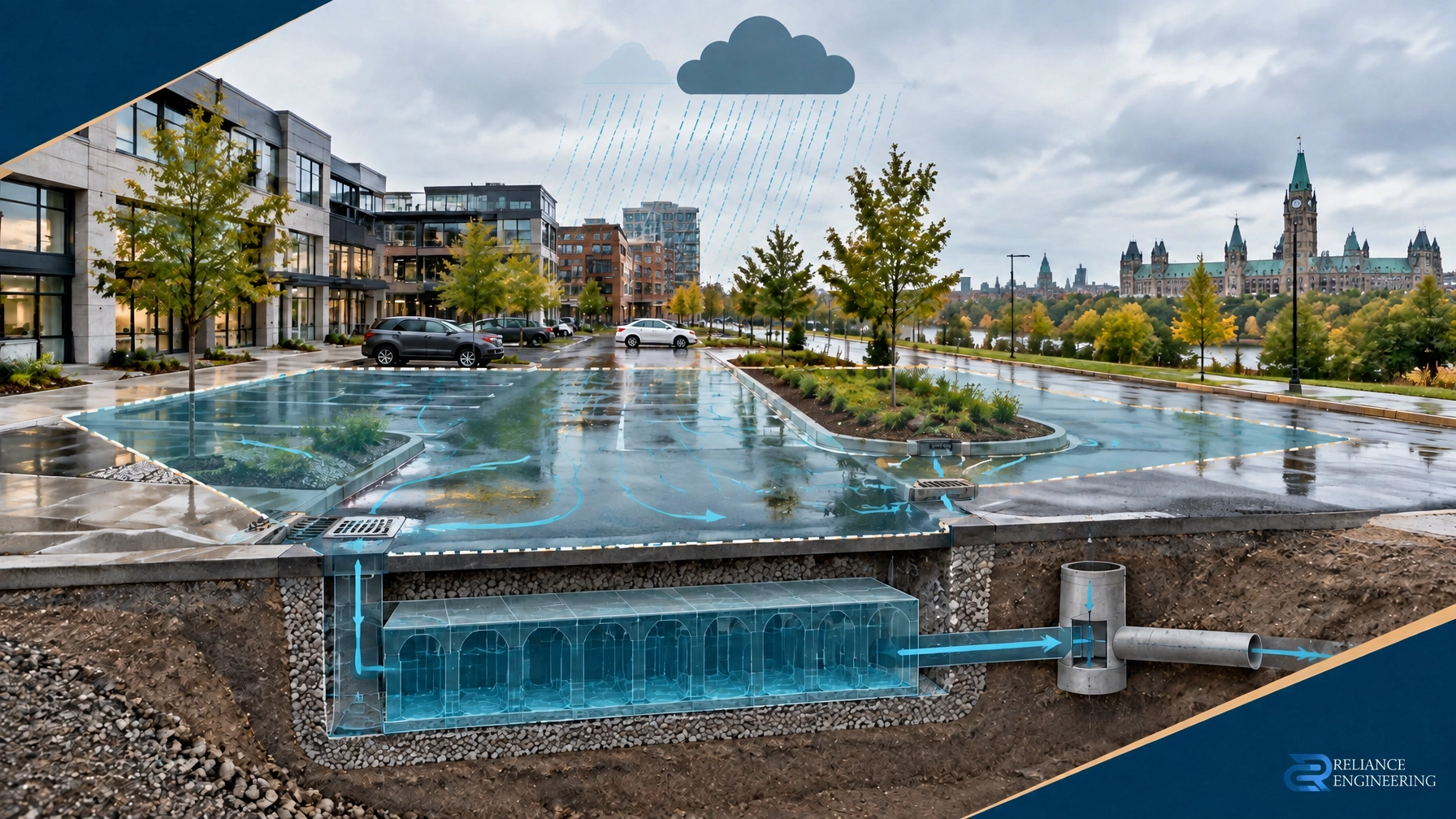
You cannot dump unlimited water into municipal sewers. Most Ontario municipalities require "post-to-pre" development control. This means the peak flow of water leaving your site after construction must be equal to or less than the flow before you touched the dirt. We achieve this through sophisticated detention systems, such as underground storage tanks or rooftops designed for temporary ponding.
2. Water Quality (Pollutant Removal)
Runoff from parking lots and roads carries oils, heavy metals, and sediment. The MECP requires "Enhanced" protection (80% Total Suspended Solids removal) for most sensitive areas. Our Site Servicing Plans integrate Oil-Grit Separators (OGS) and treatment-train approaches to ensure your discharge is clean and compliant.
3. Erosion and Sediment Control (ESC)
Erosion control isn't just for the finished product: it's critical during construction. A single storm event on an unprotected site can lead to heavy municipal fines and stop-work orders. We design robust Erosion and Sediment Control Plans that protect both the environment and your bottom line.

The LID Revolution: Low Impact Development
The "old way" of managing stormwater was to pipe it all into a big, dry pond. In modern Ontario development, land is too valuable for massive ponds, and regulations have shifted toward Low Impact Development (LID).
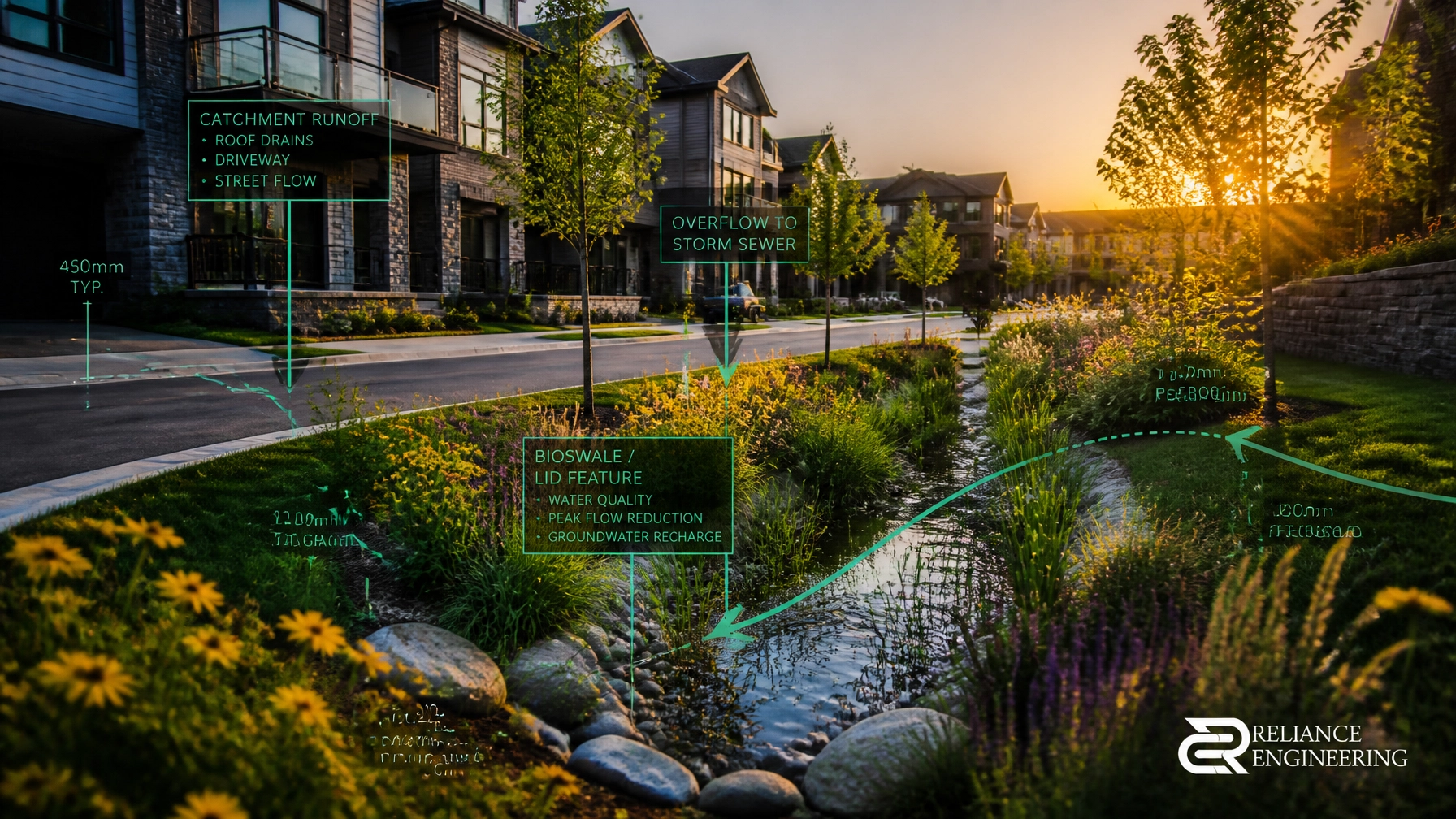
LID is about managing water exactly where it falls. This "Source Control" approach is now a primary requirement in the MECP’s draft LID guidance and municipal standards across Ontario. Key techniques we implement include:
- Bioswales and Rain Gardens: Vegetated channels that slow water down and filter it naturally.
- Permeable Pavement: Allowing water to soak through parking lots into the ground, reducing the need for massive pipes.
- Infiltration Galleries: Underground "soakaway" pits that recharge the local groundwater table.
- Rainwater Harvesting: Collecting water for on-site irrigation, a key win for sustainable branding.
By integrating LID into your Site Grading Plan, you can often reclaim developable land that would otherwise be lost to traditional SWM ponds.

The Secret to Fast Approvals: The "One Submission" Goal
At Reliance Engineering, our USP is simple: We get designs approved in one submission.
How? We don't guess. We know the specific nuances of every municipality across Ontario. We understand that a project in Mississauga has different infiltration requirements than a project in downtown Toronto. We take full ownership of the process, acting as your expert consultant to guide you through the Site Plan Approval (SPA) and Building Permit phases.
Our designs are precise, our reports are comprehensive, and our response time is unmatched. When a municipal reviewer sees a report signed by Naresh Ochani, P.Eng. M.Eng., they know the calculations are sound and the standards have been met.
Practical Checklist for Developers
Before you break ground on your next project in Ontario, ensure your engineering team has addressed the following:
- Pre-Consultation: Have you met with the municipality to confirm the "90th-percentile" rainfall target?
- Water Balance: Does your design account for infiltration and evapotranspiration to mimic pre-development conditions?
- Climate Change Resilience: Are you using the latest IDF (Intensity-Duration-Frequency) curves to account for more intense future storms?
- Operations & Maintenance: Do you have a clear plan for how the LID features will be maintained once the project is handed over?
Take Charge of Your Site's Future
Don't let stormwater be an afterthought that sinks your budget. Partner with an engineering firm that prioritizes your schedule and your project’s viability.

Contact Information
Reliance Engineering
Principal: Naresh Ochani, P.Eng. M.Eng.
Address: 6850 Millcreek Dr, Mississauga, ON L5N 2H4
Phone: 647-385-6418
Email: [email protected]
Website: www.relianceengineering.ca
Office Hours:
- Saturday: 12:00 PM – 2:00 PM
- Sunday: Closed
Authorized by the Association of Professional Engineers of Ontario (PEO) | Certificate of Authorization: 100548882.