Ontario Land Development | Updated October 24, 2026
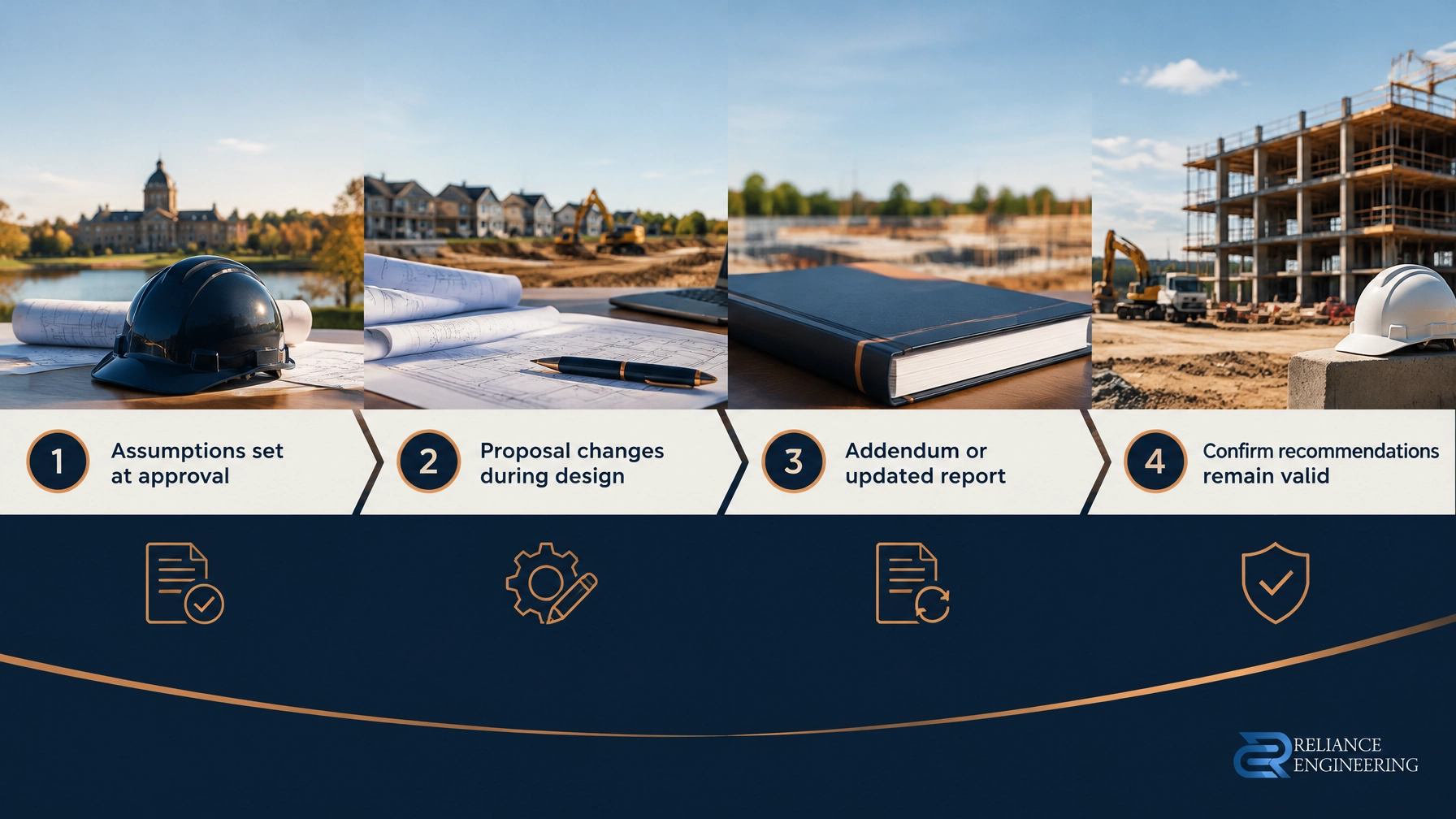
A Functional Servicing Report (FSR) is not a one-time ticket to construction. Its conclusions depend on specific assumptions: development statistics, design criteria, servicing boundary conditions, phasing and conformity with applicable master plans. Those assumptions can change between application approval and detailed design.
If the proposal or its servicing context changes, the approved FSR may no longer describe the project being built. The municipality may then require an updated report, an addendum or further analysis. Requirements vary by municipality; there is no single change threshold that applies across Ontario.
What the FSR establishes at approval
An FSR assesses whether a proposed development can be serviced and identifies infrastructure needs. Depending on the proposal and municipal terms of reference, it may establish:
- Water demand, including domestic demand and fire-flow requirements.
- Sanitary flow generation and capacity considerations.
- Storm drainage areas, preliminary stormwater management (SWM) concepts and applicable criteria.
- A proposed connection strategy and servicing routes.
- Development phasing, construction staging and potential infrastructure upgrades.
These conclusions inform municipal approvals and later design. York Region’s FSR Terms of Reference identifies development statistics such as unit count, site area, height and phasing as part of describing the proposal. Hamilton’s Functional Servicing Report guidelines also address infrastructure capacity, boundary conditions, downstream impacts, phasing and staging.
An FSR should coordinate with site servicing plans, grading, stormwater management reports and the approved development concept. Clean layouts, clear calculations and constructible routing help carry the servicing strategy from planning into detailed design.
Revision triggers that warrant reassessment
A change does not automatically require a full report in every municipality. It does mean the project team should check whether the approved analysis still applies and ask the municipality what documentation it expects.

1. Unit count, density or land use changes
A change to the number of units, development type, density or building height can affect water, fire-flow and sanitary-demand calculations. A revised rezoning condition or a shift in the scope of an Official Plan Amendment (OPA) or Zoning By-law Amendment (ZBA) can also change the proposal assessed in the FSR.
Revisit demand calculations and capacity conclusions when the approved or proposed development statistics change.
2. Building footprint, site layout or drainage changes
A revised footprint or site plan may move connection points, change servicing routes or alter grading and drainage areas. The SWM concept may no longer fit the revised site, even if the overall land use remains similar.
Check whether the revised layout still supports coordinated design, practical controls and buildable grading.
3. Phasing or construction staging changes
The approved FSR may rely on a particular sequence of development or infrastructure upgrades. If construction stages change, confirm that servicing is available when each phase needs it and that temporary arrangements remain workable. Waterloo’s FSR terms of reference specifically list proposed phasing, development strategy and construction staging as report components.
4. Boundary conditions or capacity inputs change
Hydraulic results and capacity conclusions rely on the inputs agreed for the analysis. Those inputs may need to be revisited between application review and detailed design. Hamilton’s guidelines call for a pre-submission meeting to discuss boundary conditions and the limits of downstream capacity analysis. The City also expects the FSR to demonstrate that downstream water, sanitary and stormwater systems are not pushed beyond its design criteria.
Confirm with the municipality whether the original boundary conditions and capacity assumptions remain current.
5. Legislation, criteria or master plans are updated
A change in legislation, municipal criteria, a master servicing plan or a Master Environmental Servicing Plan (MESP) may affect the basis of the original recommendations. The City of Waterloo’s FSR Terms of Reference, Note 5, expressly allows the City to request an updated study or addendum when proposal changes or legislative changes warrant further planning analysis.
6. Conservation Authority limits require confirmation
If the applicable Conservation Authority regulation limit or related site constraints change, the FSR and associated drawings may need review. Hamilton’s FSR checklist, item 27, asks whether the regulation limit has been confirmed with the Conservation Authority.

How an update is delivered
The municipality determines what level of update is appropriate. It may request a revised FSR, a focused addendum or a letter from the original author. York Region’s terms say a revised proposal should be reflected in an updated report or a letter from the author explaining the changes and whether the recommendations and conclusions remain the same, depending on the extent of the revisions. The City of Barrie’s 2026 FSR Terms of Reference contains similar direction.
An addendum is most useful when it clearly identifies the revisions assessed, updates relevant calculations and drawings, and states whether the original conclusions still apply. A short letter should not leave the reviewer guessing which assumptions were checked.
There may also be additional review. Waterloo Note 6 allows the City to require a peer review at the applicant’s cost. Note 3 says the City may request an FSR at a later stage, even if it was not requested earlier. Its Note 1 warns that an incomplete or insufficient report may result in an application being deemed incomplete and returned. Hamilton’s guidance likewise stresses complete supporting information. Confirm requirements with the municipality; an earlier approval does not guarantee that a later submission will be accepted unchanged.
What reviewers test in an addendum
A reviewer will typically want to know whether the report still reflects the project and the current servicing context. Depending on the municipal scope, that may include whether:
- Water, fire-flow and sanitary demand calculations match the revised development statistics.
- The connection strategy and servicing routes still fit the site and municipal infrastructure.
- The SWM summary, drainage areas and controls still match the revised layout and criteria.
- Downstream infrastructure remains within applicable municipal design criteria.
- Phasing, upgrades and master-plan conformity still support the proposal.
These are not universal tests or thresholds. The municipality’s terms of reference and project-specific direction determine the required analysis.
Developer’s practical addendum checklist
Before construction or the next submission:
- Compare every design revision with the proposal assessed in the approved FSR.
- Check whether allocation letters, approval conditions and demand calculations still match.
- Confirm the municipality’s boundary conditions and capacity inputs are current.
- Ask the municipality whether it expects an author’s letter, an addendum or a full updated report.
- Keep the original FSR author engaged; York and Barrie refer to an update or letter from the author.
- Verify that revised phasing and staging were assessed in the report.
- Reconfirm applicable SWM criteria, master-plan references and Conservation Authority limits.
- Allow time and budget for possible additional analysis or peer review.
Keep the approved servicing strategy buildable
An FSR remains useful when its assumptions continue to match the project. When the proposal, criteria or servicing inputs change, a focused reassessment can help identify issues before they affect detailed design or construction. Ask the municipality early what it requires, then coordinate the update with site servicing plans, grading and stormwater management reports.
Reliance Engineering provides functional servicing reports, site servicing plans, stormwater management reports and approval support across Ontario. For practical advice on whether your FSR needs an update, request a consultation or review our Functional Servicing Report services.
Professional credentials and contact
Naresh Ochani, P.Eng., M.Eng.
Principal Engineer, Reliance Engineering Canada Limited
PEO Certificate of Authorization: 100548882
6850 Millcreek Dr, Mississauga, ON L5N 2H4
647-385-6418 | [email protected]
Office hours: Monday–Friday, 9:00 AM–5:00 PM; Saturday, 12:00 PM–2:00 PM; Sunday, Closed.