Published: October 27, 2026 | Topic: Stormwater management reports Ontario
An SWM report is often reviewed for storage volumes and release rates. But a facility’s long-term performance also depends on details that can be overlooked: whether the outlet can be inspected and cleaned, whether maintenance equipment can reach the forebay, and where removed sediment will go.
Those details determine whether the approved facility can keep working as designed. Requirements vary by municipality; the examples below are not province-wide standards.
Outlet control must remain accessible
A small orifice can set a precise release rate, but sediment and debris can obstruct it. If an outlet clogs, the pond may not drain as expected. That can reduce available storage for a later storm and, depending on site conditions, increase upstream ponding or flood risk.
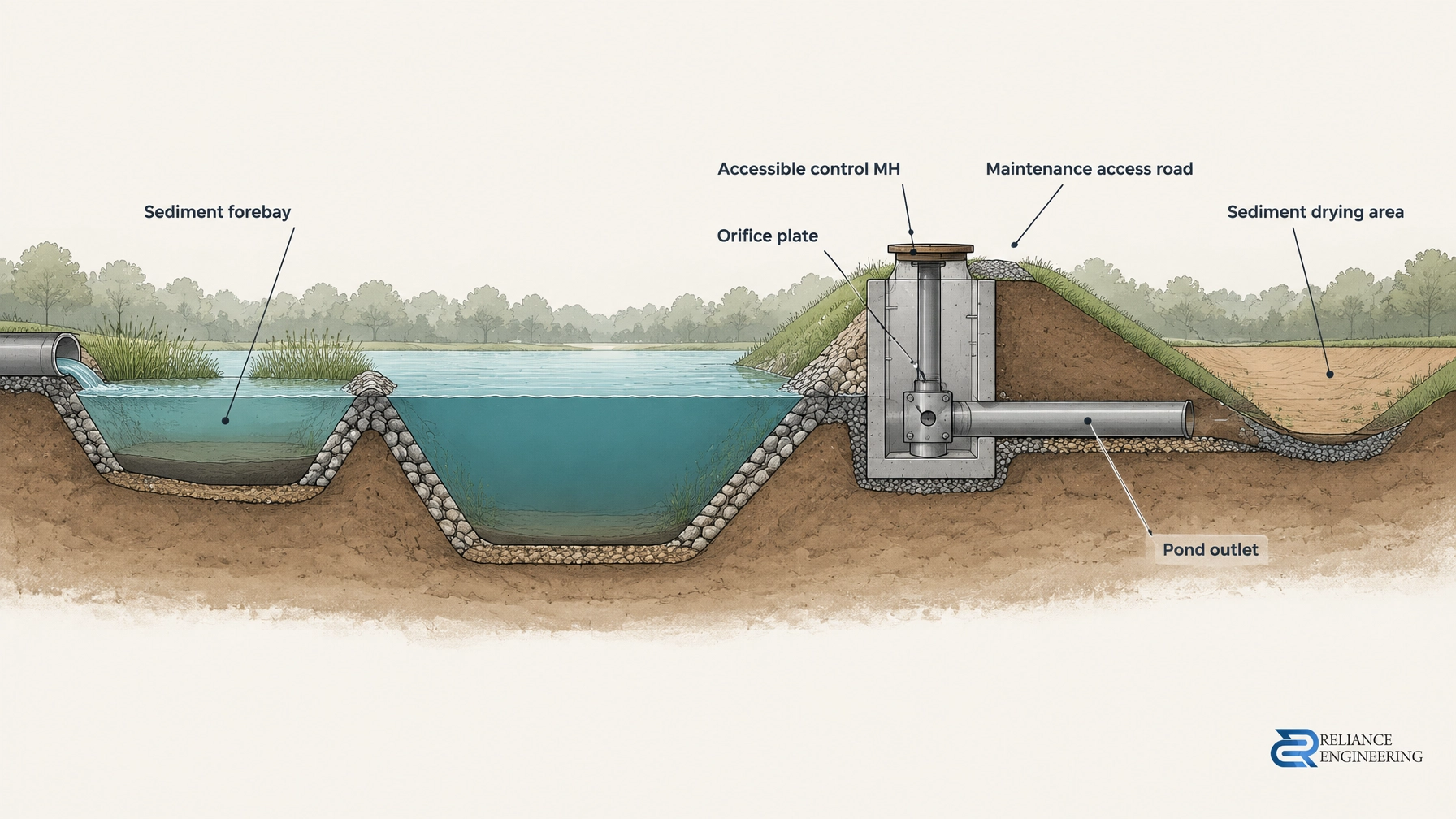
The Township of Clearview’s 2025 Engineering Design Criteria, Section C, provides one municipal example: stainless-steel orifice plates must be at least 75 mm in diameter, with 100 mm or larger preferred. Clearview also describes a screened orifice plate or weir plate fixed to a permanent structure for extended detention. It recommends locating flow-control devices in maintenance-hole structures in the berm, where they are easier to access, maintain and clean, rather than in a vertical pipe in the pond.
These are Clearview’s criteria, not universal Ontario dimensions. Other municipalities may set different minimums or preferences. Confirm current local criteria and approval conditions for each project.

Design maintenance access for real equipment
A maintenance route is not useful if a vacuum truck or excavator cannot reach the work area, turn around or load sediment safely. Access should be part of the facility design, not added after the pond layout is fixed.
Clearview’s example calls for a primary access road at least 4 m wide, with an additional 3.0 m buffer where the road is adjacent to residential properties. Its specified asphalt section is 50 mm HL4, 150 mm Granular A and 250 mm Granular B.
For access roads and turnaround areas at forebays, outlet pools and control structures, Clearview specifies a maximum gradient of 10%, minimum width of 4 m, minimum inside turning radius of 14 m, and a 10 m loading platform at forebay and outlet-pool locations. It also limits crossfall to 2% and calls for 3 m of clear space between the road and property lines.
These dimensions illustrate one municipality’s criteria; equipment, roadway design and requirements elsewhere may differ. The practical test is simple: can the intended maintenance equipment get to every component it needs to reach?
Plan where sediment will go during cleanout
A cleanout plan needs a workable way to manage sediment and keep inflows under control while maintenance is underway.
In Clearview’s criteria, the design may provide either a sediment drying space or a pond bypass sewer. The drying space is to be sized using stated sediment-volume assumptions, located above the extended detention level, and graded to drain back to the pond. Clearview specifies a 2–5% slope toward the pond and a maximum sediment depth of 0.5 m. Its criteria also call for sizing the area for sediment accumulation over a 10-year period.
As the alternative, a bypass sewer between the inlet and outlet can be sized using minor-system criteria to divert incoming flows around the pond during cleanout. The appropriate option depends on site layout, inflows, available land and municipal review.
Clearview also calls for sediment forebays at each inlet in accordance with MECP guidelines, with an estimate of cleanout frequency. Its criteria state that sediment should be removed when storage volume is reduced to 40% of the required volume. For emergency overflow, Clearview specifies capacity of at least 0.1 m³/s/ha and 0.3 m of freeboard to the top of the berm. These are Clearview examples; designers should verify current local requirements.
Maintenance belongs in the lifecycle plan
The Sustainable Technologies Evaluation Program (STEP) guide, Inspection and Maintenance Guide for Stormwater Management Ponds and Constructed Wetlands (2016, revised April 2018), is guidance, not a regulation. It recommends inspecting major components after significant rainfall events of 25 mm or more, or at least four times per year. It recommends measuring sediment depth at least every 3–5 years.
The guide describes sediment removal when treatment performance has fallen by five percentage points below the design target, for example, from 80% to 75% TSS removal. Its cited Ontario data reports annual in-situ sediment accumulation of about 0.2–5.9 m³/ha/year, while Ontario guidance cites a typical range of 0.5–3.0 m³/ha/year. The guide’s surveyed cleanout projects ranged from $53 to $512 per m³ removed.
These are summary and guideline figures, not universal maintenance triggers, accumulation rates or prices. Actual sediment volumes and costs depend on site conditions, access, dewatering, sediment quality, hauling distance and restoration needs. Use site-specific estimates and confirm the facility’s approval and O&M requirements.
A different regional example: Windsor/Essex
The Windsor/Essex Region Stormwater Management Standards Manual (December 2018) describes a different set of constraints: flat terrain, clay soils, high groundwater, backwater conditions and pumped outlets. In that context, the manual generally recommends assuming zero outflow in storage calculations unless a reliable outlet condition is demonstrated.
For maintenance, the regional manual ties sediment removal to treatment performance falling five percentage points below the required efficiency. It recommends inspections after significant storms during the first two years; annual inspections may be sufficient afterward unless site conditions call for more frequent checks.
This regional example shows why a design assumption suitable in one part of Ontario may not transfer elsewhere. Confirm local criteria, outlet conditions and maintenance requirements with the applicable municipality and approval agencies.
The SWM report should carry the cleanout narrative
A routing table alone does not explain how the facility will be maintained. A clear report should connect its calculations and drawings to the planned inspection and cleanout process.
Depending on the applicable municipal requirements, include outlet-control calculations, forebay sizing and estimated cleanout frequency, maintenance-access details, and the rationale and sizing for a drying area or bypass sewer. Cross-reference the O&M manual so inspection intervals, sediment-removal triggers, equipment needs and maintenance responsibility are clear.
Ontario’s MECP Stormwater Management Planning and Design Manual provides provincial technical guidance. Municipal criteria, site conditions and approvals still govern the project.
For related civil coordination, see our stormwater management reports, site servicing plans and functional servicing reports.
Outlet and cleanout design check
Owners and developers reviewing a designer’s package can use this checklist:
- Are outlet-control calculations shown for the orifice and/or weir?
- Is the orifice checked against local minimum criteria and clogging risk?
- Is the flow-control device accessible from a maintenance-hole or berm structure, rather than buried in the pond?
- Does maintenance access reach the forebay and outlet and meet local vehicle requirements?
- Does forebay sizing include an estimated cleanout frequency?
- Is a sediment drying area or bypass sewer identified with a sizing rationale?
- Does the O&M manual state inspection frequency and the sediment-removal trigger?
- Are ownership and long-term maintenance responsibilities stated, including whether the facility is municipal or private?

Discuss your SWM report requirements
Reliance Engineering designs practical outlet controls, clear calculations and maintenance access coordinated with site servicing plans and grading. Our goal is a clean, buildable design package that supports municipal approvals and anticipates long-term operation, not just submission-day review.
Request a consultation to discuss stormwater management reports Ontario projects require.
Contact and professional credentials
Naresh Ochani, P.Eng., M.Eng.
Principal Engineer, Reliance Engineering Canada Limited
PEO Certificate of Authorization: 100548882
6850 Millcreek Dr, Mississauga, ON L5N 2H4
Phone: 647-385-6418
Email: [email protected]
Office hours: Monday–Friday 9:00 AM–5:00 PM; Saturday 12:00 PM–2:00 PM; Sunday Closed.
References
- Township of Clearview Engineering Design Criteria, Section C: Stormwater Management and Drainage Systems (2025)
- STEP / TRCA and CH2M, Inspection and Maintenance Guide for Stormwater Management Ponds and Constructed Wetlands (2016; revised April 2018)
- Windsor/Essex Region Stormwater Management Standards Manual (December 2018)
- Ontario MECP Stormwater Management Planning and Design Manual