In the world of Ontario land development, a Functional Servicing Report (FSR) is not just a document; it is the technical backbone of your entire application. Whether you are navigating a Zoning By-law Amendment (ZBA), an Official Plan Amendment (OPA), or a Site Plan Approval (SPA), the FSR is the gatekeeper. It proves to the municipality that your project is viable, sustainable, and capable of integrating with existing infrastructure.
At Reliance Engineering, we have spent over 20 years mastering the complexities of Ontario's regulatory landscape. We understand that a delayed report means a delayed project. This guide provides the essential knowledge required to navigate FSR requirements across Ontario and ensure your development moves from concept to construction.
What is a Functional Servicing Report?
A Functional Servicing Report is a legal engineering document prepared by a licensed Professional Engineer (P.Eng.). Its primary purpose is to demonstrate that a proposed development can be adequately supported by municipal water, wastewater, and stormwater infrastructure.
The FSR bridges the gap between high-level planning and detailed engineering. It answers three critical questions for municipal reviewers:
- Is there enough water pressure for domestic use and fire protection?
- Can the existing sanitary sewers handle the additional sewage flow?
- How will stormwater runoff be managed to prevent flooding and protect the environment?
Without a stamped FSR, development applications in Ontario simply cannot proceed. It establishes the technical feasibility of the project before you invest heavily in detailed design.
When is an FSR Required in Ontario?
The requirement for an FSR is usually triggered when a development increases the load on municipal infrastructure. If you are changing the use of a site or increasing its density, you will likely need one. Common scenarios include:
- Official Plan Amendments (OPA): When proposing a use not currently permitted by the municipality’s long-term vision.
- Zoning By-law Amendments (ZBA): When seeking to change specific site regulations, such as density or building height.
- Draft Plans of Subdivision: Required for large-scale residential or industrial developments.
- Site Plan Control: Often required for multi-residential, commercial, or industrial projects to ensure site-specific servicing is adequate.
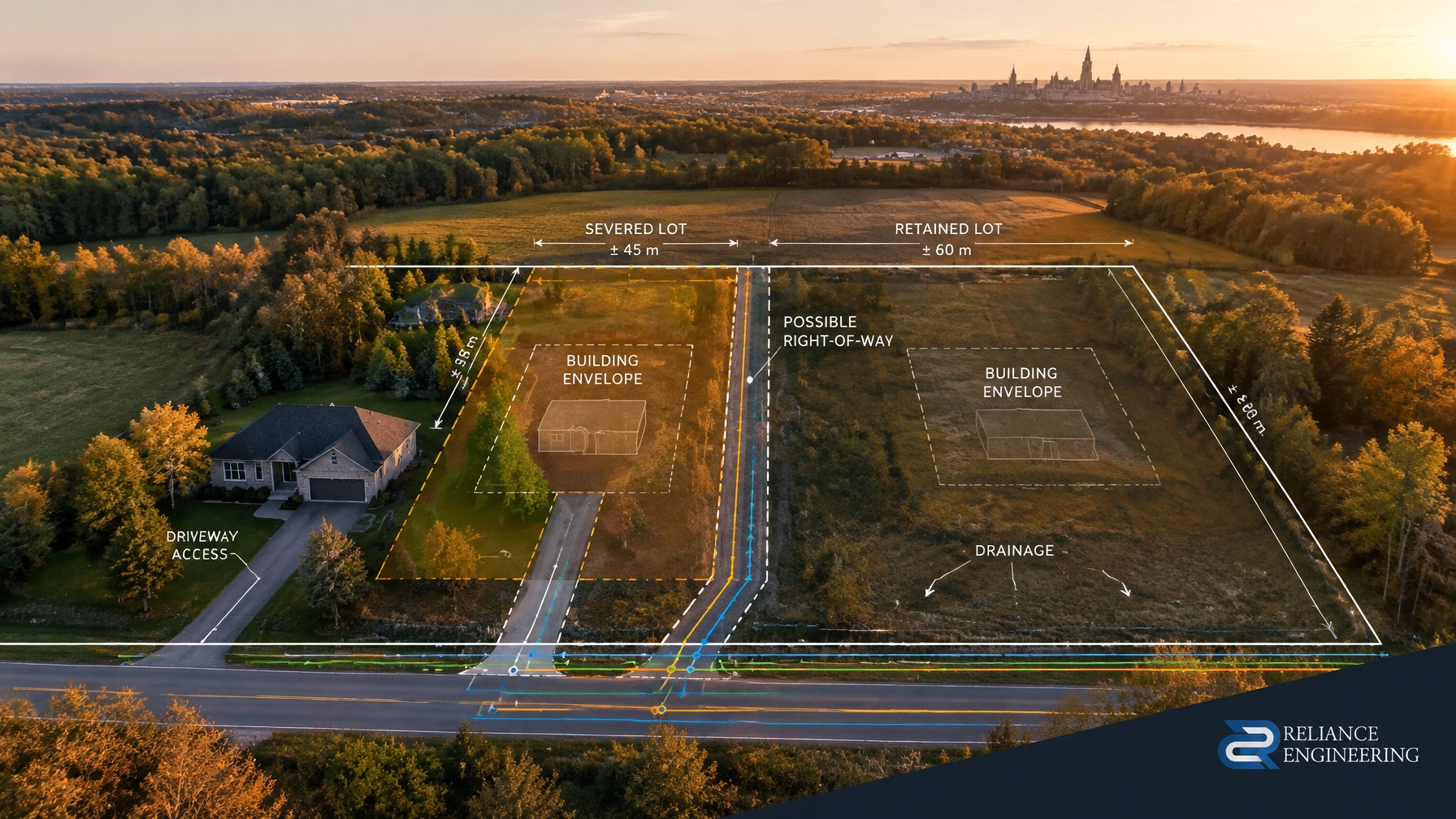
- Severance Applications: Even smaller developments may require a "Servicing Brief" or a simplified FSR to prove the new lot can be serviced.
Early consultation with municipal staff is vital. Standards vary significantly between the City of Toronto, the Region of Peel, York Region, and smaller Ontario municipalities.
The Three Pillars of Functional Servicing
A comprehensive FSR must address three core infrastructure systems with precision.
1. Water Distribution and Fire Protection
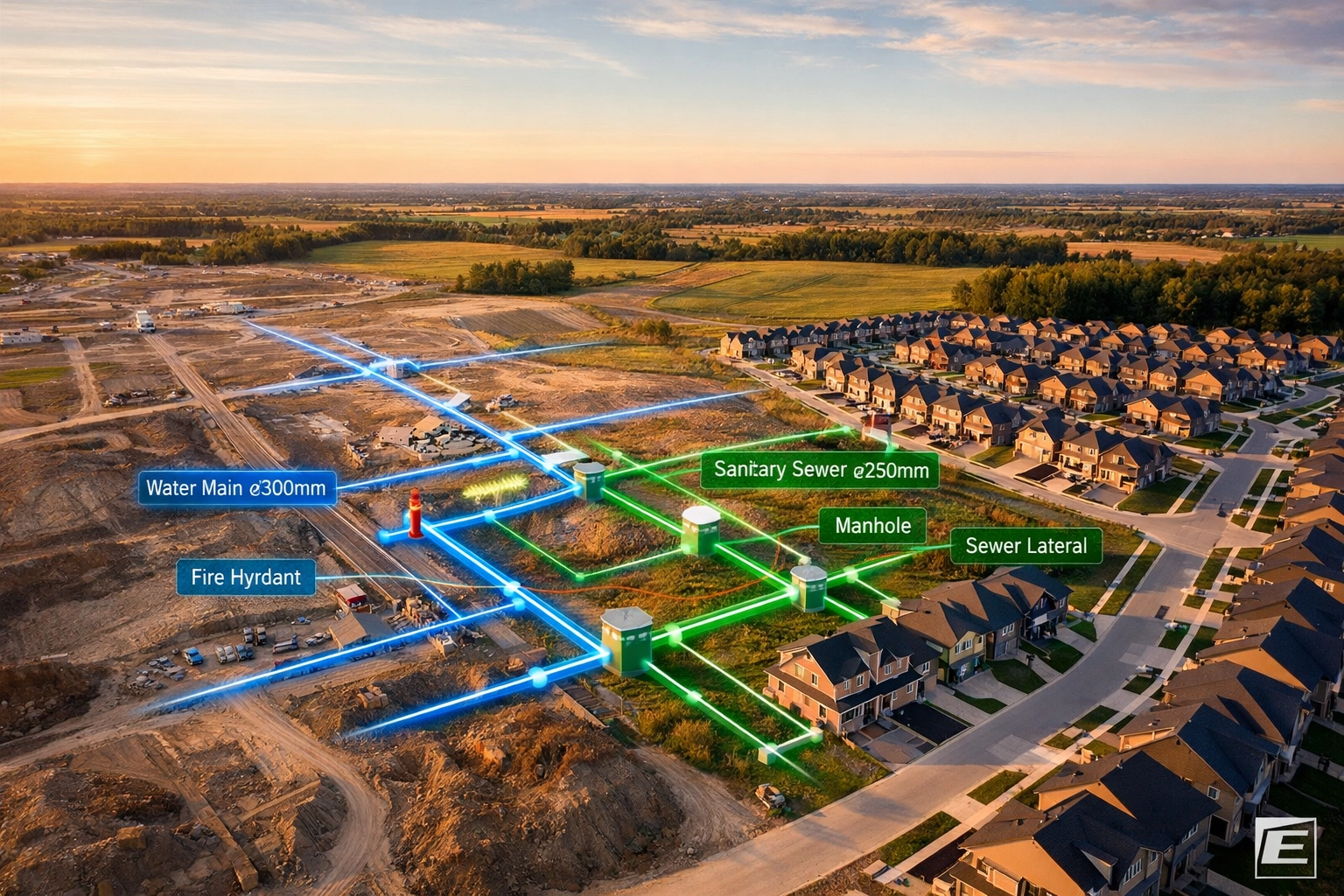
The report must confirm that the existing municipal water main has sufficient capacity. This involves calculating the average and peak daily demands for the new development. Crucially, it must also prove that there is adequate "Fire Flow": the volume of water available to fight a fire at the required pressure. This often requires hydraulic modeling and coordination with the local fire department's standards.
2. Sanitary Sewer Design
You must verify that the downstream sanitary sewer system can accommodate the new population or commercial load. This includes:
- Calculating "Peak Flow" using municipal population density factors.
- Accounting for "Infiltration and Inflow" (I&I) to ensure the pipes don't overflow during storm events.
- Reviewing sanitary sewer design capacity to determine if downstream upgrades are necessary.
3. Stormwater Management (SWM)
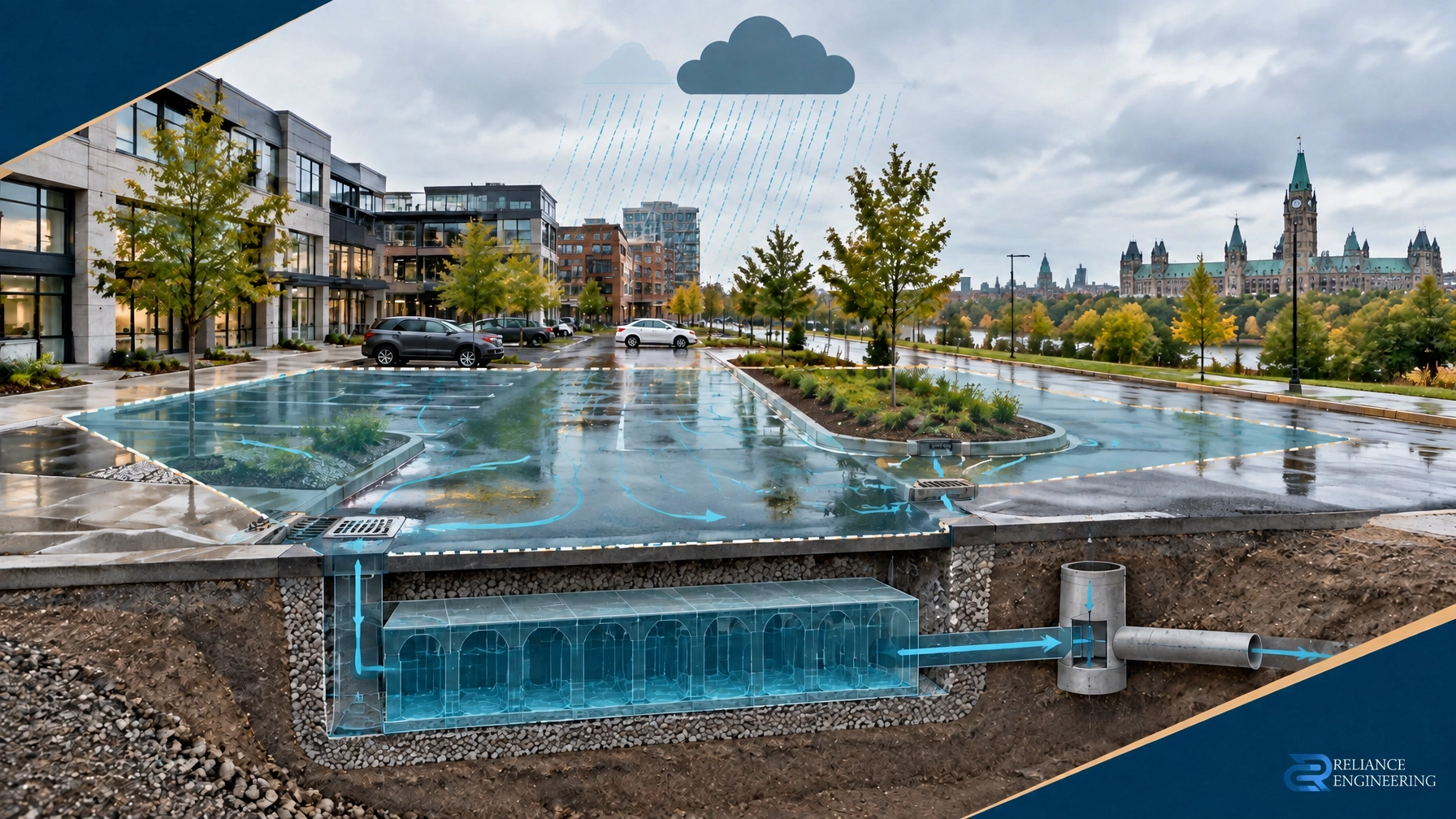
Ontario has some of the strictest stormwater management standards in North America. The FSR must detail how the site will handle rain and snowmelt. This involves:
- Quantity Control: Ensuring post-development runoff rates do not exceed pre-development levels to prevent downstream flooding.
- Quality Control: Implementing measures to remove TSS (Total Suspended Solids) before water enters natural watercourses.
- Water Balance: Maintaining groundwater recharge levels, particularly in sensitive environmental areas.
Professional Certification: The P.Eng. Stamp
In Ontario, an FSR must be prepared, signed, and stamped by a licensed Professional Engineer. This is a requirement under the Professional Engineers Act. The stamp is more than just a formality; it represents legal accountability. It confirms that the analysis meets the Ontario Building Code, provincial regulations, and specific municipal engineering standards.
At Reliance Engineering, our principal, Naresh Ochani, P.Eng. M.Eng., personally oversees the technical integrity of our reports. With over two decades of experience, we ensure that every calculation: from site grading to hydraulic modeling: is defensible and accurate.

Critical Components of a Successful Report
To avoid costly "Requests for Revision" from municipal reviewers, your FSR should follow a rigid, professional structure:
- Project Background: Clear description of the proposed development.
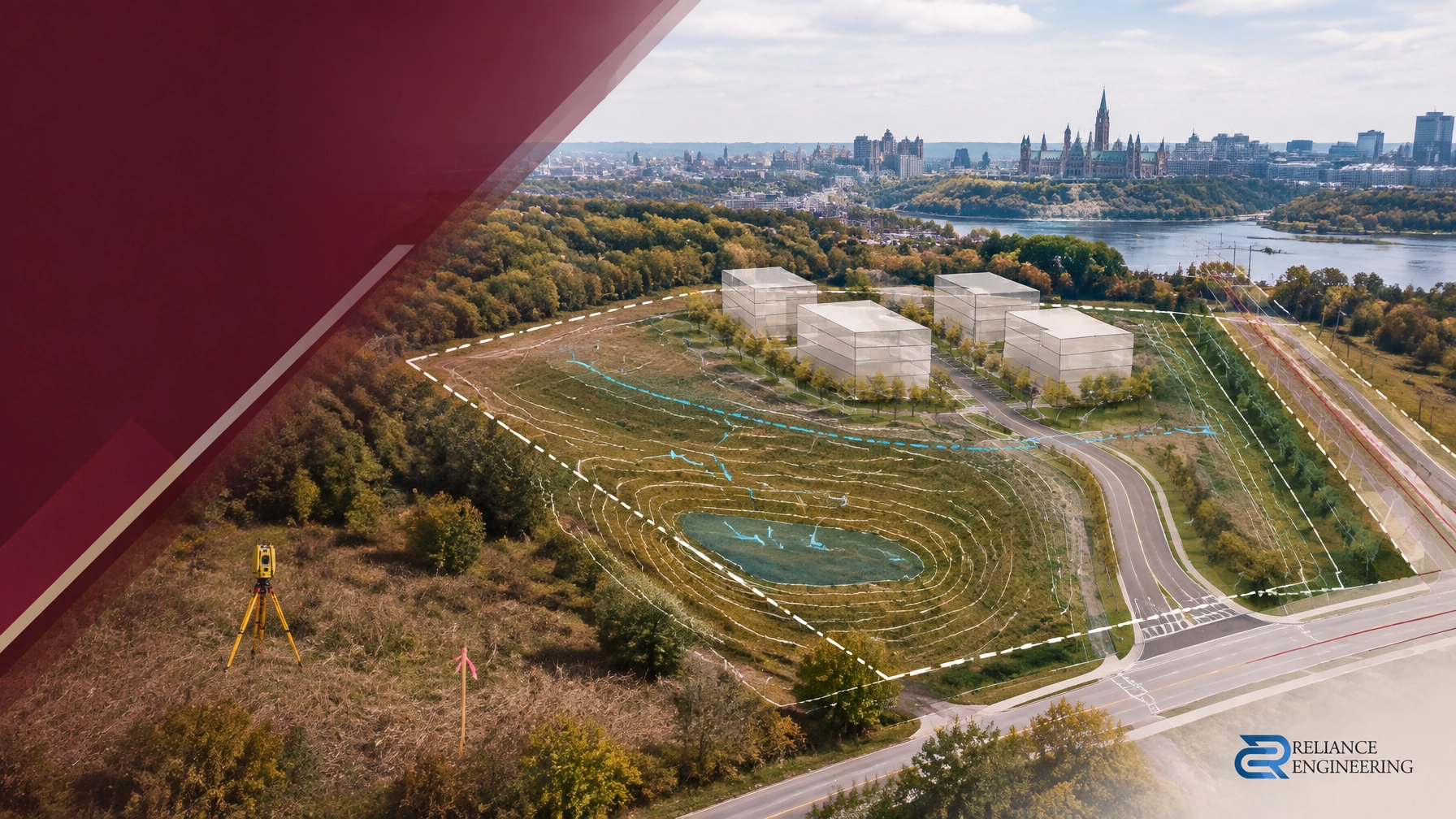
- Existing Conditions: Detailed assessment of topography, existing pipes, and nearby watercourses.
- Servicing Strategy: A clear narrative of how the site will connect to the municipal grid.
- Supporting Documentation: This is where many reports fail. You must include hydraulic modeling results, drainage area maps, and flow calculations in the appendices.
- Engineering Drawings: Visual representations of the site servicing plan and grading.
Navigating the Regulatory Landscape
Ontario’s development process involves multiple stakeholders. Beyond the municipality, you may need to coordinate with:
- Conservation Authorities (e.g., TRCA, CVC, LSRCA): If your site is near a floodplain or wetland, they will review your Stormwater Management and Erosion and Sediment Control plans.
- Ministry of the Environment, Conservation and Parks (MECP): For certain large-scale water or sewage works.
- Regional Governments: In regions like Peel or Halton, the region manages the "major" pipes (water and sanitary), while the local municipality manages the "minor" pipes and roads.
Common Pitfalls and How to Avoid Them
1. Lack of Pre-Consultation
Starting calculations without talking to the municipality is a recipe for disaster. Pre-consultation identifies specific local requirements, such as unique runoff coefficients or specific fire flow mandates.
2. Ignoring Downstream Deficiencies
If the municipal sewer is already at capacity, your FSR must identify this. You may need to propose off-site upgrades or on-site storage solutions (like attenuation tanks).
3. Incomplete Appendices
Municipal reviewers will not take your word for it. They need to see the math. Missing drainage maps or modeling input data will lead to an immediate rejection.

Why Experience Matters: The Reliance Engineering Advantage
Land development in Ontario is increasingly complex. From high-density redevelopments like 35 Wabash Avenue in Toronto to hospital expansions such as the Etobicoke General Hospital, every project presents unique engineering challenges.
We specialize in helping developers, architects, and landowners navigate the Site Plan Approval process. Our expertise in storm system design and site servicing ensures that your FSR is not just a "check-box" item, but a strategic tool that adds value to your project.
Our Project Highlights Across Ontario:
- Toronto: 24 Howard Park Avenue
- Newmarket: 345-351 Davis Drive
- St. Catharines: 16-20 Queen Street
- Oakville: 85 Bronte Road
Final Thoughts: Prepare for Success
An Ontario Functional Servicing Report is the foundation of your development permit. By investing in high-quality engineering early in the process, you minimize risk, reduce municipal review times, and avoid costly construction-stage surprises.
If you are planning a development in Ontario and need an expert team to handle your FSR, site grading, or stormwater management, contact Reliance Engineering today. We provide practical, compliant, and cost-effective solutions tailored to the specific needs of your site.
Contact Information
Reliance Engineering
Naresh Ochani, P.Eng. M.Eng.
Founder and Principal
Address: 6850 Millcreek Dr, Mississauga, ON L5N 2H4
Phone: 647-385-6418
Email: [email protected]
Website: www.relianceengineering.ca
Office Hours:
- Saturday: 12:00 PM – 2:00 PM
- Sunday: Closed
- Monday – Friday: 9:00 AM – 5:00 PM
Ready to start your project? Contact us for a consultation and let us help you navigate the Ontario regulatory landscape with confidence.