Article type: Development approvals guidance
Focus: Civil engineering scope for Ontario municipal approvals
Updated: October 21, 2026
The cheapest meeting in development can be one of the most consequential. A well-prepared pre-consultation can clarify which engineering studies and drawings a municipality expects with an application. Miss that scope, or assume the checklist is optional or final, and the project may face an incomplete-submission notice, added review steps, delay, or redesign.
The meeting does not approve a proposal. Its value is practical: it helps the applicant and consulting team understand what information to prepare before filing.
What pre-consultation is, and whether it is required
Pre-consultation, also called pre-application consultation, is an early discussion between an applicant and municipal staff about a proposed development. It can identify application requirements, technical concerns, external reviews and site-specific constraints.
The process varies by municipality and application type. Recent provincial changes also matter: on June 6, 2024, Bill 185 removed municipal authority to require mandatory pre-application consultation by by-law before a planning application. Toronto now describes its process as voluntary but strongly encouraged for Official Plan Amendments (OPA), Zoning By-law Amendments (ZBA), draft plans of subdivision and site plan control applications. Mississauga formalizes pre-application consultation in its site plan process, while allowing applicants to waive the meeting itself in certain circumstances.
Confirm the current process with the municipality responsible for your application. Do not assume a meeting, or the same checklist rules, applies everywhere.
- City of Toronto: Pre-Application Consultation Process
- City of Mississauga: Apply for site plan approval
The meeting’s practical output: a checklist or record
A pre-consultation meeting typically produces a checklist, comments package or record identifying materials to include with the formal application. Toronto calls this its Planning Application Checklist Package; Mississauga provides a submission checklist; Brampton’s site plan process provides a checklist and comments.
For civil engineering, that record may identify reports and drawings such as a Functional Servicing Report (FSR), Stormwater Management Report, site grading plan, site servicing plan and erosion and sediment control (ESC) plan. It may also flag other work, such as traffic or environmental studies, depending on the site and proposal.
The checklist is a scope-setting tool, not a guarantee that no further information will be requested. Municipal reviewers may ask for additional material during review, including after an application is considered complete.
Civil studies that may be identified

Functional Servicing Report: An FSR explains existing infrastructure, proposed water and sanitary demands, servicing connections and capacity considerations. It can identify whether the development’s servicing assumptions appear feasible and whether upgrades or further analysis may be needed. See our Functional Servicing Report services.
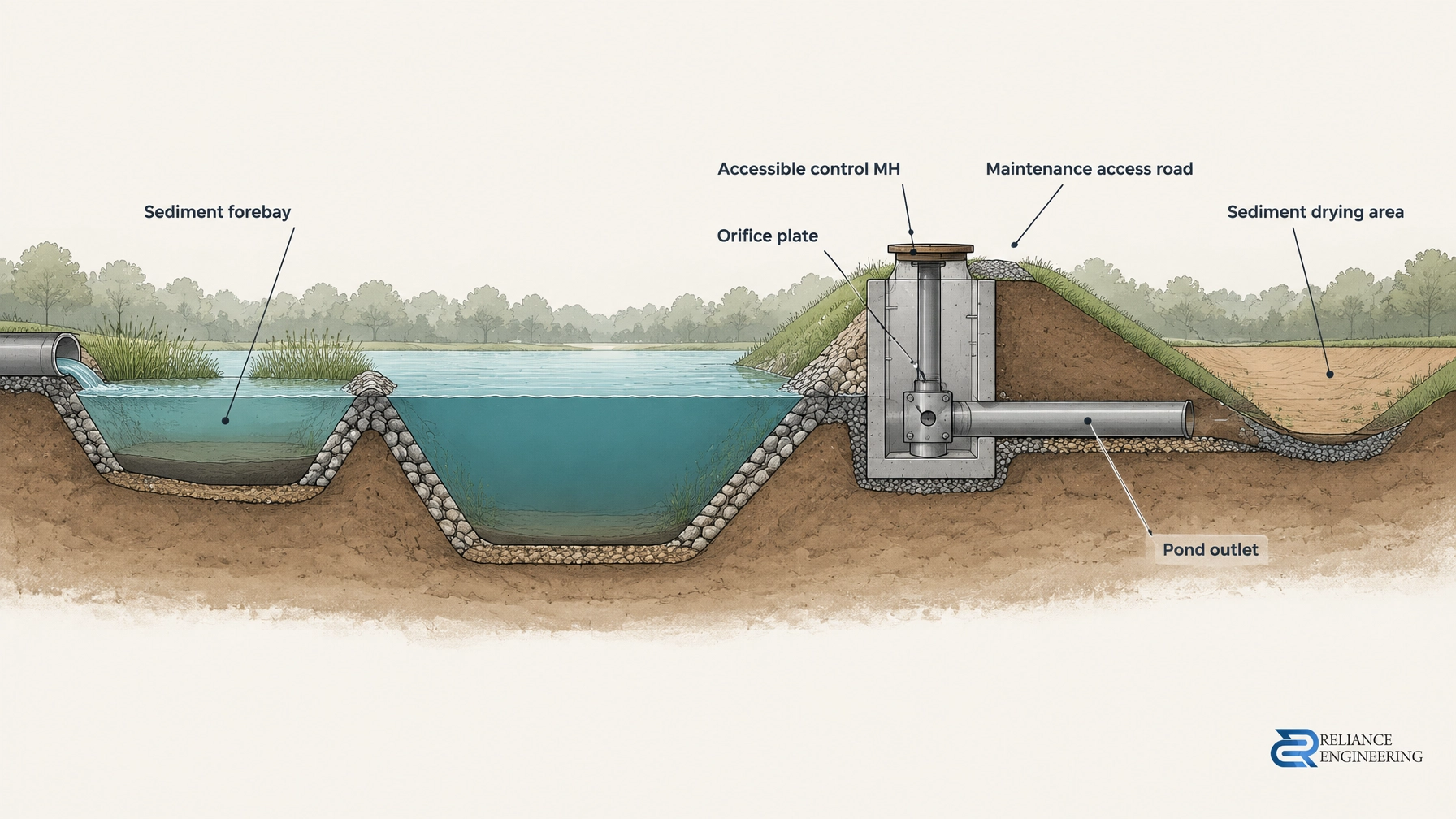
Stormwater Management Report: The required scope can depend on municipal criteria, the site and the application. Clarify what analyses, calculations and design criteria the municipality expects. An agreed early approach supports clear calculations and coordinated drainage design. Learn more about stormwater management reports in Ontario.
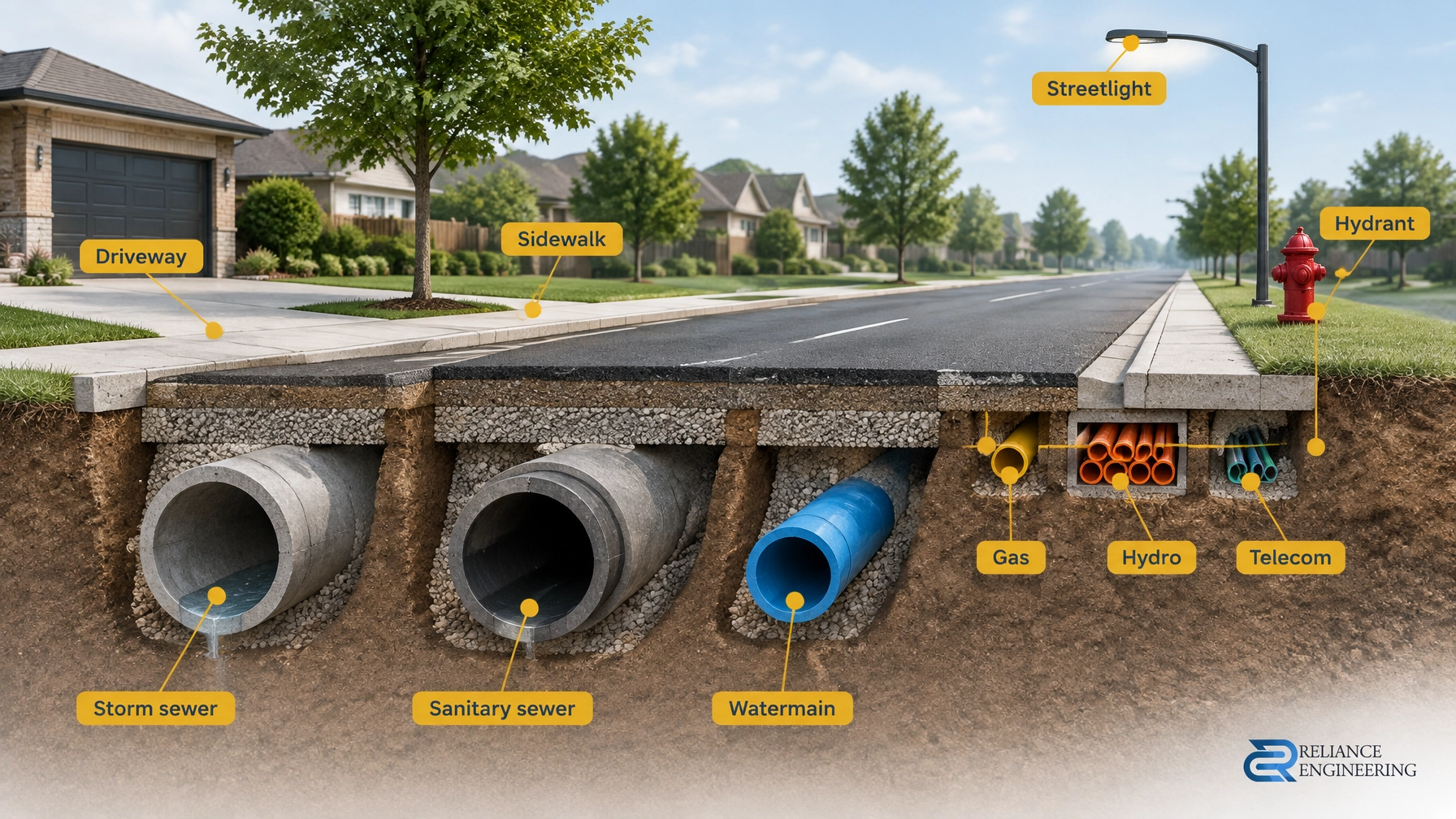
Site grading and servicing plans: Grading plans show proposed elevations, drainage patterns and how the site will connect to surrounding grades. Site servicing plans show proposed water, sanitary and storm connections. Early coordination helps produce buildable grading, clean layouts and constructible routing. See our site grading plans and site servicing plans.
Erosion and sediment control plan: An ESC plan identifies practical controls to limit sediment movement during construction and protect adjacent lands and drainage systems. Reviewers may also flag agency requirements or other site-specific studies.
The scope agreed at pre-consultation influences engineering effort, budget and schedule. If the team later designs to different servicing assumptions, or omits a requested study, review comments and resubmissions can follow.
Understand the 60-day rule before relying on it
The number “60 days” is easy to misread. O. Reg. 549/06 prescribes a 60-day period for the purposes of specified Planning Act subsections: 17(44.4), 34(24.4) and 51(52.4). It is not a general 60-day deadline for a municipality to assess application completeness, nor is it a universal decision period for every planning application.
Application requirements and timelines depend on the applicable Planning Act provisions and application type. If required information is missing, an application may not be treated as complete under the relevant process, which can prevent the applicable review from proceeding as intended. Verify the rules for your specific submission rather than assuming one province-wide clock applies.

For the current regulation, see O. Reg. 549/06. This distinction is important: an incomplete submission can stall progress, but the regulation’s 60-day period should not be described as a blanket completeness clock.
Checklist validity is municipal, not provincial
A checklist may have a validity window, but there is no single province-wide period. Brampton’s Site Plan Review User Guide, for example, states that its PAC checklists and comments are valid for six months from the meeting date. That is a municipal example, not an Ontario-wide standard. Confirm the current validity period for your application and calendar it.
Prepare for the meeting with the civil scope in mind
Bring a current conceptual site plan and involve a civil engineer who can discuss grading, drainage and servicing constraints. Before the meeting, assemble available survey and site information, identify the proposed use and development concept, and list unresolved engineering assumptions.
Ask municipal staff:
- Which municipal criteria documents and design standards apply?
- Which reports and drawings are required for this application?
- Will a Conservation Authority review, permit or other external approval be triggered?
- How will water, sanitary and storm capacity availability be assessed?
- Which departments review the civil drawings, and when are comments consolidated?
- Does the checklist expire, and what happens if the proposal changes?
After the meeting, review the checklist line by line with the design team. Confirm the FSR and stormwater scope, then coordinate the report assumptions with grading and servicing drawings before filing. That approach supports clear drawings, practical designs and permit-ready documentation.
What happens next
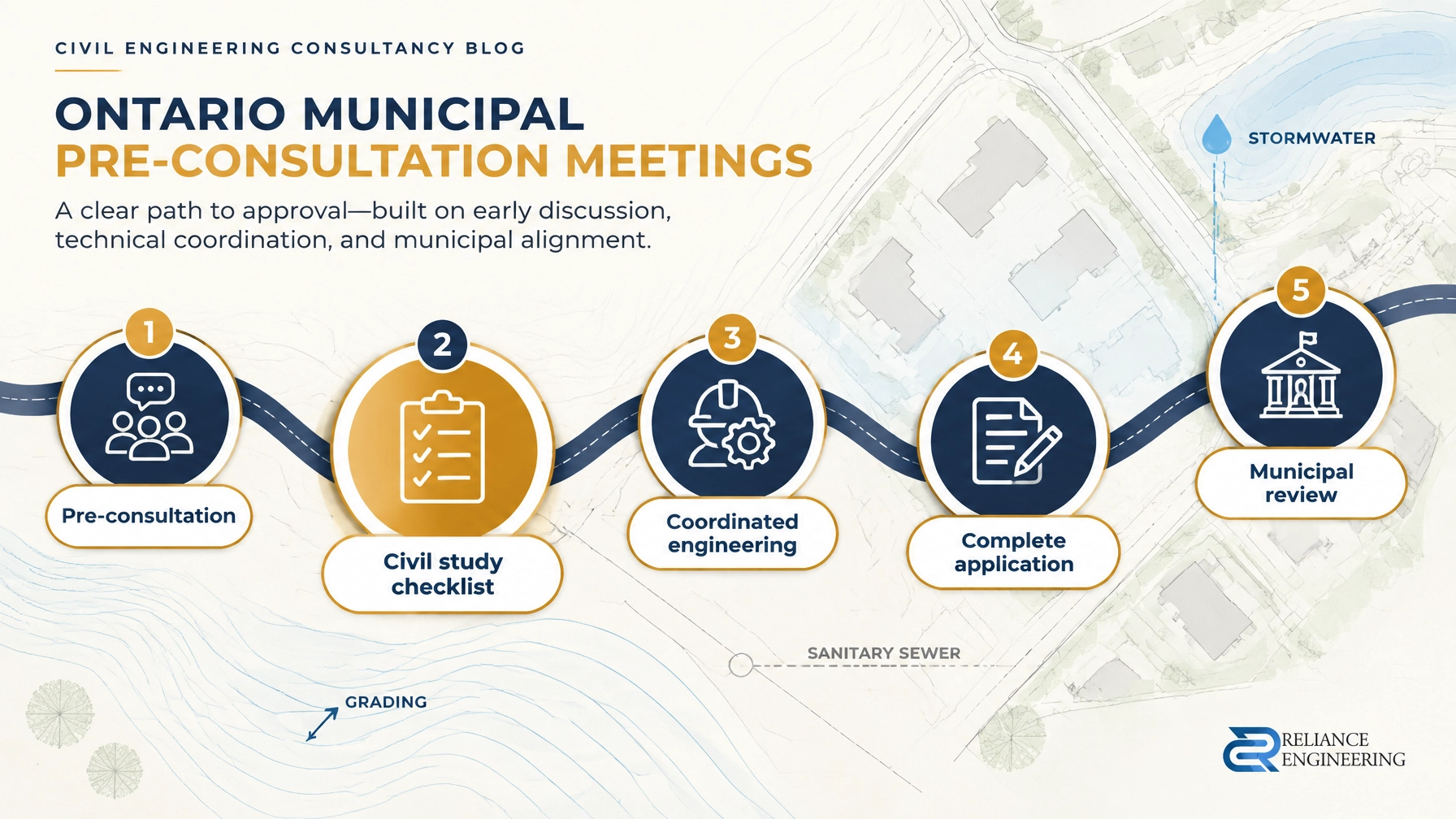
Once the civil scope is clear, engineering can advance in a coordinated sequence: assess servicing feasibility, establish the stormwater strategy, prepare grading and servicing layouts, and develop ESC measures where required. Those plans and reports should use consistent assumptions and align with the municipal checklist.
Pre-consultation does not guarantee approval or prevent later comments. It does give applicants an opportunity to identify expectations early and reduce avoidable gaps in the submission.
Key takeaways
- Check whether pre-consultation is required, encouraged or waivable for your application and municipality.
- Use the meeting to clarify civil study scope, design criteria, capacity review and external-agency involvement.
- Treat the checklist as a working scope document, not a guarantee that no further information will be requested.
- Confirm validity periods locally and align engineering documents with the checklist before filing.
- Do not confuse O. Reg. 549/06’s specified 60-day period with a universal completeness or decision clock.
Request civil engineering approval support
Reliance Engineering prepares Functional Servicing Reports, Stormwater Management Reports, site grading plans, site servicing plans and ESC plans for development applications across Ontario. With more than 20 years of principal engineer experience and municipal experience across Ontario, we provide coordinated design, clear calculations and responsive approval support.
Request a consultation to discuss your pre-consultation checklist and engineering scope.
Professional contact
Naresh Ochani, P.Eng., M.Eng.
Principal Engineer, Reliance Engineering Canada Limited
PEO Certificate of Authorization: 100548882
6850 Millcreek Dr, Mississauga, ON L5N 2H4
Phone: 647-385-6418
Email: [email protected]
Office hours: Monday–Friday, 9:00 AM–5:00 PM; Saturday, 12:00 PM–2:00 PM; Sunday, Closed.