Series: Ottawa, Ontario Development Approval Series : Post 1 of 7
Slot: Site Servicing & Stormwater
Published: September 10, 2026 at 2:00 PM
Topic: Stormwater Management Reports for Ottawa municipal approvals
Stormwater management is a core part of development review in Ottawa. A proposed commercial site, infill project, subdivision, severance, or institutional development must demonstrate how runoff will be collected, controlled, treated, routed, and safely released.
A professional stormwater management report for Ottawa, Ontario must do more than present calculations. It must connect the hydrologic analysis to a coordinated site design, constructible routing, municipal requirements, and the concerns of the applicable Conservation Authority.
Reliance Engineering prepares practical SWM reports supported by clear calculations, practical controls, and approval support throughout the review process.
The Allowable Release Rate Is Site-Specific
The allowable release rate is the maximum flow that can leave the developed site and enter the receiving system without creating downstream impacts.
The target is not automatically the same for every Ottawa property. It depends on:
- Whether the receiving system is a separated storm sewer, combined sewer, or watercourse
- Existing downstream capacity
- Applicable City of Ottawa sewer design criteria
- A master drainage plan or area-specific stormwater strategy
- The site’s pre-development drainage conditions
- Requirements from Mississippi Valley Conservation Authority, Rideau Valley Conservation Authority, or South Nation Conservation
- Comments issued during municipal or Conservation Authority review
For many development applications, the design objective is to ensure that post-development peak flows do not exceed pre-development peak flows for the required design storms. The specific controlling storm may be based on the receiving system and City criteria. In some areas, the allowable rate is derived from a pre-development design storm. In other areas, an area-specific unit release rate or downstream facility limit applies.
The report should clearly identify:
- The receiving system
- The source of the allowable release rate
- Pre-development drainage areas and runoff assumptions
- Post-development drainage areas and imperviousness
- The proposed controlled outlet rate
- The control device used to achieve the target
Where a site drains directly or indirectly to a watercourse, the allowable release rate may also be governed by watershed or facility-specific requirements. The City’s review comments and the relevant Conservation Authority should be treated as the final source of site-specific criteria.
How Ottawa Reviewers Evaluate the Hydrologic Analysis
A strong SWM report explains the complete drainage analysis from existing conditions through final design.
Pre-development analysis
The pre-development assessment generally includes:
- Existing land uses
- Existing impervious and pervious areas
- Existing drainage boundaries
- Existing overland flow routes
- Existing storm sewer or watercourse outlets
- Runoff coefficients
- Time of concentration
- Peak flow calculations for required design storms
The assumptions must be traceable. Reviewers should be able to understand how the existing peak flow was calculated and why the selected drainage areas represent actual site conditions.
Post-development analysis
The post-development analysis should show how the proposed building, parking areas, driveways, walkways, landscaped areas, grading, and drainage infrastructure change runoff.
The report should identify:
- Proposed drainage areas
- New hard surface areas
- Building roof drainage
- Catchbasin and storm sewer connections
- Overland flow routes
- Uncontrolled peak flows
- Controlled peak flows after storage and outlet restrictions
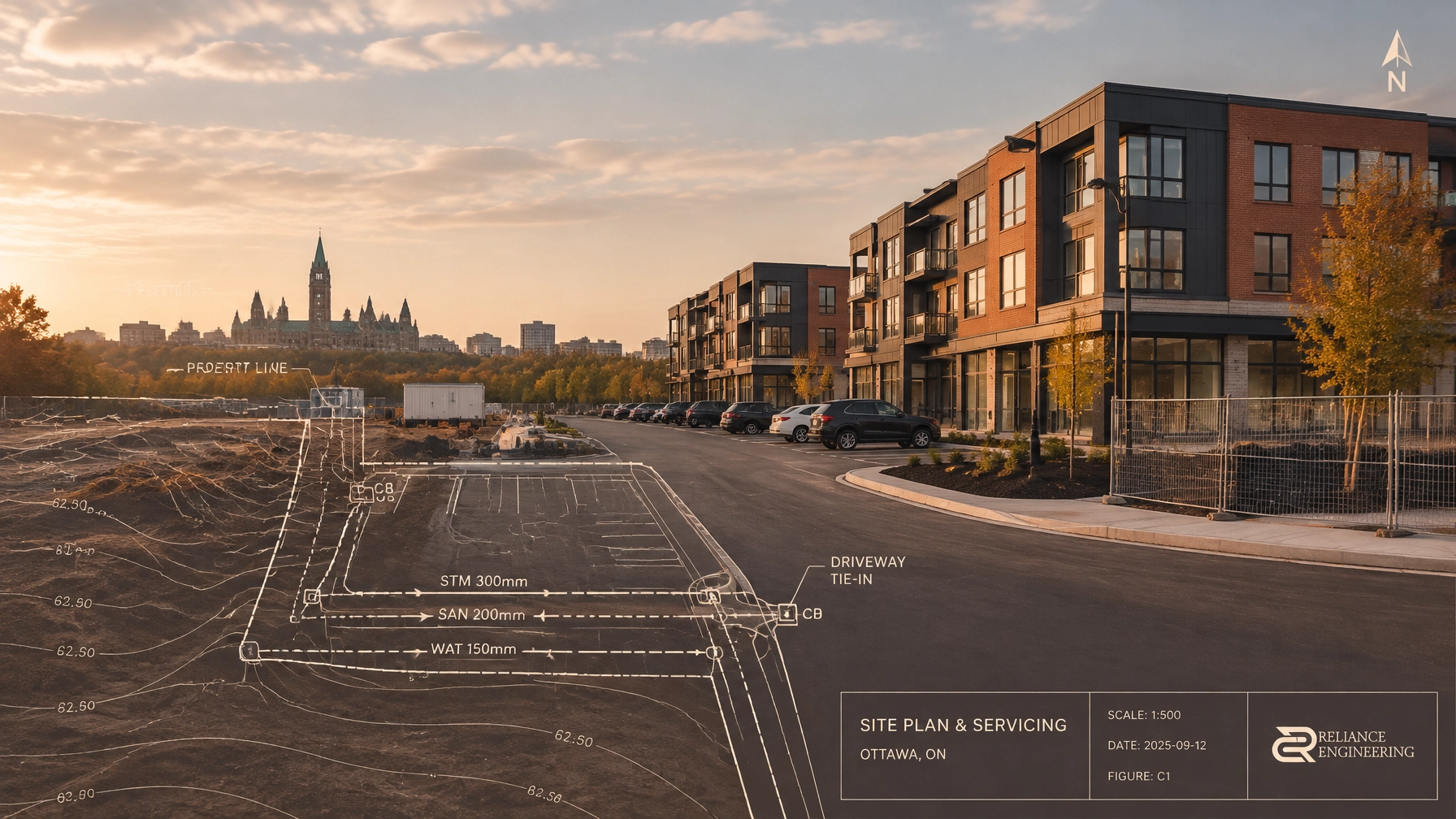
The analysis should be coordinated with the Site Servicing Plan and Site Grading Plan. A release rate that appears compliant in a report is not useful if the grading plan cannot direct runoff to the proposed storage or control structure.
Storage Sizing Must Work for the Required Storms
Once the allowable release rate is established, the SWM design must provide enough storage to detain excess runoff.
Storage may be provided through:
- Stormwater management ponds
- Underground storage tanks or chambers
- Oversized storm pipes
- Rooftop storage
- Parking lot or surface storage
- Infiltration facilities
- Bioretention areas or other LID measures
- A coordinated treatment train using more than one control
Storage sizing typically compares post-development inflow with the controlled outlet rate. The report should demonstrate that the proposed facility can temporarily store the difference and release it without exceeding the allowable rate.

A reviewer will generally expect to see:
- Storage volume calculations
- Stage-storage information
- Stage-discharge information
- Proposed high-water levels
- Outlet elevations
- Orifice, inlet control device, or vortex regulator sizing
- Emergency overflow elevations
- Allowable versus proposed release rates
- Required versus provided storage
- Maintenance access and operation requirements
For smaller infill projects, the City’s Quick Stormwater Management Tool may identify required on-site storage and an overall site release rate based on lot size and proposed hard surface coverage. The storage and discharge solution must be shown on the submitted grading and servicing plans. If the design uses at-grade storage, infiltration, or a combination of measures, a formal SWM brief or report may be required.
Minor System and Major System Design
Ottawa stormwater review considers both the minor and major drainage systems.
The minor system includes catchbasins, storm sewers, roof leaders, lot drainage, swales, and related infrastructure designed to collect and convey more frequent storm events.
The major system carries runoff when the minor system capacity is exceeded. It may include:
- Roads
- Overland channels
- Swales
- Open spaces
- Emergency spill routes
- Stormwater management ponds
- Natural drainage features
The 100-year event must be reviewed as part of the major system assessment. The report and drawings should show where excess water will go and confirm that the routing is safe and constructible.
Reviewers will look for:
- Defined overland flow routes
- Safe grading away from building openings
- No uncontrolled discharge toward adjacent properties
- Adequate emergency overflow paths
- Safe ponding limits on parking areas and drive aisles
- Confirmation that buildings and critical infrastructure are protected
- Protection of downstream properties and public rights-of-way
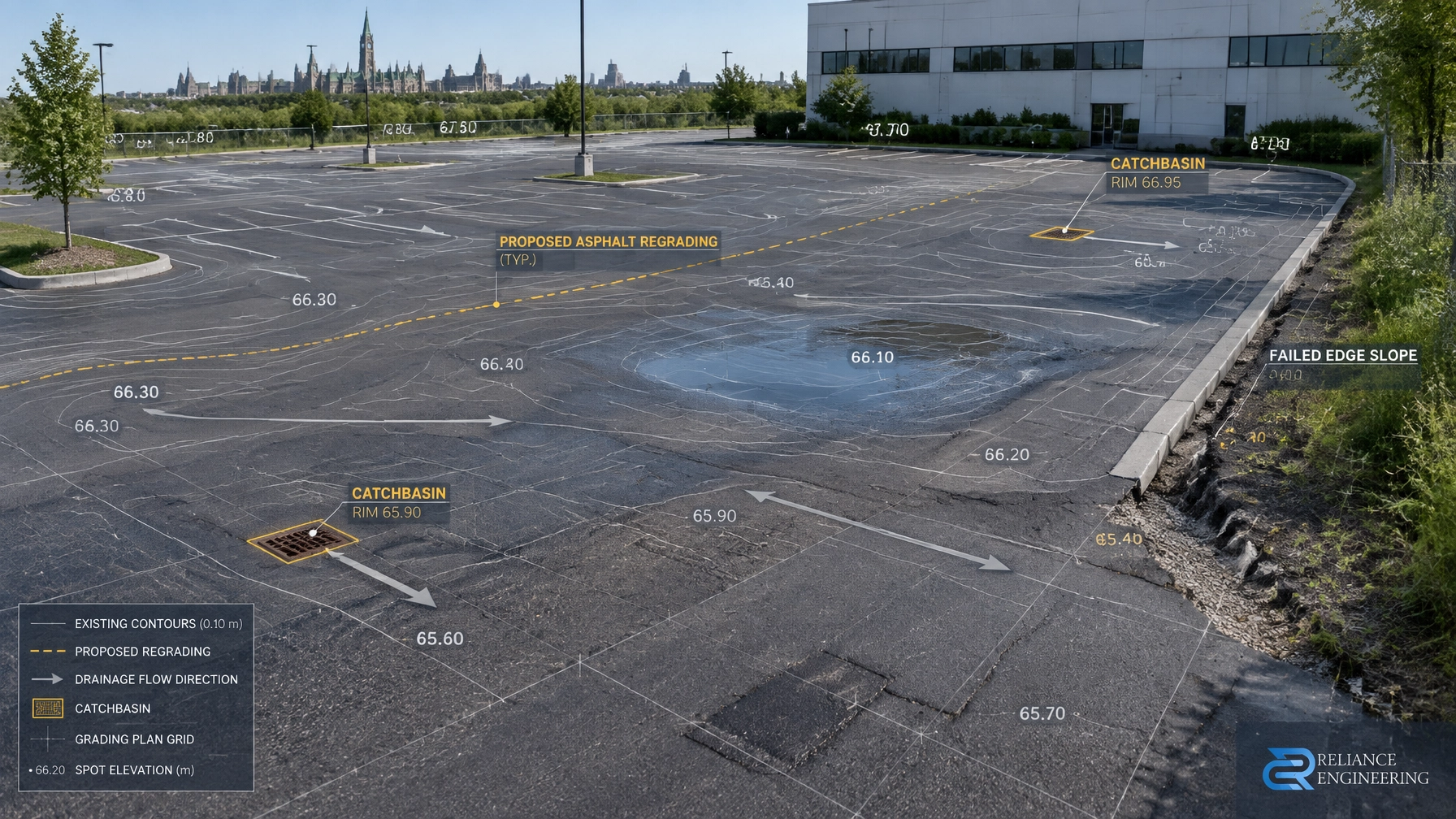
A grading plan that only works during ordinary rainfall is incomplete. The design must also explain how the site responds during a major storm.
Water Quality, Erosion Control, and LID
Quantity control is only one part of a complete stormwater strategy.
Where required by the receiving system, watershed, City criteria, or Conservation Authority, the report must address water quality treatment. An Enhanced Level of Protection is commonly associated with an 80% long-term average removal of total suspended solids, or TSS.
Treatment strategies may include:
- Oil-grit separators
- Sediment forebays
- Wet ponds
- Extended detention
- Bioretention areas
- Vegetated swales
- Infiltration systems
- Filtration systems
- Other approved treatment devices
The selected method must be appropriate for the site use and receiving environment. Commercial and industrial sites may require additional consideration for sediment, oil, hydrocarbons, and spill control.
Low Impact Development should be reviewed where required or practical. LID measures may reduce runoff volume, improve water balance, support infiltration, and reduce the size of downstream storage. However, LID features must be supported by appropriate soil, groundwater, grading, maintenance, and overflow information.
Erosion and sediment control must also be coordinated with the SWM design. During construction, exposed soil can quickly overload catchbasins, block control devices, and damage downstream watercourses. Reliance Engineering coordinates SWM requirements with Erosion and Sediment Control Plans.

Conservation Authority Review in Ottawa
The City of Ottawa is the primary municipal approval authority, but Conservation Authority review may be required when a site affects a watercourse, wetland, floodplain, valley, outlet, or other regulated feature.
Depending on location, review may involve:
- Mississippi Valley Conservation Authority
- Rideau Valley Conservation Authority
- South Nation Conservation
The Conservation Authority may request additional information related to:
- Flood hazards
- Erosion risks
- Water balance
- Wetland hydrology
- Groundwater recharge
- Thermal impacts
- Downstream watercourse conditions
- Outlet stability
- Regulatory setbacks
- Protection of natural features
For properties in regulated areas, municipal approval may not be the only approval required. Applicants should confirm Conservation Authority jurisdiction during pre-consultation and coordinate any permit requirements with the City submission.
What a Complete Ottawa SWM Submission Includes
A practical report should be concise, traceable, and coordinated with the complete civil package.
Typical contents include:
- Design criteria and source documents
- Existing conditions and drainage analysis
- Proposed conditions and drainage analysis
- Allowable release rate calculations
- Quantity control storage sizing
- Outlet and control device calculations
- Water quality treatment strategy
- LID review, where required
- Overland flow and 100-year assessment
- Erosion and sediment control coordination
- SWM summary tables
- Design recommendations and maintenance requirements
The report should match the City Site Plan Control submission requirements and the City’s Site Servicing Study Terms of Reference.
It may also form part of a broader Functional Servicing Report, Site Plan Approval Drawing, OPA/ZBA application, Severance/Consent application, or Building Permit Drawing.

Prepare the SWM Strategy Before Finalizing the Site Layout
Stormwater management should be reviewed early, not added after the building, parking, landscaping, and servicing layouts are complete.
Early coordination helps confirm:
- Whether storage can fit on the property
- Whether the receiving system has adequate capacity
- Whether a pond, tank, rooftop system, or LID approach is practical
- Whether a legal outlet is available
- Whether grading can provide safe overland routing
- Whether Conservation Authority review is likely
- Whether additional studies or approvals are required
Reliance Engineering provides stormwater management reports, coordinated civil drawings, practical designs, and approval support across Ontario.
Contact Reliance Engineering
Naresh Ochani, P.Eng. M.Eng.
PEO Certificate of Authorization: 100548882
Authorized to provide professional engineering services in Ontario.
Reliance Engineering
6850 Millcreek Dr, Mississauga, ON L5N 2H4
Phone: 647-385-6418
Email: [email protected]
Office hours:
Monday to Friday: 9:00 AM–5:00 PM
Saturday: 12:00 PM–2:00 PM
Sunday: Closed
Request a stormwater management consultation for your Ottawa development, site plan, severance, zoning, or building permit project.