Series: Ottawa Grading & Drainage : 8:00 AM
Published: September 17, 2026
Primary keyword: Ottawa asphalt regrading
Service area: Ontario
A new asphalt surface will not correct a drainage problem that already exists below it.
If a commercial parking lot has recurring birdbath ponding, ice buildup, or freeze-thaw cracking, the drainage grade must be reviewed before the paving contractor mobilizes. The key is to field-verify the existing low points, catchbasin rims, asphalt panels, driveway tie-ins, and approved flow routes before setting the final paving elevations.
For property owners searching for commercial parking lot drainage Ottawa services or reliable Ottawa ponding solutions, regrading should begin with site verification: not with the paver.
Why ponding returns after repaving
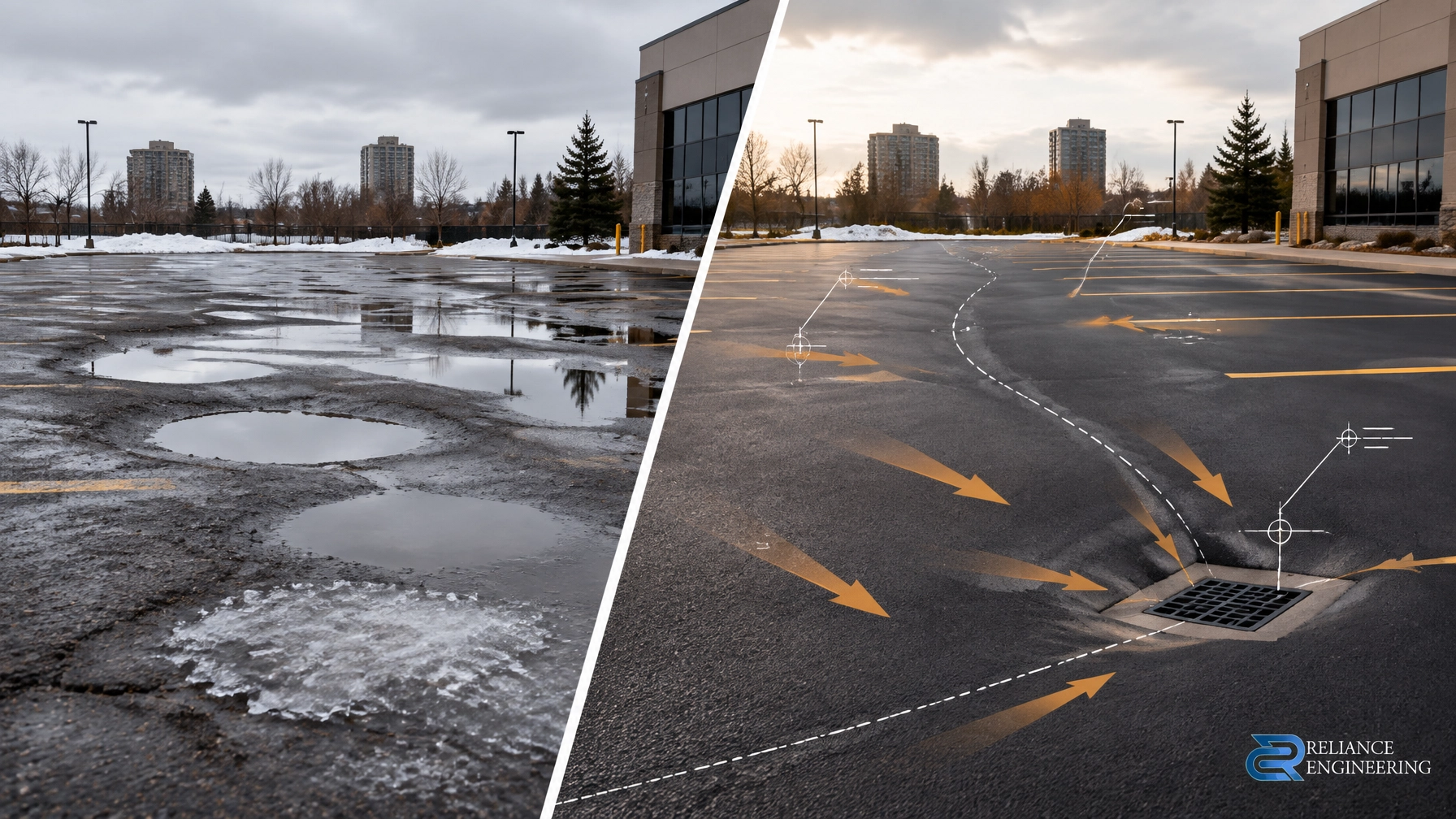
Birdbath ponding usually results from one or more of the following:
- Settled asphalt panels
- Reverse or insufficient surface slopes
- Catchbasin rims that sit too high
- Low points located away from catchbasins
- Uneven asphalt lifts
- Failed base or subgrade preparation
- Driveway tie-ins that push water back into the site
- Curbs, sidewalks, or landscaping that interrupt drainage
- Blocked or damaged private storm connections
- Overland flow routes that no longer reach an approved outlet
A fresh asphalt lift may hide these conditions temporarily. It does not create positive drainage unless the underlying elevations and final surface grades are coordinated.
In Ottawa’s freeze-thaw climate, water left on the pavement can freeze overnight, expand into cracks, and weaken the asphalt structure. Repeated icing also creates slip hazards, maintenance problems, and potential liability for commercial property owners.
The practical objective is simple: water should move continuously from high points toward a catchbasin, swale, curb outlet, municipal storm system, private storm connection, or another approved drainage outlet.
Field-verify the lot before the paver arrives
A drawing based only on old plans may not show what exists today. Commercial parking lots settle, catchbasin rims are adjusted, curbs are repaired, and previous asphalt overlays change the relationship between the pavement and drainage infrastructure.
A proper Ottawa asphalt regrading review should field-verify:
- Existing asphalt elevations and visible low points
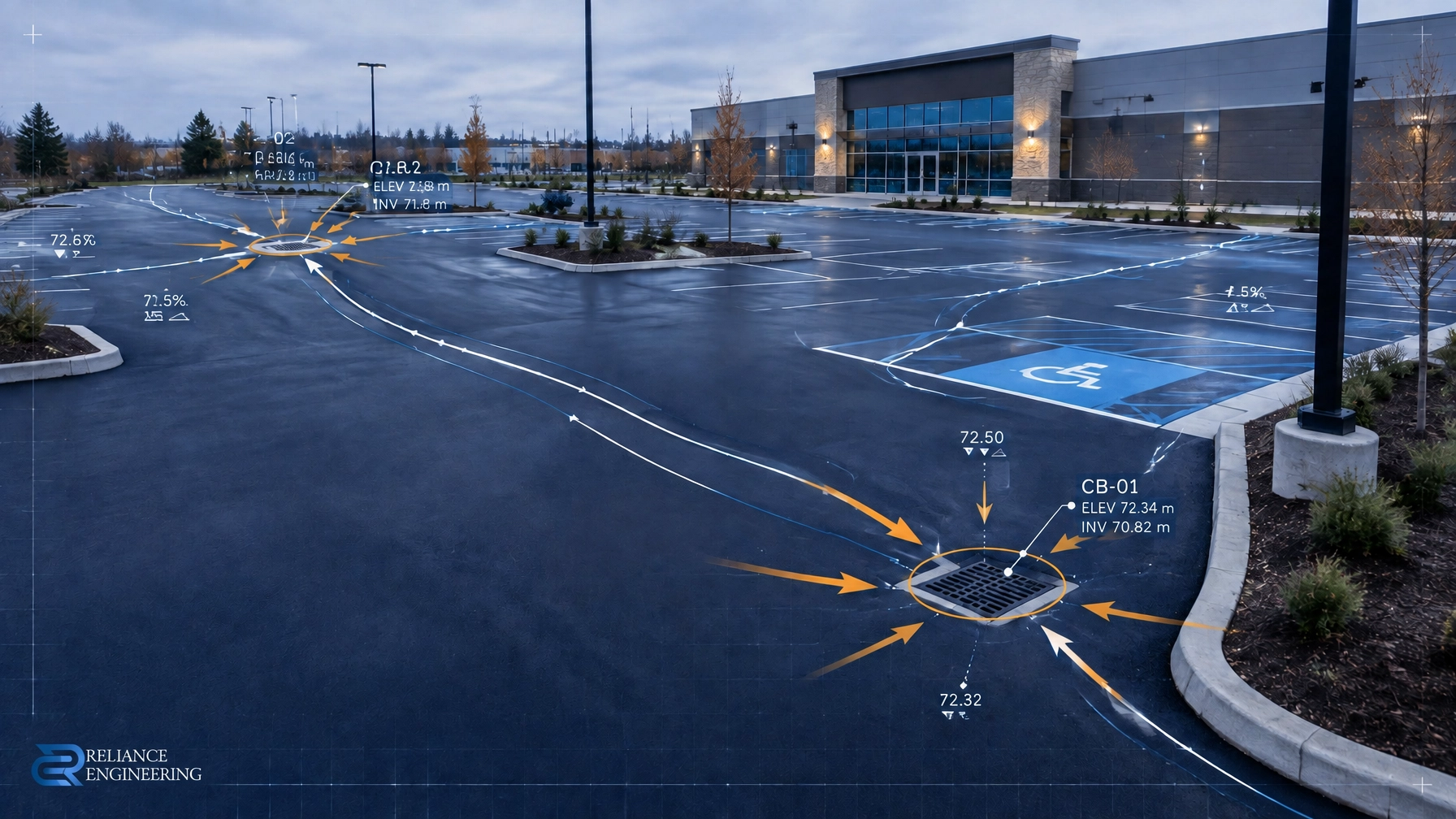
- Catchbasin grate and rim elevations
- Catchbasin locations relative to the proposed drainage areas
- Storm manholes and private storm connections
- Curbs, gutters, sidewalks, and accessible routes
- Building entrances, loading doors, and foundation elevations
- Parking stall and drive aisle grades
- Property line and road elevations
- Driveway and road tie-ins
- Existing swales, ditches, and overland flow routes
- Asphalt panel joints and areas of visible settlement
- Snow storage areas that may block drainage
The survey should compare actual field conditions with the approved grading and drainage pattern. This is important because the City of Ottawa expects approved drainage patterns to be maintained. A repair cannot simply redirect runoff to a neighbouring property, sidewalk, right-of-way, easement, or an unapproved low area.

Confirm the catchbasin rim before setting asphalt grades
A catchbasin should function as part of the overall grading design. Its rim must be low enough to intercept surface runoff, but it should not create an unsafe depression or interfere with vehicles and pedestrians.
Before repaving, review:
- Existing and proposed catchbasin rim elevations
- Grate condition and accessibility for maintenance
- Pipe inverts and direction of flow
- Connection to the municipal storm system or private storm connection
- Sediment, debris, or structural damage
- Proposed asphalt thickness and finished surface elevation
- Whether a new inlet or drain is required
If the catchbasin rim is too high, water may remain on the asphalt even when the surface appears generally sloped. If the rim is too low, the surrounding asphalt may form an abrupt depression that collects debris and creates a vehicle hazard.
The final grading plan should coordinate the catchbasin elevations with the asphalt contractor’s proposed milling, base correction, overlay, and surface course. This reduces the risk of completing the paving work and then discovering that the inlet is still ineffective.
Regrade asphalt panels, not just isolated potholes
A patch is not a drainage design.
Where ponding extends across an asphalt panel, the better solution may involve milling high areas, rebuilding the base, placing a tapered asphalt lift, or adjusting the surrounding pavement to establish a continuous drainage path.
Each panel or drainage area should be reviewed for:
- Cross-fall toward the intended outlet
- Longitudinal slope along the drive aisle
- Transitions between parking bays
- Curb and gutter elevations
- Accessible parking and walkway grades
- Building entrance thresholds
- Snow and ice accumulation areas
- Connection to adjacent pavement panels
The design must provide buildable grading. Very shallow grades can be difficult to construct accurately and may lose their drainage function after settlement. The final design should also avoid abrupt changes that create trip hazards, vehicle impacts, or accessibility concerns.
A clear grading plan should identify spot elevations at:
- High and low points
- Catchbasin rims and manhole covers
- Pavement edges and curb lines
- Parking stall corners
- Driveway entrances
- Road tie-ins
- Walkways and ramps
- Building entrances
- Property boundaries
- Changes in grade
- Swales and other overland drainage routes
The City of Ottawa’s servicing and grading plan requirements identify the need for existing and proposed elevations, drainage arrows, catchbasin elevations, driveway details, surface water outlets, and critical grade control points.
Preserve the approved drainage pattern
The City of Ottawa explains that property owners are responsible for maintaining the established lot grading and drainage pattern. Its lot grading and drainage guidance also warns against filling or obstructing swales, covering catchbasins, or altering grades in a way that negatively affects drainage.
This applies when repairing commercial asphalt as well.
Before changing grades, confirm whether the work affects:
- An approved lot grading plan
- A municipal storm connection
- A private storm sewer
- A road or driveway entrance
- A public right-of-way
- A drainage easement
- A neighbouring property
- A regulated watercourse, wetland, or flood-prone area
Ottawa properties may also fall within the jurisdiction of Rideau Valley Conservation Authority, Mississippi Valley Conservation Authority, or South Nation Conservation. Conservation Authority requirements may apply where work affects regulated lands, watercourses, wetlands, steep slopes, floodplain limits, or stormwater discharge.
The applicable requirements should be confirmed before construction rather than after a drainage complaint or inspection issue.
Design the overland flow route before winter does
Catchbasins and storm sewers provide the minor drainage system. The overland flow routes provide a safe path for runoff when rainfall exceeds inlet or pipe capacity.
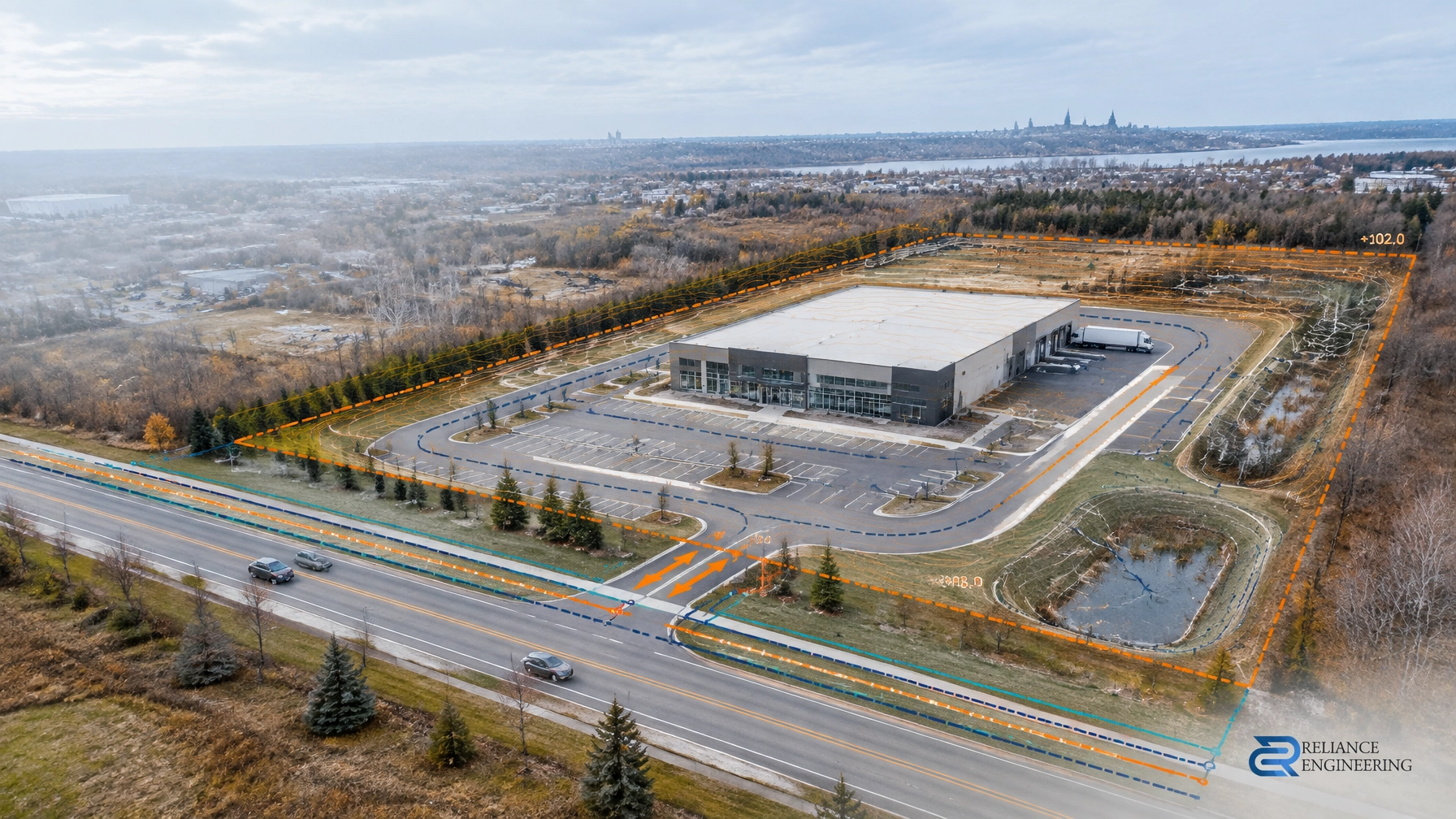
A commercial lot should have a defined route from the parking surface to an approved outlet. This route may pass through a drive aisle, curb opening, grassed swale, landscaped corridor, driveway entrance, municipal road system, or stormwater management facility.
It should not direct water toward:
- Building entrances
- Loading doors
- Accessible routes
- Adjacent properties
- Retaining walls
- Unprotected slopes
- Snow storage areas
- Areas where debris will block the flow
A drainage-focused approach considers both everyday rainfall and larger storm events. Where storage, ponding limits, or outlet controls are part of the design, a stormwater management report may be required.
Coordinate paving with erosion and sediment controls
If regrading involves excavation, base replacement, catchbasin work, or connections to storm infrastructure, construction runoff must also be controlled.
An Erosion and Sediment Control Plan can coordinate:
- Catchbasin protection
- Mud mats and construction access
- Silt fencing
- Stockpile protection
- Sediment traps
- Construction limits
- Dewatering controls
- Inspection and maintenance notes
These controls protect municipal storm systems, private drainage infrastructure, roads, ditches, and neighbouring properties while the site is being rebuilt.
Use a coordinated, permit-ready drawing package
A successful repair may require more than a paving contractor’s field sketch. Depending on the scope, the civil package may include:
- Site Grading Plan
- Site Servicing Plan
- Stormwater Management Report
- Erosion and Sediment Control Plan
- Catchbasin and storm connection details
- Road and driveway tie-in details
- Accessible route coordination
- Overland flow route mapping
- Construction notes and elevation controls
Reliance Engineering prepares practical designs, clear drawings, buildable grading, and permit-ready drawings coordinated with municipal requirements and site conditions.
For reference, review or download Naresh Ochani’s 2026.015 grading plan for 2194 Frank Bender Street, Ottawa. A project-specific grading plan must still be prepared using current survey information and verified field conditions.
Fix the grade before the paver mobilizes
Before approving a repaving schedule, have the drainage system reviewed. The correct solution may involve:
- Catchbasin rim adjustment
- Asphalt panel regrading
- Milling and resurfacing
- Base or subgrade correction
- New inlet or trench drain installation
- Curb and gutter revisions
- Driveway tie-in corrections
- Storm connection coordination
- Overland flow route improvements
- Updated municipal or Conservation Authority approvals

Consultation and professional credentials

Naresh Ochani, P.Eng. M.Eng.
PEO Certificate of Authorization: 100548882
Reliance Engineering provides civil engineering services across Ontario, including:
- Site Grading Plans
- Site Servicing Plans
- Erosion and Sediment Control Plans
- Stormwater Management Reports
- Functional Servicing Reports
- Site Plan Approval Drawings
- OPA/ZBA Drawings
- Severance and Consent Application Drawings
- Building Permit Drawings
Reliance Engineering
6850 Millcreek Dr, Mississauga, ON L5N 2H4
Phone: 647-385-6418
Email: [email protected]
Office hours: Monday–Friday 9:00 AM–5:00 PM; Saturday 12:00 PM–2:00 PM; Sunday Closed
Planning Ottawa asphalt regrading before your next paving project?
Contact Reliance Engineering before the paver arrives. We can review existing conditions, verify the drainage grade, coordinate catchbasins and storm connections, and prepare clear, permit-ready drawings for municipal approval.