In the world of Ontario land development, timing is everything. For property developers, builders, and commercial project owners, the interval between project inception and the first shovel in the ground is a high-stakes race against carrying costs, market shifts, and regulatory changes. At the heart of this timeline sits one critical technical document: the Functional Servicing Report (FSR).
If prepared with precision and deep municipal insight, an FSR is the engine that drives your project through the approval gates of the Site Plan Approval (SPA) process. If handled poorly, it becomes a bottleneck: a source of endless municipal "back-and-forth" that can stall a development for months, if not years.
What is a Functional Servicing Report?
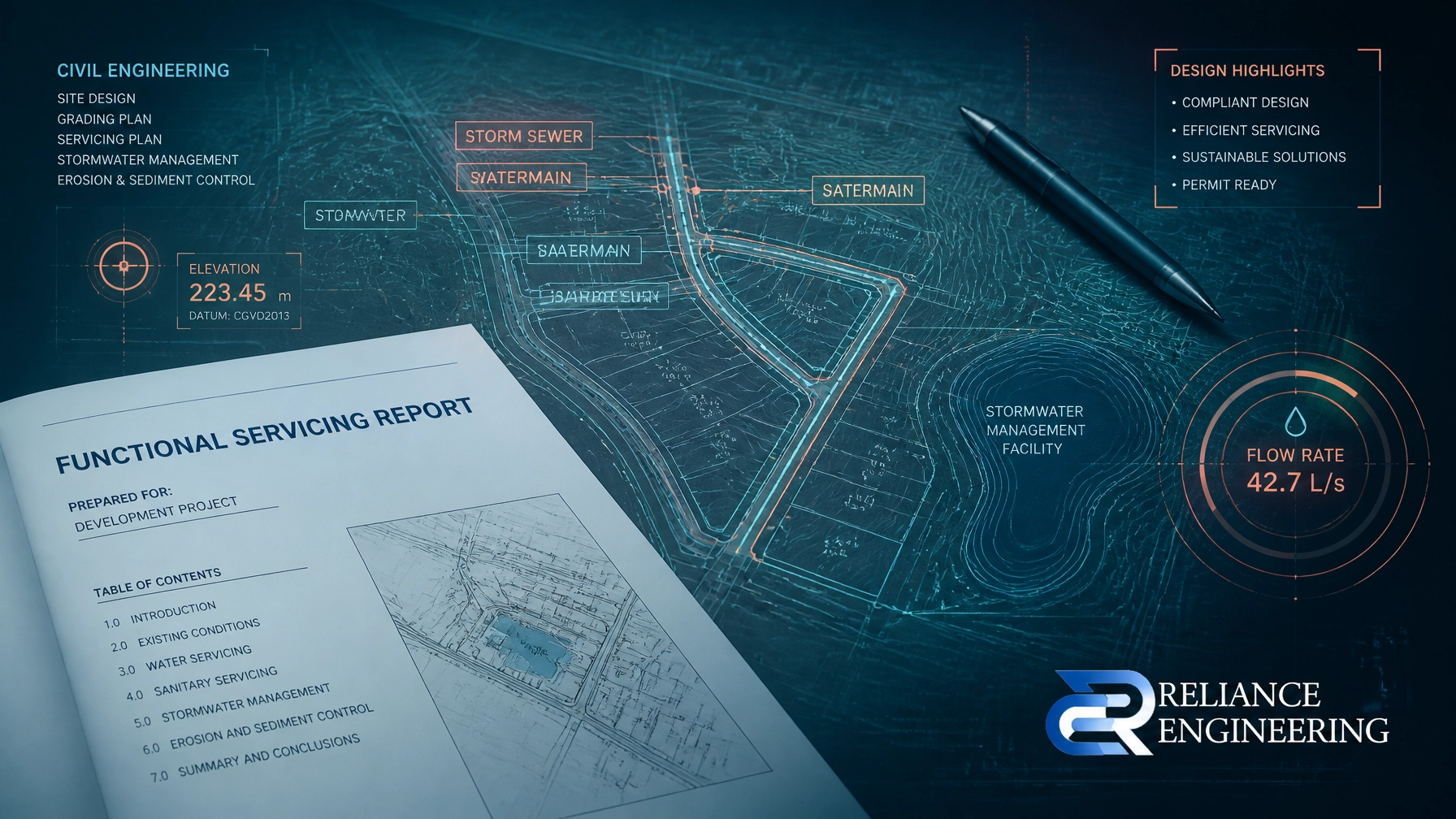
A Functional Servicing Report is a comprehensive engineering study required by municipalities across Ontario to demonstrate that a proposed development can be adequately serviced by existing or planned municipal infrastructure. It is not merely a formality; it is a feasibility proof.
An expert-level FSR addresses four primary pillars:
- Water Servicing: Calculating domestic and fire-flow demands to ensure the local grid can support the new building without compromising existing service.
- Sanitary Servicing: Analyzing projected sewage flows and confirming downstream capacity in the municipal sewer network.
- Stormwater Management: Outlining the high-level strategy for handling runoff, which must then be detailed in a separate Stormwater Management Report.
- Site Access and Grading: Establishing the functional layout that ensures the site is buildable and accessible.
At Reliance Engineering, we treat the FSR as a strategic roadmap. It bridges the gap between a conceptual architectural plan and the final Site Servicing Plans required for a building permit.

The "Break" Scenario: Why FSRs Fail Municipal Review
Most developers who experience "approval hell" can trace the origin back to a flawed FSR. Municipal engineering departments in Ontario are under-resourced and highly risk-aversive. If an FSR contains "messy" data or vague assumptions, it will be sent back for revision immediately.
Common pitfalls that break a timeline include:
- Lack of Coordinated Design: When the FSR suggests a servicing strategy that is physically impossible to implement on the Site Grading Plans.
- Ignoring Downstream Capacity: Failing to account for municipal infrastructure bottlenecks that require off-site upgrades.
- Generic Calculations: Using "rule of thumb" estimates instead of the clear calculations required by specific municipal standards.
- Poor Layouts: Drawings that lack clean layouts, making it difficult for municipal reviewers to follow the proposed flow of services.
When a report is rejected, you don't just lose time on the engineering; you lose your "spot in line" with the municipality. At Reliance Engineering, our goal is to get your design approved in one submission by leveraging our 20+ years of municipal experience.
The "Make" Scenario: High-Level Strategy for Developers
A successful Functional Servicing Report does more than just "pass" review; it optimizes the project's profitability. A well-engineered report identifies the most constructible routing for services, reducing excavation costs and avoiding expensive utility conflicts.
Coordination: The Triple Threat
The FSR does not exist in a vacuum. To ensure a smooth approval, we provide a coordinated design package where the FSR, the Stormwater Management Report, and the Site Servicing Plans are developed in lockstep.
- FSR (The Strategy): Defines what can be done and how the site connects to the city.
- Stormwater Management Report (The Control): Implements practical controls for water quality and quantity, ensuring the development meets environmental and municipal criteria.
- Site Servicing Plans (The Execution): Provides the clean layouts and technical details for the contractor to build the project as approved.
By integrating these three elements from day one, we eliminate the risk of conflicting designs that often emerge when developers hire different firms for different components of the civil package.

Technical Precision: Clear Calculations and Clean Layouts
Municipal engineers in Ontario: whether in Mississauga, Toronto, or across the province: look for two things in an FSR: clarity and accountability.
We deliver permit-ready drawings and reports that feature clear calculations for fire flow (FUS or OBC standards), sanitary peaking factors, and hydraulic analysis. We don't hide behind engineering jargon. We present the data in a way that makes the municipal reviewer's job easier. When the reviewer can clearly see that our constructible routing adheres to all setbacks and depth requirements, the path to approval is cleared.
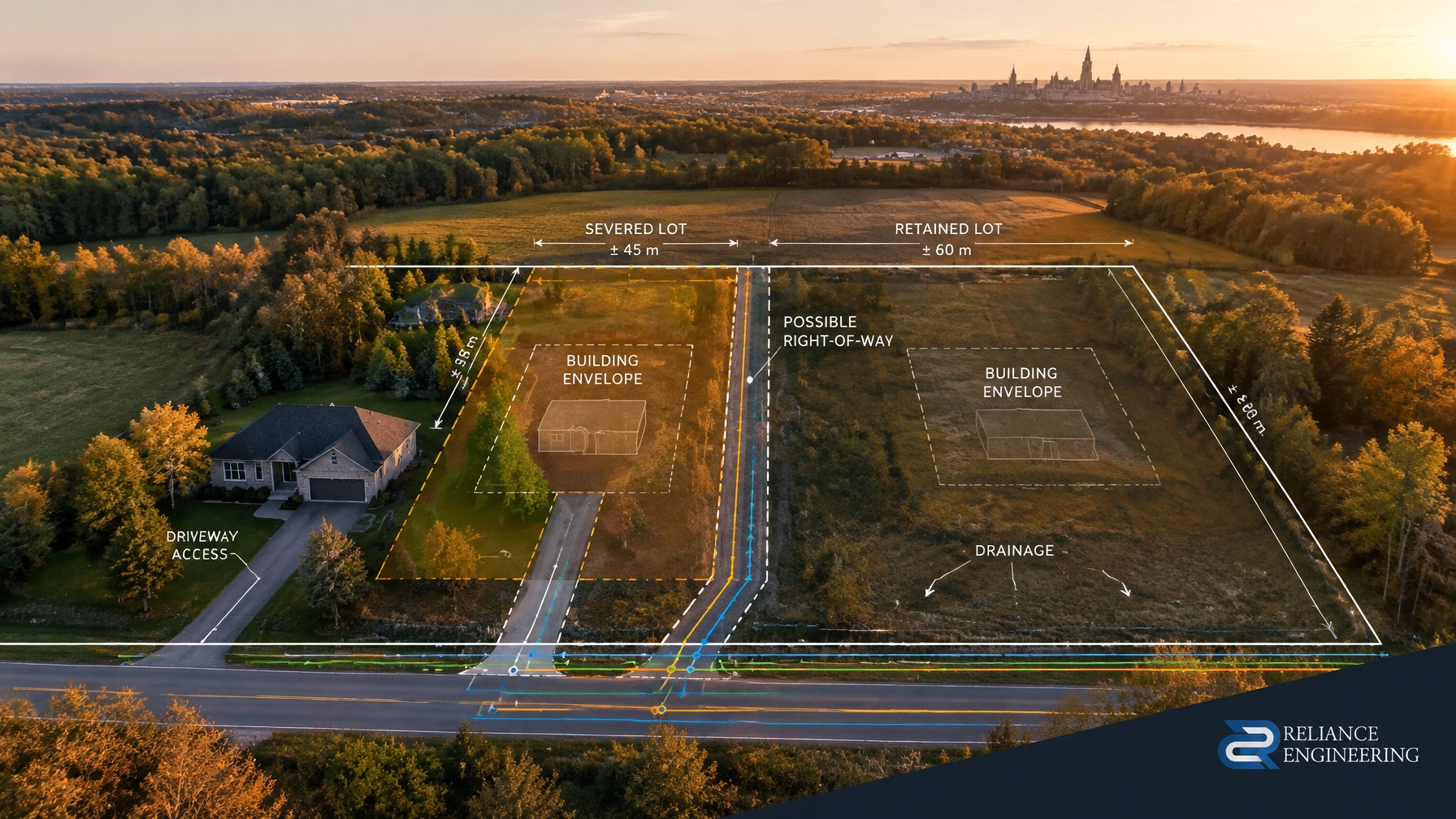
Our attention to detail extends to Erosion and Sediment Control Plans and Land Severance Drawings, ensuring that every technical document supporting your application is held to the same high standard of precision.
Why Municipal Experience is Your Greatest Asset
The "hidden" factor in engineering approvals is the relationship with the municipality. Each city in Ontario has its own nuances: Vaughan's requirements differ from Hamilton's; London has different standards than Ottawa.
With over two decades of principal engineer experience, Naresh Ochani, P.Eng. M.Eng., understands these local regulations intimately. This municipal experience allows us to anticipate potential objections before they are raised. We design with the final approval in mind, ensuring that our ZBA / OPA Drawings and Building Permit Drawings are aligned with the high-level functional strategy.

Conclusion: Take Ownership of Your Approval Timeline
A Functional Servicing Report should never be a checkbox on a list; it is the foundation of your project's technical viability. By choosing an engineering partner that prioritizes coordinated design, clean layouts, and constructible routing, you are not just buying a report: you are securing your project's future.
At Reliance Engineering, we take full ownership of our clients' needs. We are responsive, professional, and dedicated to getting your designs approved efficiently.
Professional Credentials & Contact Information
Reliance Engineering
Authorized by the Association of Professional Engineers of Ontario (PEO)
Certificate of Authorization: 100548882
Lead Engineer: Naresh Ochani, P.Eng. M.Eng.
Address: 6850 Millcreek Dr, Mississauga, ON L5N 2H4
Phone: 647-385-6418
Email: [email protected]
Website: www.relianceengineering.ca
Office Hours:
- Monday – Friday: 9:00 AM – 5:00 PM
- Saturday: 12:00 PM – 2:00 PM
- Sunday: Closed