Executive Summary
- Article type: No-Nonsense Expert Guide
- Published: August 24, 2026
- Focus: Commercial parking lot drainage Ontario, asphalt regrading, ponding solutions, and commercial property grading fixes
- Service area: Ontario
- Prepared by: Reliance Engineering
- Principal Engineer: Naresh Ochani, P.Eng. M.Eng.
- PEO Certificate of Authorization: 100548882
Ponding that returns after repaving is not usually an asphalt problem alone. It is often a grading, settlement, outlet, or construction-control problem that was not fully diagnosed before the repair.
A fresh asphalt surface may look smooth for a short time. However, if the underlying low spots remain, catchbasins are blocked or poorly positioned, or water has no defined route to leave the lot, the ponding will return.
The durable solution is a coordinated drainage design based on accurate elevations, buildable grading, and positive drainage. For commercial properties across Ontario, professional site grading is the starting point for correcting recurring ponding and protecting the pavement, buildings, access routes, and surrounding lands.
Why Parking Lot Ponding Returns After Repaving
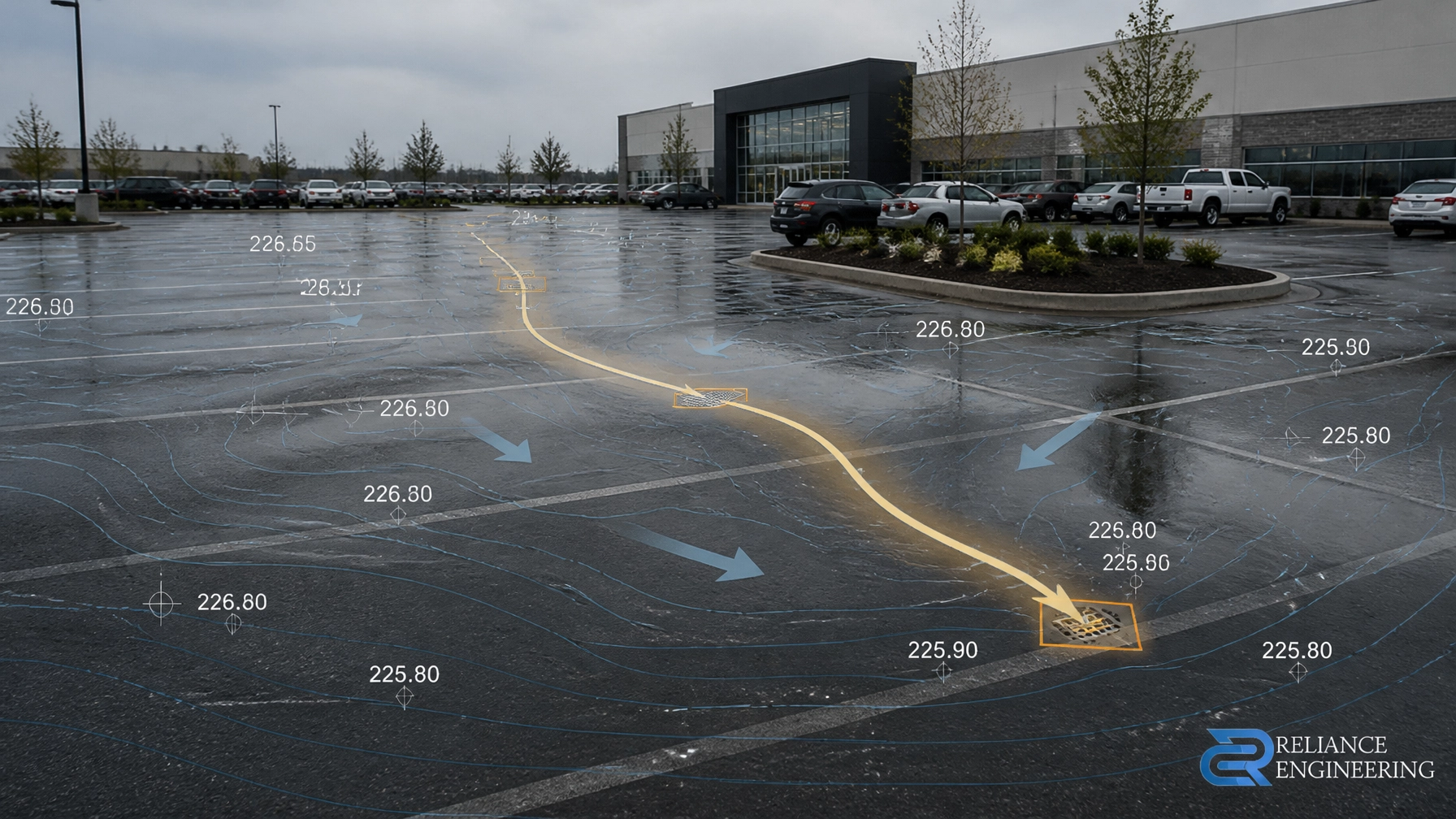
Repaving improves the surface condition of asphalt. It does not automatically correct the grades below it. Several common conditions can cause water to collect again.
1. Settlement Creates New Low Spots
Commercial parking lots experience heavy vehicle loading, seasonal freeze-thaw cycles, water infiltration, and gradual subgrade movement. These conditions can cause the asphalt or granular base to settle.
Settlement creates depressions that function like shallow bowls. Even if the surrounding pavement has a reasonable slope, water will remain trapped in the lowest area unless the depression is removed or properly regraded.
A thin asphalt patch may fill the visible depression temporarily. It does not necessarily correct the sub-base or reconnect the surface to the intended drainage route. When the patch settles or water moves around its edge, the ponding returns.
2. Low Spots Are Not Connected to Drainage Inlets
Every paved area needs a clear route to an approved outlet. If a low point has no catchbasin, area drain, swale, or other designed drainage connection, it will collect water.
This issue is common where:
- Pavement grades have changed over time
- Catchbasins were installed at the wrong elevation
- Asphalt overlays raised the surrounding surface
- Curb islands interrupt sheet flow
- Parking stalls or drive aisles were patched without reviewing the complete lot
The problem is not solved by adding material to one location. The entire drainage pattern must be reviewed so the surface flows continuously toward the intended collection points.
3. Blocked or Damaged Catchbasins Restrict Drainage
A correctly graded parking lot can still pond if the drainage system cannot receive or convey runoff.
Leaves, gravel, construction sediment, pavement debris, and ice can block catchbasin grates or reduce sump capacity. Damaged structures, raised rims, collapsed connections, and blocked storm pipes can create similar symptoms.
Catchbasins should be inspected and cleaned as part of the initial assessment. If the outlet system is not functioning, asphalt regrading alone will not provide a complete ponding solution.
4. Poor Overland Flow Routes Increase Risk
Underground storm infrastructure is important, but it may not handle every major rainfall event. A commercial site also needs safe overland flow routes for excess runoff.
Without defined routes, water can move toward:
- Building entrances
- Loading areas
- Accessible parking spaces
- Adjacent properties
- Public sidewalks and roads
- Unprotected construction areas
New curbs, landscape islands, snow storage areas, temporary stockpiles, and site modifications can obstruct these routes. A drainage-focused design reviews how runoff moves across the property during both regular storms and larger events.

What a Professional Site Grading Review Includes
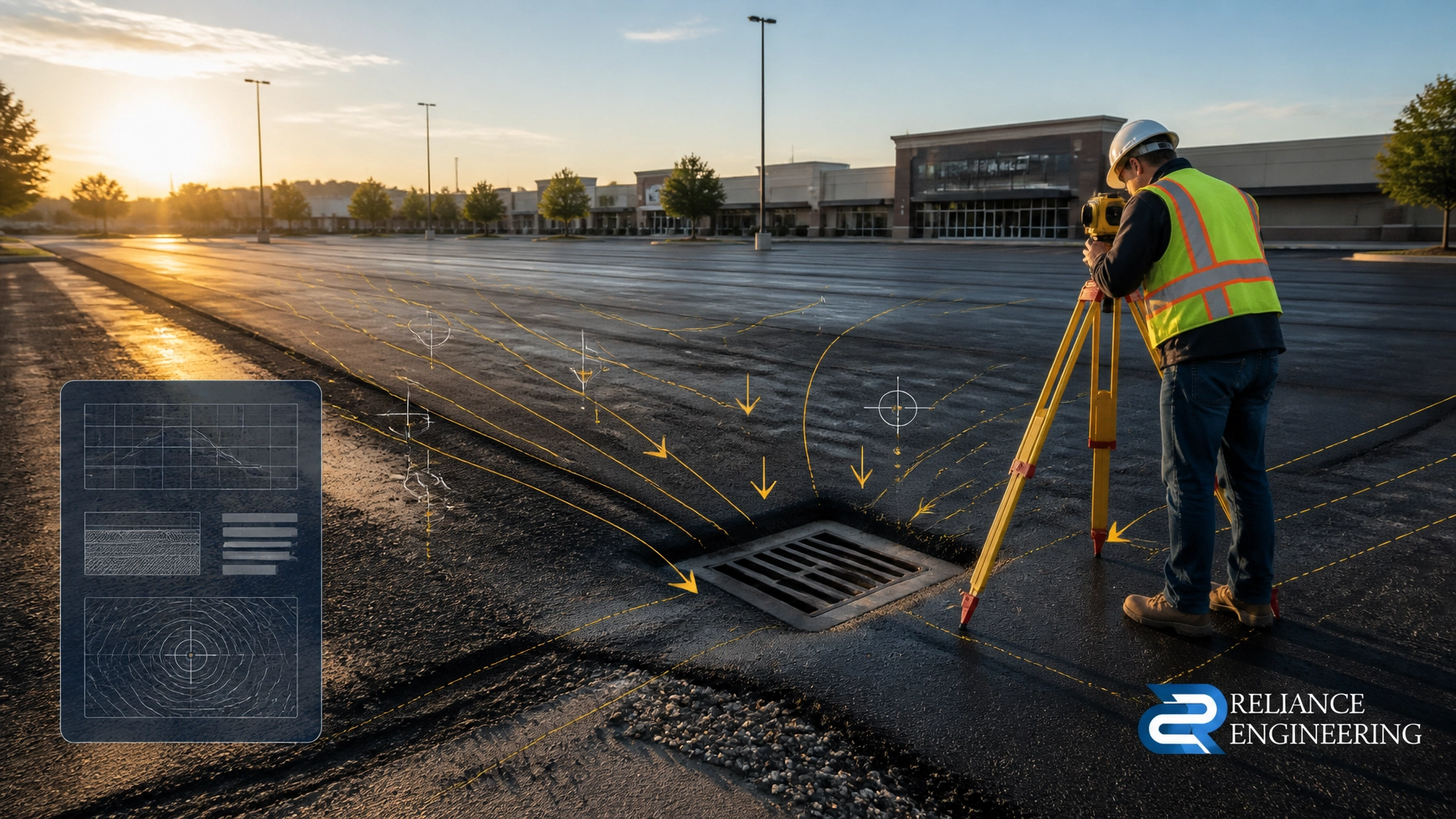
A reliable commercial property grading fix begins with a field-based review rather than a visual patching recommendation.
Reliance Engineering’s Site Grading Plans service uses survey data, architectural information, existing drainage conditions, and municipal requirements to prepare clear and compliant designs.
A typical review considers:
- Existing and proposed elevations
- Asphalt grades and cross-falls
- Parking stalls and drive aisles
- Catchbasin and area drain locations
- Building entrances and finished floor elevations
- Curbs, sidewalks, landscape islands, and retaining walls
- Tie-ins to roads, ditches, and storm systems
- Swales and drainage routes
- Adjacent property drainage
- Erosion and sediment control requirements
The objective is not simply to show more spot elevations. The objective is to develop practical designs that can be constructed accurately and that direct water away from buildings, pedestrian routes, and neighbouring properties.
How Asphalt Regrading Corrects the Root Problem
Asphalt regrading reshapes the pavement profile so water has a continuous path to a functioning outlet.
The appropriate construction method depends on the condition of the asphalt and the underlying base. Potential measures may include:
- Milling high areas to remove excess material and restore the intended slope.
- Excavating and rebuilding settled sections where the granular base or subgrade has failed.
- Recompacting or replacing granular material to provide a stable foundation.
- Placing a leveling course to correct localized depressions.
- Applying a coordinated asphalt overlay where existing curb, entrance, and drainage elevations permit.
- Adjusting catchbasin rims to match the proposed surface elevations.
- Reconnecting flowlines, swales, and tie-ins to maintain positive drainage across the site.
The design must account for more than the middle of the parking lot. It must coordinate the pavement with curbs, sidewalks, entrances, loading docks, accessible routes, catchbasins, storm sewers, and adjacent grades.
This is where buildable grading matters. A design that works only on paper can create construction problems if slopes are too complex, tie-ins are unclear, or elevations do not match existing site conditions. Clear drawings reduce field uncertainty and help contractors complete the work without unnecessary rework.

Positive Drainage Requires Coordinated Civil Design
Parking lot ponding may involve more than surface grading. A complete solution may require coordination with:
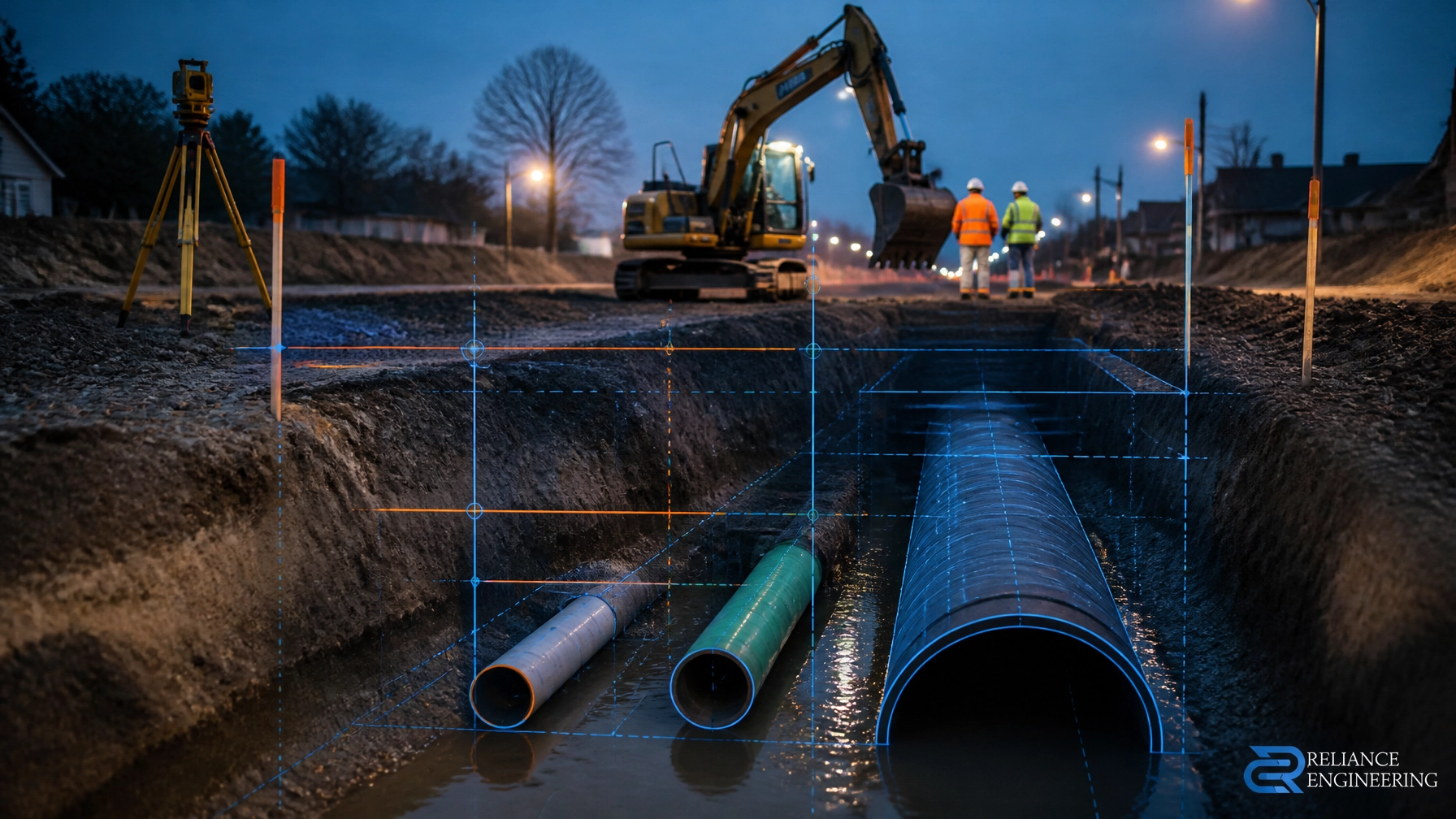
- Site Servicing Plans for storm sewer connections, catchbasins, and pipe layouts
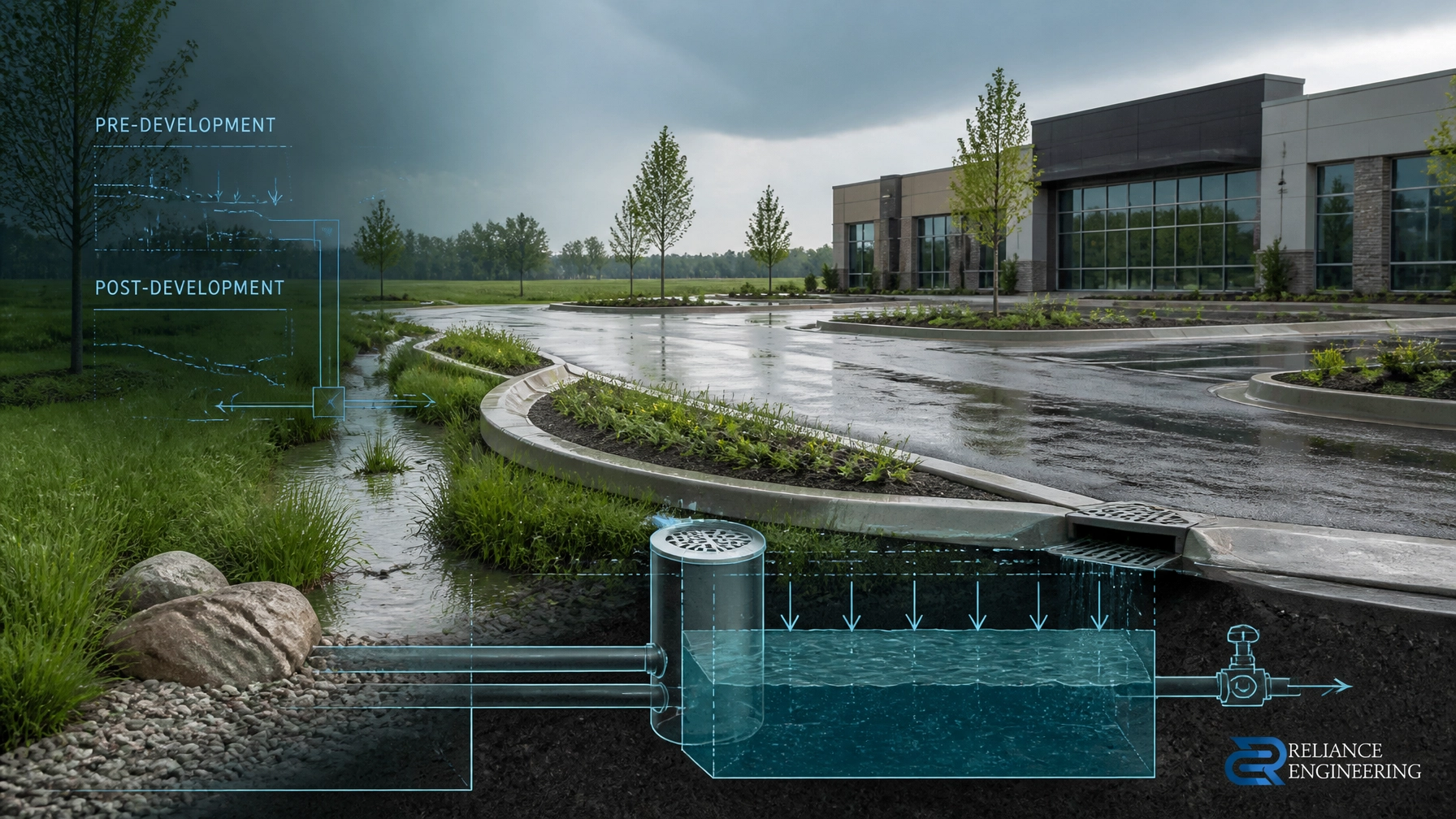
- Stormwater Management Reports where runoff quantity, quality, or discharge requirements apply
- Site plan approval requirements
- Municipal engineering standards
- Conservation authority requirements, where applicable
- Accessibility and entrance grades
- Landscaping and snow storage areas
A coordinated design helps ensure that the proposed asphalt grades, storm servicing, drainage outlets, and overland flow routes work together.
If the drainage pattern changes significantly, municipal review may be required. Depending on the scope, the project may need revised Site Plan Approval Drawings, servicing information, or other approval support.
ESC Must Be Included During Regrading Work
Parking lot drainage repairs often disturb asphalt edges, granular base, soil, landscaped areas, and construction access points. Those disturbed areas can release sediment into catchbasins and storm sewers.
That is why regrading work should be coordinated with an Erosion and Sediment Control Plan.
A practical ESC plan may include:
- Silt fence around disturbed areas
- Stabilized construction access and mud mats
- Catchbasin protection
- Stockpile protection
- Sediment traps or check dams
- Construction limit fencing
- Dewatering notes where required
- Inspection and maintenance requirements
Poor ESC can block the same catchbasins that the drainage work is intended to serve. It can also cause muddy roads, inspection failures, municipal complaints, and environmental impacts.
Reliance Engineering prepares drainage-aware ESC layouts that coordinate with the grading design, construction limits, staging, and overland drainage. The result is a practical control plan that contractors can install and maintain.

What Property Owners Should Do Before Repaving
Before approving another asphalt repair, commercial property owners and managers should ask:
- Has the lot been surveyed and reviewed for existing elevations?
- Are all ponding locations mapped?
- Have catchbasins, storm pipes, and outlets been inspected?
- Does every low area have a defined drainage route?
- Are building entrances and adjacent properties protected?
- Will the proposed grades preserve accessibility and safe vehicle movement?
- Are overland flow routes identified?
- Is ESC included for the construction phase?
- Are the drawings clear enough for the contractor to build accurately?
- Will the proposed work require municipal approval or submission support?
If the answer to these questions is unclear, repaving may only postpone the problem.
Permit-Ready Drawings for Commercial Drainage Repairs
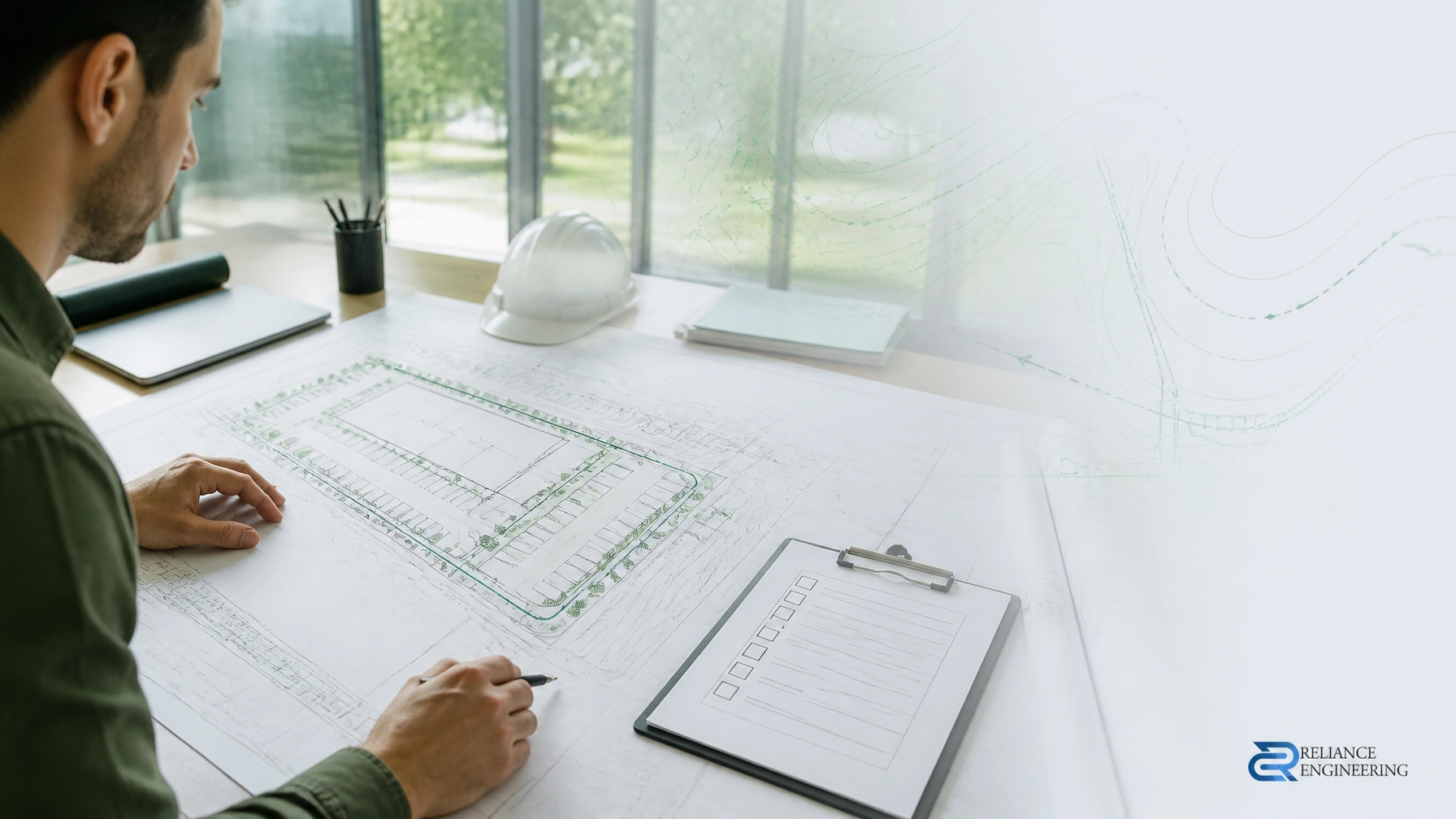
A professional grading package should provide more than a general concept. It should show the elevations, slopes, drainage routes, catchbasin locations, tie-ins, notes, and details needed for review and construction.
Reliance Engineering prepares permit-ready drawings supported by practical civil engineering advice and approval support. Our goal is to provide a drainage-focused approach that addresses the cause of ponding, not just its visible symptoms.
With more than 20 years of principal engineer experience and detailed knowledge of municipal requirements across Ontario, we help commercial owners, developers, builders, architects, contractors, and property managers move from recurring drainage complaints to a clear, buildable correction plan.
Book a Commercial Parking Lot Drainage Consultation
If ponding returns after repaving, arrange a professional review before committing to another temporary patch.
Contact Reliance Engineering to discuss commercial parking lot drainage, asphalt regrading, and commercial property grading fixes across Ontario.
Contact Information
- Address: 6850 Millcreek Dr, Mississauga, ON L5N 2H4
- Phone: 647-385-6418
- Email: [email protected]
- Website: www.relianceengineering.ca
- Office Hours: Saturday 12:00 PM–2:00 PM; Sunday Closed
Professional Credentials
- Naresh Ochani, P.Eng. M.Eng.
- PEO Certificate of Authorization: 100548882
Request a consultation for a practical drainage assessment and permit-ready grading solution.