Article type: How-to / technical advisory
Focus: Grading and drainage improvements for commercial parking lots
Service area: Ontario
Prepared by: Reliance Engineering Canada Limited
Commercial parking lot drainage problems rarely remain minor. A small area of standing water can become ice buildup in winter, damaged asphalt in spring, and a recurring maintenance expense throughout the year.
For property owners, builders, and facility managers, the right solution is usually not another patch or an uncoordinated asphalt overlay. The durable approach is to investigate the existing grades, identify the drainage failures, and prepare a coordinated plan for asphalt regrading, catch basin improvements, and safe runoff routes.
Reliance Engineering provides practical designs, clear drawings, and approval support for commercial property grading fixes across Ontario.
Standing Water Is a Grading Problem
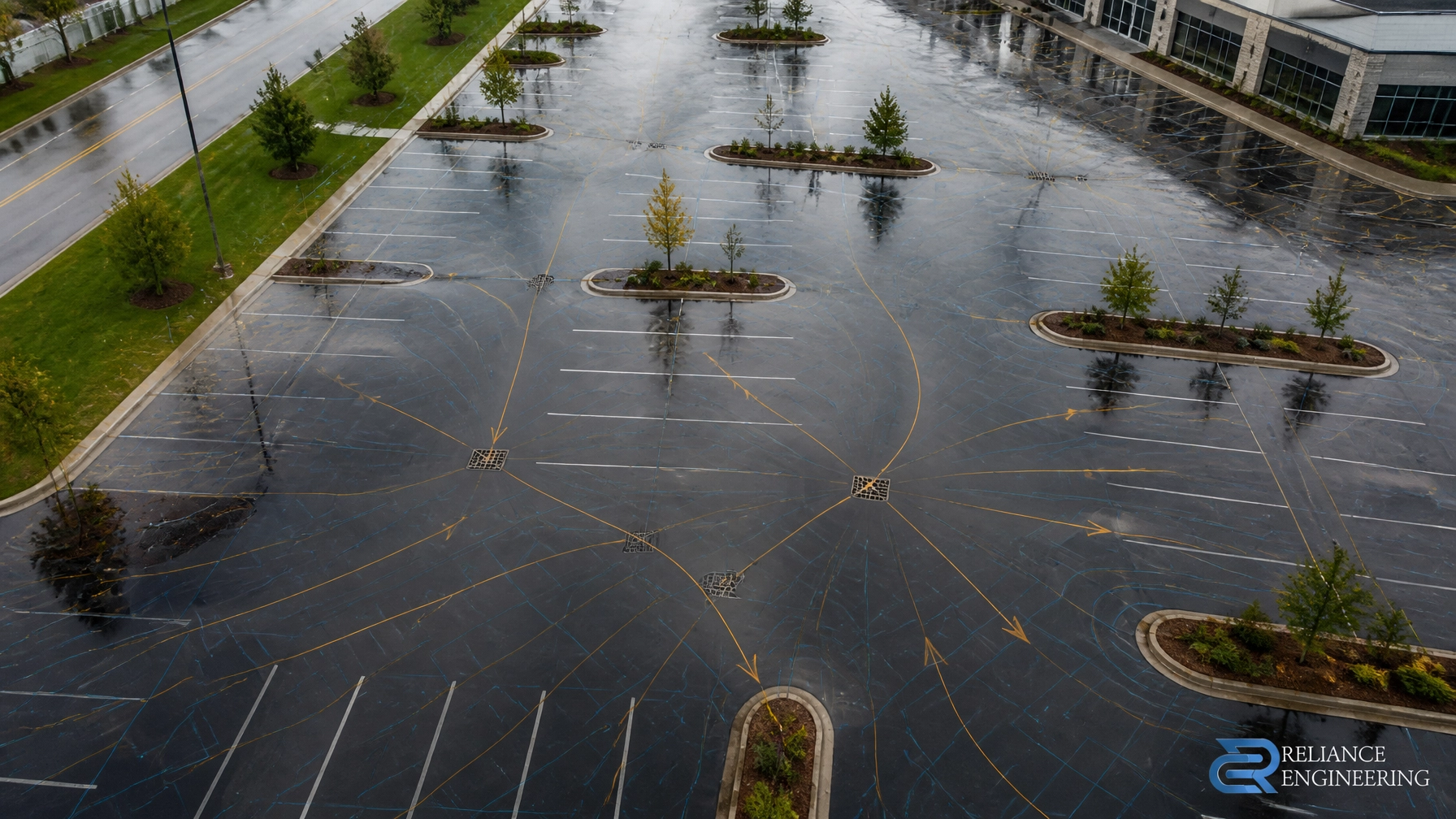
Water should move away from buildings, pedestrian routes, loading areas, and parking stalls toward an appropriate collection point. When water remains on the surface after rainfall or snowmelt, the parking lot likely has one or more of the following issues:
- Low areas caused by asphalt or granular base settlement
- Insufficient cross-slope or longitudinal slope
- Catch basins set too high or located away from natural low points
- Blocked inlets, damaged grates, or undersized drainage infrastructure
- Reverse grades created during resurfacing
- Snow storage placed across drainage paths
- Uncoordinated changes to curbs, entrances, loading areas, or landscape features
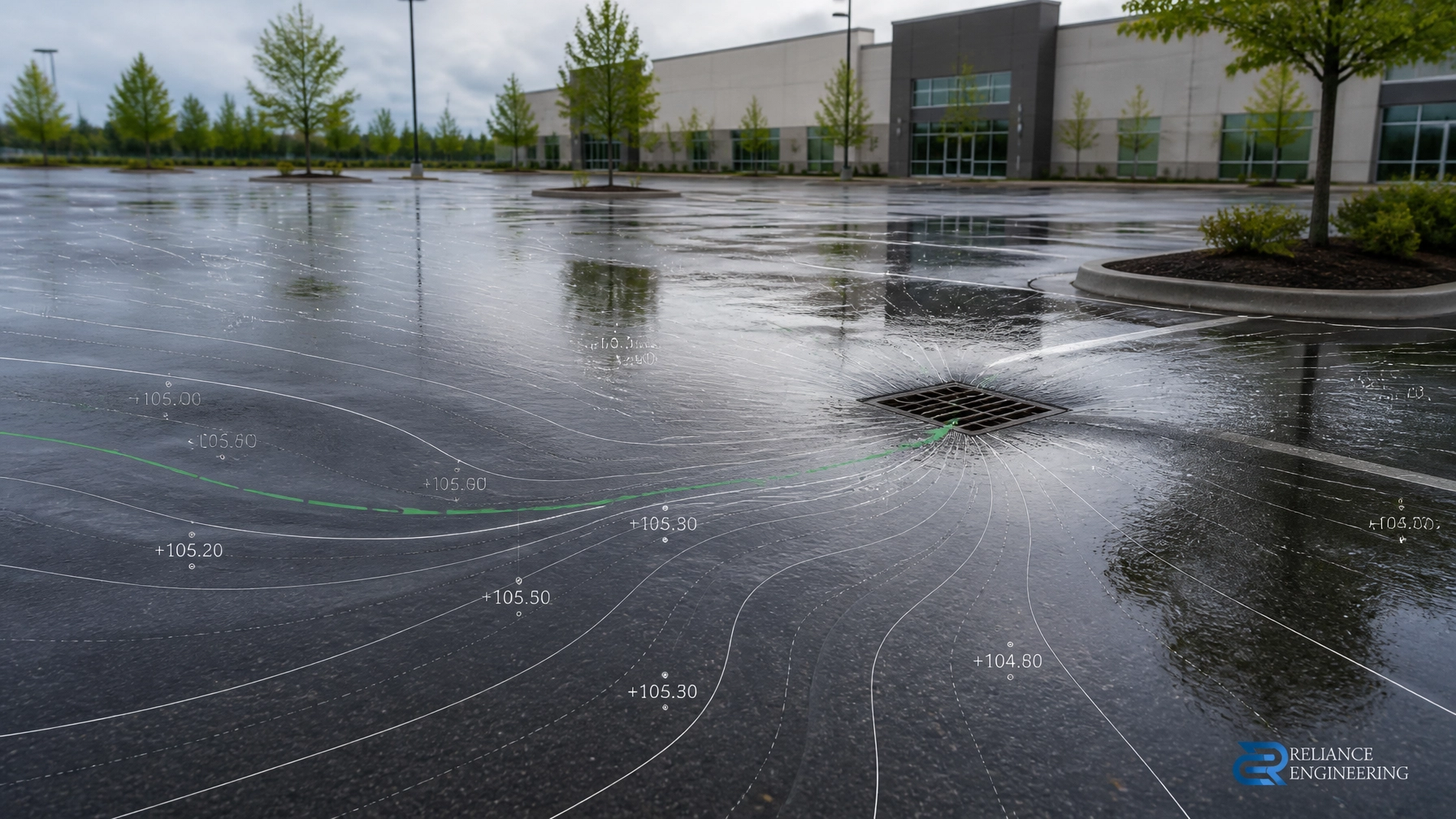
A surface can appear generally flat while still containing several small depressions. These depressions collect water, sediment, salt, and debris. Over time, the problem becomes visible through darkened asphalt, cracking, potholes, frost damage, and recurring ice.
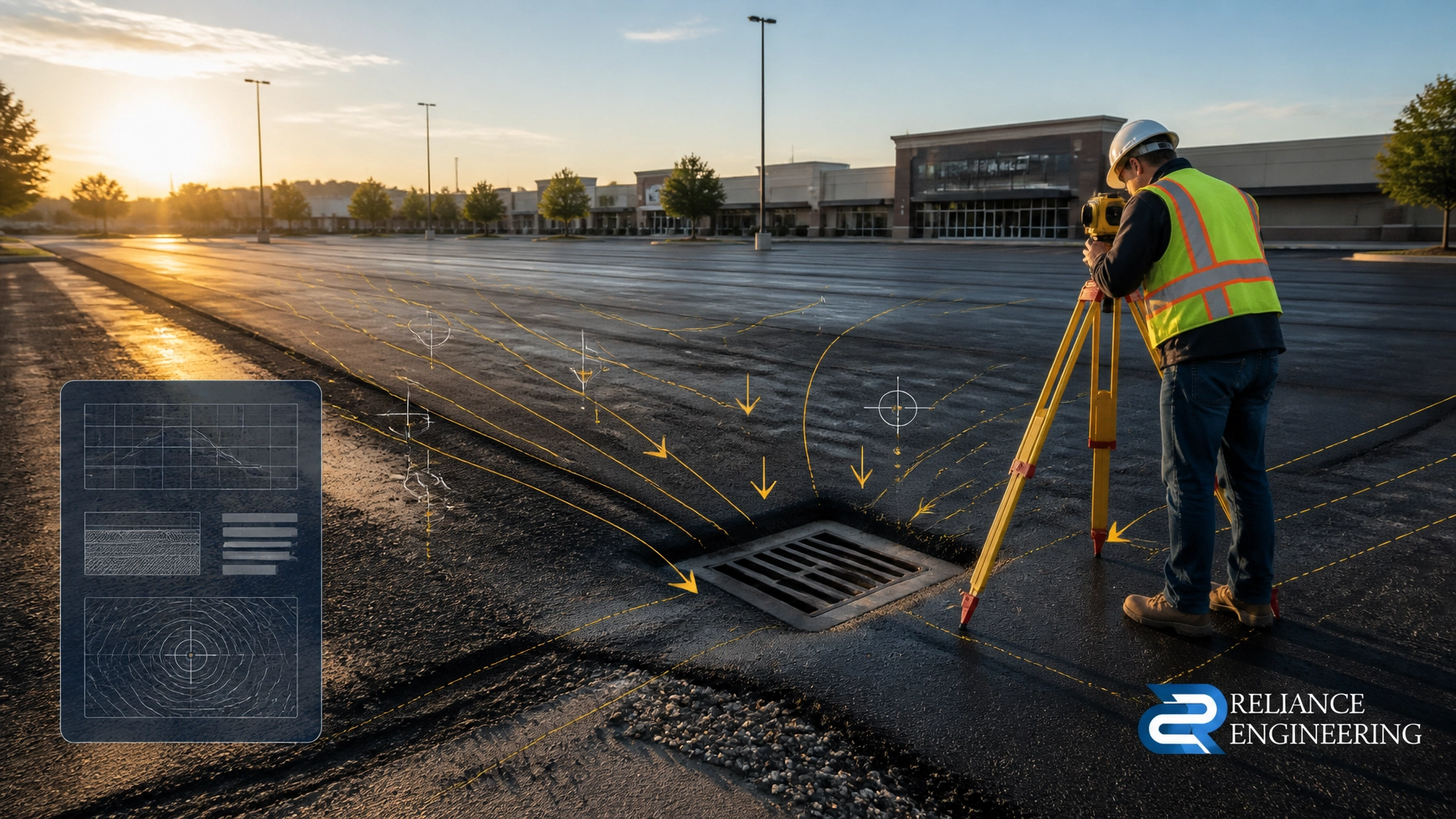
A professional Site Grading Plan identifies existing and proposed elevations, slope directions, catch basin locations, swales, driveway grades, and overland flow routes. It converts a visible ponding problem into a measurable design issue.
Why Positive Drainage Matters in Ontario
Positive drainage means the finished surface is shaped so water consistently flows toward a planned outlet. There should be no unserved low point where runoff can collect beside a building, in a drive aisle, or at a pedestrian crossing.
This is particularly important in Ontario because water that enters cracks or the pavement structure can freeze and expand. Repeated freeze–thaw cycles weaken asphalt, granular materials, and the subgrade. When heavy vehicles use the affected area, pavement deformation accelerates.
Poor drainage can lead to:
- Ice sheets in parking stalls and drive aisles
- Slippery conditions near entrances and sidewalks
- Increased salting and snow-removal requirements
- Cracking, potholes, and edge deterioration
- Saturated granular base materials
- Damage around catch basin frames
- Flooding at loading doors or building entrances
- Premature pavement replacement
- Construction rework after resurfacing
The Lake Simcoe Region Conservation Authority parking lot design guidelines also recognize the connection between parking lot grades, drainage, and winter salt reduction. Better drainage helps limit the amount of water that freezes and reduces dependence on excessive salting.
Asphalt Regrading Is More Than an Overlay
A standard overlay can improve appearance, but it may not correct the underlying drainage pattern. If the existing lot has reverse slopes or multiple low points, placing new asphalt over the same profile can preserve the problem: or create new ones.
Asphalt regrading should begin with an assessment of the existing surface and drainage system. The design team should confirm:
- Existing elevations and pavement slopes
- The location and condition of catch basins and area drains
- Building entrances, loading doors, curbs, sidewalks, and accessibility routes
- Storm sewer connections and available outlets
- Snow storage areas and winter maintenance routes
- Existing or proposed overland flow routes
- Areas of settlement, cracking, and base failure
Depending on the site, the correction may include milling high areas, placing tapered asphalt lifts, reconstructing localized pavement sections, resetting catch basin frames, adding inlets, or modifying storm drainage infrastructure.
The objective is simple: every portion of the parking lot should have a clear drainage function. Water must move predictably without crossing building entrances, collecting at the bottom of a drive aisle, or flowing toward neighbouring properties.

Selecting the Right Ponding Solutions
Not every parking lot requires complete reconstruction. The appropriate ponding solutions depend on the extent of the problem, the condition of the pavement structure, and the available drainage outlets.
Localized correction
If ponding is limited to a few small areas, localized removal and replacement may be effective. The affected section can be rebuilt with proper subgrade preparation and a corrected finished grade.
Milling and resurfacing
Where the surface contains widespread settlement or inconsistent slopes, milling can remove high points and allow the new asphalt surface to be placed at the required elevations. This approach is useful when the existing base remains serviceable.
Tapered asphalt overlay
A tapered overlay can build up a localized depression and guide water toward an existing inlet. This must be carefully coordinated with curb reveal, door thresholds, accessible routes, and adjacent pavement.
Catch basin or area drain improvements
If a low point cannot be corrected through grading alone, a new catch basin, area drain, or trench drain may be required. The inlet must be coordinated with the proposed surface elevations and connected to an appropriate storm system.
Trench drains at critical locations
Trench drains can intercept runoff across loading aprons, building entrances, and other locations where broad sheet flow may create operational or safety concerns.
A grading-focused review prevents property owners from spending money on a surface treatment that does not solve the drainage cause.
Coordinate Grading With Site Servicing
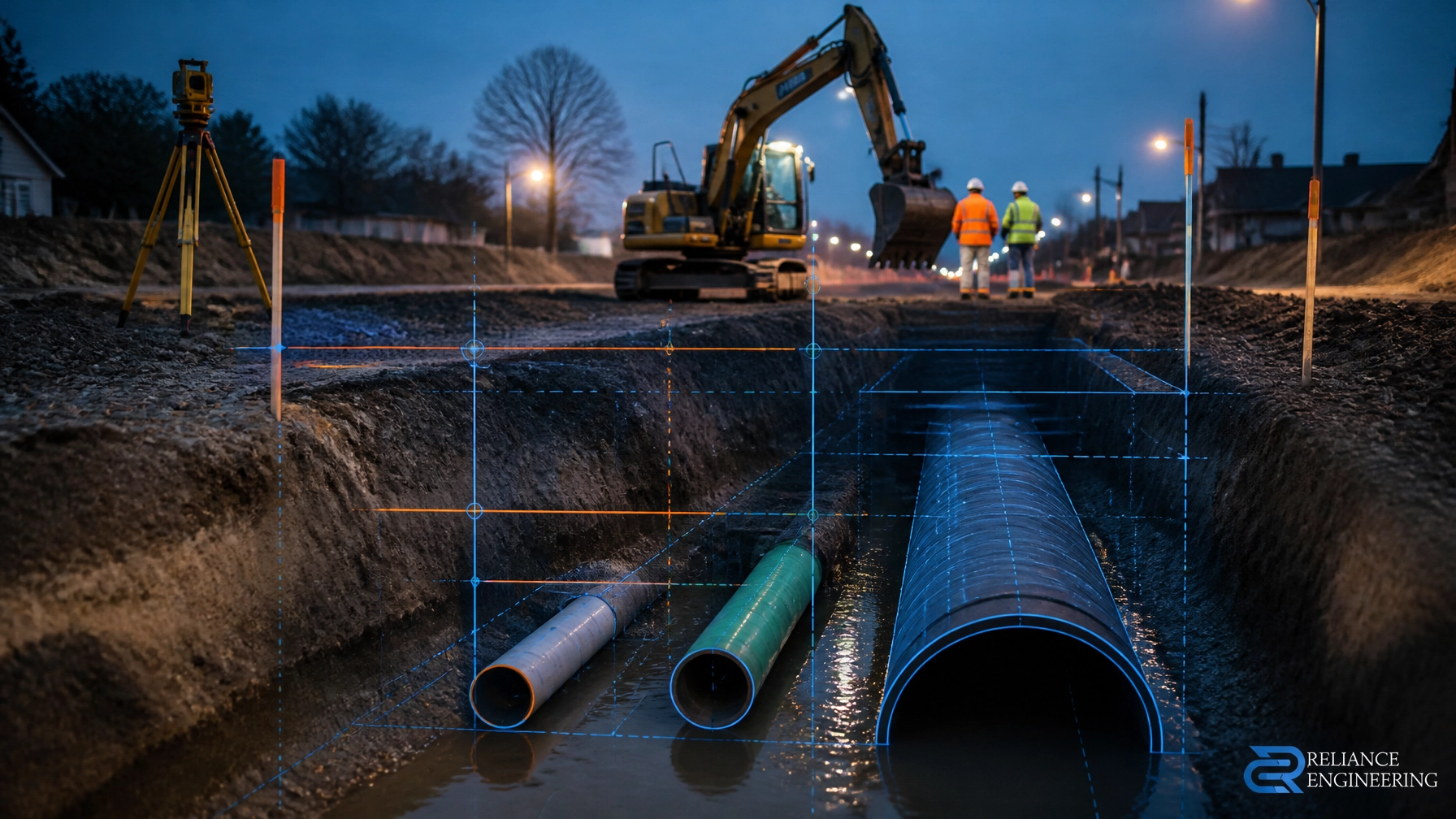
Parking lot drainage cannot always be solved through surface grades alone. The pavement design must be coordinated with underground services, storm sewer capacity, curbs, landscaping, and building connections.
Reliance Engineering’s Site Servicing Plans coordinate storm, sanitary, and water infrastructure with the overall site layout. A Stormwater Management Report may also be required where the project changes runoff volumes, discharge rates, storage requirements, or municipal drainage conditions.
This coordinated design approach helps avoid common conflicts, such as:
- A catch basin shown on the plan but disconnected from the storm system
- A storm pipe that cannot accommodate the proposed inflow
- A parking lot grade that drains toward a building entrance
- A landscape island that blocks an overland flow route
- A curb or sidewalk that creates a new low point
- A resurfacing design that conflicts with accessible grades
- Construction elevations that do not match the approved drawings
Clear coordination at the design stage is less expensive than correcting these problems after paving.
Erosion and Sediment Control Must Protect the Drainage System
Drainage improvements can fail during construction if sediment is allowed to enter catch basins and storm sewers. Commercial parking lot projects often involve exposed soil, demolition, excavation, stockpiling, and heavy vehicle traffic. Without practical controls, sediment can block inlets and damage downstream infrastructure.
An Erosion and Sediment Control Plan should be coordinated with the grading and construction sequence. Depending on the site, the plan may include:
- Silt fence and construction limit fencing
- Mud mats at construction entrances
- Catch basin protection
- Stockpile protection
- Sediment traps and check dams
- Dewatering notes
- Inspection and maintenance requirements
- Defined construction-stage drainage routes
The purpose is not to add generic notes to a drawing. The purpose is to keep sediment on site, protect municipal infrastructure, and maintain the drainage system while construction proceeds.

A Practical Process for Commercial Property Grading Fixes
A reliable parking lot drainage correction typically follows four steps.
1. Review the existing condition
Collect available surveys, site plans, paving records, drainage information, photographs, and maintenance history. Field observations should document ponding locations, ice buildup, settlement, cracked pavement, blocked inlets, and snow storage practices.
2. Prepare the grading and drainage design
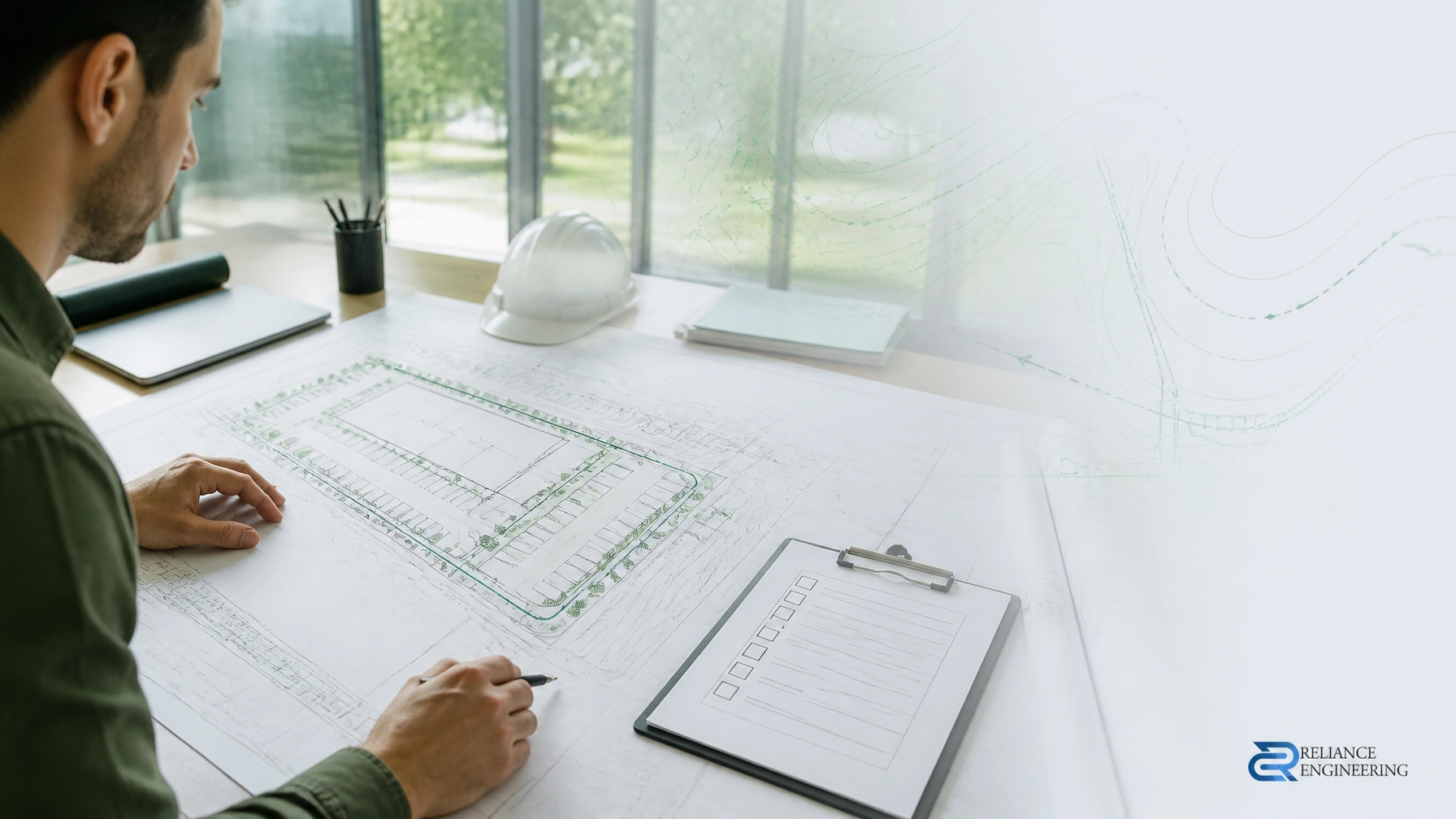
Develop proposed elevations, slope arrows, catch basin adjustments, swales, flowlines, and overland flow routes. The design should account for building entrances, loading areas, pedestrian routes, curbs, landscaping, and municipal requirements.
3. Coordinate supporting documents
Where required, coordinate the grading work with site servicing, stormwater management, erosion and sediment control, and municipal approval requirements. The result should be a complete set of permit-ready drawings, not an isolated paving sketch.
4. Support construction and approvals
Clear drawings help contractors understand the intended elevations and drainage paths. Where municipal review is required, professional approval support and timely responses to comments can reduce delays and avoid redesign.

Maintenance Still Matters After Regrading
A properly designed lot requires ongoing maintenance. Property managers should:
- Clean catch basins after the spring thaw and before winter
- Keep snow piles away from inlets and drainage paths
- Remove leaves, sediment, and debris from grates
- Repair broken asphalt around catch basin frames
- Seal cracks before water reaches the granular base
- Inspect the lot after major rainfall and snowmelt
- Address new settlement before it becomes structural damage
If ponding returns after maintenance, the property should receive another grading and drainage review. Repeated patching without correcting the drainage pattern usually increases long-term costs.
Request a Drainage Review
Persistent ponding, ice buildup, or premature asphalt failure should be treated as a civil engineering concern: not only a paving concern.
Reliance Engineering prepares practical designs, buildable grading, coordinated drainage solutions, and permit-ready drawings for commercial parking lots and land development projects across Ontario. Our drainage-focused approach considers surface grades, storm infrastructure, overland flow routes, construction controls, and municipal requirements together.
For expert advice on asphalt regrading or commercial parking lot drainage in Ontario, contact us directly.
Contact and Professional Credentials
Reliance Engineering Canada Limited
6850 Millcreek Dr, Mississauga, ON L5N 2H4
Phone: 647-385-6418
Email: [email protected]
Office hours: Saturday 12:00 PM–2:00 PM; Sunday Closed
Naresh Ochani, P.Eng., M.Eng.
PEO Certificate of Authorization: 100548882
Request a consultation for commercial property grading fixes, site grading plans, erosion and sediment control plans, and municipal approval support.