In the world of Greater Toronto Area (GTA) land development, there is an "invisible" hurdle that has the power to halt a multi-million dollar project faster than a zoning dispute or a funding delay. It lies several meters underground, tucked away in the labyrinth of concrete and clay pipes that make up our municipal infrastructure.
We are talking about Sanitary Sewer Downstream Capacity Analysis.
If you are a developer, architect, or property owner looking to intensify a site in Toronto, Mississauga, or York Region, you’ve likely heard this term. But why is it suddenly the "make or break" component of a Functional Servicing Report? At Reliance Engineering, led by our Founder and Principal Naresh Ochani with over 20 years of experience, we have seen projects stall for months: or even years: simply because the downstream system couldn’t handle the extra "flush."
Here is why this analysis matters more than ever in 2026 and how you can navigate the aging infrastructure of the GTA to keep your project on track.
What Exactly is a Downstream Capacity Analysis?
Before we dive into the risks, let’s define the requirement. A Sanitary Sewer Design isn’t just about the pipes on your property. A downstream capacity analysis is a technical study that evaluates the existing municipal sewer network from your proposed point of connection to a point where the system reaches a major "trunk" sewer or a pumping station.
The goal is simple: to prove that the existing pipes have enough "room" (residual capacity) to transport the additional sewage generated by your new development without causing backups, overflows, or basement flooding for your neighbors.
The GTA Crisis: Aging Pipes and Intensification
The Greater Toronto Area is currently facing a "perfect storm" regarding wastewater management.
1. The Age Factor
Much of the infrastructure in the downtown core and older suburbs was installed 50 to 80 years ago. These pipes weren't just designed for a smaller population; they were built using materials and standards that are now considered obsolete. Over time, these pipes crack and deteriorate.
2. Inflow and Infiltration (I/I)
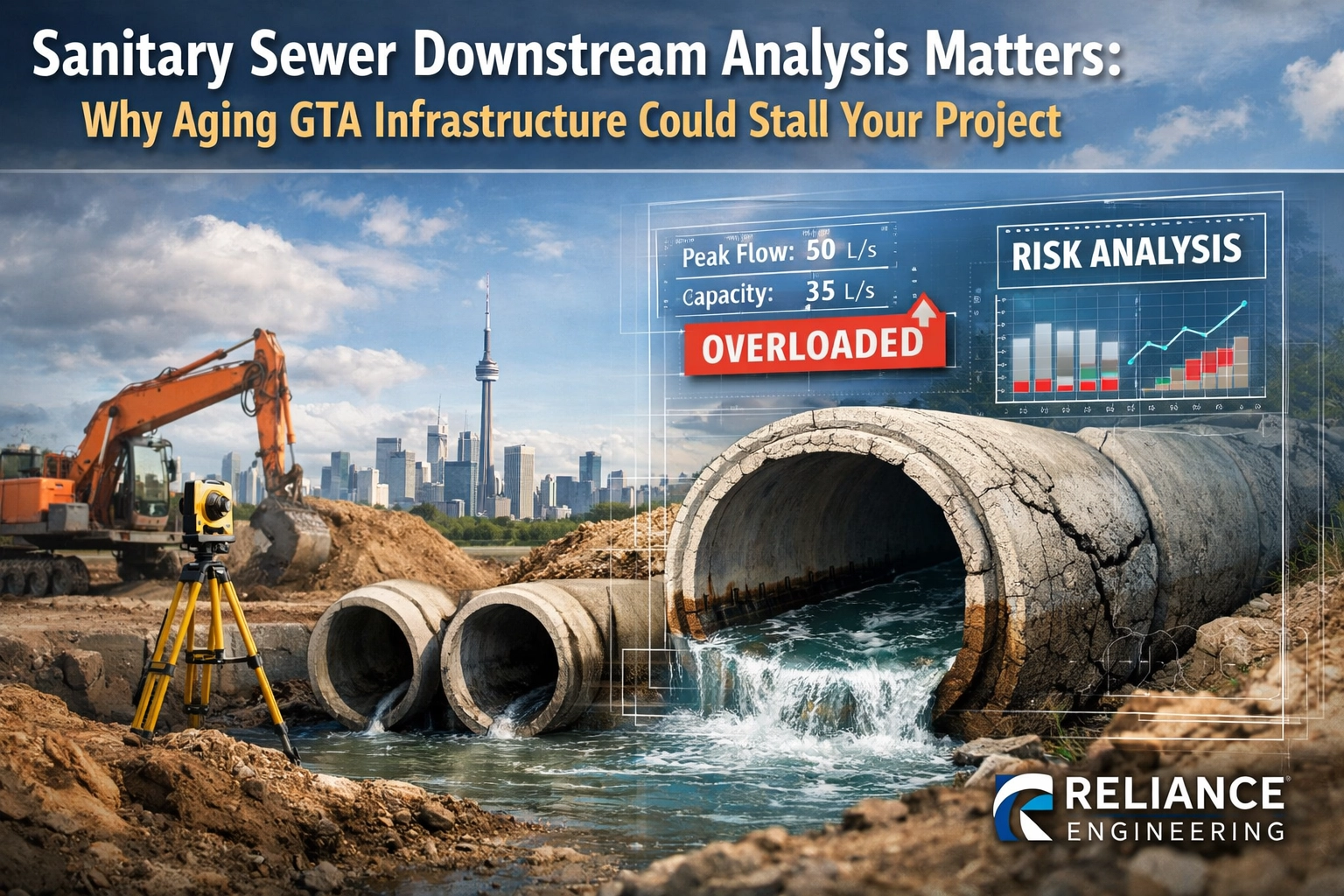
As pipes age, they become "leaky." Groundwater and rainwater seep into the sanitary system through cracks (Infiltration) or through manhole covers and illegal cross-connections (Inflow). This is known as I/I. During heavy rain events, these old sanitary sewers often run full: not with sewage, but with rainwater. If your project adds more flow to a system already burdened by I/I, the municipality will likely deny your permit.
3. Policy-Driven Intensification
Provincial and municipal policies are pushing for higher density. We are seeing single-family lots turned into townhomes and parking lots turned into high-rise towers. While this is great for housing supply, it puts an immense localized strain on the sewer grid. A pipe that comfortably served four houses in 1960 cannot necessarily serve a 20-unit townhome complex in 2026.
Why Your Project Could Stall
If your Site Servicing Plan is submitted without a robust downstream analysis, or if that analysis reveals a lack of capacity, several things can happen:
- Holding Provisions: The municipality may place a "Holding" (H) symbol on your zoning. You can’t build until the capacity issue is resolved.
- Infrastructure Upgrades: You may be required to pay for the upsizing of several hundred meters of municipal sewer pipes. This is a massive, often unbudgeted expense that can kill project pro-formas.
- Redesign Delays: You might be forced to reduce the number of units in your development to lower the flow, requiring a total redesign of your architectural and engineering plans.

The Reliance Engineering Advantage: 20+ Years of Navigating the "Gray Areas"
At Reliance Engineering, we don't just crunch numbers; we navigate the complex bureaucracy of GTA municipalities. Whether it's the City of Toronto’s Basement Flooding Protection Program or York Region’s stringent I/I reduction requirements, we’ve been there.
The Goal: One-Submission Approval
Every month your project sits in the "comments" phase at City Hall is a month of carrying costs and lost revenue. Our principal-led approach ensures that our Sanitary Sewer Design and downstream reports are exhaustive the first time. We anticipate the reviewer’s questions before they ask them.
Our experience includes complex urban projects like the 35 Wabash Avenue Townhomes and the Redevelopment of Etobicoke General Hospital. These projects required precision in Storm System Design and sanitary analysis to ensure that new, high-density uses integrated seamlessly with old municipal systems.
Key Components of a Successful Analysis
To get through the municipal review process quickly, your analysis must be more than a "best guess." We focus on:
- Flow Monitoring: In many cases, we recommend or coordinate actual flow monitoring in the existing sewers to get real-world data rather than relying on outdated municipal "theoretical" models.
- Peak Flow Calculations: We use the latest municipal standards to calculate the Peak Domestic Flow plus the allowed Infiltration allowance.
- Hydraulic Modeling: For larger developments, we utilize hydraulic modeling to simulate how the system reacts during peak usage hours.
- Mitigation Strategies: If capacity is tight, we look for engineering solutions. Can we implement on-site storage? Can we find I/I reductions elsewhere in the system to "offset" your new flow?
Don’t Wait Until the Permit Phase
One of the biggest mistakes developers make is waiting until they apply for a building permit to look at downstream capacity. By then, it’s often too late to pivot without significant costs.
We recommend conducting a preliminary Functional Servicing Report during the due diligence phase. Before you even close on a property, you should know if the "invisible" infrastructure beneath the street is going to be your biggest ally or your greatest enemy.
Our work on projects like 345-351 Davis Drive in Newmarket and 85 Bronte Road in Oakville highlights how early-stage engineering can identify constraints that define the very shape and scale of a development.
Comprehensive Civil Engineering Solutions
While sanitary sewers are a critical piece of the puzzle, they don't exist in a vacuum. A project’s success depends on how the sanitary system integrates with the Site Grading Plan, Stormwater Management, and Water Distribution Design.
At Reliance Engineering, we provide a holistic approach. We ensure your Grading Plans work with your servicing, so you don't end up with a sanitary connection that is physically impossible to build due to elevation conflicts.
Conclusion: Expertise You Can Rely On
Aging infrastructure is a reality of developing in the GTA, but it doesn't have to be a project-killer. With the right analysis and a proactive approach, even the most constrained sites can find a path to approval.
With over two decades of experience, Naresh Ochani and the team at Reliance Engineering provide the technical depth and municipal insight needed to move your project from the drawing board to the construction site. Our goal is always the same: One submission, one approval.
Are you planning a new development or an intensification project in the GTA? Don’t let sewer capacity catch you off guard.
Contact Us today to discuss your project and ensure your downstream analysis is handled by the experts. Explore our Services or view our past Projects to see how we’ve helped other developers succeed in the GTA’s challenging environment.
Reliance Engineering
Practical. Compliant. Cost-Effective.
Expertise in Land Development, Grading, Servicing, and Stormwater.
www.relianceengineering.ca