Series: Ottawa Site Servicing & Stormwater
Publication slot: 2:00 PM
Location: Ottawa, Ontario
Article type: Technical approval-readiness guide
A stormwater management report for an Ottawa development must do more than present runoff calculations. It must demonstrate that the proposed site can safely collect, control, treat, and release stormwater while meeting City of Ottawa engineering standards, Conservation Authority requirements, and applicable provincial criteria.
For sites reviewed by the Rideau Valley Conservation Authority (RVCA), Mississippi Valley Conservation Authority (MVCA), or South Nation Conservation (SNC), the report must also address watershed conditions, receiving systems, erosion risk, and downstream impacts.
A coordinated package gives reviewers clear information and reduces avoidable comments during Ottawa municipal approvals.
What Ottawa reviewers expect in a stormwater management report
A typical Ottawa stormwater management report should explain:
- Existing and proposed drainage conditions
- Site area and drainage catchments
- Runoff coefficients and hydrologic assumptions
- Minor and major drainage systems
- Allowable release rates
- Required storage volumes
- Storm sewer connections
- Water quality treatment
- Erosion and sediment control measures
- Overland flow routes
- Impacts on adjacent properties
- Coordination with grading and site servicing plans
The design basis should identify the applicable City of Ottawa engineering standards, municipal comments, site plan control conditions, Conservation Authority criteria, and relevant MECP or provincial water quality requirements.
The City’s stormwater management adaptation planning document provides broader municipal context. Project-specific submissions must still respond to the criteria applicable to the site, receiving system, and proposed development.
Conservation Authority review must be identified early
The applicable Conservation Authority depends on the site location and watershed.
- RVCA may review projects draining toward the Rideau River system and its tributaries.
- MVCA may review sites within the Mississippi watershed.
- SNC may review sites within the South Nation watershed.
Their review can affect more than the stormwater pond or outlet. Requirements may include:
- Protection of watercourses and natural features
- Erosion protection at discharge points
- Enhanced water quality treatment
- Floodplain or hazard considerations
- Thermal or fish habitat protection
- Sediment control during construction
- Restrictions on outlet locations
- Additional reporting or approval conditions
The Conservation Authority review should be included in the project schedule before the stormwater strategy is finalized. A design that satisfies a municipal sewer connection but does not address the receiving watercourse can create additional review comments or require redesign.
Quantity control: release rates and storage sizing
Quantity control limits the rate at which stormwater leaves the site. The allowable release rate may be tied to:
- The capacity of the receiving municipal storm sewer
- The downstream sewer system
- The receiving watercourse
- Pre-development runoff conditions
- A City or Conservation Authority-defined target
- Site-specific drainage or flood protection requirements
The allowable rate must be clearly stated in the report and carried through the calculations, outlet design, grading plan, and servicing drawings.
Storage is then sized to manage the difference between post-development inflow and the controlled release. Depending on the project, storage may be provided through:
- Underground tanks or chambers
- Parking lot ponding
- Rooftop or surface storage
- Oversized storm pipes
- Dry or wet ponds
- Grassed or landscaped storage areas
- Combination systems
The report should show clear calculations for the design storms requested by the City or Conservation Authority. It should also identify maximum ponding depths, emergency overflow routes, storage elevations, and the relationship between storage and finished grading.
A storage system is only useful when it can be built and maintained. The outlet, access points, inspection structures, and emergency overflow must be shown on the drawings. This is where buildable grading, constructible routing, and practical controls become important.
A public Ottawa development report illustrates the type of information typically reviewed, including allowable release rate calculations, quantity storage, overland routing, and erosion and sediment control measures. See this Ottawa stormwater management report example.
Quality control: treatment must match the site
Stormwater quality control addresses sediment, oil, grit, and other pollutants generated by roofs, drive aisles, loading areas, parking spaces, and paved surfaces.
The treatment approach may include:
- Oil-grit separators
- Sediment forebays
- Extended detention
- Wet or dry ponds
- Vegetated treatment areas
- Infiltration or Low Impact Development measures
- Catchbasin and inlet controls
- Enhanced treatment units at the downstream end of the system
The required treatment level depends on the receiving environment and applicable criteria. Many Ontario projects use MECP-based water quality objectives, including enhanced suspended solids removal where required. A report should not simply state a treatment percentage. It should explain the selected treatment unit, drainage area, design flow, bypass arrangement, maintenance requirements, and expected performance.
For a commercial or industrial site, an oil-grit separator may be needed before the storm connection. Its location should be coordinated with the storm sewer profile, maintenance access, property line, fire routes, landscaping, and utility corridors.
Where extended detention or a forebay is proposed, the report should explain how sediment will settle, how the facility will be maintained, and how the discharge will be protected from erosion.

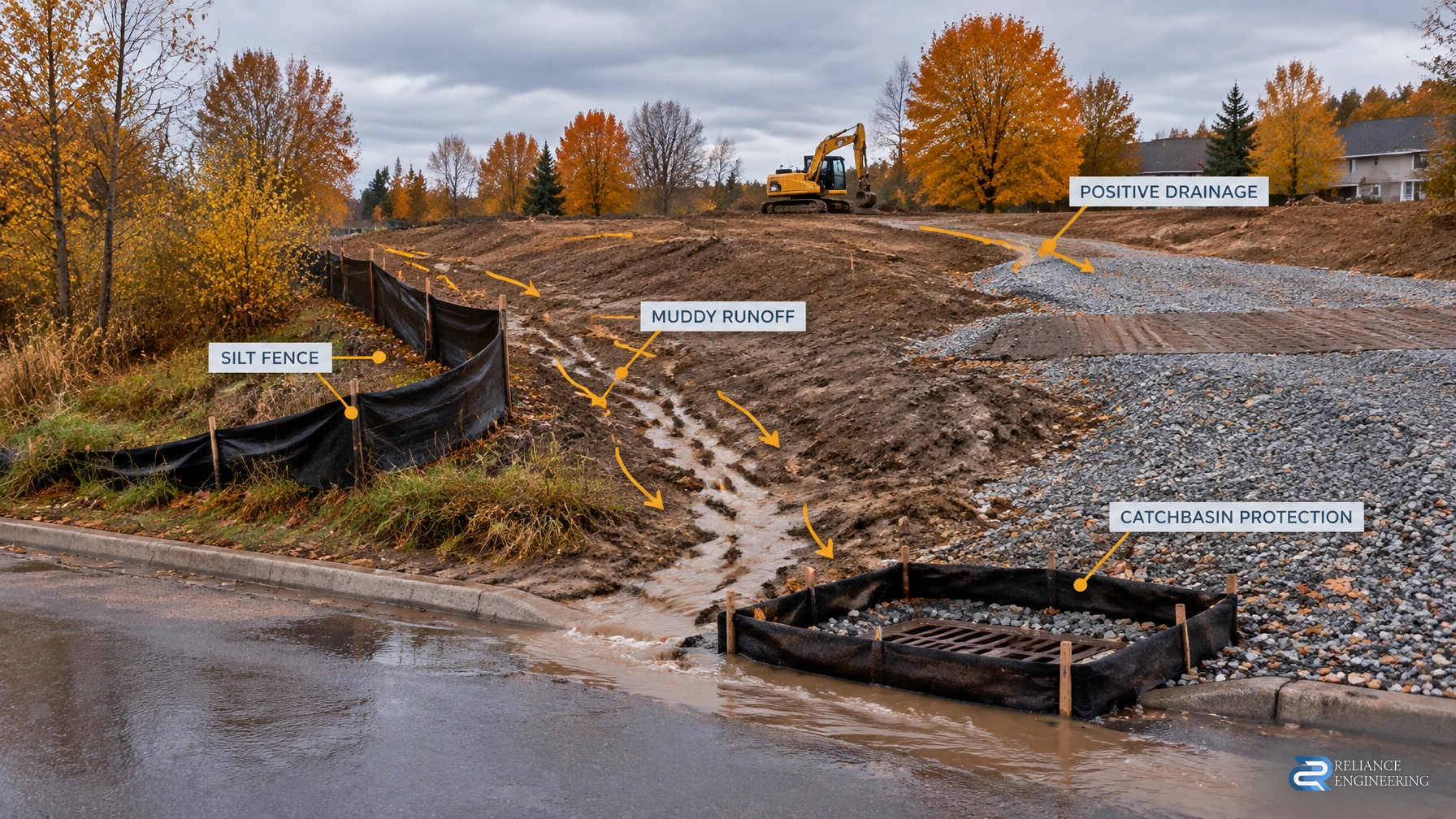
Erosion and sediment control must connect to the permanent design
Erosion and sediment control is not a separate standard-notes exercise. It must be coordinated with the site’s temporary and permanent drainage patterns.
The ESC plan should identify:
- Silt fence locations
- Construction access and mud mat
- Catchbasin protection
- Sediment traps or check dams
- Stockpile controls
- Dewatering measures
- Construction limits
- Stabilization requirements
- Inspection and maintenance responsibilities
The controls must be located where they can intercept sediment before it reaches a storm sewer, ditch, watercourse, or neighbouring property.
The ESC plan should also reflect construction staging. A control that works after final grading may not work during excavation or servicing installation. Coordinating the ESC plan with the erosion and sediment control design process helps create practical controls that contractors can install and maintain.
Coordinate the report with site servicing and grading
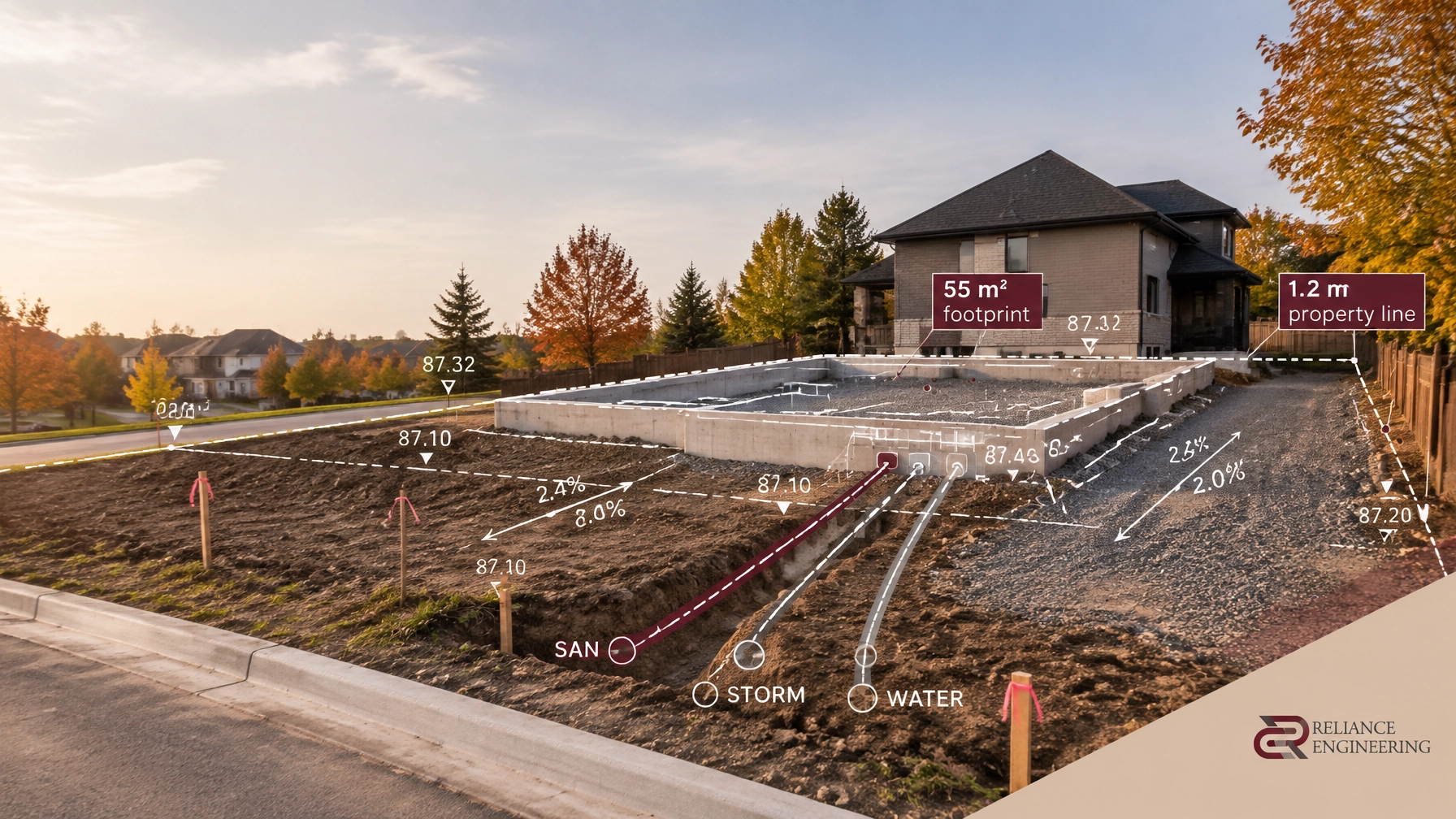
A stormwater management report should never be prepared in isolation from the civil drawings.
The following items must agree:
- Catchbasin locations
- Storm sewer sizes and slopes
- Manhole inverts
- Oil-grit separator location
- Storm connection point
- Storage limits
- Finished elevations
- Overland flow routes
- Emergency overflow elevations
- Foundation drainage strategy
- Utility crossings and easements
The Ottawa site servicing plan should show the same stormwater strategy described in the report. The functional servicing report should also explain how the proposed storm connection relates to available municipal infrastructure.
This coordinated design prevents common review issues such as:
- A storage volume that does not fit within the grading plan
- An outlet located below the receiving sewer connection
- A separator that conflicts with a foundation or utility
- A major flow route directed toward a neighbouring property
- A storm sewer profile that cannot be constructed
- Different release rates shown in different documents
Clean layouts, clear calculations, and consistent design assumptions make the package easier for the City and Conservation Authority to review.
Building a submission that can reach sign-off
A strong Ottawa stormwater submission typically includes:
- Stormwater management report
- Drainage area plan
- Quantity control calculations
- Storage volume calculations
- Quality treatment calculations
- Oil-grit separator or treatment unit details
- Erosion and sediment control plan
- Site grading plan
- Site servicing plan
- Storm sewer profile or connection details, where required
- Supporting geotechnical, environmental, or watershed information
- Responses to municipal and Conservation Authority comments
The package should use the same site area, elevations, runoff assumptions, release rate, storage volume, and outlet details throughout.
This is the foundation of permit-ready drawings and effective approval support. It does not guarantee approval or eliminate all review comments, but it reduces avoidable inconsistencies that often lead to a resubmission cycle.
Reliance Engineering provides coordinated Ottawa stormwater support
Reliance Engineering prepares stormwater management reports, Ottawa site servicing plans, grading plans, ESC plans, and functional servicing reports for commercial, industrial, residential, and institutional projects across Ontario.
Our approach combines:
- Municipal experience
- Practical controls
- Clear calculations
- Clean layouts
- Coordinated design
- Constructible routing
- Buildable grading
- Responsive review support
We also prepare civil site plan approval drawings that coordinate stormwater management with the complete municipal submission.
Request a free consultation
If your Ottawa project requires a stormwater management report, Conservation Authority review, or City of Ottawa servicing submission, contact Reliance Engineering before the civil package is finalized.
We can review your site information, identify the likely stormwater requirements, and recommend a practical path toward approval.

Reliance Engineering Canada Limited
6850 Millcreek Dr, Mississauga, ON L5N 2H4
Phone: 647-385-6418
Email: [email protected]
Free consultation: Contact Reliance Engineering
Office hours: Monday–Friday 9:00 AM–5:00 PM; Saturday 12:00 PM–2:00 PM; Sunday Closed.
Naresh Ochani, P.Eng. M.Eng.
PEO Certificate of Authorization: 100548882