Published: September 3, 2026
Focus: Grading & Drainage
Service: Erosion and Sediment Control Plans
Service area: Ontario
Estimated reading time: 7 minutes
Standard ESC notes do not control construction runoff
Commercial construction sites change quickly. Topsoil is stripped, parking areas are excavated, storm infrastructure is installed, stockpiles move, and temporary access routes are adjusted. During each phase, the direction, speed, and volume of runoff can change.
A set of standard erosion and sediment control notes may state that silt fence, catchbasin protection, and site inspections are required. However, notes alone do not show:
- Where runoff will travel during each construction stage
- Which catchbasins will receive sediment-laden water
- Where a temporary swale or check dam is needed
- How construction access will prevent mud tracking
- How stockpiles will be protected
- How controls will be maintained when conditions change
For commercial sites, this difference is important. An ESC Plan must be connected to the actual site grading, drainage network, construction limits, and construction sequence.
At Reliance Engineering, we prepare practical controls and clear drawings that help protect roads, catchbasins, storm sewers, ditches, watercourses, and neighbouring properties during construction.
Grading determines whether ESC controls will work
Erosion and sediment control begins with understanding how water will move across the site.
A temporary construction surface does not drain in the same way as a completed asphalt parking lot. Before curbs, catchbasins, storm sewers, and landscaped areas are finished, the site may rely on temporary swales, berms, ditches, or controlled overland flow routes.
If those temporary routes are not identified, runoff can:
- Concentrate at the edge of an excavation
- Flow around or under a silt fence
- Carry sediment toward a road
- Enter an unprotected catchbasin
- Discharge onto a neighbouring property
- Erode a ditch or downstream outlet
This is why drainage-aware design is essential. The ESC layout should follow the proposed grading plan and show how controls will function as the site moves from clearing and rough grading to servicing, building construction, parking lot work, and final stabilization.
Parking lot grading creates specific ESC risks
Commercial parking lots are especially sensitive because large paved areas concentrate runoff. A grading issue that appears minor during construction can become a long-term drainage problem after asphalt is placed.
For example, a low point intended to drain toward a catchbasin may collect sediment during construction before the inlet is protected. If the temporary grading does not direct runoff to a sediment trap or other control, the sediment may enter the storm sewer.
This coordination is also important for:
- Commercial parking lot drainage Ontario projects
- Asphalt regrading
- Ponding solutions
- Commercial property grading fixes
- New commercial developments and expansions
- Parking lot reconstruction and resurfacing
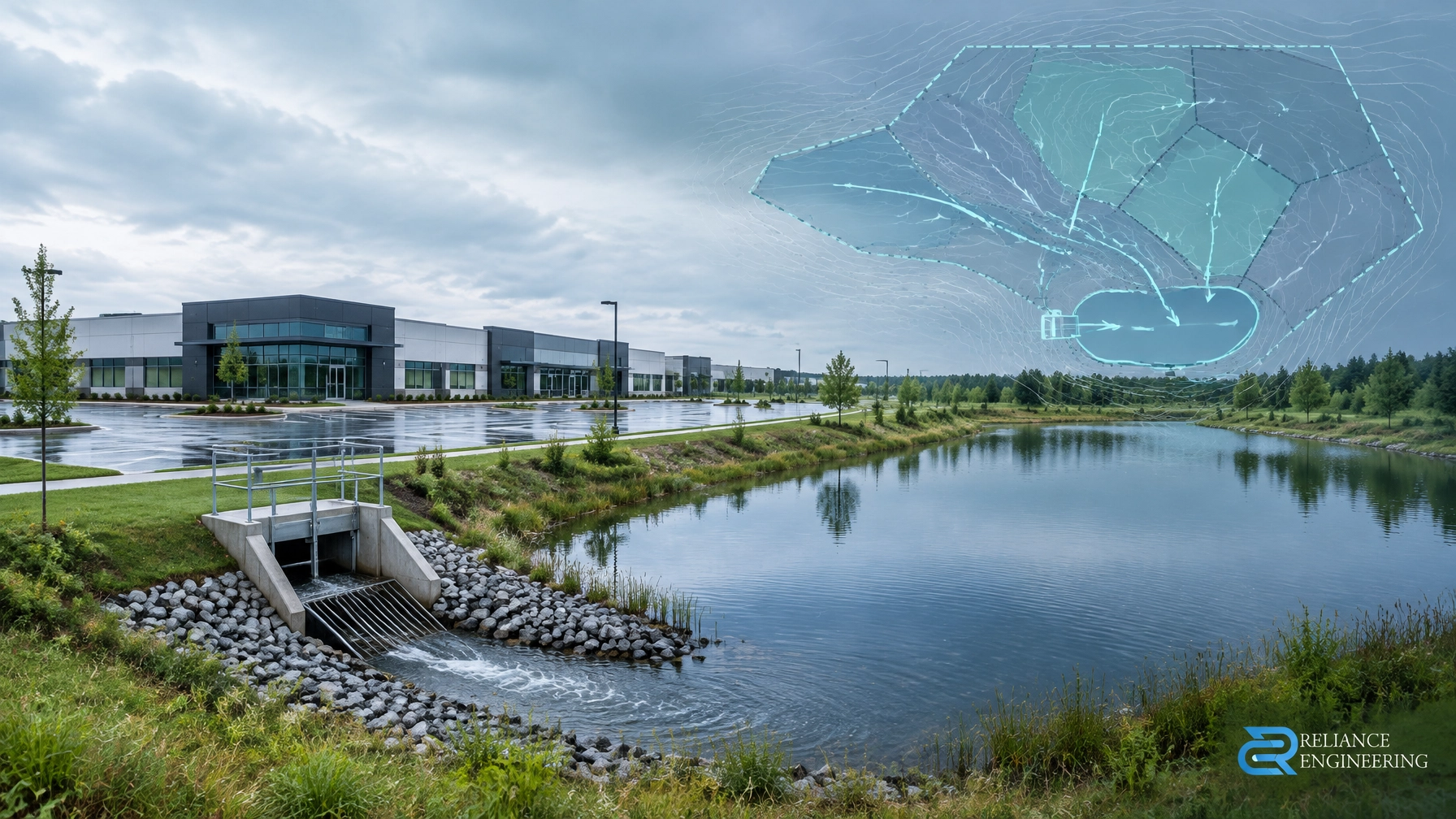
A coordinated plan considers temporary and permanent drainage together. It identifies where sediment should settle, where clean water should be diverted, and how the site can transition safely into its final grading design.

Boilerplate ESC plans fail when they are not location-specific
A generic note such as “install silt fence around the perimeter” does not account for the actual boundary conditions of a commercial site.
The downgradient property line may be beside a municipal road, a ditch, a storm sewer inlet, a watercourse, or a neighbouring commercial property. Each condition requires a different level of attention.
Similarly, “protect all catchbasins” is not a complete design direction. The plan should identify:
- Existing and proposed catchbasins
- Catchbasins receiving runoff from disturbed areas
- Appropriate inlet protection measures
- Overflow provisions
- Inspection and cleaning requirements
- The point at which protection can be removed
A control that is shown in the wrong location can create a false sense of security. A silt fence placed across an active drainage route may redirect water toward a building excavation. A catchbasin filter without overflow capacity may increase localized ponding. A mud mat that is too short or poorly positioned may not prevent vehicles from tracking soil onto the road.
Professional ESC design replaces assumptions with site-specific locations, details, and instructions.
A commercial ESC Plan must cover the full construction sequence
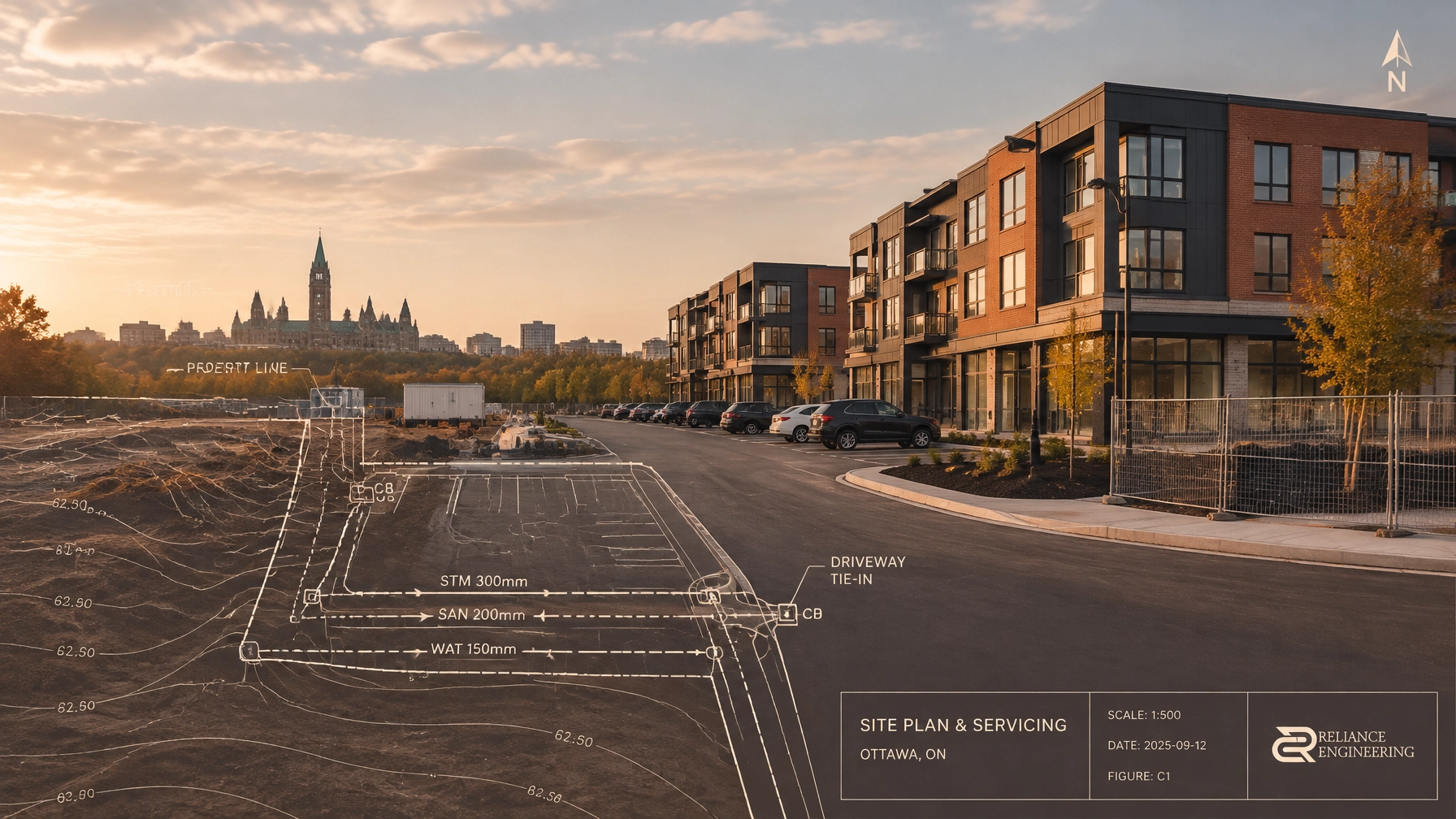
Commercial sites require controls that can be installed, inspected, moved, and maintained as work progresses. Reliance Engineering’s ESC Plan services may include:
- Silt fence layout
- Mud mat and construction access
- Catchbasin protection
- Sediment traps and check dams
- Stockpile protection
- Dewatering notes
- Construction limit fencing
- ESC notes and details
- Maintenance and inspection notes
- Permit-ready drawings with engineer's stamp
These measures are not independent items. They work as a system.
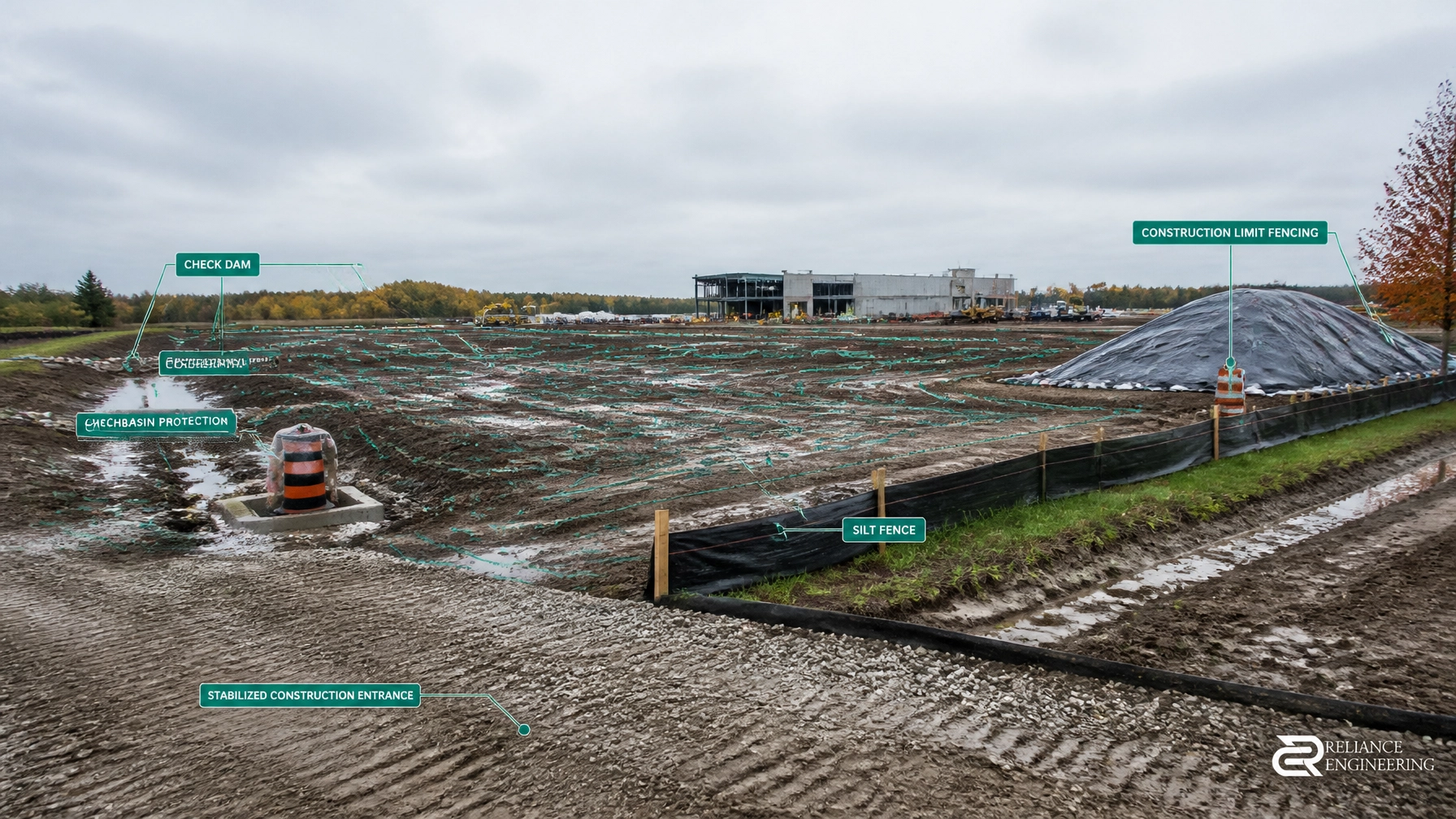
A stabilized construction entrance helps keep soil off public roads. Silt fencing limits the movement of sediment at the site perimeter. Temporary swales and check dams slow concentrated runoff. Sediment traps provide a location for suspended material to settle. Catchbasin protection reduces the risk of sediment entering the storm sewer. Stockpile protection prevents exposed soil from becoming a new source of sediment.
The layout must also identify construction limits. This helps prevent unnecessary disturbance and protects existing vegetation, drainage features, ditches, and natural areas that should remain undisturbed.

Maintenance notes are an operating requirement, not a formality
Even a well-designed ESC Plan can fail if controls are not inspected and maintained.
Sediment fences can become damaged by equipment. Inlet filters can fill with sediment. Mud mats can become covered with soil. Check dams can be displaced by concentrated flows. Stockpile covers can tear or blow away.
The plan should clearly identify inspection responsibilities and maintenance actions. Typical requirements include inspection:
- Before construction disturbance begins
- During active construction
- After significant rainfall
- When controls are damaged
- When sediment accumulation reduces control capacity
- Before temporary measures are removed
Maintenance and inspection notes should also address sediment removal, repair or replacement of damaged measures, street sweeping, dewatering procedures, and final stabilization.
The goal is practical: keep sediment on site instead of allowing it to reach roads, catchbasins, storm sewers, ditches, watercourses, and neighbouring properties.
The ESC Plan should support municipal approval
Municipal reviewers and conservation authorities need to understand how the proposed controls respond to site-specific risks. A clear plan makes that review more efficient.
An approval-ready ESC submission commonly needs to coordinate with:
- Site Grading Plans
- Site Servicing Plans
- Stormwater Management Reports
- Functional Servicing Reports
- Site Plan Approval Drawings
- Building Permit Drawings
- OPA/ZBA Drawings
- Severance/Consent Application Drawings
For example, the ESC Plan should reflect the storm sewer layout shown in the Site Servicing Plan, the proposed drainage strategy in the Stormwater Management Report, and the temporary and permanent elevations shown in the Site Grading Plan.
This coordinated design reduces conflicts between drawings and provides stronger approval support when municipal comments are received.
Ontario requirements vary by municipality, site alteration by-law, conservation authority, and project conditions. Relevant technical references may include municipal engineering standards, applicable Ontario Provincial Standard Specifications and Drawings, and conservation authority guidance such as the TRCA Erosion and Sediment Control Guide for Urban Construction.

A practical review prevents common commercial-site failures
Before submitting or starting construction, the owner, developer, contractor, and design team should confirm:
- Are all disturbed areas shown?
- Does the ESC layout follow the temporary grading and drainage pattern?
- Are all downgradient boundaries protected?
- Are road entrances stabilized with a suitable mud mat?
- Are stockpiles located and protected?
- Are catchbasins and storm outlets clearly identified?
- Are sediment traps, check dams, or temporary swales provided where runoff concentrates?
- Are dewatering notes included where excavation or groundwater conditions require them?
- Are construction limits and protected areas fenced?
- Are inspection, maintenance, repair, and removal requirements clear?
- Will controls remain effective through each construction phase?
- Are the drawings coordinated with grading, servicing, stormwater, and municipal submission requirements?
If the answer to these questions cannot be found directly on the drawings, the plan may rely too heavily on boilerplate notes.
Reliance Engineering provides drainage-aware ESC design across Ontario
An effective ESC Plan is not a collection of standard details. It is a construction-phase drainage strategy.
Reliance Engineering reviews the site layout, grading design, drainage patterns, construction access, municipal requirements, and project staging. We then prepare practical controls, clear drawings, ESC notes and details, and maintenance requirements that contractors can understand and implement.
Our objective is direct: protect surrounding infrastructure and natural systems, keep sediment on site, provide approval support, and help keep construction moving.
For commercial parking lot drainage, asphalt regrading, ponding solutions, or commercial property grading fixes, request a consultation before construction begins.
Contact and professional credentials
Reliance Engineering
6850 Millcreek Dr
Mississauga, ON L5N 2H4
Phone: 647-385-6418
Email: [email protected]
Office hours:
Monday–Friday: 9:00 AM–5:00 PM
Saturday: 12:00 PM–2:00 PM
Sunday: Closed
Naresh Ochani, P.Eng. M.Eng.
PEO Certificate of Authorization: 100548882