Published: September 3, 2026
Category: Grading & Drainage
Topic: Erosion and Sediment Control Plans
Reading time: 7 minutes
If you own or manage a commercial property in Ontario, ponding in the parking lot is more than a maintenance issue. Correcting it may involve asphalt removal, granular excavation, regrading, catchbasin adjustments, drainage improvements, or new overland flow routes.
Once soil, granular material, or existing pavement is disturbed, the project may also require an Erosion and Sediment Control Plan Ontario municipalities can review and enforce.
An ESC Plan shows how soil, sediment, and construction runoff will be controlled during site work. For commercial parking lot drainage Ontario projects, the purpose is straightforward:
- Keep sediment out of catchbasins and storm sewers
- Prevent muddy roads and tracking onto adjacent properties
- Protect completed grading and drainage work
- Reduce the risk of site alteration by-law issues
- Support building permit or municipal approval requirements
- Keep construction moving after inspections and rain events
A parking lot regrading project may be smaller than a subdivision, but it can still create direct connections to municipal storm systems. That connection is why practical, site-specific controls matter.
Asphalt Regrading Can Trigger ESC Requirements
Commercial property owners often assume that repaving or correcting ponding is only an asphalt contractor’s scope. That is not always the case.
A drainage fix may require:
- Removing failed asphalt and granular base
- Cutting and filling portions of the parking area
- Adjusting catchbasin rims
- Installing or modifying area drains
- Creating new positive drainage
- Changing driveway or entrance elevations
- Redirecting runoff toward approved outlets
- Protecting adjacent sidewalks, roads, and properties
These activities can expose soil and create concentrated runoff. During a rainfall event, loose material may move toward catchbasins, municipal streets, ditches, or neighbouring lands.
Ontario’s B-6 Guidelines for Evaluating Construction Activities Impacting on Water Resources identify prevention, runoff control, regular inspection, and maintenance as key principles. Municipal and conservation authority requirements may also apply through site alteration by-laws, engineering standards, or permit conditions.
Requirements vary by municipality and site conditions. The correct approach is to confirm requirements before construction begins: not after sediment has entered the storm system.

What an ESC Plan Does for a Commercial Parking Lot
A professional ESC plan coordinates temporary controls with the proposed grading and construction sequence. It should not be a collection of generic notes added at the end of a drawing package.
At Reliance Engineering, we do not just add standard notes: we design practical controls that suit the site, construction limits, drainage pattern, and municipal requirements.
For an asphalt regrading or commercial property grading fix, the plan may include the following.
1. Silt Fence and Perimeter Controls
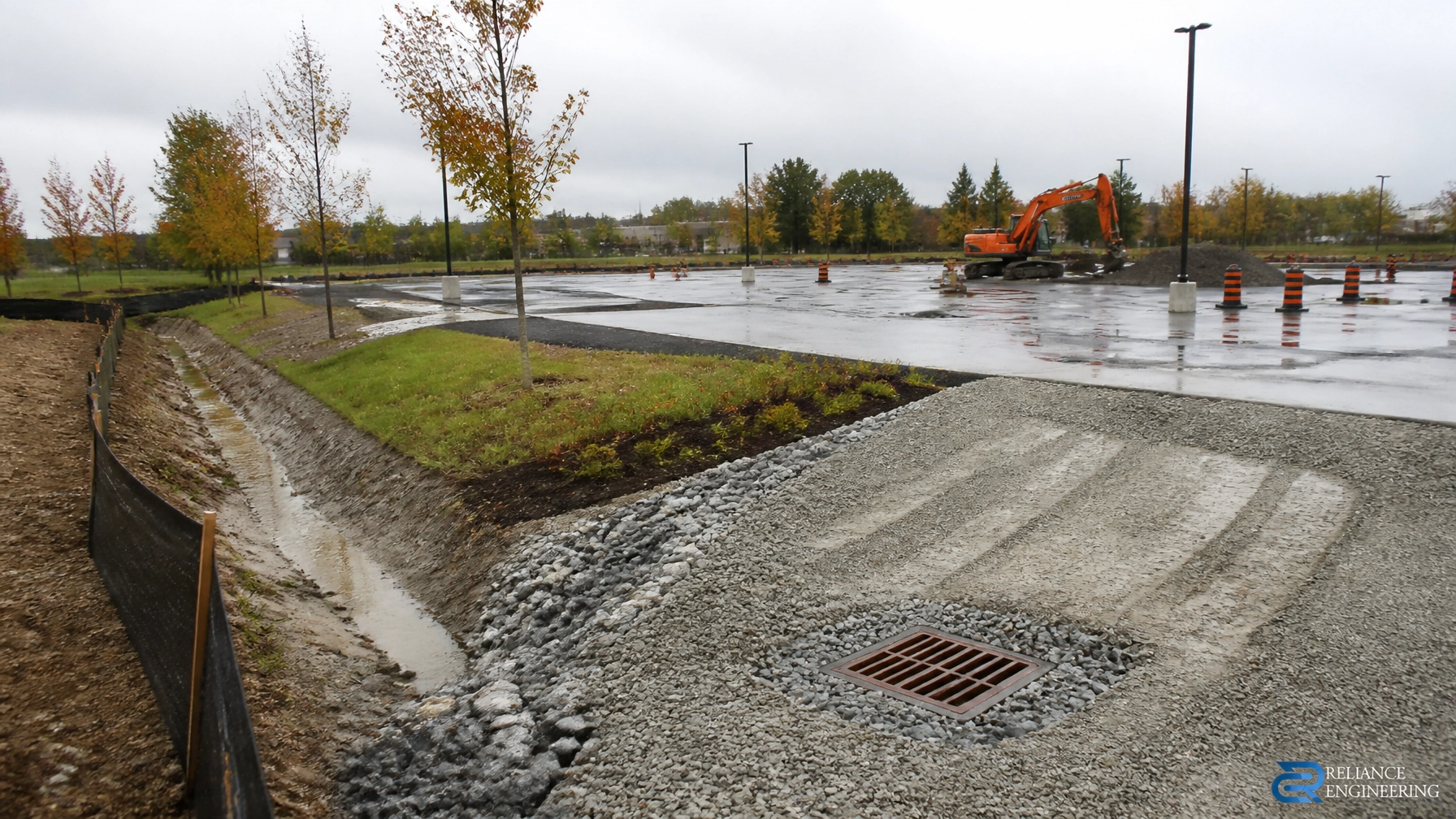
Silt fence is generally placed along the downslope edge of disturbed areas. It helps intercept sediment carried by sheet flow before it leaves the work area.
The location must be practical. A fence placed across concentrated flow, in the path of construction equipment, or without proper termination will not perform as intended.
Perimeter controls may also include:
- Construction limit fencing
- Protection around landscaped areas
- Barriers near adjacent properties
- Defined limits for excavation and stockpiling
2. Mud Mat and Stabilized Construction Access
A stabilized construction entrance helps prevent mud and sediment from being tracked onto public roads.
A properly located mud mat or stone access typically:
- Defines where vehicles enter and leave
- Provides a non-erodible surface
- Reduces tire tracking
- Protects the municipal road
- Gives the contractor a clear daily housekeeping requirement
If vehicles carry loose soil onto the road, municipal complaints and inspection issues can follow quickly. Access control is one of the simplest and most important parts of an ESC plan.
3. Catchbasin Protection
Existing catchbasins are often the fastest route from a disturbed parking lot to the municipal storm sewer.
Catchbasin protection may be required during:
- Asphalt removal
- Granular excavation
- Concrete curb replacement
- Catchbasin adjustment
- Temporary grading
- Landscaping and restoration
The selected protection must be accepted by the local municipality and suitable for the drainage condition. Some inlet protection products can restrict flow, create unsafe ponding, or fail during heavy rain if used incorrectly.
The plan should identify each protected inlet, the type of protection, inspection requirements, and maintenance responsibilities.
4. Sediment Traps, Check Dams, and Temporary Drainage
If regrading creates a temporary swale or concentrated flow route, the ESC plan may require check dams, sediment traps, or temporary diversion measures.
These controls reduce flow velocity and allow sediment to settle before runoff reaches a catchbasin or property boundary.
This is where ESC must be coordinated with the grading design. A temporary control cannot block the intended drainage path or redirect water toward a building, accessible route, neighbouring property, or public road.
5. Stockpile and Dewatering Controls
Soil, granular material, and millings should be placed in controlled locations away from catchbasins and property lines. Stockpiles may require covering, perimeter controls, or stabilization depending on their size, duration, and location.
If groundwater or accumulated stormwater must be pumped from an excavation, dewatering notes should identify:
- Where the water will be discharged
- How discharge velocity will be controlled
- Whether filtration or settling is required
- How adjacent lands and storm systems will be protected
- Who is responsible for inspection and maintenance
Discharging turbid water directly onto a road, adjacent property, or unprotected surface can create a separate compliance problem.
ESC Must Work With the Grading Plan
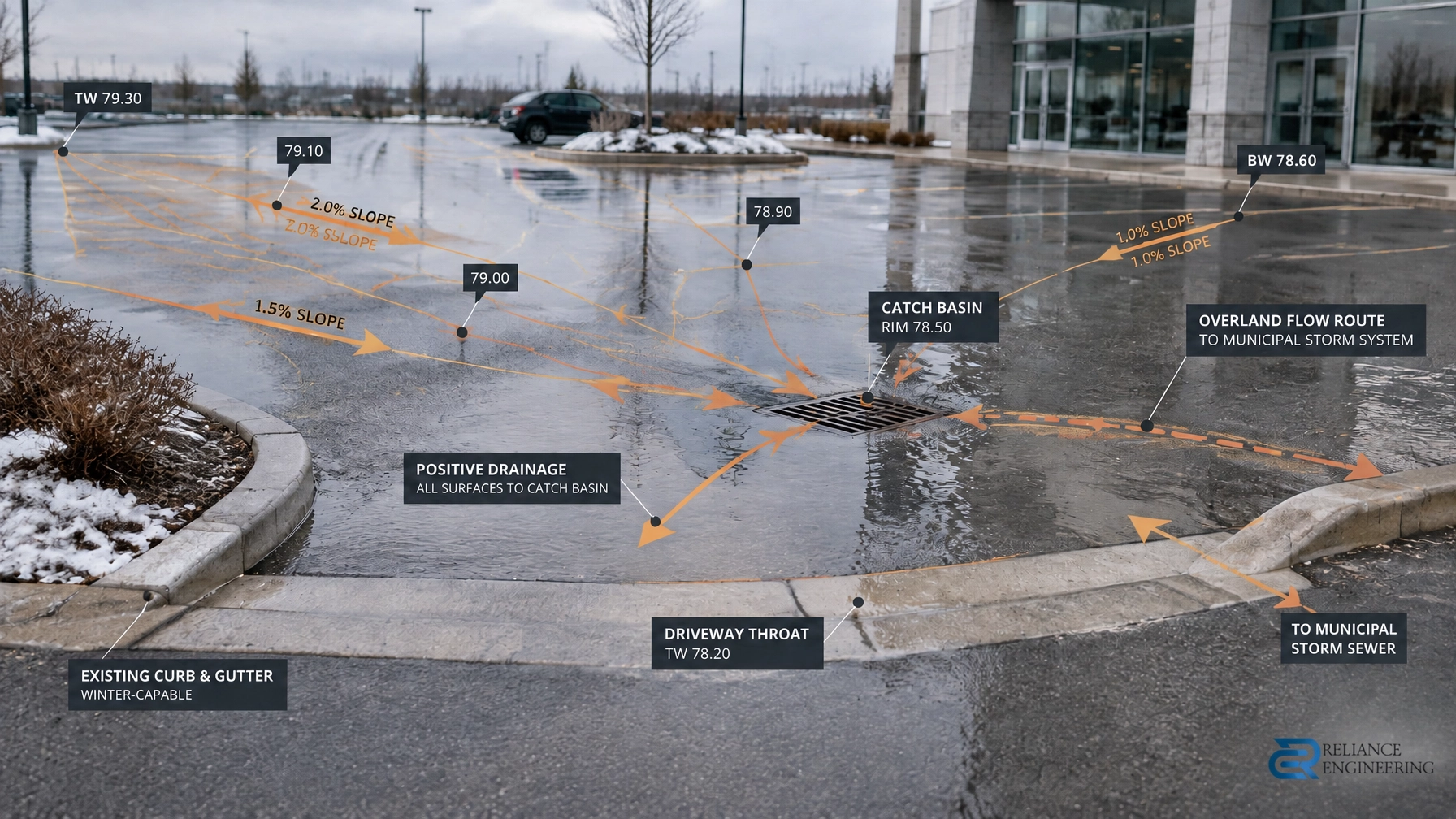
A ponding solution is not complete when the asphalt surface looks level. The finished design must provide positive drainage, safe slopes, and stable overland flow routes.
A drainage-focused Site Grading Plan should coordinate:
- Existing and proposed elevations
- Parking lot slopes
- Catchbasin and area drain locations
- Driveway and entrance grades
- Building and finished floor elevations
- Swales and overland flow routes
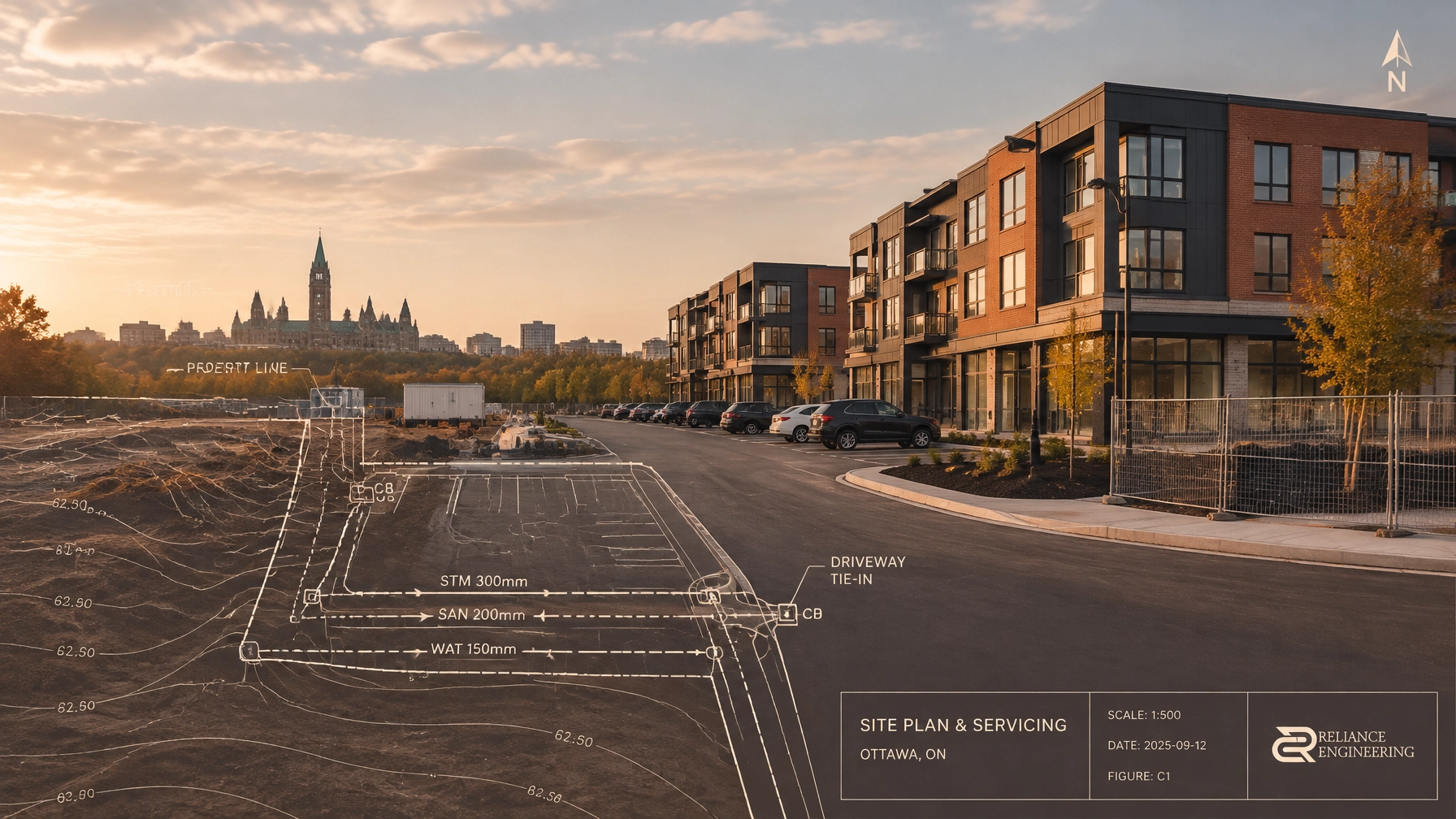
- Tie-ins to roads, ditches, and storm systems
- Protection of adjacent properties
The ESC plan should use the grading plan as its base where appropriate. This allows the contractor and inspector to understand how temporary controls relate to both existing and proposed drainage.
A grading plan that ignores construction conditions can create problems even when the final design is technically sound. Practical designs must be buildable in the field.

Pre-Construction ESC Checklist for Property Owners
Before authorizing asphalt regrading or a commercial parking lot drainage project, confirm the following:
Approvals and Documentation
- Has the municipality confirmed whether an ESC plan is required?
- Is a site alteration permit or building permit involved?
- Has the conservation authority been consulted where applicable?
- Are the grading, servicing, and ESC drawings coordinated?
- Are the drawings permit-ready and stamped where required?
Site and Drainage Review
- Are all existing catchbasins and storm inlets shown?
- Is the direction of existing runoff understood?
- Are neighbouring properties, sidewalks, roads, and ditches protected?
- Are natural features, trees, or watercourses near the work area?
- Does the proposed design provide positive drainage and safe overland flow?
Construction Controls
- Will silt fence be installed before disturbance?
- Is the mud mat located at the actual construction entrance?
- Are catchbasin protection measures accepted by the municipality?
- Are stockpiles located away from inlets and property boundaries?
- Are temporary swales, check dams, or sediment traps required?
- Are dewatering procedures clear?
- Is construction limit fencing shown?
Inspection and Maintenance
- Who will inspect the controls?
- Will inspections occur after significant rainfall?
- Who will repair damaged or displaced measures?
- How will sediment be removed from controls?
- When can temporary controls be removed?
- Will disturbed areas be stabilized promptly after paving and grading?
The contractor is responsible for installation and maintenance in the field, but the property owner or manager should understand what has been designed and what the approval requires.
ESC Coordination With Other Approval Drawings
Parking lot drainage fixes may be part of a larger commercial project. ESC requirements should be coordinated with the full civil and approval package, including:
- Site Servicing Plans
- Stormwater Management Reports
- Functional Servicing Reports
- Site Plan Approval Drawings
- Building Permit Drawings
- OPA/ZBA Drawings
- Severance/Consent Application Drawings
A coordinated design reduces conflicting information between grading, servicing, stormwater, architecture, and construction documents. It also gives reviewers a clearer understanding of how the project will be built and maintained.
Ontario Guidance and Municipal Review
Ontario ESC planning is generally based on a combination of:
- Municipal ESC standards and engineering requirements
- Conservation authority requirements
- Site alteration by-laws
- Storm sewer protection requirements
- Construction best practices
- Applicable provincial environmental guidance
The Toronto and Region Conservation Authority technical guidelines and checklists provide current technical resources for projects within its jurisdiction. Other conservation authorities may use their own submission requirements or reference the Erosion and Sediment Control Guideline for Urban Construction.
These references do not replace a project-specific review. Local requirements, drainage connections, soil conditions, site constraints, and construction sequencing must be evaluated together.
The Practical Standard: Keep Sediment on Site
For a commercial property owner, an ESC plan is risk control. It protects the municipal storm system, the new drainage work, neighbouring properties, and the project schedule.
The most effective plan combines:
- Practical controls
- Clear drawings
- Drainage-aware design
- Buildable grading
- Defined inspection and maintenance requirements
- Approval support
If you are planning asphalt regrading, a ponding solution, or a commercial property grading fix in Ontario, arrange the ESC review before construction starts.
Request a consultation with Reliance Engineering for an erosion and sediment control plan, coordinated grading design, or municipal approval support.
Professional Credentials and Contact Information
Reliance Engineering
6850 Millcreek Dr, Mississauga, ON L5N 2H4
Phone: 647-385-6418
Email: [email protected]
Naresh Ochani, P.Eng. M.Eng.
PEO Certificate of Authorization: 100548882
Reliance Engineering is authorized by the Association of Professional Engineers of Ontario to offer professional engineering services.
Office hours:
Monday–Friday: 9:00 AM–5:00 PM
Saturday: 12:00 PM–2:00 PM
Sunday: Closed
Frequently Asked Questions
Is an ESC plan required for commercial parking lot regrading in Ontario?
It may be required when the work disturbs soil, changes drainage, connects to a municipal storm system, or falls under a site alteration or building permit process. Requirements depend on the municipality, conservation authority, site conditions, and scope of work.
Does repaving a parking lot require erosion and sediment control?
Repaving alone may have limited ESC requirements, but asphalt removal, granular excavation, grading changes, catchbasin adjustments, and exposed soil can create sediment discharge risks. Confirm requirements before work begins.
Who maintains the ESC controls during construction?
The contractor is typically responsible for installing, inspecting, maintaining, repairing, and removing the controls in accordance with the approved plan and municipal requirements. The owner should ensure these responsibilities are clearly assigned.
What should be shown on a parking lot ESC plan?
A typical plan may show silt fence, mud mat and stabilized construction access, catchbasin protection, sediment traps, check dams, stockpile protection, dewatering notes, construction limits, ESC details, and inspection and maintenance requirements.