Article type: Expert guide and approval checklist
Focus: Stormwater management reports for Ontario developments
Estimated reading time: 8 minutes
Prepared by: Reliance Engineering Canada Limited
A Stormwater Management Report explains how a proposed development will collect, control, treat, and safely release runoff. For many Ontario projects, it is a core requirement for site plan approval, rezoning, subdivision, commercial development, and larger building permit applications.
Municipalities and Conservation Authorities often send reports back for the same five reasons: incomplete content, unclear calculations, failure to follow local criteria, weak coordination, or controls that are not practical to build.
A report cannot be approved efficiently if it only presents theoretical results. It must connect clear calculations with practical controls, clean layouts, municipal experience, coordinated design, and constructible routing.
Reliance Engineering prepares Stormwater Management Reports for residential, commercial, industrial, institutional, and infill developments across Ontario.
1. The Report Is Incomplete or Does Not Follow the Required Terms of Reference
The most preventable reason for a returned submission is missing information.
Municipalities typically review a Stormwater Management Report against their own criteria, submission checklists, and, where applicable, Conservation Authority guidelines. A report that does not address the required sections may be considered incomplete before the technical review even begins.
Common omissions include:
- Existing and proposed drainage boundaries
- Pre-development and post-development drainage analysis
- Runoff coefficient calculations
- Peak flow calculations
- Quantity control storage design
- Allowable release rate calculations
- Orifice and outlet control sizing
- Water quality treatment strategy
- Low Impact Development review
- Overland flow assessment
- Erosion and sediment control measures
- Water balance assessment, where required
- SWM summary tables
- Operations and maintenance recommendations
The technical requirements vary by municipality, watershed, site condition, and type of development. The applicable criteria should be confirmed before the report is prepared, not after the first submission is returned.
How to prevent this issue
Begin with a criteria review. Confirm the municipality’s stormwater requirements, applicable Conservation Authority guidelines, design storm events, allowable release rates, water quality targets, LID expectations, and climate change requirements.
The report should use a clear structure that allows reviewers to find every required calculation and conclusion quickly. A concise report is not a report with missing information. It is a complete report organized for efficient review.
For additional provincial context, consult Ontario’s Stormwater Management Planning and Design Manual.
2. The Calculations Are Unclear, Unsupported, or Inconsistent
Municipal reviewers need to understand how the proposed controls were sized and whether the results can be verified.
A report may be sent back when it includes final numbers without showing the assumptions behind them. It may also be returned when the calculations do not match the site plan, grading plan, or proposed servicing strategy.
Typical technical problems include:
- Incorrect or unsupported runoff coefficients
- Inconsistent drainage area measurements
- Unreasonable time of concentration assumptions
- Peak flow values that do not reflect the proposed site condition
- Storage volumes that do not correspond to the release rate
- Inadequate orifice and outlet control sizing
- Missing model input and output summaries
- Unexplained changes between preliminary and final designs
- Failure to account for downstream or tailwater conditions
- Different elevations, pipe sizes, or storage levels shown in separate documents
Clear calculations are essential for municipal approvals. Reviewers must be able to trace the design from existing conditions to proposed conditions, then from runoff calculations to storage, outlet controls, water quality measures, and final discharge.

How to prevent this issue
Document the design assumptions in plain language. Identify drainage areas, runoff coefficients, design storms, control targets, storage volumes, outlet elevations, and the method used to calculate peak flows.
Include organized calculation tables and SWM summary tables. Confirm that the report, drawings, and supporting models use the same site areas, elevations, pipe data, and drainage directions.
An internal technical review before submission can identify discrepancies that would otherwise result in another round of municipal comments.
3. The Report Uses Generic Standards Instead of Local Ontario Criteria
A stormwater solution that works for one municipality may not satisfy another. Ontario municipalities and Conservation Authorities can have different criteria for quantity control, quality treatment, LID, infiltration, water balance, erosion protection, and allowable discharge.
This is why a generic report template can create delays. The document may look complete but still fail to address the local requirements for the project.
Municipalities may require consideration of:
- Specific design storm events
- Pre-development release rates
- Downstream capacity
- Water quality treatment targets
- Erosion control
- Enhanced treatment for receiving systems
- Infiltration and water balance
- Low Impact Development practices
- Climate change allowances
- Overland flow routes
- Protection of adjacent properties
The report should also reflect site-specific constraints. Soil conditions, groundwater, bedrock, contamination, utility conflicts, available grading, and outlet limitations can affect whether a proposed LID or infiltration system is feasible.
How to prevent this issue
Obtain the current municipal and watershed criteria at the beginning of the project. Where required, confirm the approach through pre-consultation with municipal staff or the applicable Conservation Authority.
Evaluate LID options rather than listing them without analysis. If infiltration is not practical, explain why and provide an appropriate alternative. The final design should demonstrate how quantity, quality, water balance, and conveyance requirements are addressed for the specific site.
Reliance Engineering uses municipal experience to develop practical controls that support both approval and construction.
4. The Proposed Controls Are Not Practical or Constructible
A report may meet a theoretical target but still create concerns if its controls cannot be built, maintained, or coordinated with the rest of the property.
Examples include:
- Storage located where building foundations, parking, or utilities conflict
- Outlet structures that cannot be accessed for maintenance
- LID measures placed in unsuitable soils
- Inlet and outlet elevations that do not work with the site grading
- Overland flow routes blocked by walls, buildings, or fencing
- Stormwater facilities that require unrealistic slopes or pipe connections
- Water quality measures shown without sufficient space or maintenance access
Municipalities need confidence that the stormwater strategy will function after construction. Contractors and owners also need drawings that can be interpreted and built without major field changes.
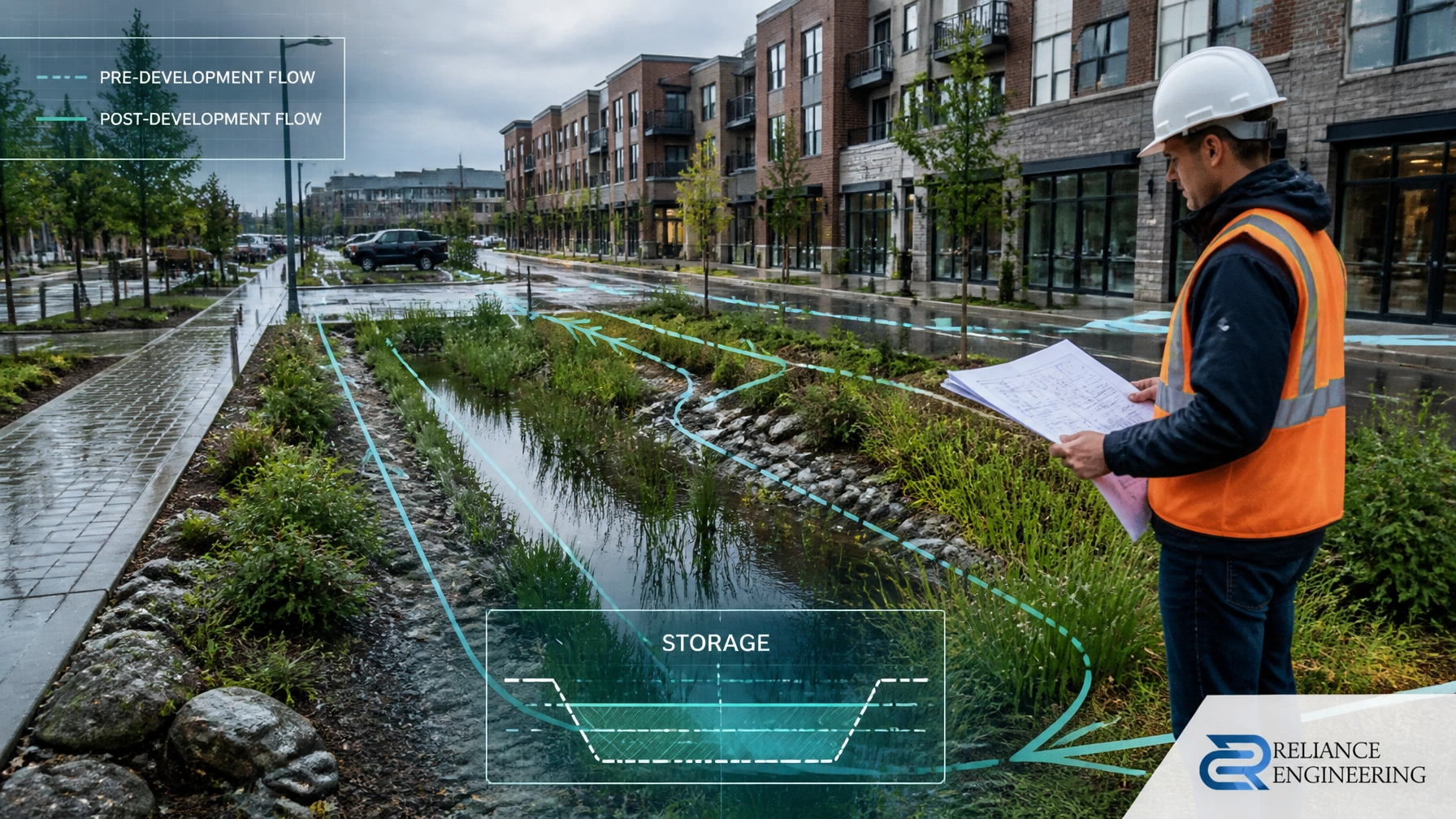
A practical report connects the hydrologic design to the physical site. It identifies where water flows, where it is stored, how it is controlled, and how it reaches the approved outlet.
How to prevent this issue
Coordinate the SWM design with the site grading plan and site servicing plans. Confirm that storage areas, inlets, outlets, pipes, overflows, and access points fit within the proposed site layout.
Use clean layouts and constructible routing. Show practical controls that can be installed and maintained under actual site conditions.
The stormwater design should also be reviewed with the architect, landscape designer, geotechnical consultant, utility coordinator, and contractor where appropriate.

5. The Stormwater Report Does Not Match the Other Project Documents
Coordination is one of the most important factors in the review of a development application.
Municipal reviewers compare the Stormwater Management Report with the site grading plan, site servicing plans, functional servicing report, architectural drawings, landscape plans, and erosion and sediment control plans. If these documents describe different site conditions, the submission may be returned for clarification or redesign.
Common conflicts include:
- The report assumes a drainage direction that differs from the grading plan
- The servicing plan shows a storm connection at a different location
- Storage elevations do not match proposed grades
- Pipe sizes or inverts differ between drawings and calculations
- The overland flow route is not shown on the grading plan
- LID features appear in the report but not in the site plan
- The functional servicing strategy does not support the stormwater outlet
- Erosion and sediment control measures do not reflect construction phasing
A strong Functional Servicing Report should be coordinated with the SWM strategy and should clearly explain the proposed connection and infrastructure requirements.
How to prevent this issue
Use one coordinated civil design approach. Confirm that the report and drawings use the same:
- Site area and drainage boundaries
- Finished grades and storage elevations
- Storm sewer sizes and inverts
- Outlet locations and release rates
- Building footprints and paved areas
- Overland flow routes
- LID locations and treatment assumptions
This coordination should happen before submission. Fixing conflicts after municipal comments often affects several disciplines and can delay the project.

A First-Submission Checklist for Ontario Stormwater Management Reports
Before submitting a Stormwater Management Report, confirm that:
- The applicable municipal and Conservation Authority criteria have been reviewed.
- Existing and proposed drainage conditions are clearly identified.
- Runoff coefficients and peak flow calculations are documented.
- Quantity control storage and allowable release rates are demonstrated.
- Orifice and outlet controls are properly sized.
- Water quality treatment and LID requirements are addressed.
- Overland flow and adjacent property protection are assessed.
- The report includes clear SWM summary tables.
- All calculations have been checked internally.
- The report matches the site grading, servicing, and functional servicing documents.
- Erosion and sediment control requirements are coordinated with construction conditions.
- The final submission is prepared and reviewed by a qualified professional.
No consultant can guarantee that a municipality will approve every project in one submission. However, a complete, technically defensible, locally informed, and coordinated report significantly reduces avoidable review comments.
Prepare a Stormwater Management Report That Supports Approval
A Stormwater Management Report should do more than satisfy a checklist. It should give the municipality confidence that the proposed development will manage runoff safely, protect downstream systems, and function as designed.
Reliance Engineering provides stormwater management reports, site servicing plans, site grading plans, functional servicing reports, erosion and sediment control plans, and permit-ready civil drawings for developments across Ontario.
Request a consultation to discuss your project requirements and municipal approval strategy.
Contact and Professional Credentials
Reliance Engineering Canada Limited
6850 Millcreek Dr, Mississauga, ON L5N 2H4
Phone: 647-385-6418
Email: [email protected]
Office hours:
Monday–Friday: 9:00 AM–5:00 PM
Saturday: 12:00 PM–2:00 PM
Sunday: Closed
Naresh Ochani, P.Eng. M.Eng.
PEO Certificate of Authorization: 100548882
Reliance Engineering is authorized by the Association of Professional Engineers of Ontario to offer professional engineering services.