For property developers, builders, and landowners across Ontario, nothing halts a project faster than a municipal rejection rooted in infrastructure capacity issues. Whether you are planning a multi-unit townhouse complex, a commercial plaza, an industrial facility, or a land severance project, securing planning approvals depends on one undeniable reality: existing municipal water, sanitary, and storm networks must be able to support your proposed load.
This is where the functional servicing report takes center stage. Far from being a mere administrative checklist item, an FSR is the ultimate test of site viability. Without a rigorous, technically sound study backed by extensive municipal experience, your project risks becoming bogged down in endless review cycles.
At Reliance Engineering, we specialize in delivering approval-focused reports that cut through red tape, verify system capacity, and give municipal reviewers the exact data they need to grant approvals with confidence.
1. The FSR as the Ultimate Test of Site Viability
Before committing significant capital to land acquisition, architectural layouts, or detailed engineering design, developers must evaluate whether the surrounding municipal infrastructure can physically handle the increased demand.
In Ontario, municipal authorities and review agencies operate under strict provincial policies that prohibit overloading existing water and wastewater systems. If a site cannot demonstrate adequate reserve capacity for water supply and sanitary sewage, municipal planning authorities will withhold approvals for Zoning By-law Amendments (ZBA), Official Plan Amendments (OPA), Plan of Subdivision, and Site Plan Approval (SPA) applications.
An expertly crafted Functional Servicing Report provides an upfront, realistic assessment of whether a site is shovel-ready or whether off-site upgrades will be required. By conducting thorough site evaluations and clear calculations, our team identifies potential bottlenecks before they derail your timeline.

2. Existing Infrastructure Review and Demand Calculations
A robust Functional Servicing Report begins with a comprehensive audit of existing municipal infrastructure adjacent to and downstream of the subject property. Our engineering approach examines:
- Watermain Capacity: Assessing existing pipe diameters, operational pressures, and available flows to ensure domestic water demands can be met continuously.
- Sanitary Sewer Networks: Calculating peak wastewater generation rates from the proposed development and verifying downstream sewer capacity to prevent surcharging or overflow risks.
- Stormwater Management Systems: Reviewing major and minor storm drainage pathways, existing catchments, and municipal receiving watercourses or storm sewers.
Using provincial design guidelines and municipal standards, we perform rigorous demand calculations that contrast existing system capacities with projected loads. This data-driven methodology ensures our clients receive practical recommendations and coordinated civil design solutions that satisfy municipal reviewers on the first submission.
For related insights on managing site runoff, explore our specialized expertise in stormwater management reports Ontario.
3. Fire Flow Review: Ensuring Life Safety and Regulatory Compliance
One of the most critical components of any Functional Servicing Report is the fire flow review. Municipalities and local fire departments enforce stringent requirements regarding available fire suppression flows for commercial, industrial, and multi-residential developments.
During the FSR stage, our engineers calculate the required fire flow based on building construction types, floor areas, occupancies, and exposure distances (per Ontario Building Code and Fire Underwriters Survey standards). We then model hydrant flow test data against these requirements.
If existing watermains lack sufficient pressure or volume to meet fire flow demands, our reports outline precisely what internal looping, booster pumps, or off-site watermain upgrades are necessary to achieve compliance. This proactive review prevents costly redesigns late in the building permit phase.

4. How Weak FSRs Trigger Endless Municipal Comments
Submitting a generic, poorly coordinated, or mathematically flawed Functional Servicing Report is the fastest way to trigger a cascade of municipal review comments. When municipal engineering staff find discrepancies in peak flow calculations, omitted downstream analyses, or unverified utility connections, projects face:
- Multiple Review Rounds: Re-submissions that stretch out planning timelines by months or even years.
- Escalating Costs: Expensive emergency redesigns, unexpected off-site contribution fees, or delayed construction financing.
- Approval Stalls: Total stagnation at the zoning or site plan approval stage, frustrating investors and straining project budgets.
Avoiding these pitfalls requires deep local knowledge and precision. At Reliance Engineering, our familiarity with municipal review criteria across Ontario allows us to anticipate reviewer concerns and address them proactively in our initial submissions.
5. Integrating FSRs with Site Servicing Plans, Grading, and SWM
A Functional Servicing Report does not exist in a vacuum. It serves as the foundational technical document that informs all subsequent engineering deliverables required for municipal approvals and building permits.
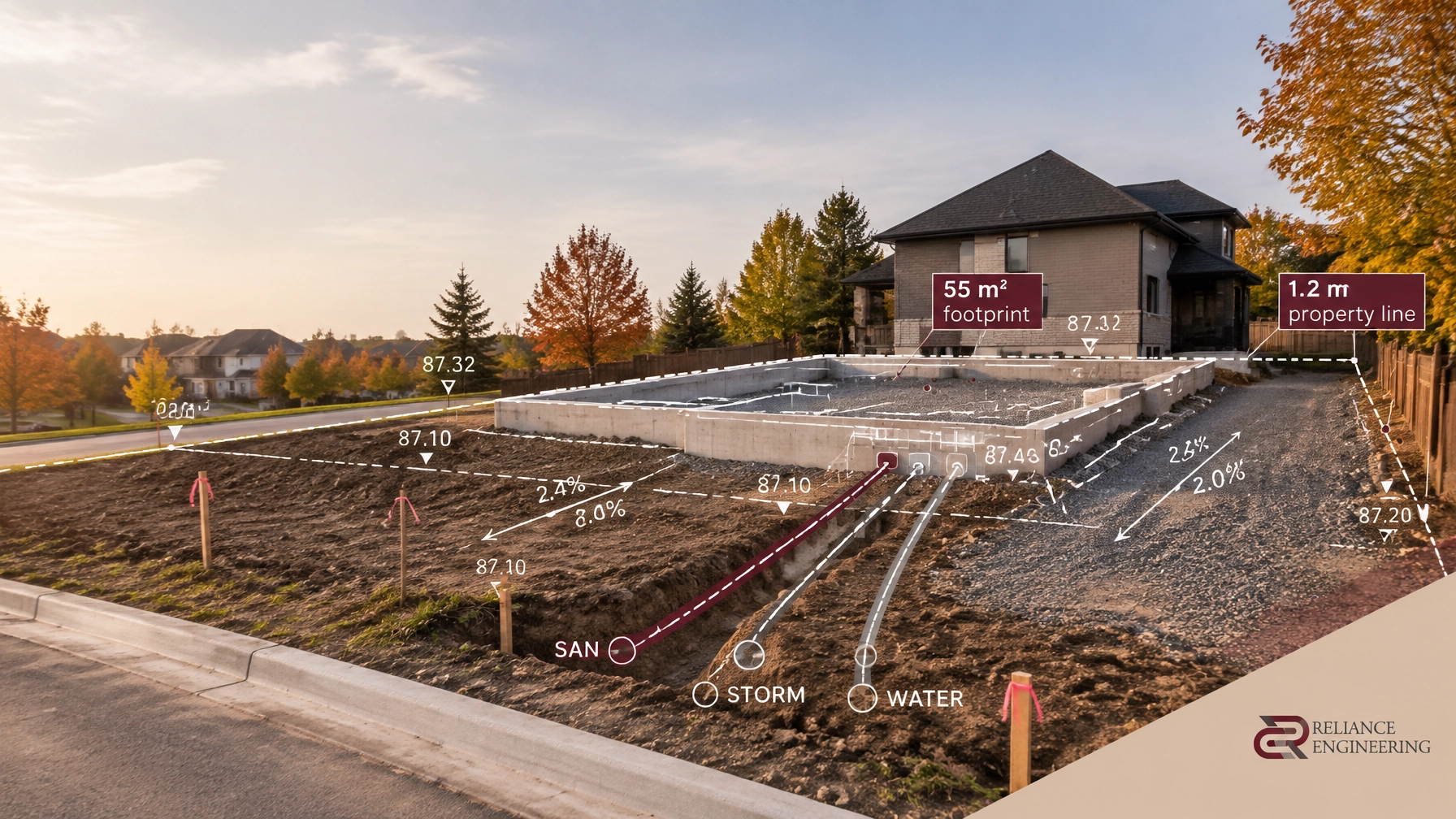
- Site Servicing Plans: Translate the servicing concepts established in the FSR into precise, buildable utility layouts showing exact pipe alignments, invert elevations, and connection points.
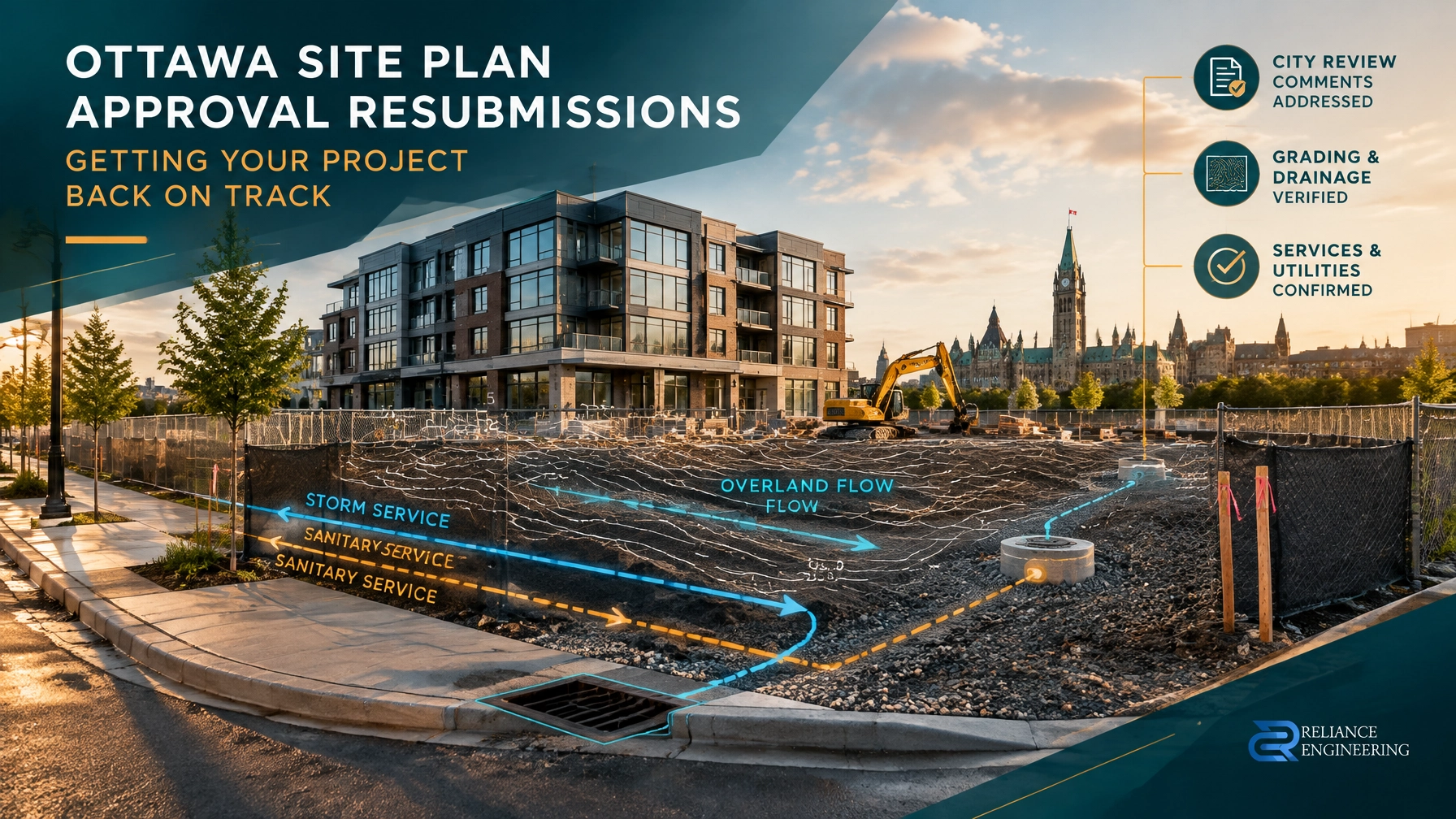
- Site Grading Plans: Ensure proper surface drainage, safe overland flow routes, and seamless integration with adjacent properties while maintaining constructible routing.
- Stormwater Management (SWM) Reports: Detail on-site detention, water quality treatment, and controlled release rates to protect downstream infrastructure and natural environments.
When these disciplines are managed through a unified, coordinated approach, drawings align seamlessly, reducing review friction and accelerating permit issuance.

6. Who Needs a Functional Servicing Report?
FSRs are required across a wide spectrum of land development projects in Ontario whenever a proposal intensifies land use or increases municipal utility demand. Key project types include:
- Site Plan Approval (SPA) Applications: Medium to high-density residential, commercial plazas, and institutional facilities.
- Zoning By-law Amendments (ZBA) & Official Plan Amendments (OPA): Major intensification projects that alter baseline population or employment densities.
- Townhouse and Subdivision Developments: Multi-lot residential configurations requiring new internal municipal infrastructure.
- Industrial Facilities: Manufacturing plants or logistics warehouses with high water usage or specialized discharge requirements.
- Land Severance & Consent Sites: Infill development projects where existing services must be proven adequate to support new lots.
Partner with Reliance Engineering for Certainty in Approvals
Navigating municipal infrastructure requirements in Ontario demands proven expertise, rigorous technical analysis, and deep regulatory insight. Backed by over 20 years of principal engineering experience, Reliance Engineering delivers comprehensive civil engineering services that safeguard your investment and streamline your path to construction.
Contact us today to discuss your upcoming project and discover how our precision-driven engineering solutions can keep your development on schedule.
Office Hours & Contact Information
-
Monday–Friday: Standard Business Hours
-
Saturday: 12:00 PM–2:00 PM
-
Sunday: Closed
-
Address: 6850 Millcreek Dr, Mississauga, ON L5N 2H4
-
Phone: 647-385-6418
-
Email: [email protected]
Professional Credentials:
Naresh Ochani, P.Eng., M.Eng.
PEO Certificate of Authorization: 100548882
Authorized by the Professional Engineers of Ontario to offer professional engineering services to the public.