In the world of Ontario land development, a Functional Servicing Report (FSR) is the backbone of your application. Whether you are working on a Site Plan Approval, a severance application, or a major zoning amendment, the FSR proves to the municipality that your project can be supported by existing infrastructure.
At Reliance Engineering, we have seen it all over the last 20+ years. We have seen projects fast-tracked through the system and others that languish in "Review Purgatory" for months because of avoidable errors. A rejected FSR doesn't just mean a redline; it means delayed construction starts, increased carrying costs, and missed market windows.
Here are the seven most common mistakes developers and junior consultants make with their Functional Servicing Reports in Ontario: and exactly how to fix them.
1. Skipping the Pre-Application Consultation
The most expensive mistake you can make is starting your engineering design in a vacuum. Every municipality in Ontario: from the City of Toronto to the Region of Peel: has its own specific set of standards, nuances, and capacity constraints.
The Mistake: Moving straight to calculations without talking to municipal staff. You might assume the local trunk sewer has capacity, only to find out there is a moratorium on new connections in that specific catchment area.
The Fix: Conduct a formal pre-consultation. This step clarifies the required scoping for your FSR. It identifies which watermains need flow testing and which hydrants are available for data collection. By engaging early, you ensure your report addresses the municipality's specific concerns from page one, preventing a "Request for Revision" that asks for data you didn't collect.
2. Underestimating the Scope of Servicing Requirements
A common misconception is that an FSR is a brief summary or a "letter of intent." In reality, an FSR is a comprehensive engineering analysis.
The Mistake: Treating the report as a simple one-page summary. If you fail to examine the entire underground infrastructure chain: including water treatment plant capacity, pumping stations, and local collector sewers: your report is incomplete.
The Fix: Your Site Servicing Plan and FSR must provide a deep dive into the site’s impact. You must evaluate:
- Water Distribution: Is there sufficient pressure and fire flow?
- Sanitary Sewers: Can the local and trunk sewers handle the additional peak flow?
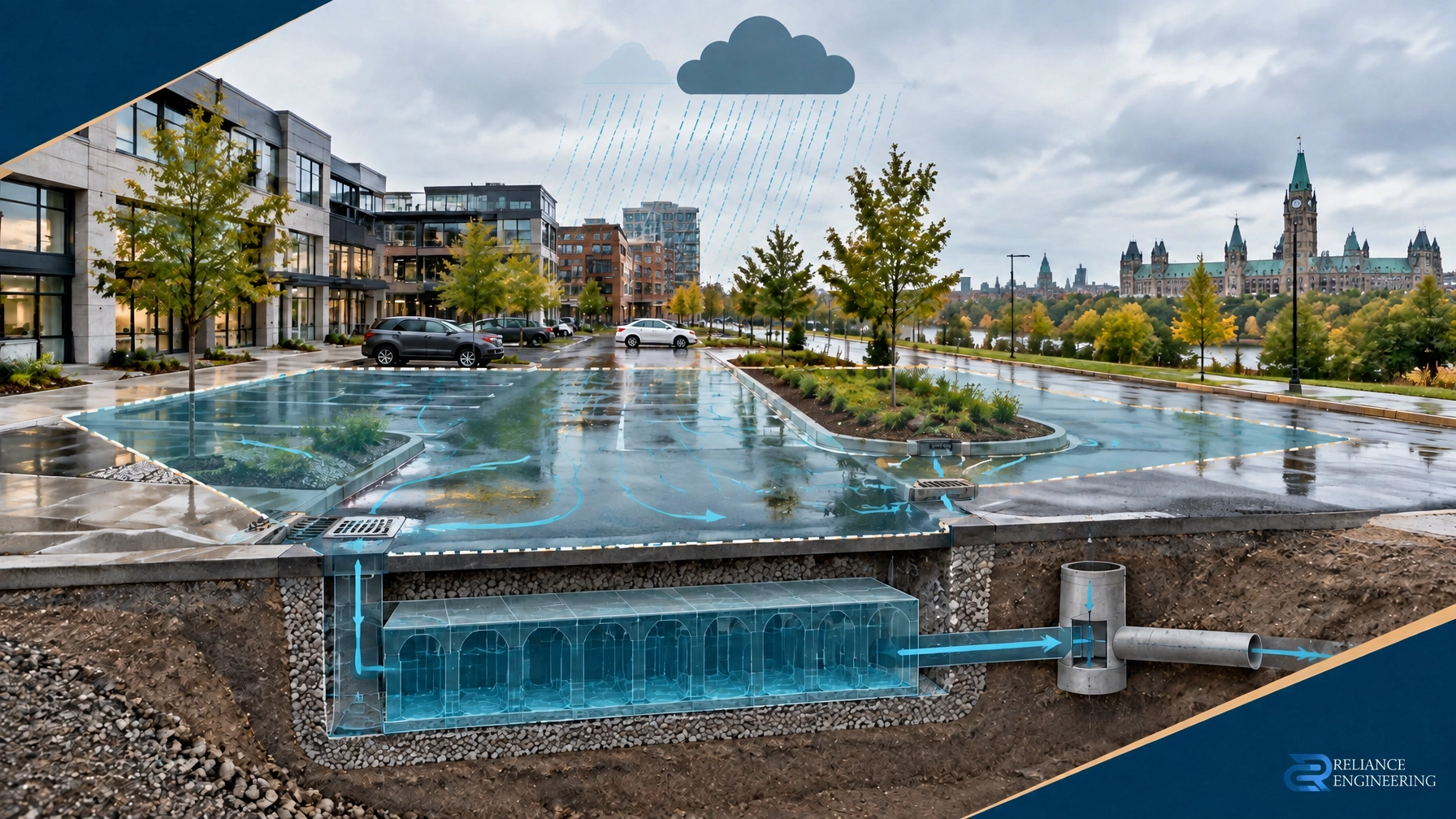
- Stormwater: How will the site handle a 100-year storm event?
Anything less than a holistic view will be flagged by municipal reviewers as insufficient.
3. Relying on "Professional Opinions" Instead of Hard Data
Municipal engineers are not looking for your opinion; they are looking for your math. In Ontario, regulatory bodies require rigorous mathematical proof that a development is viable.
The Mistake: Making general statements like "the existing infrastructure appears adequate" without providing the modeling to back it up.
The Fix: Use advanced hydraulic modeling and detailed calculations. This includes water demand calculations based on specific population densities (per the Ontario Building Code and municipal standards) and Sanitary Sewer Design that accounts for infiltration and peak factors. If you say the system works, include the computer modeling results in the appendices. Hard data is the only way to get a stamp of approval.

4. Conflicting Information Between the FSR and Stormwater Management Report
It sounds simple, but coordination is where many projects fail. In many firms, different technicians might work on the servicing versus the stormwater components.
The Mistake: The FSR says one thing about the site’s drainage, while the Stormwater Management (SWM) Report says another. For example, if your FSR lists a specific finished floor elevation but your Site Grading Plan or SWM report uses a different elevation for flood protection, the municipality will reject both.
The Fix: Total synchronization. At Reliance Engineering, we ensure that the FSR, the SWM report, and the Storm System Design are treated as a single ecosystem. Every number must match across all documents. Before submission, perform a "cross-report" audit to verify that elevations, flow rates, and catchment areas are consistent.
5. Working with Outdated or Unverified Infrastructure Data
Ontario's infrastructure is constantly changing. New developments are being plugged in every month, and what was true about sewer capacity two years ago may not be true today.
The Mistake: Using old GIS data or "assumed" flow rates from a neighboring project's report.
The Fix: Always request the most recent GIS data from the municipality and conduct site-specific hydrant flow tests. Relying on verified, current data protects you from liability and ensures your Water Distribution Design is accurate. If the municipal data is limited, we recommend calibrated modeling to improve accuracy and reduce the risk of future infrastructure failure.

6. Ignoring Evolving Municipal and Provincial Standards
Ontario’s regulatory landscape is in a state of constant flux. Changes to the Provincial Policy Statement or updates to a municipality’s Official Plan can change the requirements for your development overnight.
The Mistake: Using a "template" from a project completed three years ago. If the municipality has updated its engineering guidelines or its climate change resiliency standards (such as Low Impact Development or LID requirements), an old template will fail.
The Fix: Stay current on the specific Engineering Design Criteria for the municipality where you are working. Whether it is a Zoning Amendment or a Building Permit for an ICI project, you must reference the most current versions of the municipal guidelines. This demonstrates professional competence and builds trust with the reviewer.
7. Submitting Without Professional Certification and Final Checks
The final hurdle is often the simplest, yet it is where many applications stall.
The Mistake: Submitting a report that lacks the proper Professional Engineer (P.Eng.) seal, signature, or the required appendices. In Ontario, the Professional Engineers Act is strict. A report without a seal is not a legal document.
The Fix: Develop a rigorous internal checklist. Before any report leaves our office at Reliance Engineering, we ensure:
- All professional seals and signatures are in place.
- All appendices (modeling results, flow test data, drainage maps) are attached.
- The report is explicitly aligned with the regional master servicing strategy.
A complete, professional submission signals to the municipality that you are an expert who respects their time and their standards.

Why Experience Matters in Ontario Land Development
Navigating the complexities of Reliance Engineering's services requires more than just technical skill; it requires a deep understanding of the local landscape. With over 20 years of experience, we have successfully navigated high-profile projects like the 35 Wabash Avenue Townhomes and the Redevelopment of Etobicoke General Hospital.
We know what municipal reviewers are looking for because we have been working with them for decades. We don't just provide reports; we provide a clear path to approval.
If you are struggling with a complex site or need an FSR that gets approved the first time, reach out to us. We specialize in turning engineering challenges into permit-ready solutions.
Contact Information
Naresh Ochani, P.Eng. M.Eng.
Founder and Principal
Reliance Engineering
Address: 6850 Millcreek Dr, Mississauga, ON L5N 2H4
Phone: 647-385-6418
Email: [email protected]
Website: www.relianceengineering.ca
Office Hours
- Saturday: 12:00 PM – 2:00 PM
- Sunday: Closed
- Monday – Friday: Professional Consulting by Appointment
Whether you are in the middle of a 345-351 Davis Drive style redevelopment or a residential severance in Oakville, don't let a poorly prepared FSR stand in your way. Let’s get your project moving.