Navigating municipal approvals across Ontario requires more than just a conceptual idea and architectural sketches. When proposing a new residential subdivision, commercial plaza, or industrial expansion, local municipalities and conservation authorities demand absolute proof that the existing municipal infrastructure can support your project. This proof is delivered through a robust, precise Functional Servicing Report (FSR).
At Reliance Engineering, we know that an FSR is not merely a bureaucratic checkbox. It is the definitive engineering foundation that confirms infrastructure capacity for water, sanitary, and storm systems. Without a comprehensive FSR backed by clear calculations and municipal experience, municipal review committees simply will not move forward.
What Is a Functional Servicing Report and Why Is It Mandatory?
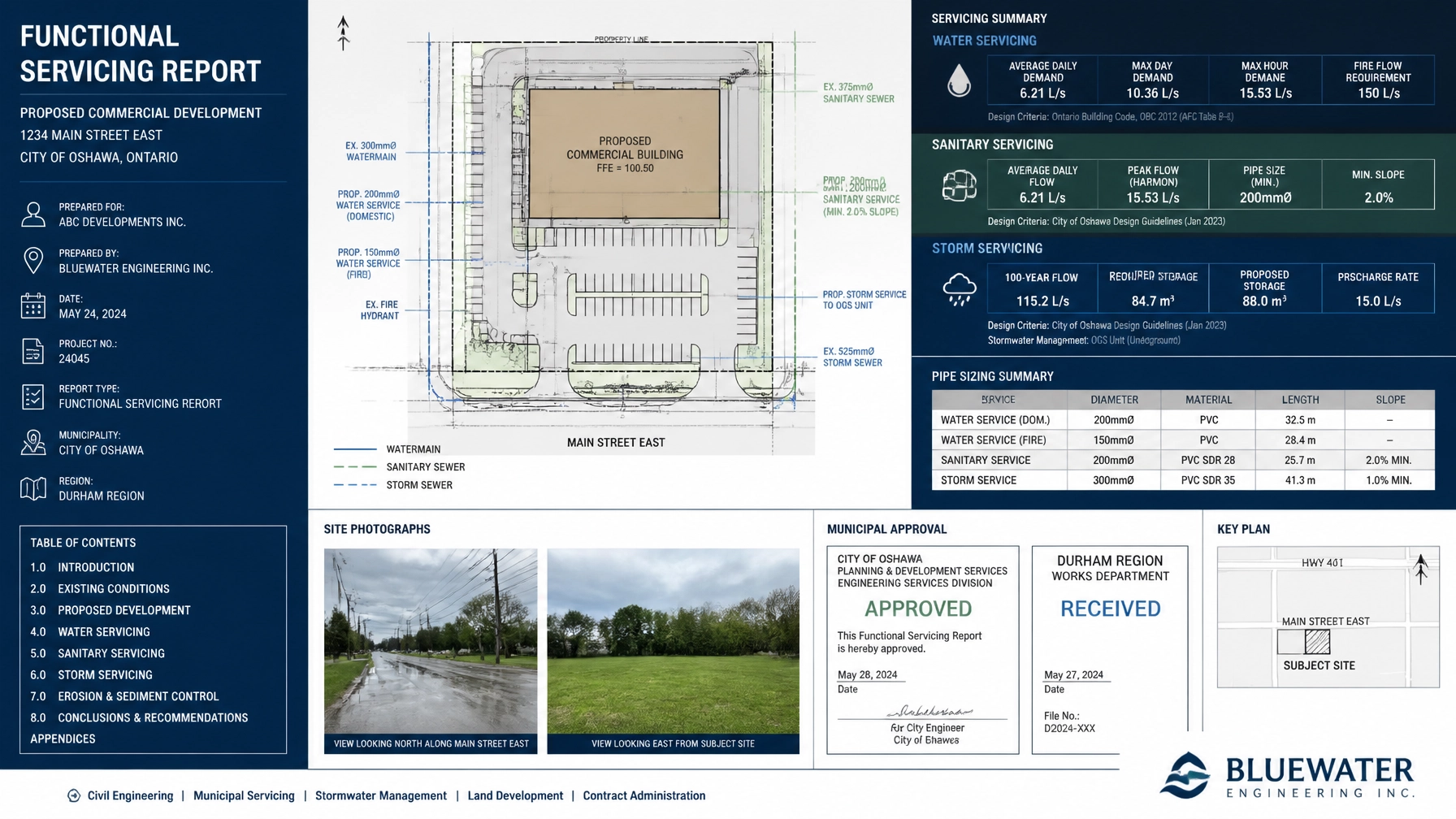
A Functional Servicing Report evaluates how a proposed land development interacts with existing municipal infrastructure. It synthesizes hydrologic data, utility capacities, and civil design principles to demonstrate that the site can be safely serviced without degrading public infrastructure or increasing environmental risks.
Municipalities across Ontario enforce strict submission requirements for Official Plan Amendments (OPA), Zoning By-law Amendments (ZBA), Site Plan Approvals (SPA), and Plan of Subdivision applications. An FSR addresses three core municipal pillars:
- Water Supply: Confirming adequate domestic flow and fire-flow pressure for safety and daily operations.
- Sanitary Capacity: Calculating peak sewage generation and verifying downstream sewer main capacity.
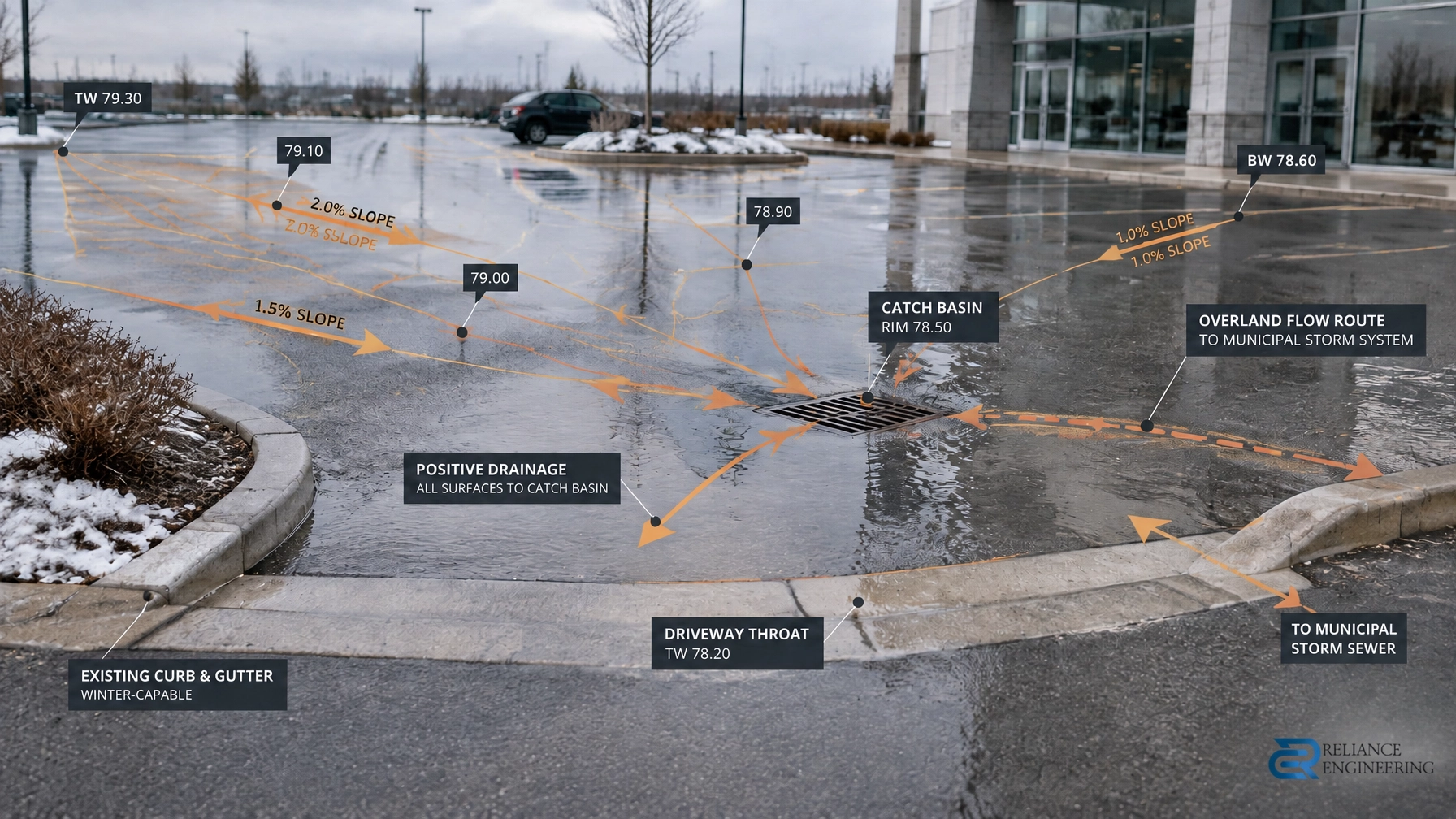
- Stormwater Management (SWM): Controlling post-development runoff rates to match pre-development levels and protecting local watercourses.
When municipal reviewers open an application package, they look for clean layouts and rigorous technical substantiation. A deficiency in any of these areas results in immediate review delays and costly resubmissions.
Integrating Site Servicing Plans and Infrastructure Routing

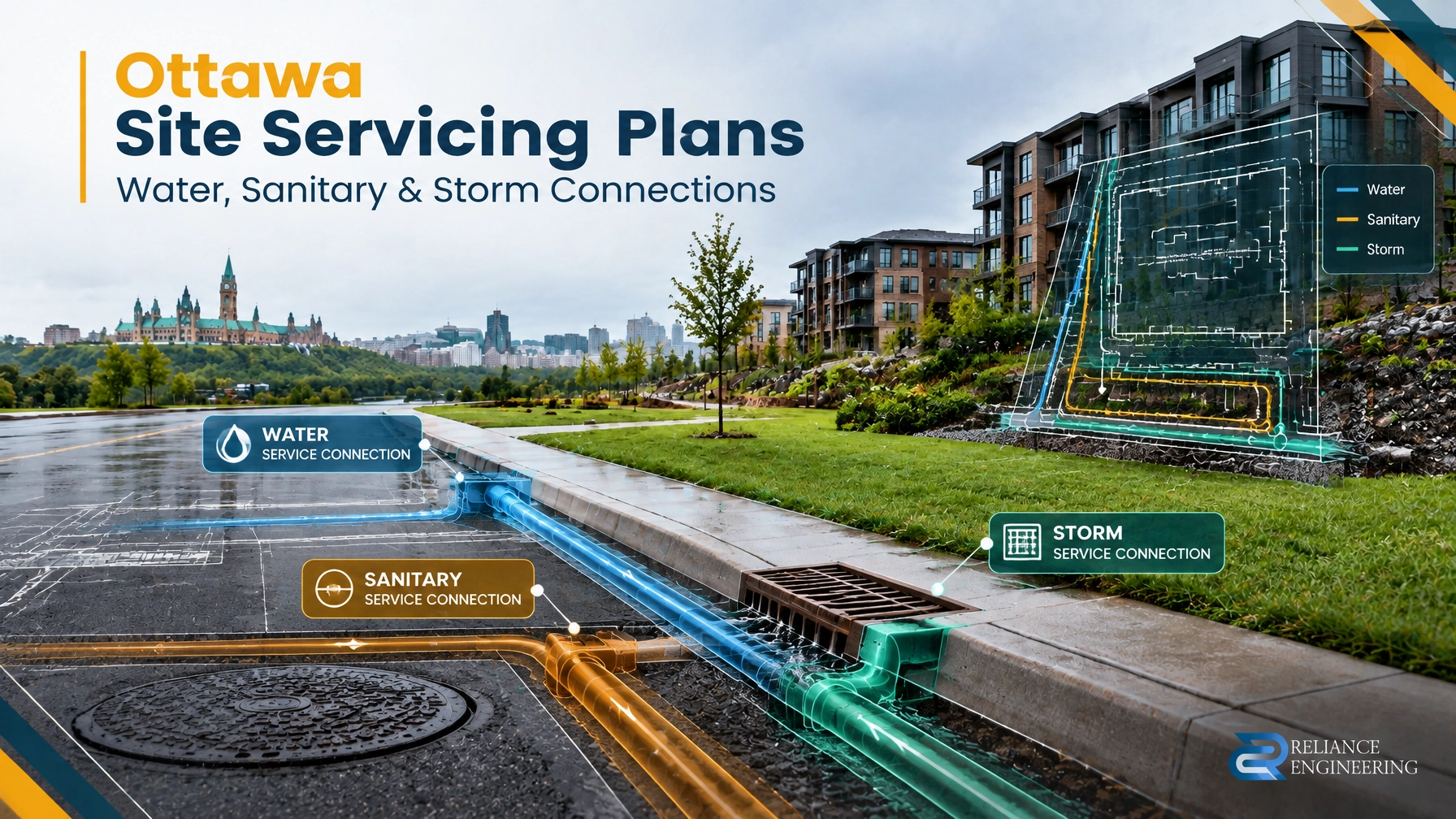
An effective FSR bridges the gap between high-level planning and detailed engineering design. It establishes the framework for subsequent site servicing plans by detailing constructible routing for all underground utilities.
Watermain and Sanitary Design
Municipalities require certainty that new connections will not disrupt neighboring properties. Our engineering team evaluates existing hydraulic grade lines to ensure optimal pressure zones for domestic use and emergency fire suppression. For sanitary networks, we analyze pipe slopes, invert elevations, and peak flow capacities to guarantee smooth, gravity-driven conveyance.
Coordinated Design and Utility Alignment
Conflict between utilities: such as watermains crossing storm sewers or conflicting with gas and electrical lines: can halt construction on-site. By establishing coordinated design parameters early in the FSR stage, we eliminate clashes between civil services and architectural layouts. This proactive approach saves thousands of dollars in construction adjustments and accelerates building permit issuance.
Stormwater Management Reports: Controlling Runoff and Protecting the Environment

With changing weather patterns and stringent provincial guidelines, stormwater management reports Ontario regulators require have become increasingly rigorous. Every development alters the natural hydrological cycle by increasing impervious surfaces (roofs, asphalt, concrete). Without adequate controls, this leads to downstream flooding, stream erosion, and water quality degradation.
An FSR incorporates detailed practical controls to manage both water quantity and quality:
- Quantity Control: Implementing detention basins, underground storage tanks, and controlled outlet structures to restrict post-development peak flows to pre-development levels.
- Quality Control: Utilizing oil-grit separators, bioretention cells, and Low Impact Development (LID) measures to treat runoff before it enters municipal storm sewers or natural water bodies.
- Erosion and Sediment Control: Protecting receiving channels during and after the construction phase.
Our team leverages decades of municipal experience to design stormwater management systems that satisfy local conservation authority guidelines and provincial criteria on the very first submission.
The Reliance Engineering Advantage: Precision Meets Speed
Navigating municipal approvals across Ontario demands deep familiarity with local review standards, submission protocols, and engineering bylaws. With over 20 years of principal engineer leadership, Reliance Engineering provides clients with direct, solution-oriented guidance through every phase of the development lifecycle.
We pride ourselves on delivering:
- Clear Calculations: Transparent, defensible hydrologic and hydraulic modeling that withstands strict municipal audits.
- Permit-Ready Drawings: Precise technical documentation that aligns seamlessly with municipal expectations.
- One-Submission Approvals: Our rigorous quality control often achieves approval on the initial review, saving months of project delays.
Partner with Proven Civil Engineering Experts
Whether you are planning a commercial redevelopment, a residential subdivision, or a complex multi-unit conversion, your project's success hinges on a bulletproof Functional Servicing Report and expertly engineered site servicing.
Contact Reliance Engineering today to discuss your project requirements and secure fast, reliable municipal approvals across Ontario.
Contact Information & Professional Credentials
- Company Name: Reliance Engineering
- Address: 6850 Millcreek Dr, Mississauga, ON L5N 2H4
- Phone: 647-385-6418
- Email: [email protected]
- Website: www.relianceengineering.ca
- Office Hours: Saturday 12:00 PM–2:00 PM; Sunday Closed.
- Professional Lead: Naresh Ochani, P.Eng. M.Eng.
- PEO Certificate of Authorization: 100548882