The landscape of residential real estate across Ontario has shifted. With the provincial government pushing for increased density through Bill 23 and "as-of-right" zoning changes, the multi-unit conversion has become the gold rush of 2026. However, while every "guru" on social media is touting the benefits of turning a single-family home into a four-plex, very few are talking about the technical hurdles that can evaporate your ROI before you even break ground.
At Reliance Engineering, we see the numbers that investors miss. We see the engineering complexities that turn a "sure thing" into a "money pit." If you want to master the multiplex game, you need to understand the intersection of civil engineering and financial returns.
Here is the truth about Ontario multi-unit conversions that the "experts" aren't telling you.
1. The "As-of-Right" Trap: Zoning vs. Servicing
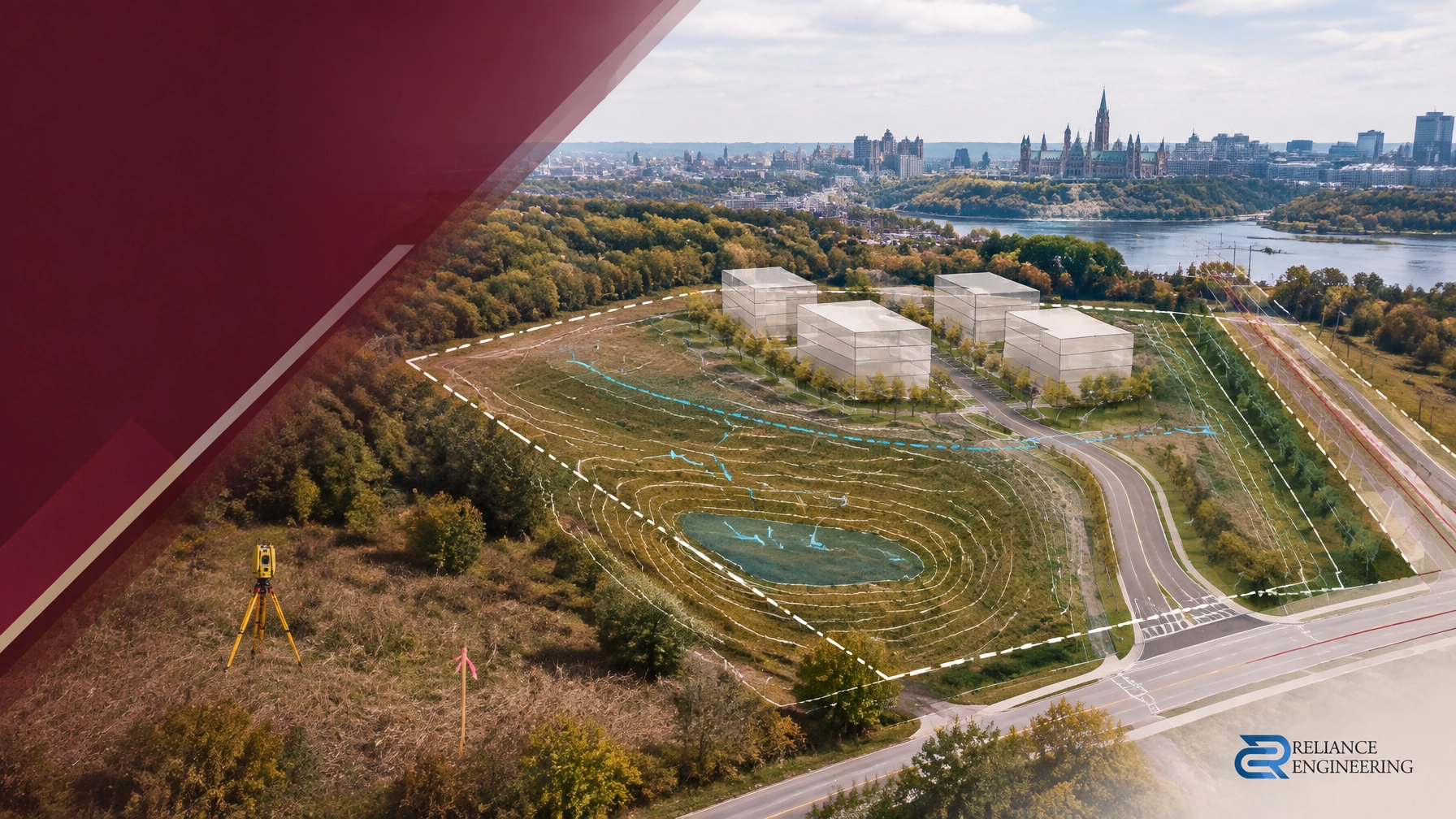
The biggest misconception in the market right now is that "as-of-right" zoning means an automatic green light. While the province says you can build up to four units on a single residential lot, the municipality’s infrastructure might say you can't.
Zoning is about land use; servicing is about capacity. If you are converting a bungalow into a four-plex, you are quadrupling the demand on the sanitary sewer and water lines. Many older neighborhoods across Ontario have aging infrastructure that is already at its limit.
Before you close on a property, you need a functional servicing report. This document determines if the existing city pipes can handle your increased load. If the city requires you to upgrade the water main or the sanitary lateral in the street, your $50,000 "budget" for site prep just became $150,000. That is an ROI killer.
2. The ROI Secret: The 4+1 Strategy
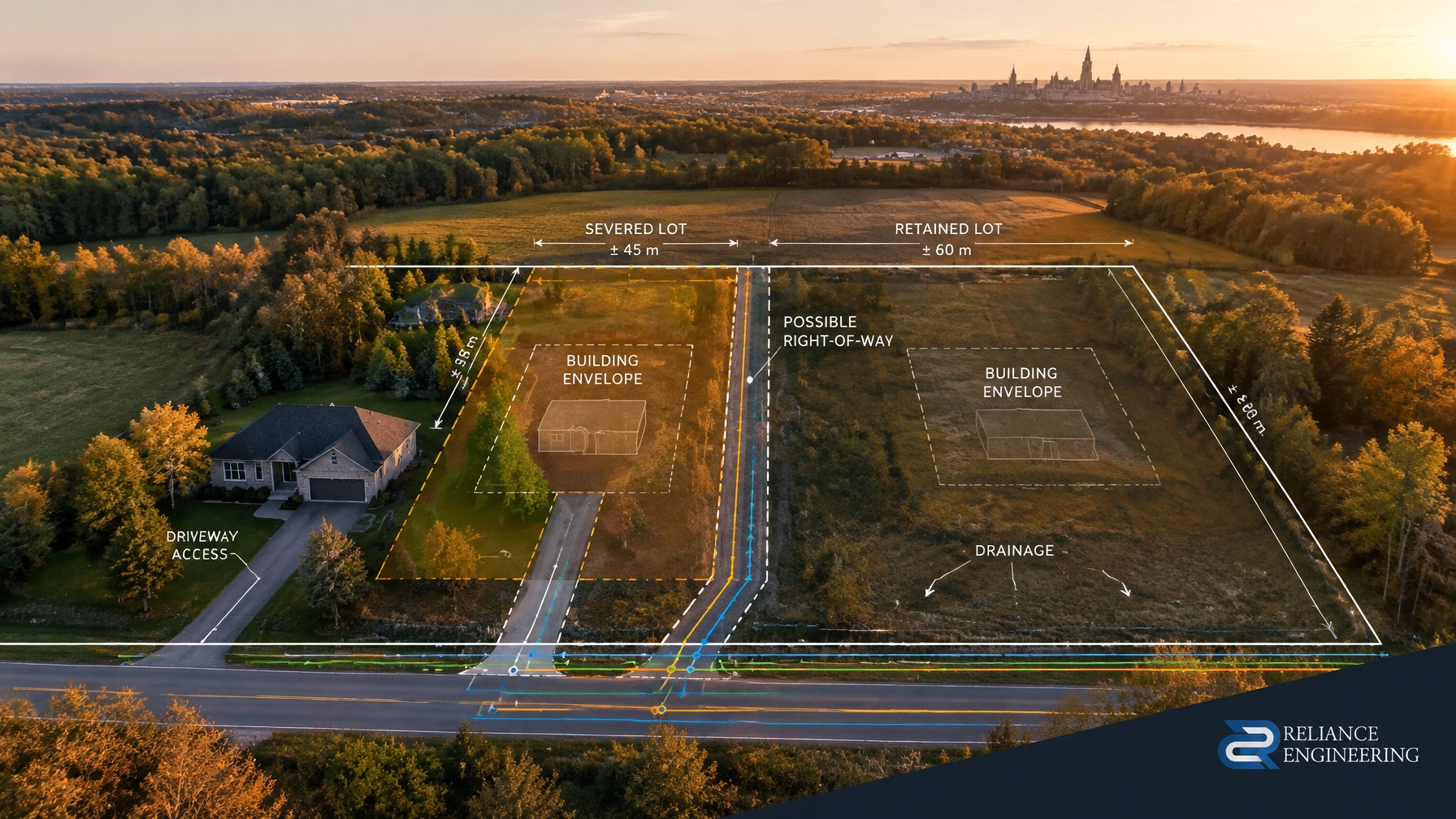
Investors looking for maximum yield are no longer stopping at four units within the main structure. The real "secret" to high-margin returns in Ontario is the 4+1 strategy. This involves creating four units in the primary dwelling and adding an Additional Dwelling Unit (ADU) or "Garden Suite" in the rear yard.
From an engineering perspective, this requires a sophisticated site servicing plan. You have to figure out how to run water, sewer, and power to the back of the lot without interfering with the existing foundation or violating setback requirements.

3. The Invisible ROI Killer: Site Grading
Most investors focus on the interior floor plans and the kitchen finishes. They completely ignore the ground. When you increase the density of a lot: adding a larger footprint or more paved surfaces for parking: you change how water moves on that property.
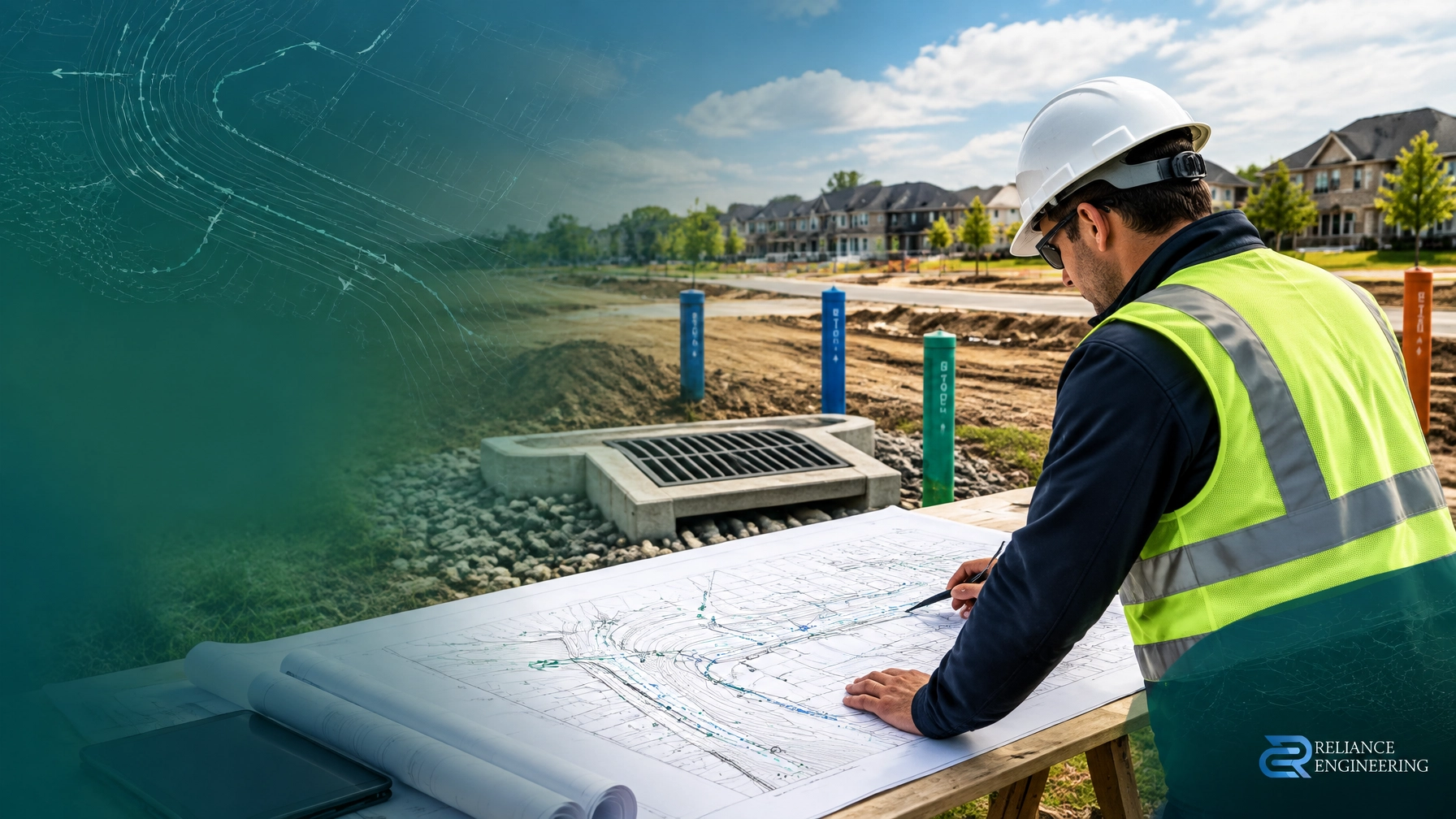
Ontario municipalities are incredibly strict about drainage. You cannot shed water onto your neighbor’s property. If your conversion requires more hard surfaces (concrete/asphalt) for the required parking stalls, you will likely need a professional site grading plan.
If your grading is wrong, you risk basement flooding in your new units. Remedying this after the fact is ten times more expensive than getting the engineering right during the permit phase. We specialize in creating grading plans that maximize usable space while ensuring 100% compliance with local stormwater bylaws.
4. Sanitary Sewer Design: The Math of Four Flushes
When you move from one family to four families, the peak flow calculations for your sanitary system change drastically. If the existing lateral is only 4 inches, it might not be enough.
A critical part of the conversion process is the sanitary sewer design. At Reliance Engineering, we calculate the hydraulic loads to ensure that your building functions correctly under peak usage. Nothing kills the reputation (and value) of a rental property faster than chronic sewage backups because the internal infrastructure wasn't designed for the density.
5. Stormwater Management (SWM) for Small Sites
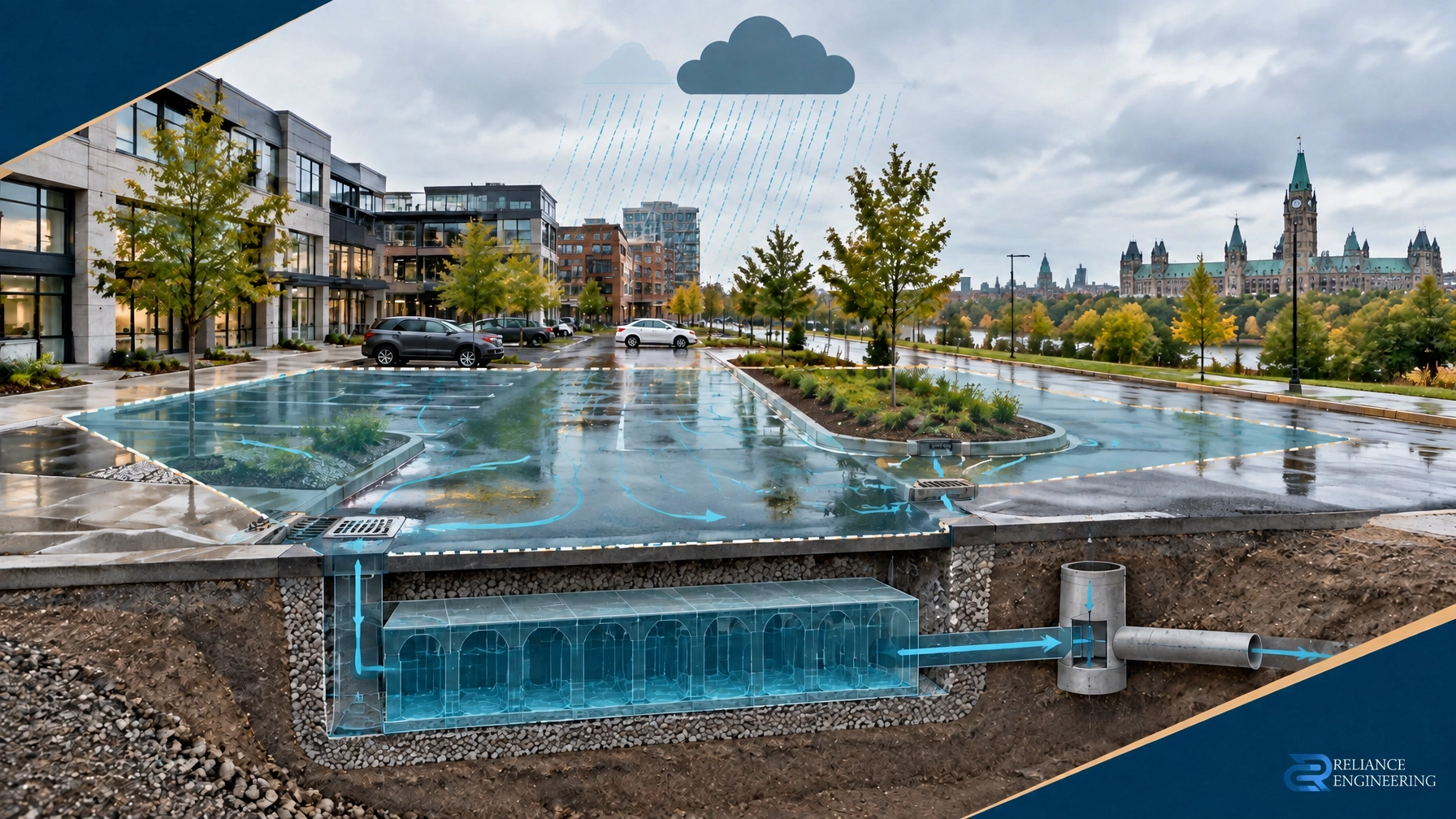
You might think stormwater management is only for large subdivisions or commercial plazas. You would be wrong. As Ontario cities become more dense, "Infill SWM" is becoming a standard requirement for multiplex conversions.
If your property has a high percentage of "impervious cover" (roofs and driveways), the city may require you to install on-site retention or detention systems. This could be an underground "dry well" or a specialized infiltration gallery. These systems are "hidden" costs that can take a bite out of your cash flow if not planned for early.

6. Permit Fast-Tracking: Time is Money
In land development, "holding costs" are the silent enemy. Every month you spend waiting for a permit is a month of mortgage payments, taxes, and insurance with zero rental income.
The secret to fast-tracking permits in Ontario is not "who you know" at City Hall: it's the quality of your submission. When a city reviewer sees a professional, stamped set of plans from an engineering firm that has addressed every servicing and grading concern, the file moves faster. Incomplete or amateurish applications get "red-lined" and kicked to the bottom of the pile.
7. The Math: CAP Rate vs. Cash Flow
Let’s look at the math. A typical single-family home in a high-demand Ontario market might have a CAP rate of 2-3%. By converting that same property into a legal 4-plex + Garden Suite, you can often push that yield significantly higher.
- Gross Rent Multiplier: Converting to multi-unit allows you to capture smaller, higher-per-square-foot rents.
- Appraisal Value: Once a property is a legal multiplex, it is often appraised based on its income-producing potential rather than just comparable sales of neighboring bungalows.
However, your ROI is only as good as your "Total Development Cost" (TDC). By engaging with a civil engineering firm early, you can lock in your TDC with accuracy. No surprises in the ground means no surprises in your bank account.
8. Why Professional Engineering is Your Best Investment
Many developers try to save money by using "draftspeople" for their site plans. This is a mistake. A draftsperson can show where a wall goes, but they cannot certify the storm system design or provide the legal stamps required for complex servicing approvals across Ontario.
At Reliance Engineering, we provide the technical backbone for your investment. We ensure that your project is:
- Compliant: Meeting all provincial and municipal standards.
- Efficient: Designing systems that are cost-effective to build.
- Protectable: Mitigating risks of flooding and infrastructure failure.

Conclusion: Don't Build on Shaky Ground
The opportunity for multi-unit conversions across Ontario is massive, but the margin for error is slim. Success in this niche requires more than a "buy and hold" mentality; it requires a "develop and optimize" strategy.
Don't let hidden engineering costs kill your ROI. Whether you are looking at a project like the 35 Wabash Avenue Townhomes or a simple 4-plex conversion in Mississauga, the engineering fundamentals remain the same.
Ready to unlock the true potential of your property?
Contact Reliance Engineering today for a consultation on your next conversion project. We provide the clarity and expertise you need to build with confidence.
Contact Information
Reliance Engineering
Naresh Ochani, P.Eng. M.Eng.
Address: 6850 Millcreek Dr, Mississauga, ON L5N 2H4
Phone: 647-385-6418
Email: [email protected]
Website: www.relianceengineering.ca
Office Hours
- Saturday: 12:00 PM – 2:00 PM
- Sunday: Closed
- Monday – Friday: By Appointment
Meta Data:
- Focus Keyword: Multi-unit conversions Ontario
- Secondary Keywords: Multiplex ROI, site grading plan, functional servicing report, land development Ontario, 4-plex strategy.
- Description: Discover the hidden engineering secrets that impact the ROI of multi-unit conversions in Ontario. Learn how site grading and servicing plans can make or break your investment.