Topic: Site servicing plans | Updated: October 23, 2026
A demolition permit may be cleared, then the servicing plan hits the old-services question: what happens to the existing water service and sanitary or storm laterals?
The answer depends on the municipality, the condition of the services and whether reuse is approved. Clear decommissioning notes help owners coordinate demolition, municipal work, inspections and new construction.
What triggers disconnection or new connections?
Requirements vary by municipality. Toronto provides a clear example: its water and sewer service connection or disconnection page says new water and sewer connections are required for new construction and substantially demolished buildings. Toronto defines substantial demolition as removal of more than 50% of the exterior walls of the first storey above grade, whether or not the walls are replaced. New connections are also required when converting from septic to sewer.
Other municipal rules may depend on whether the existing service will be reused, the location of a replacement connection, or the demolition permit process. Confirm the requirements for the specific property before assuming an existing lateral can stay in service.
Who disconnects, and where?
Municipalities differ on who performs the disconnection and where the service must be capped. The main, property line and private-side piping are not interchangeable locations. Confirm the required method with the municipality before tendering demolition work.

-
Municipal program at the main: Toronto and Markham examples. Toronto Water’s Site Servicing Program generally has municipal contractors disconnect the sewer service at the main when the new connection is installed. The work is typically coordinated in one visit after demolition, during construction of the replacement building, at the owner’s cost. Markham also coordinates municipal sewer disconnection and capping through its process when a new connection is installed. Its residential infill grading and servicing approval is required before building permit issuance; demolition applications require proof that arrangements have been made to terminate and cap services.
-
Owner or contractor performs the work: Ottawa and Kingston examples. Ottawa’s approach can require the owner’s contractor to cap at or near the property line on private property, with inspection before backfill. Kingston’s requirements differ: a permanently discontinued lateral must be disconnected at the sanitary sewer and removed at the owner’s expense, subject to the applicable permit and inspection process.
-
Owner-arranged, municipality-witnessed: Hamilton example. Hamilton requires the owner to arrange water-service abandonment at the City watermain at the owner’s cost, with a City water operator witnessing the work. The City also requires an abandoned-services inspection. For sewer sign-off, the owner must show abandonment or satisfactorily demonstrate that reuse is acceptable.
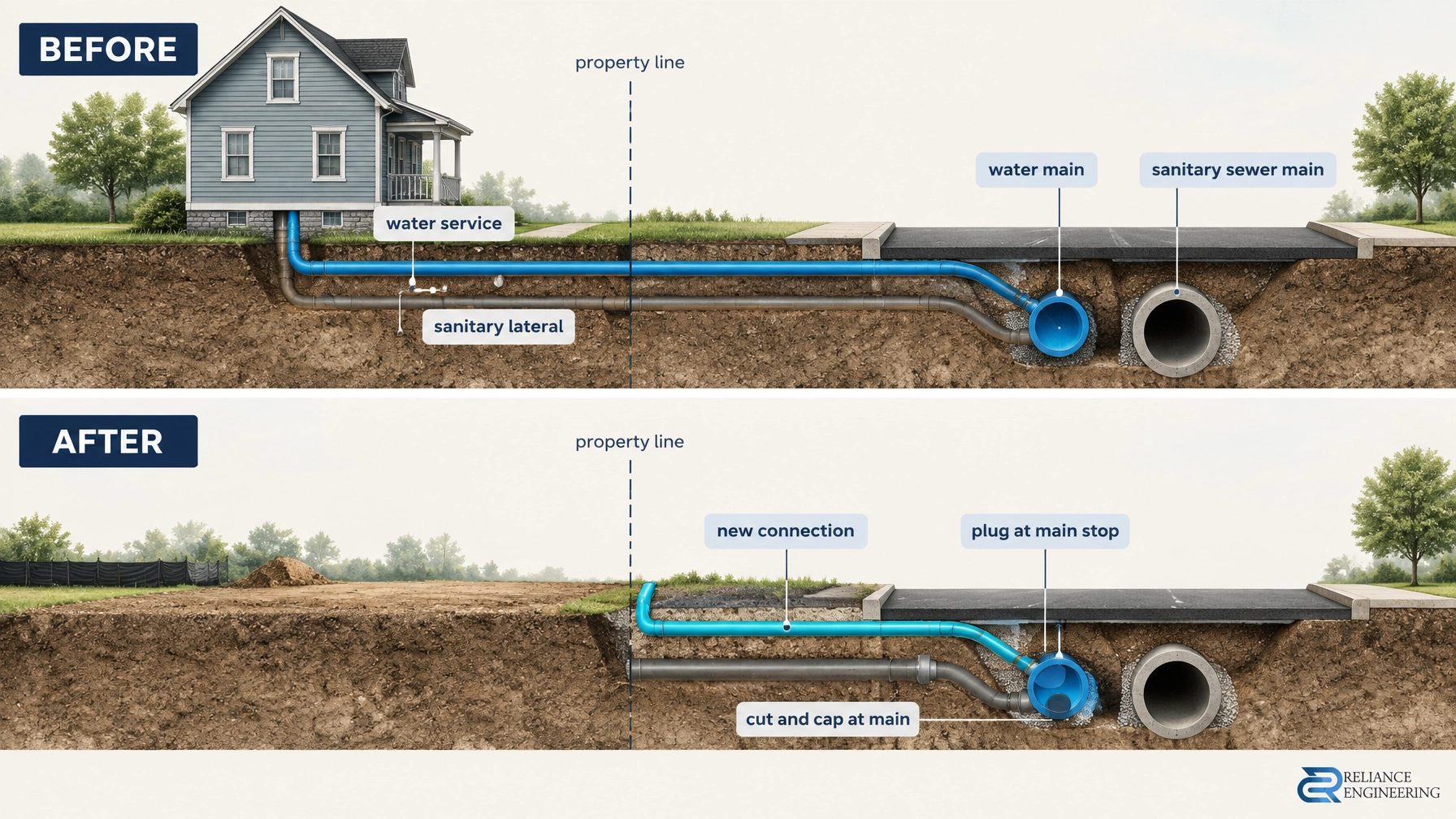
In Toronto, separating the municipal-side lateral at the main physically disconnects it from the sewer system. Toronto Water’s 2018 staff report identified this as a way to limit infiltration and inflow (I&I) through cracks, breaks and joints, and noted that the cap can later be checked by CCTV. The City describes the municipal side as running from the main to the property line, while the private side from the property line to the building is the owner’s responsibility.
Can an existing service be reused?
Possibly, but reuse should be approved, not assumed. Toronto may consider reuse for substantially demolished residential buildings if the existing service meets current City standards and specifications. The stated limits are water services up to and including 25 mm and sewer services up to and including 150 mm.
Toronto Water’s 2018 staff report further states that a permitted connection must meet current standards, not be a double connection, have no record of sewer backups, and be free of structural and operational defects. An unapproved reuse of a municipal connection is not compliant with Toronto’s Sewers By-law.
Shared “Y” connections also need attention. Toronto’s service information identifies separation of shared services into individual connections as a reason to request service work. Show which property each service serves and how neighbour connections will be protected.
What should the site servicing plan show?
The plan should give the reviewer and contractor a clear record of existing services and their proposed disposition. Include:
- Existing water, sanitary and storm services, based on available records, survey information and field verification.
- Whether each service is to be reused, disconnected, removed or replaced.
- Specific decommissioning notes identifying the required cap location: at the main, at or near the property line, or another municipality-approved point.
- Any shared service or “Y” connection, with a clear note on separation and protection of services serving adjacent properties.
- Toronto water-meter removal and shutoff requirements where applicable.
- Profiles and invert elevations for proposed connections, plus relevant cross-sections and underground utilities.
- A PE seal where required by the applicable technical review.
For Toronto industrial, commercial and institutional projects, and other connections requiring Toronto Water technical review, the City calls for a signed, sealed and dated site service connection plan at 1:100 and a stamped servicing report. Review triggers include certain larger domestic water or sanitary connections, sanitary connections to combined sewers, storm connections and services in City-owned easements. Check the City’s Toronto Water permits and by-laws for current requirements.
Toronto’s adopted removal specifications also describe methods for sealing, plugging or capping abandoned piping. For small water services, the method includes removing the main stop and inserting a plug; larger services involve removal of the tapping sleeve and valve or tee, followed by a fill piece. The approved municipal detail, not a generic plan note, should govern the work.
Sequence the work before demolition
- Confirm the local process. Identify whether the owner, a municipal contractor or both perform the work, and where the cap must be installed.
- Submit the servicing and demolition applications. Include existing-service information and proposed reuse or decommissioning details.
- Arrange water-meter removal. In Toronto, notify Toronto Water in writing at least seven days before the water supply is no longer required. The final reading, meter and remote readout unit removal must occur before demolition.
- Coordinate disconnections with the new connection. Toronto typically coordinates sewer disconnection at the main with installation of the new connection. Do not schedule private or municipal work based on assumptions about timing.
- Keep work accessible for inspection. Where an inspection or witnessed abandonment is required, arrange it before backfill. Hamilton requires witnessed water-service abandonment; Ottawa and Kingston also have inspection requirements for applicable sewer work.
- Keep records. Retain approvals, inspection confirmations, photographs and contractor details for the building permit and construction file.
Eight-item pre-submission checklist

- Locate and verify existing services.
- Confirm whether a shared or “Y” connection exists.
- Arrange water-meter removal before demolition, where required.
- Add existing-service decommissioning notes to the servicing plan.
- Confirm whether caps belong at the main or property line.
- Schedule inspection or witnessed abandonment before backfill.
- Protect or separate services serving neighbouring properties.
- Provide a PE-stamped plan where technical review applies.
Key takeaways
- Disconnection rules are municipal, not uniform across Ontario.
- Show the existing service and its intended disposition on the servicing plan.
- Reuse requires municipal acceptance where applicable.
- Confirm cap location, responsible party and inspection timing before demolition.
- Coordinate decommissioning with new connections to avoid site delays.
Reliance Engineering prepares site servicing plans with existing-service decommissioning notes, clean layouts, coordinated design and constructible routing. We can also coordinate the servicing strategy with a functional servicing report and stormwater management reports Ontario projects require. Our municipal experience supports practical designs, clear calculations and approval support.
Need a servicing plan or help confirming local requirements? Request a consultation.
Contact and credentials
Reliance Engineering Canada Limited
6850 Millcreek Dr, Mississauga, ON L5N 2H4
Phone: 647-385-6418
Email: [email protected]
Office hours: Monday–Friday 9:00 AM–5:00 PM; Saturday 12:00 PM–2:00 PM; Sunday closed
Naresh Ochani, P.Eng., M.Eng., Principal Engineer
PEO Certificate of Authorization: 100548882