Article type: Technical how-to guide
Topic: Commercial construction, parking lot grading, drainage, and municipal approvals
Service area: Ontario
Published: August 20, 2026
Estimated reading time: 7 minutes
Commercial construction sites create immediate drainage and sediment risks. During excavation, grading, asphalt regrading, and servicing work, exposed soil can move quickly during rainfall. If runoff is not controlled, sediment can enter catchbasins, storm sewers, roads, ditches, watercourses, and neighbouring properties.
A properly prepared Erosion and Sediment Control Plan in Ontario helps prevent these problems. More importantly, the ESC plan must be coordinated with the Site Grading Plan, Site Servicing Plan, construction staging, and stormwater management design.
At Reliance Engineering, our approach is practical, drainage-aware, and focused on keeping projects buildable and approved.
ESC Plans Are a Construction-Stage Drainage Strategy
An ESC plan does more than place standard silt fence notes on a drawing. It establishes how soil, sediment, and construction runoff will be managed while the site is being altered.
Commercial sites often contain large disturbed areas, temporary access routes, stockpiles, exposed slopes, and direct connections to municipal drainage systems. These conditions create several possible paths for sediment to leave the property.
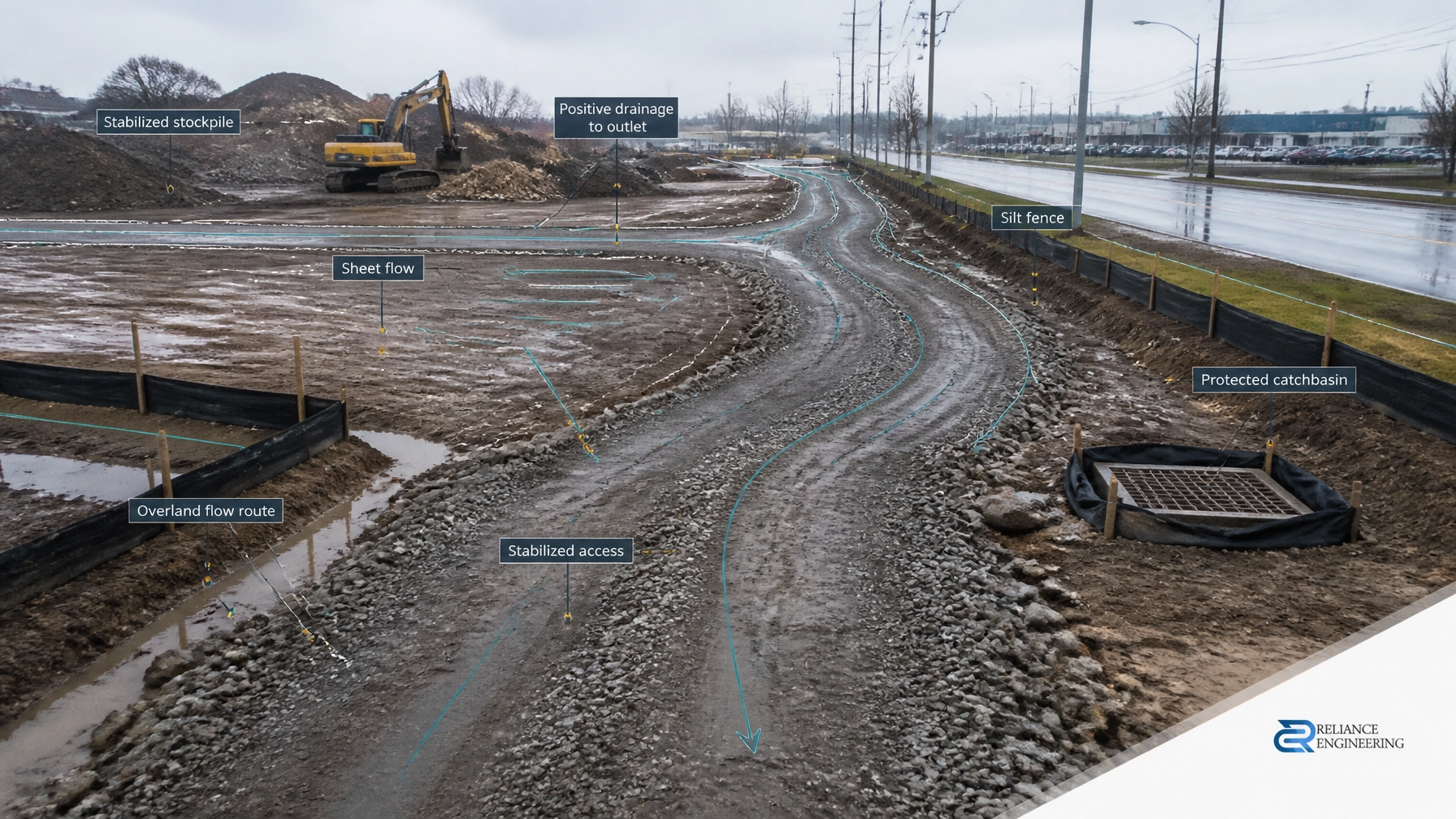
A strong ESC plan identifies:
- Construction limits and areas of exposed soil
- Temporary drainage patterns
- Low points and vulnerable catchbasins
- Overland flow routes
- Construction entrances and mud tracking risks
- Stockpile locations and protection
- Temporary swales, berms, and check dams
- Maintenance and inspection requirements
- Final stabilization and removal procedures
The controls must match the actual site. A perimeter fence that is not located along the down-gradient edge, or a catchbasin protection detail that does not suit the inlet, will not provide reliable protection.
Our Erosion and Sediment Control Plans are prepared with the construction limits, drainage-focused approach, and municipal requirements in mind.
Why Commercial Parking Lot Projects Need Careful ESC Coordination
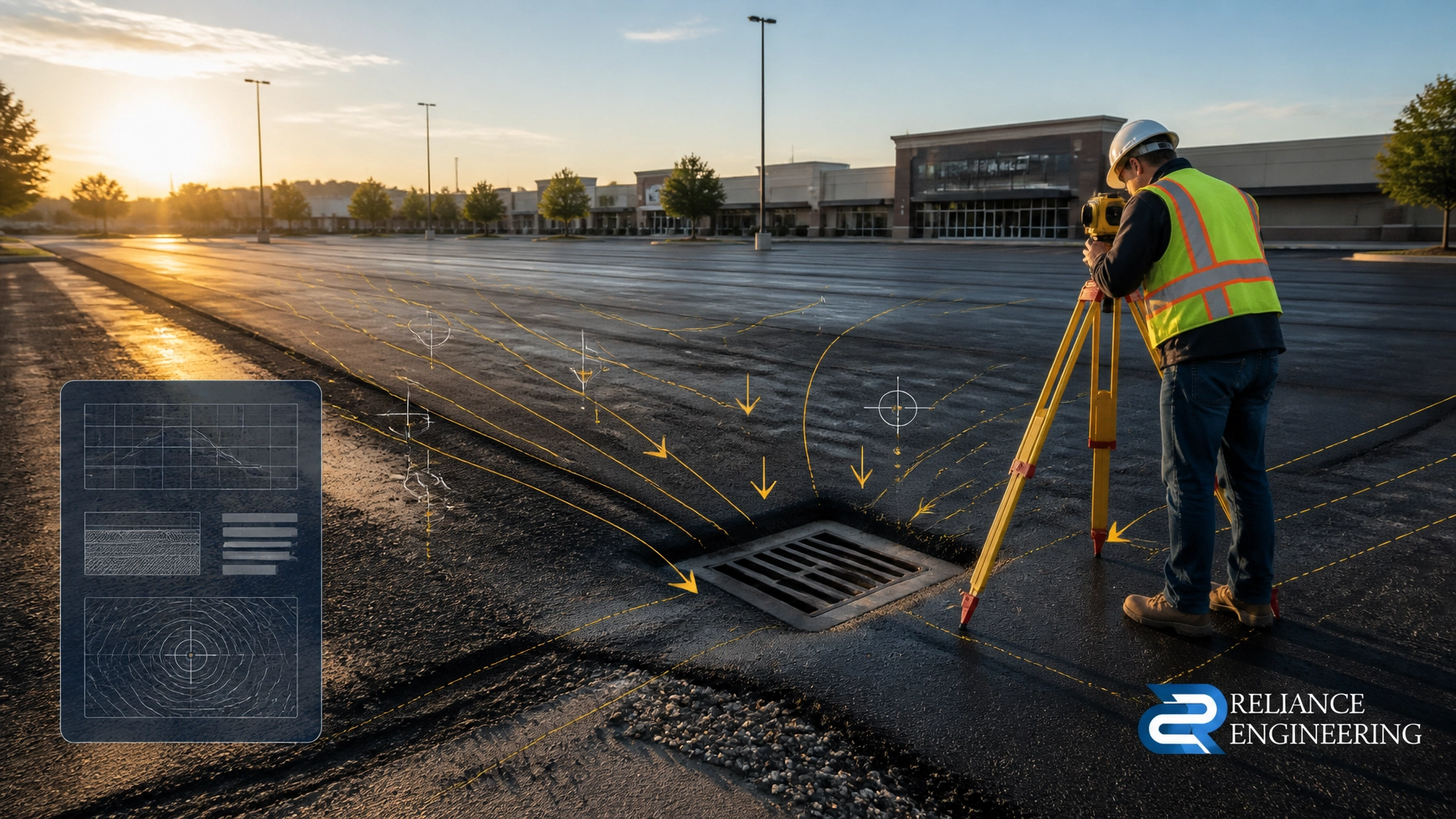
Commercial parking lot projects are particularly sensitive to grading and sediment problems. Large paved areas concentrate runoff. Small errors in subgrade elevation, curb layout, catchbasin placement, or temporary drainage can create ponding and sediment pooling.
During construction, the site may pass through several temporary conditions:
- Existing pavement is removed.
- The site is excavated and regraded.
- Granular base is placed.
- Curbs, catchbasins, and storm services are installed.
- Asphalt is placed.
- Landscaping and final stabilization are completed.
Each stage can change how water moves across the site. A drainage path that works after final asphalt placement may not work when the site is stripped or partially graded.
This is why commercial parking lot drainage in Ontario should be reviewed together with ESC. If a temporary low point directs muddy water toward an active catchbasin, the inlet can become blocked before the permanent drainage system is complete.
If the final parking lot has inadequate slopes, the owner may later require asphalt regrading, localized reconstruction, additional drainage structures, or other commercial property grading fixes. Correcting drainage before paving is generally more efficient than repairing ponding after the parking lot is in service.
How a Drainage-Aware ESC Plan Protects the Site
1. Catchbasins and storm sewers
Catchbasins are common entry points for sediment. Once sediment enters the storm system, it can reduce capacity, damage downstream facilities, and create maintenance issues for the municipality.
An ESC plan should show protection at active catchbasins and inlets. Depending on the site and municipal requirements, measures may include inlet protection, filter devices, stone protection, or other approved systems.
Protection must remain functional. If sediment accumulates around the inlet or the device becomes clogged, the contractor must clean, repair, or replace it.
2. Roads and construction entrances
Mud tracked onto public roads creates safety issues, complaints, and potential by-law enforcement. It can also carry sediment directly into roadside catchbasins.
A practical ESC plan identifies a stabilized construction entrance with an appropriate mud mat or granular access pad. The entrance should be located where construction vehicles can use it consistently and where runoff can be managed.
Regular sweeping and prompt removal of tracked material are also important. A detail on a drawing cannot replace field maintenance.
3. Ditches and watercourses
Commercial sites that drain toward a ditch, creek, wetland, or other watercourse require additional care. Exposed soil and concentrated runoff can cause erosion at outlets and carry suspended sediment downstream.
The ESC design should consider:
- Direction and velocity of temporary runoff
- Protection of ditch banks and slopes
- Sediment traps or check dams where appropriate
- Stabilization of temporary channels
- Dewatering procedures
- Downstream receiving conditions
Conservation authority requirements may also apply. Requirements vary by location and project conditions, so they should be confirmed early.
4. Neighbouring properties
Poor grading and uncontrolled runoff can move sediment onto adjacent lands, private driveways, landscaped areas, and building entrances.
A buildable grading design provides positive drainage while limiting uncontrolled flow across property lines. The ESC plan then adds temporary controls at the construction boundary, especially along down-gradient edges.
This coordination helps reduce drainage complaints and protects the relationship between the project and surrounding property owners.

ESC Must Be Coordinated With Grading and Storm Servicing
An ESC plan should not be prepared in isolation from the civil design. It must use the same base information and be consistent with the proposed grades, drainage routes, and storm servicing layout.
Our Site Grading Plans typically address:
- Existing and proposed elevations
- Parking lot grades
- Driveway and entrance elevations
- Swales and drainage routes
- Catchbasins and area drains
- Road and ditch tie-ins
- Overland flow routes
- Erosion and sediment control notes
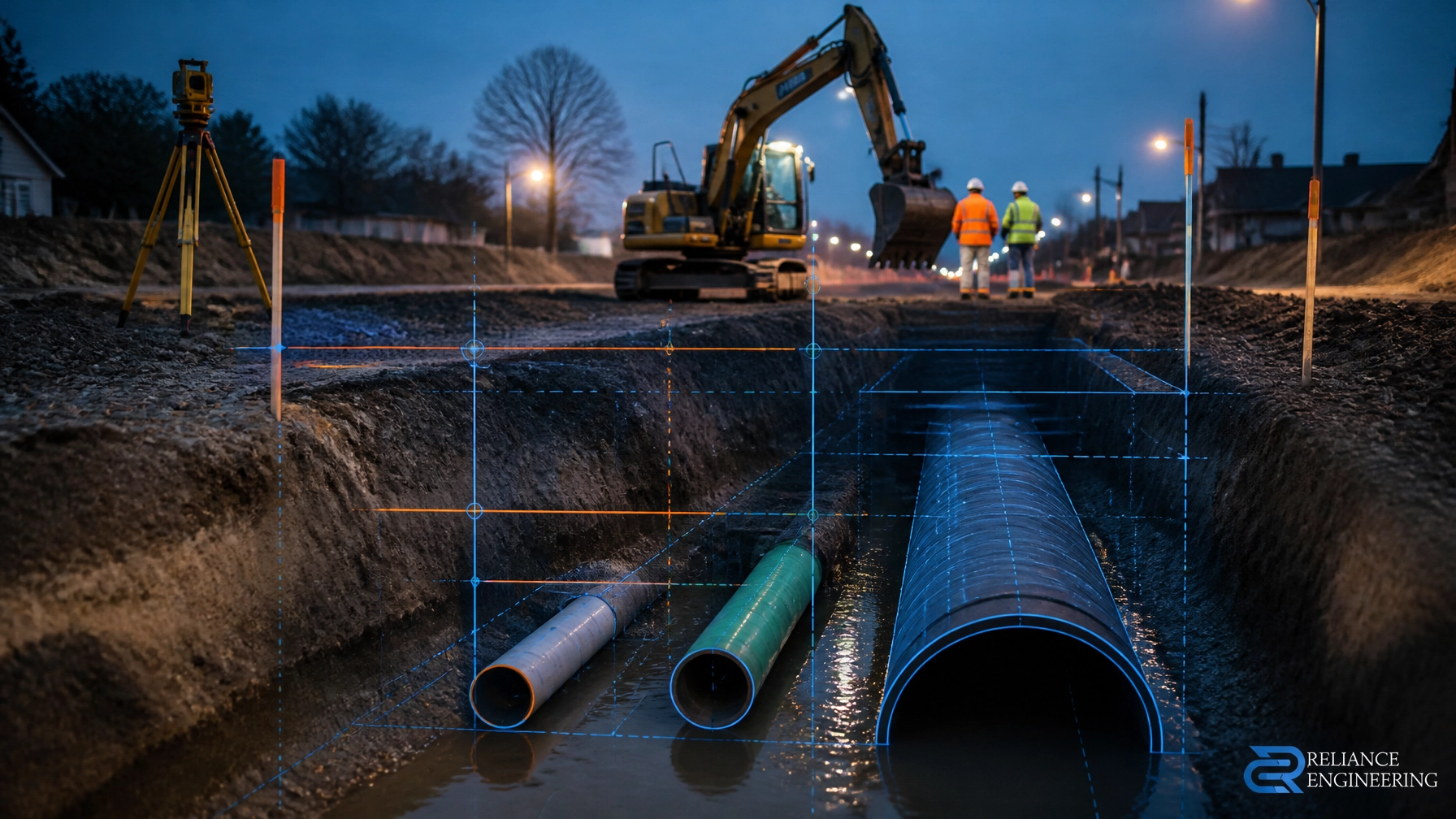
The Site Servicing Plan must also be coordinated with temporary and permanent drainage. Storm sewer locations, pipe slopes, inverts, and connection points affect how water is managed during construction.
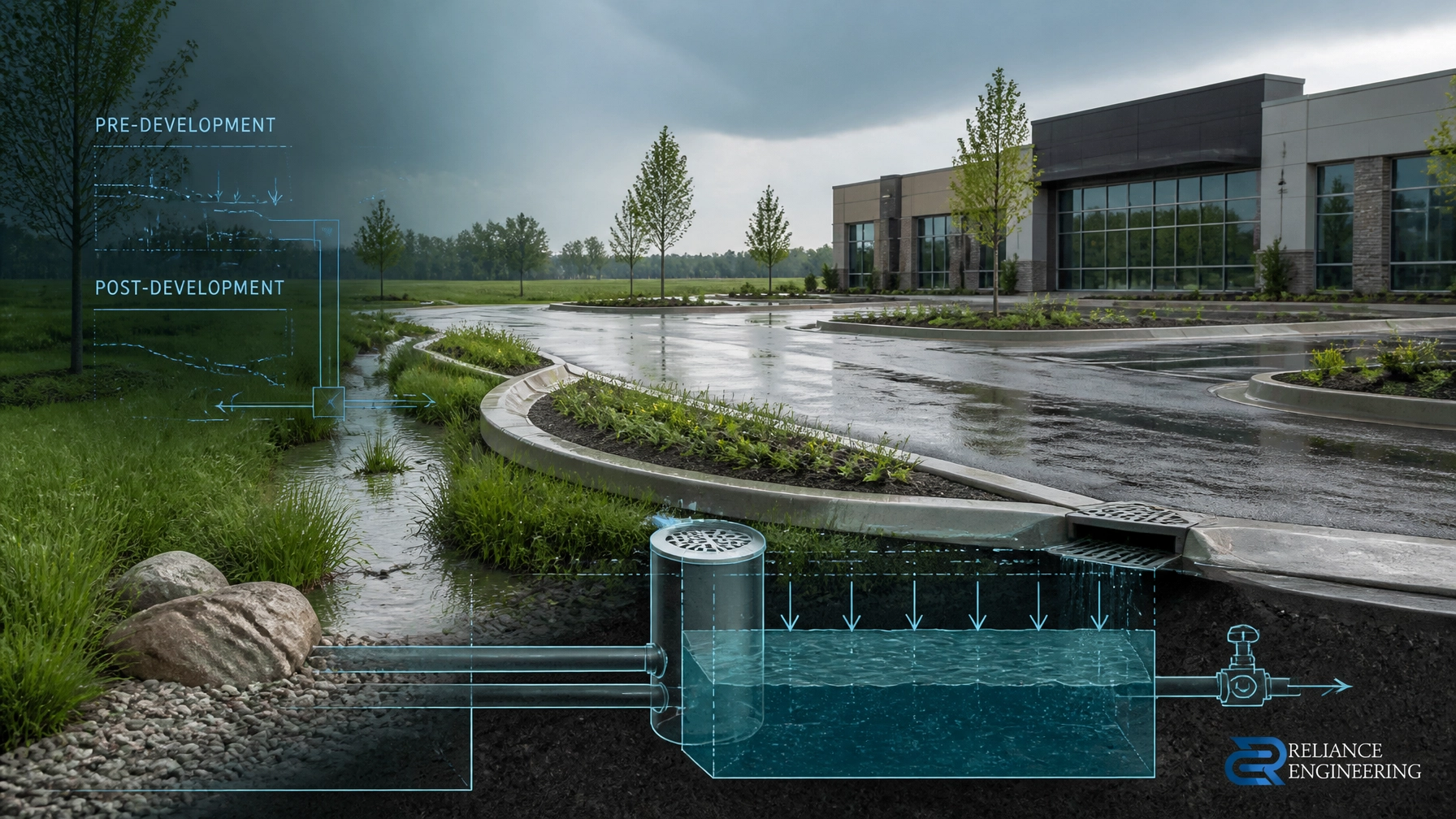
For larger commercial developments, a Stormwater Management Report may be required to address runoff quantity, quality, storage, release rates, and downstream impacts.
The objective is a coordinated design:
- Grading establishes where water should flow.
- Storm servicing provides the permanent conveyance system.
- ESC controls sediment while the site is disturbed.
- Stormwater management addresses post-development runoff performance.
When these elements conflict, the project may face redesign, inspection problems, or approval delays.
Practical Controls Commonly Shown on Commercial ESC Drawings
The appropriate controls depend on site conditions, construction staging, soil type, drainage patterns, and municipal requirements. Typical measures may include:
- Silt fence along down-gradient limits
- Construction limit fencing
- Stabilized construction entrances
- Mud mats and road protection
- Catchbasin and inlet protection
- Sediment traps
- Rock check dams
- Temporary swales and diversion berms
- Protected soil stockpiles
- Erosion blankets or temporary stabilization
- Dewatering notes and discharge controls
- Inspection and maintenance notes
These should be shown as clear drawings with construction notes and details that contractors can understand and install.
A practical control is one that works in the field, can be accessed for maintenance, and remains effective as construction progresses. Controls should also be revised when the site moves into a new construction phase.

How ESC Prevents Approval and Construction Problems
A complete ESC plan helps reduce several common project risks:
Sediment discharge
Uncontrolled runoff can carry sediment beyond the property and into municipal or natural drainage systems. This can trigger corrective action and environmental concerns.
Blocked catchbasins
Sediment-filled catchbasins can stop functioning during rainfall. This increases ponding and can affect surrounding roads and properties.
Muddy roads
Without a stable construction entrance and maintenance plan, vehicles can track soil onto public roads. This may result in complaints, cleanup costs, or by-law issues.
Inspection failures
Inspectors expect controls to be installed as shown, maintained, and adjusted when conditions change. Missing or poorly located controls can delay inspections.
Ponding and drainage complaints
If temporary or permanent grades do not provide positive drainage, water can collect in parking areas, near curbs, or beside buildings. Early grading review supports practical ponding solutions before asphalt is placed.
Approval delays
Municipal reviewers may request revisions when an ESC plan does not clearly address catchbasins, drainage routes, stockpiles, access points, or maintenance. Clear, permit-ready drawings reduce unnecessary review cycles.
What Developers and Contractors Should Confirm Before Construction
Before starting commercial grading or parking lot work, confirm that the ESC package:
- Uses the current site plan and survey
- Matches the Site Grading Plan
- Shows all relevant catchbasins and storm outlets
- Identifies temporary drainage routes
- Addresses construction access and mud tracking
- Protects adjacent roads, ditches, watercourses, and properties
- Includes practical control details
- Defines inspection and maintenance responsibilities
- Addresses construction sequencing
- Remains in place until disturbed areas are stabilized
The plan should also be reviewed with the contractor before mobilization. Field staff need to understand where controls are located, how they are maintained, and when they must be changed.
Permit-Ready ESC and Civil Drawings Across Ontario
Reliance Engineering prepares coordinated civil engineering documentation for commercial and land development projects across Ontario, including:
- Site Grading Plans
- Site Servicing Plans
- Erosion and Sediment Control Plans
- Stormwater Management Reports
- Functional Servicing Reports
- Site Plan Approval Drawings
- OPA/ZBA Drawings
- Severance and Consent Application Drawings
- Building Permit Drawings
Our focus is straightforward: practical designs, clear drawings, buildable grading, positive drainage, and approval support.
Naresh Ochani, P.Eng., M.Eng., brings more than 20 years of principal engineer experience and detailed knowledge of municipal requirements. Reliance Engineering is authorized by the Professional Engineers Ontario under Certificate of Authorization 100548882.
Request a consultation for an ESC plan, commercial parking lot drainage review, asphalt regrading assessment, or coordinated civil design package.
Contact Reliance Engineering
Reliance Engineering
6850 Millcreek Dr
Mississauga, ON L5N 2H4
Phone: 647-385-6418
Email: [email protected]
Office hours:
Monday–Friday: 9:00 AM–5:00 PM
Saturday: 12:00 PM–2:00 PM
Sunday: Closed
Naresh Ochani, P.Eng. M.Eng.
PEO Certificate of Authorization: 100548882

A well-coordinated ESC plan keeps sediment on site, protects municipal infrastructure, supports safe construction, and helps keep the project approved. For commercial construction in Ontario, drainage-aware erosion and sediment control should be addressed before grading begins: not after the first inspection or rainfall event.