

Land is the most expensive asset in Ontario real estate. If you are holding a single-family lot, you are likely sitting on underutilized capital. With the recent legislative shifts in Ontario: specifically the push for "Missing Middle" housing and Bill 23: the barriers to creating high-density, multi-unit residential properties are lower than they have been in decades.
For the savvy investor, the goal is simple: maximize the number of doors on a single piece of dirt. The most effective way to do this? Lot Severance combined with Multiplex Conversion.
By severing a single oversized lot into two and building a 4-plex or 5-plex on each, you aren't just doubling your density; you are exponentially increasing your Return on Investment (ROI). Here is the 5-step engineering and planning roadmap to making it happen.
Why Investors are Pivoting to the "Missing Middle"
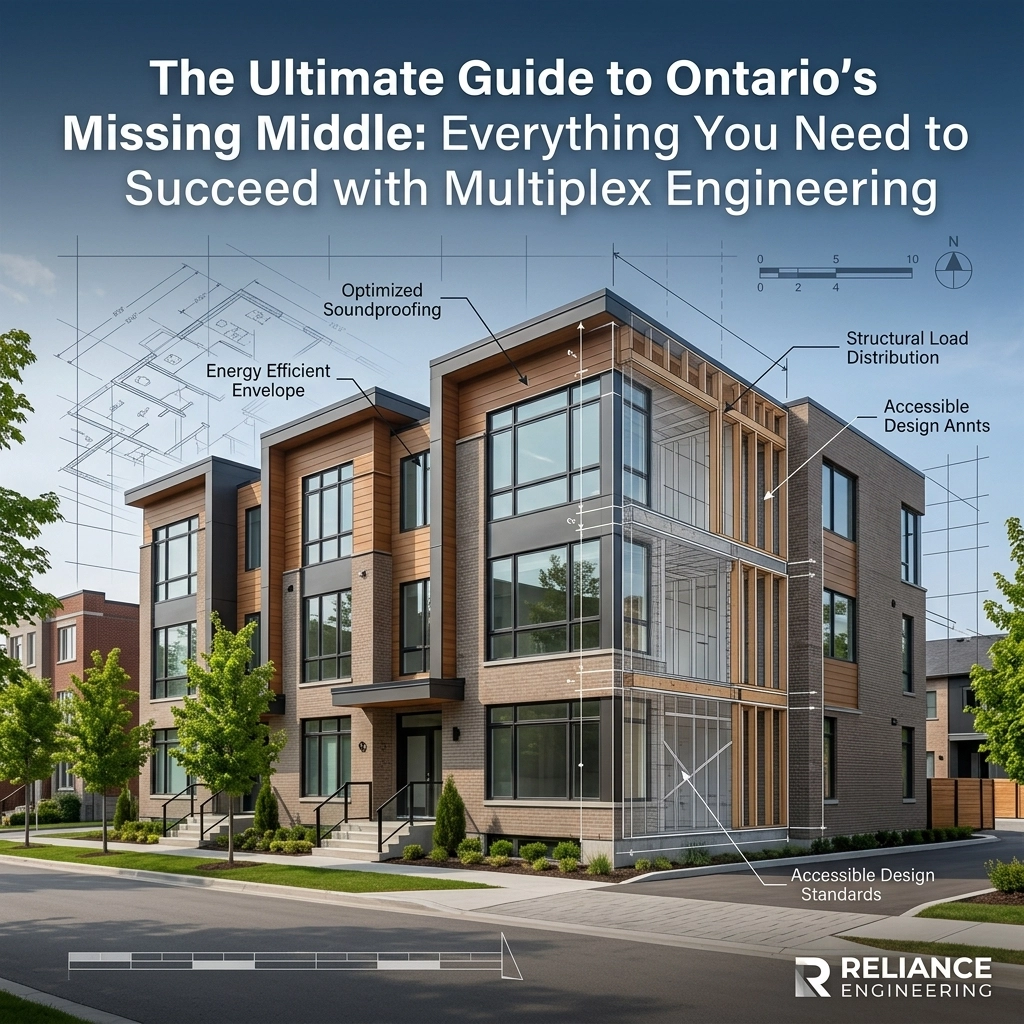
The "Missing Middle" refers to housing types between single-family homes and high-rise apartments: think duplexes, triplexes, and four-plexes. Ontario’s housing crisis has forced municipalities to allow for more density as-of-right. This means in many jurisdictions, you can now build up to four units per lot without a lengthy rezoning process.
However, "as-of-right" does not mean "without rules." The difference between a profitable 5-plex and a project stuck in the planning phase for two years is civil engineering.
Step 1: The Feasibility Study (Know Your Dirt)
Before you talk to a lender or a contractor, you need to know what the land will allow. A feasibility study determines if your lot severance is physically and legally possible.
- Zoning Review: Does the current zoning allow for severance? What are the minimum frontage and depth requirements?
- Topography: Is the land flat or sloped? Severe slopes can drastically increase the cost of a site grading plan.
- Utility Capacity: Can the existing municipal lines handle eight to ten toilets flushing at once? This requires a sanitary sewer design check.
At Reliance Engineering, we help investors identify these red flags early. There is no point in buying a property for a 5-plex conversion if the city's water main doesn't have the pressure to support the fire suppression system required for multi-unit builds.
Step 2: The Severance Application (Consent)
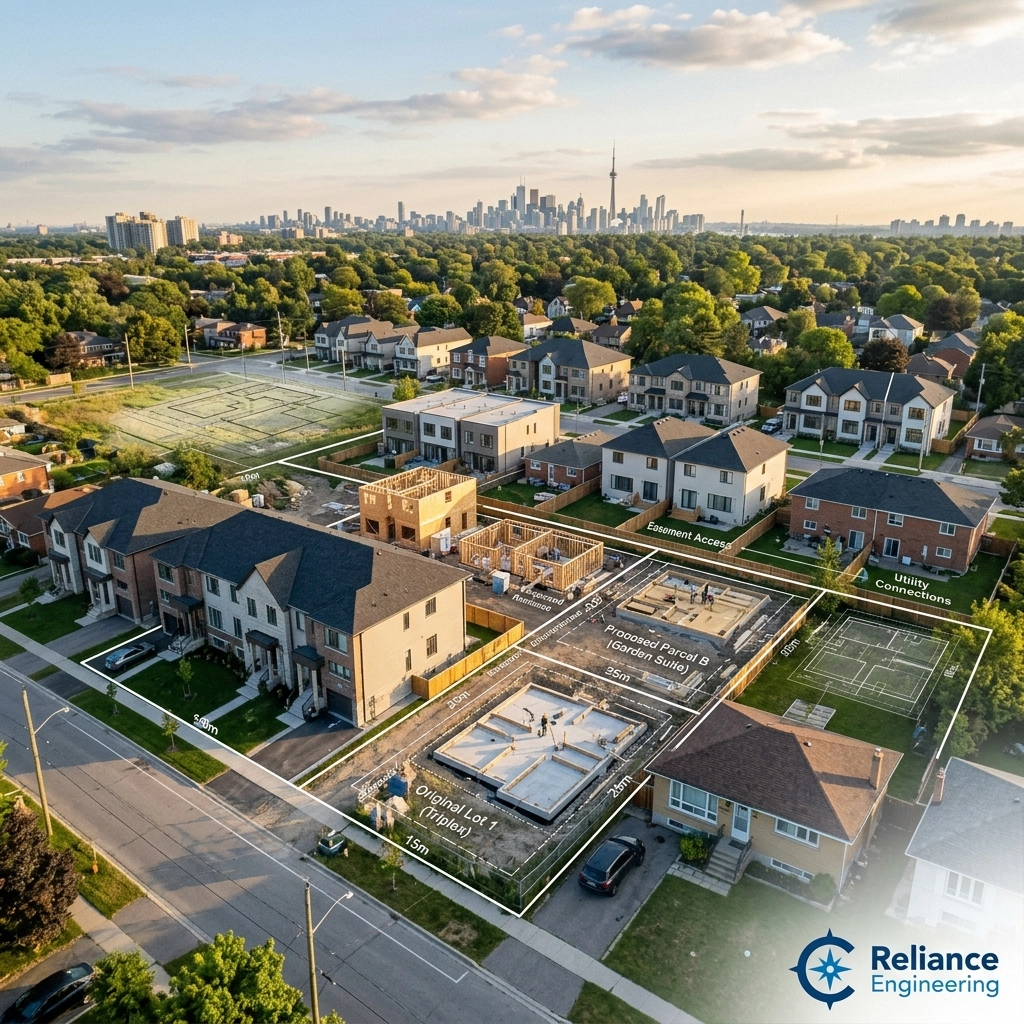
In Ontario, severing land is officially called a "Consent" application. You are asking the Committee of Adjustment for permission to divide the land into two or more separate parcels.
Why Severance is the Ultimate ROI Play
Imagine you own a lot worth $1.2M. You build a 4-plex. Total value might be $2.8M.
Now, imagine you sever that lot into two. Each lot is now worth $800k (total $1.6M in land value). You build a 4-plex on each. Now you have eight units instead of four. Your gross rental income and your exit valuation just shifted into a completely different tier.
What you need for a successful application:
- A professional land survey.
- A planning rationale (why this helps the community).
- Preliminary engineering comments to prove the new lots can be serviced.
Step 3: Engineering Design (The Make-or-Break Step)
This is where most investors fail. They focus on the floor plans but forget what’s underground. If you cannot move water off the property or get sewage out of it, you don't have a project.
The Functional Servicing Report (FSR)
For any multiplex or severance, the municipality will demand a Functional Servicing Report (FSR). This report proves that the new units will have adequate water supply, sanitary capacity, and a plan for stormwater management.
Site Grading and Servicing Plans
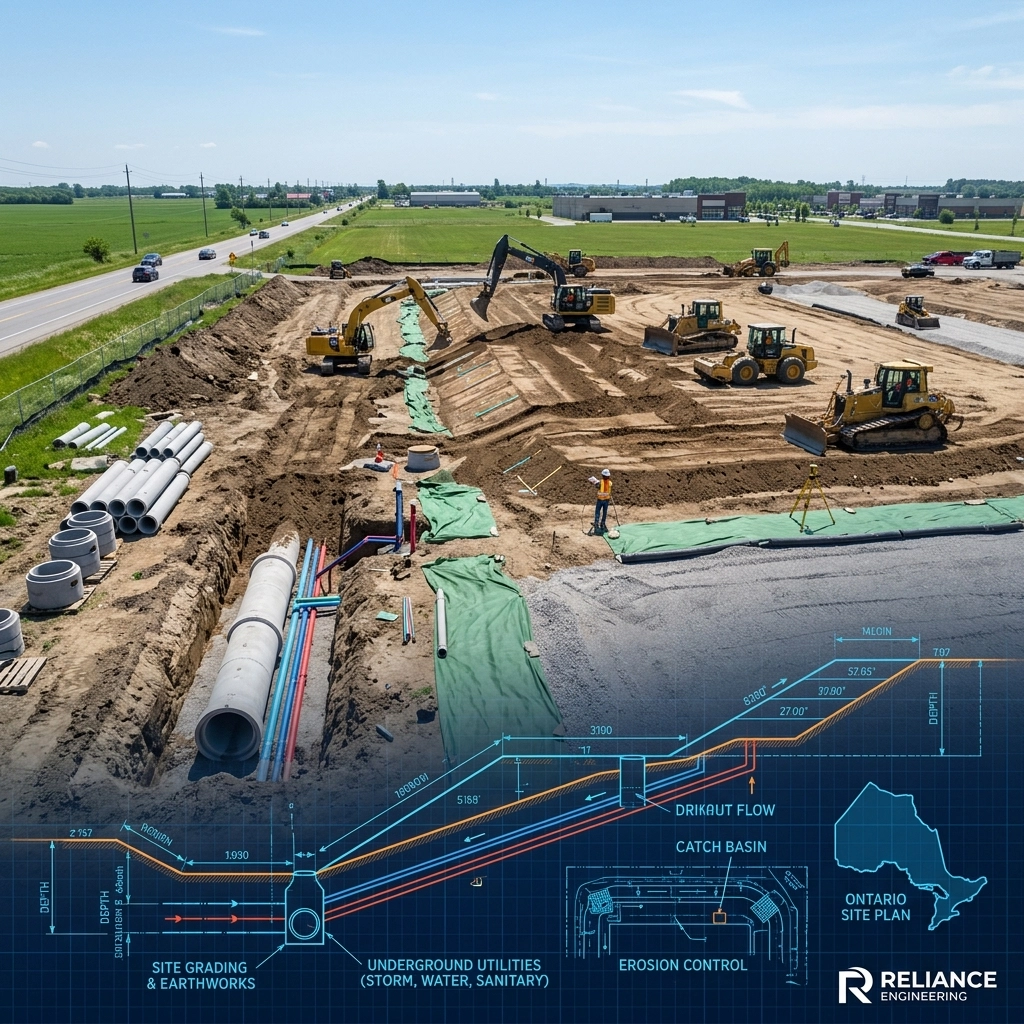
You will need a detailed site servicing plan to show exactly how pipes will connect to the city's main. Simultaneously, a site grading plan ensures that rainwater flows away from your new foundation and doesn't flood your neighbor's yard: a major cause of legal disputes and permit denials.

Step 4: Navigating the Approvals and Permits
Once your engineering is locked in, you move into the formal approval phase. This often involves:
- Committee of Adjustment (CoA): Presenting your severance and any minor variances (like being slightly over the allowed lot coverage).
- Site Plan Approval (SPA): Some municipalities require SPA for 4-plexes or 5-plexes to ensure the exterior design and landscaping meet city standards.
- Building Permits: The final hurdle. This is where your structural, mechanical, and civil drawings are reviewed for Ontario Building Code (OBC) compliance.
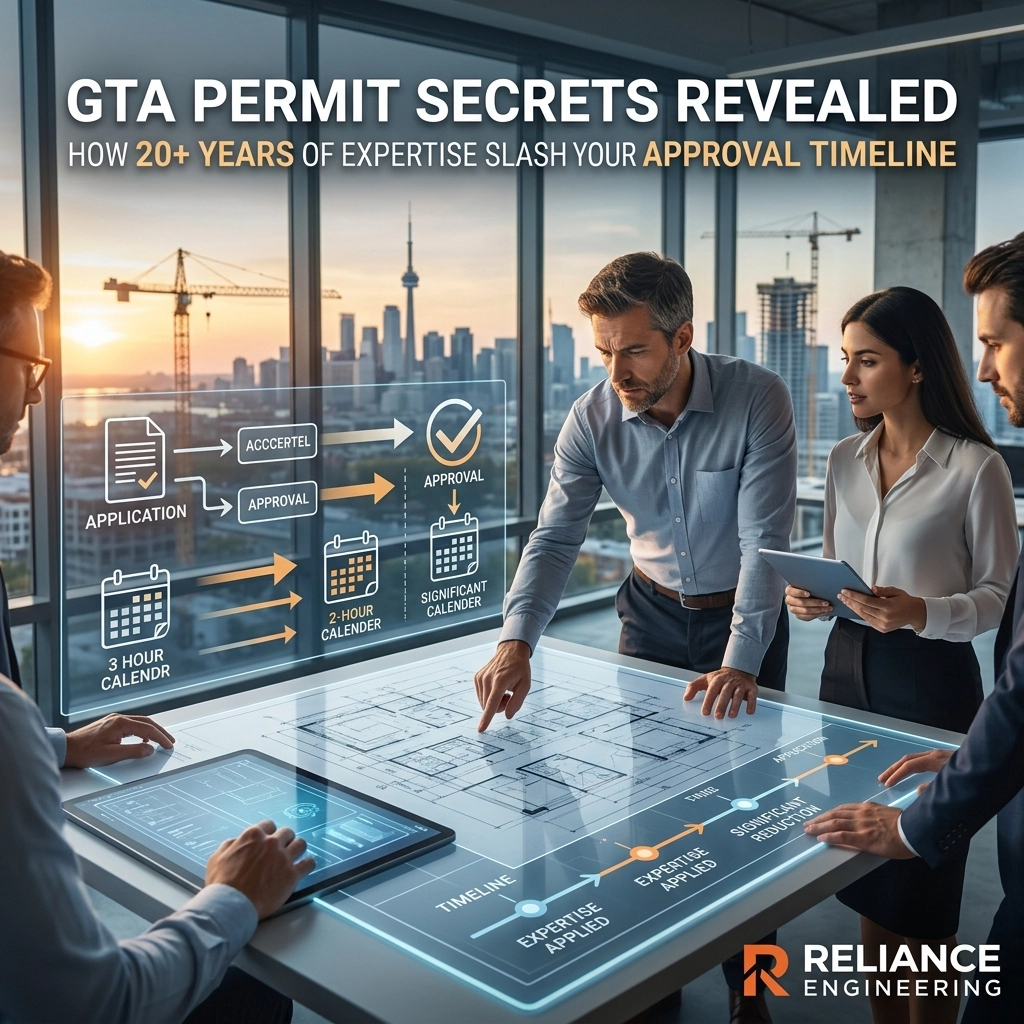
Reliance Engineering specializes in accelerating this process. We provide draft plans in days, not weeks, ensuring your project moves toward the "permit-ready" stage as fast as possible.
Step 5: Maximizing Your ROI During Construction
With permits in hand, the focus shifts to execution. For multiplexes, every square inch matters.
- Sub-metering: Always sub-meter your utilities (hydro, water, gas). This shifts the variable cost to the tenant and significantly increases your Net Operating Income (NOI).
- The 5th Unit Strategy: In some Ontario jurisdictions, a 5th unit can be added as an Accessory Dwelling Unit (ADU) or a garden suite. If your storm system design allows for the extra footprint, this is "pure profit" space.
- Curb Appeal and Engineering: Don't neglect the drainage. A poorly graded property will lead to basement dampness, which is the #1 killer of rental yields and long-term property value.
How Reliance Engineering Protects Your Investment
At Reliance Engineering, we aren't just draftsmen; we are land development consultants. We understand that for an investor, time is money. A delay of three months in the permitting phase can cost tens of thousands in carrying costs.
We provide practical, compliant, and cost-effective civil engineering solutions across Ontario. Whether you are looking at a townhome development like the 35 Wabash Avenue project or a complex infill like 24 Howard Park Avenue, our team is equipped to handle the heavy lifting of municipal approvals.

Our Services Include:
- Site Grading Plans: Ensuring proper drainage and compliance.
- Site Servicing Plans: Designing the "veins and arteries" of your building.
- Functional Servicing Reports (FSR): The essential document for multi-unit approvals.
- Stormwater Management: Innovative solutions to manage runoff on tight urban lots.
Final Thoughts for Ontario Investors
The window for maximizing ROI on residential land is wide open, but the technical requirements are becoming more stringent. If you want to sever your lot and build a 4-plex or 5-plex, do not treat the engineering as an afterthought. It is the foundation of your entire business case.
Are you ready to unlock the full potential of your property?
Stop guessing and start building with confidence. Contact Naresh Ochani and the team at Reliance Engineering for a consultation on your next project.
Contact Information
- Name: Naresh Ochani, P.Eng. M.Eng.
- Company: Reliance Engineering
- Address: 6850 Millcreek Dr, Mississauga, ON L5N 2H4
- Phone: 647-385-6418
- Email: [email protected]
- Website: www.relianceengineering.ca
Office Hours
- Saturday: 12:00 PM – 2:00 PM
- Sunday: Closed
- Monday – Friday: By Appointment

Disclaimer: This guide is for informational purposes. Local municipal bylaws vary across Ontario. Always consult with a professional engineer and a licensed planner before commencing a land development project.


Leave A Comment