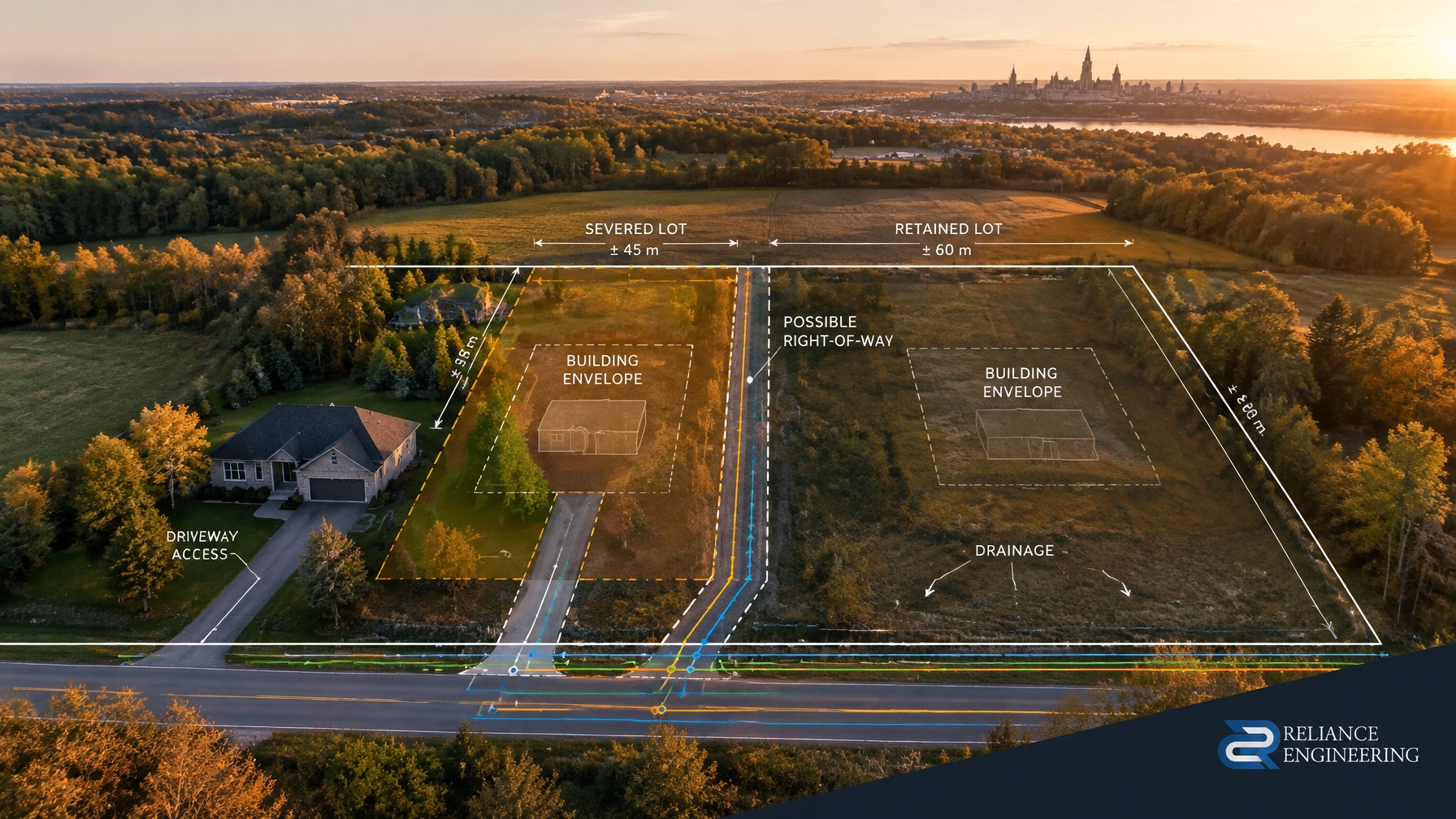
Splitting a property into two or more lots is a common way to unlock land value in Ontario. This process, known as a land severance or consent application, requires a deep understanding of municipal planning and civil engineering. At Reliance Engineering, we have over 20 years of experience helping developers and homeowners navigate these complexities across Ontario.
A successful severance is not just about a legal line on a map. It requires a functional design that ensures the new lots are buildable, safe, and serviced. The most critical technical component of this process is the site grading plan.
Below are the five essential steps to handle a severance application while ensuring your engineering requirements are met.
Step 1: Preliminary Research and Pre-Consultation
Before you submit any paperwork, you must determine if your proposal is feasible. Every municipality in Ontario has an Official Plan and Zoning Bylaws that dictate minimum lot frontages, areas, and setbacks.
Zoning and Feasibility
Start by checking if your property meets the basic requirements for a split. If your lot is 60 feet wide and the zoning requires a minimum of 30 feet per lot, a severance is likely possible. If it is 50 feet wide, you may need a Minor Variance in addition to the severance.
The Pre-Consultation Meeting
Most municipalities require a pre-consultation meeting with the planning department. This is where you present a preliminary sketch. Planning staff will provide a checklist of required studies. For most severance applications, this list includes:
- A Draft Reference Plan (prepared by a surveyor).
- A Functional Servicing Report.
- A preliminary Site Grading and Drainage Plan.
Reliance Engineering specializes in these early-stage assessments to ensure you don't spend money on an application that the city will likely refuse.
Step 2: Preparing the Technical Application Package
Once feasibility is confirmed, you must assemble a formal application. This is submitted to the local Committee of Adjustment or Land Division Committee.
The Role of the Site Grading Plan
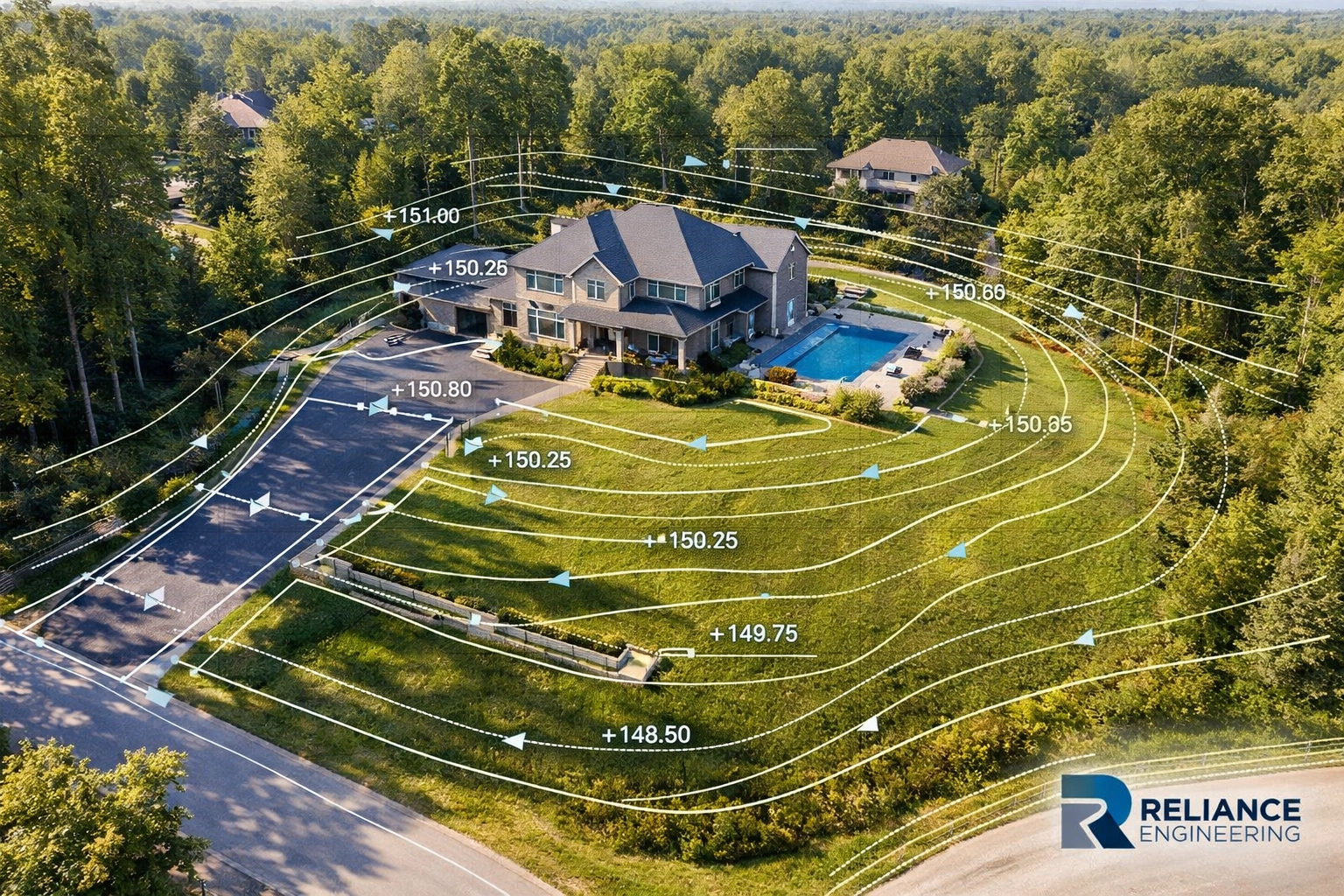
A site grading plan is often a mandatory requirement at this stage. It demonstrates to the city that the new lot can be drained properly without causing flooding on neighboring properties. In Ontario, the law is clear: you cannot change the natural flow of water in a way that negatively impacts your neighbors.
Your grading plan will show:
- Existing and proposed elevations.
- The direction of surface water flow (swales and slopes).
- Retaining walls, if necessary.
- The location of the proposed building envelopes.
Servicing Requirements
You must also prove that each new lot can be connected to municipal services. This involves sanitary sewer design and water distribution design. If the area is not serviced by municipal pipes, you will need a private well and septic assessment.
Step 3: Application Review and the Public Hearing
After submission, the planning department circulates your application to various agencies, such as the local Conservation Authority, Public Works, and the Ministry of Transportation (if applicable).
Public Notice
The municipality will post a sign on your property and mail notices to neighbors within a 60-metre radius. This allows the public to voice concerns. Common concerns often relate to drainage and privacy. Having a professional site grading plan and stormwater management strategy ready allows us to answer these technical objections immediately, keeping your application on track.
The Committee Decision
You or your representative (like Naresh Ochani, P.Eng. M.Eng.) will attend a public hearing. The Committee will either approve, deny, or defer the application. Approvals are almost always "conditional."
Step 4: Satisfying the Conditions of Approval
Getting an approval from the Committee is only the halfway point. You will typically be given one year to satisfy a list of conditions. If you miss this deadline, the approval lapses, and you must start over.
Common conditions include:
- Payment of Development Charges: Fees paid to the city to fund infrastructure.
- Parkland Dedication: A cash-in-lieu payment for green space.
- Final Engineering Approval: The city’s engineering department must review and sign off on the detailed site grading plan and site servicing plan.
- Reference Plan Registration: Your surveyor must file the final R-Plan at the Land Registry Office.
Reliance Engineering handles the technical heavy lifting during this phase. We coordinate with municipal engineers to ensure our designs meet all local standards, including storm system design and erosion control.

Step 5: Final Certification and Registration
Once all conditions are met, the Secretary-Treasurer of the Committee of Adjustment will issue a Certificate of Official. This is the legal document that allows the land to be officially severed.
From Severance to Building Permit
The final step is translating your severance into a building permit. Because Reliance Engineering has already designed the site grading plan for the severance, your transition to the building permit phase is seamless. We ensure that the grading established during the severance matches the requirements for the new house foundation and driveway.
Construction Administration
Even after the paperwork is done, we stay involved. During construction, we provide construction administration to ensure the contractor builds according to the approved grading plan. Once the house is complete, we provide a final grading certification, which is required by the city to close your permit and release any security deposits.
Why Choose Reliance Engineering?
Land development in Ontario is a high-stakes environment. A single mistake in a drainage calculation or a missed condition can result in thousands of dollars in delays.
At Reliance Engineering, we bring over two decades of expertise to every project. Led by Naresh Ochani, P.Eng. M.Eng., our team specializes in creating cost-effective, permit-ready designs. We understand the specific needs of Ontario municipalities and have a proven track record of successful projects, from townhomes in Toronto to redevelopment projects in Newmarket.
Whether you are working on a simple residential lot split or a complex redevelopment, we provide the technical clarity you need to succeed.
Contact Information
If you are considering a land severance or need a professional grading plan, contact us today for a consultation.
Naresh Ochani, P.Eng. M.Eng.
Founder and Principal
Reliance Engineering
6850 Millcreek Dr,
Mississauga, ON L5N 2H4
Phone: 647-385-6418
Email: [email protected]
Website: www.relianceengineering.ca
Office Hours:
- Saturday: 12:00 PM – 2:00 PM
- Sunday: Closed
Let us help you turn your land into a viable development opportunity. Visit our services page to learn more about how we can support your next project across Ontario.