As we navigate through 2026, the landscape of land development in the Greater Toronto Area (GTA) has reached a critical juncture. With the provincial push for increased housing density and the expansion of mixed-use developments, the strain on our municipal infrastructure has never been more apparent. For developers, architects, and property owners, the path to a building permit is often obstructed not by what is built above ground, but by what lies beneath it.
At Reliance Engineering, we have spent over two decades navigating these complexities. A Downstream Capacity Analysis (DCA) is no longer just a checkbox in a Functional Servicing Report; it is a high-stakes technical requirement that determines the viability of your entire project.
Understanding Downstream Capacity Analysis (DCA)
In simple terms, a Downstream Capacity Analysis is a technical study that evaluates whether the existing municipal sewer systems (both sanitary and storm) can handle the additional flow generated by a proposed development without causing surcharging, basement flooding, or environmental discharge.
Municipalities like the City of Toronto, Vaughan, Markham, and Brampton now mandate these studies earlier in the planning process. If the pipes downstream from your site are already at 80% or 90% capacity, adding your project’s flow could push the system over the limit. Without a verified DCA, your site servicing plan will not be approved.
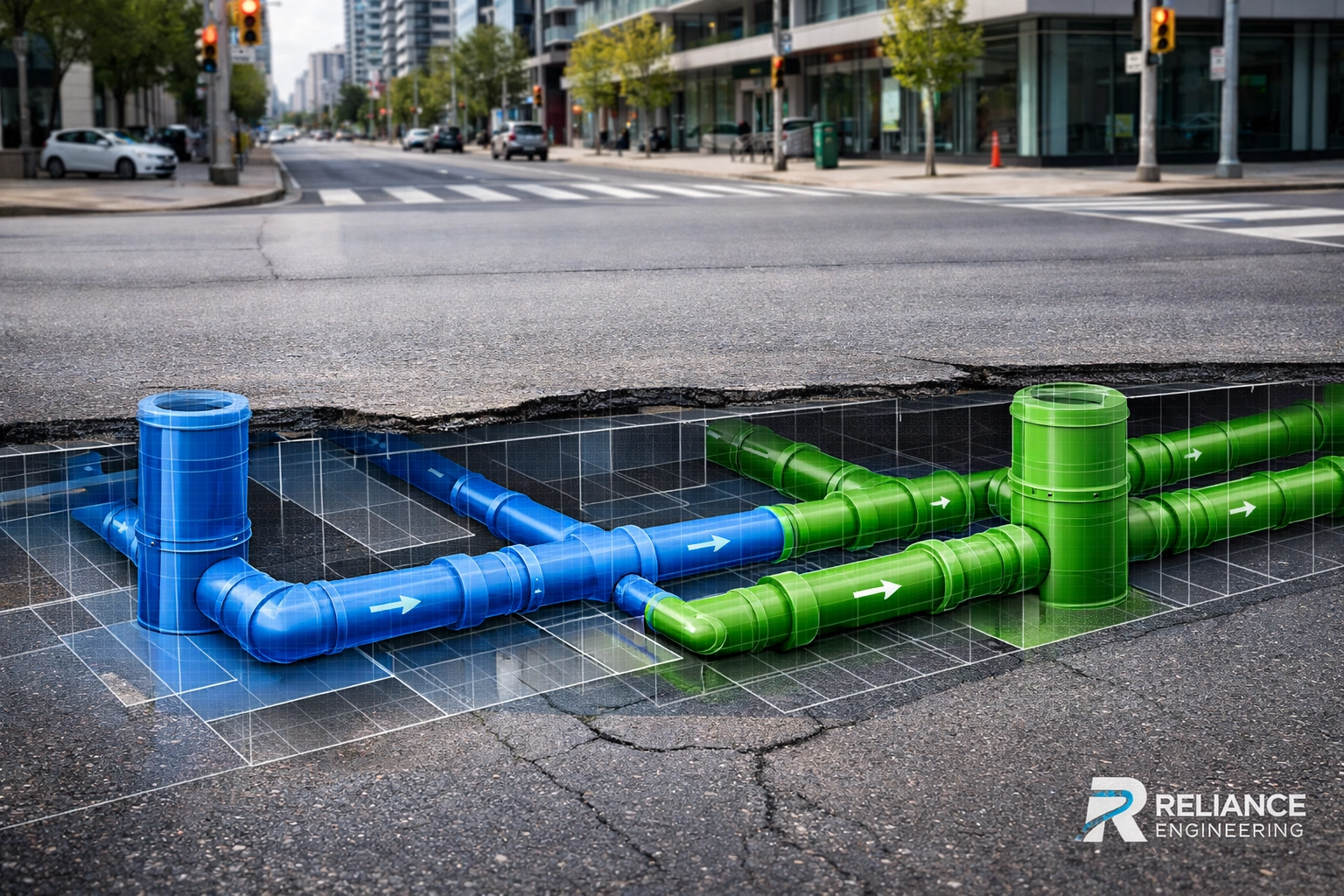
The Two Pillars: Sanitary vs. Storm Analysis
While they share the same objective: ensuring system integrity: sanitary and storm analyses require different methodologies and data sets.
1. Sanitary Sewer Downstream Analysis
The sanitary sewer design focuses on the "dry weather" and "peak" flows generated by human activity (residential, commercial, or industrial). In 2026, many GTA neighborhoods are dealing with aging clay or concrete pipes that are reaching their design life.
The analysis involves:
- Calculating Peak Flow: Using population densities and flow factors provided by the municipality.
- Infiltration and Inflow (I&I): Accounting for groundwater that leaks into the pipes.
- Pipe-by-Pipe Review: Analyzing the capacity of every pipe segment from your site to a major trunk sewer or a point where your project’s impact becomes negligible (usually less than 5% of the pipe's capacity).
2. Storm Sewer Downstream Analysis
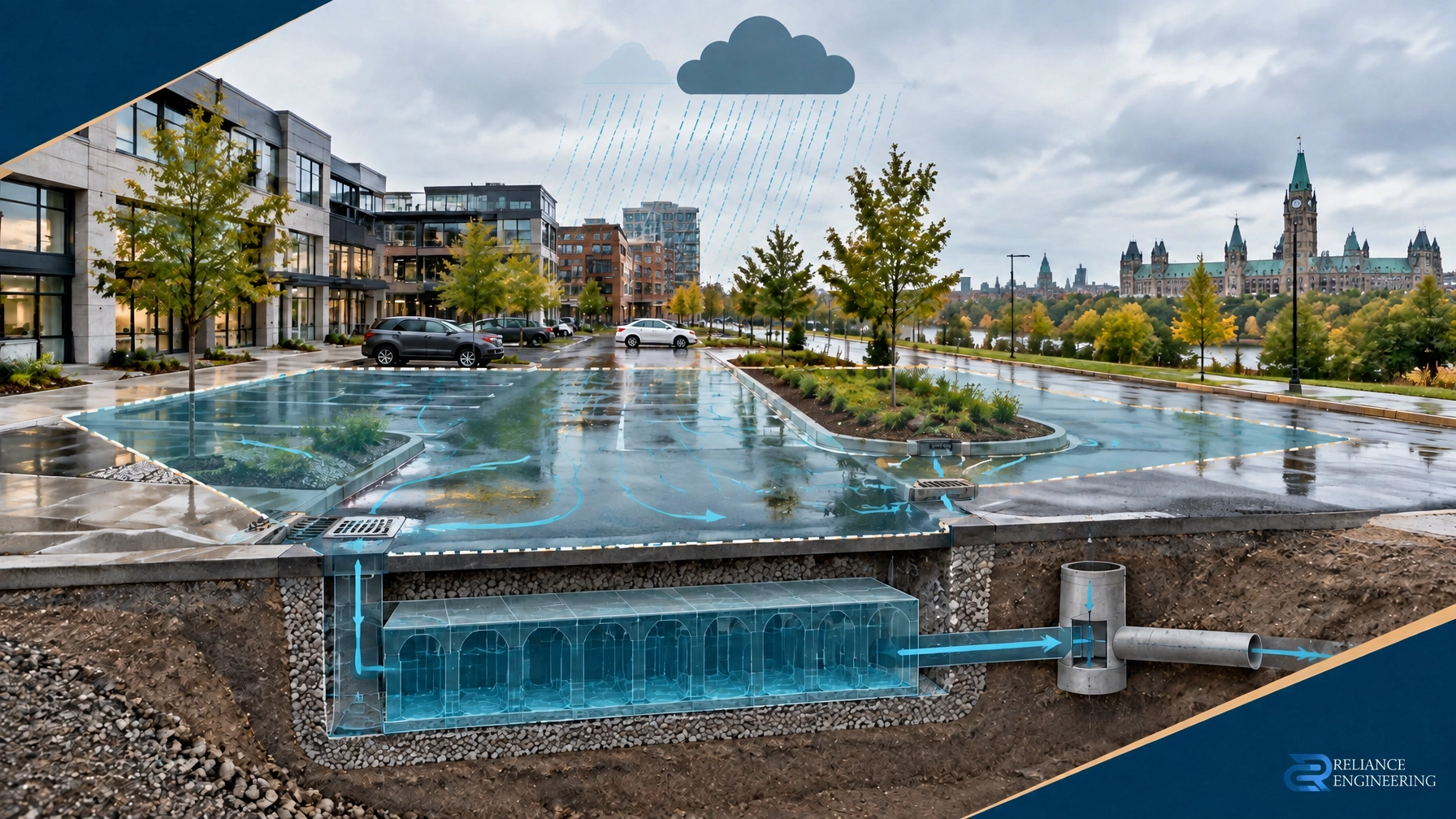
Stormwater management has become increasingly complex due to changing weather patterns and more intense "100-year" storm events. A storm system design must ensure that the downstream system can handle the runoff from your site's new impervious surfaces (roofs, parking lots, etc.).
In many parts of the GTA, municipalities require "Post-to-Pre" control, meaning the water leaving your site after development must be equal to or less than the water leaving the site in its natural state. If the downstream system is already undersized, the requirements for on-site detention (tanks, ponds, or LID measures) become significantly more stringent.
Why the GTA Infrastructure is at a Breaking Point in 2026
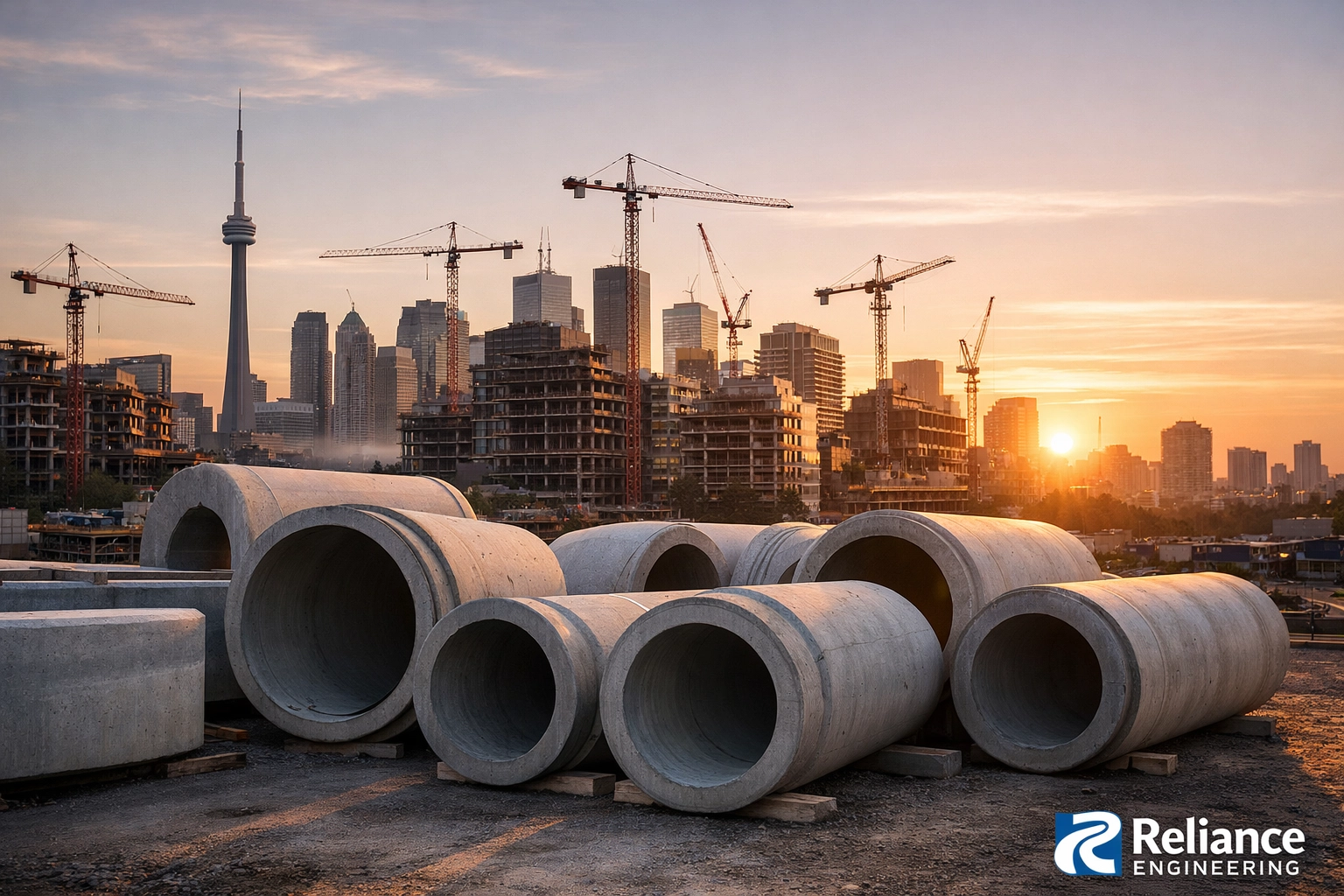
The surge in mid-rise and high-rise developments has fundamentally changed the hydraulic load on our sewers. Areas that were originally designed for single-family homes are now hosting 20-story towers. This densification, while necessary for the region's growth, puts immense pressure on infrastructure that, in some cases, dates back to the mid-20th century.
Furthermore, municipal standards have evolved. The City of Toronto, for example, has updated its Wet Weather Flow Management Guidelines to be more rigorous. Proving capacity is no longer about a simple calculation; it often requires sophisticated hydraulic modeling and, in some cases, field flow monitoring.
The Consequences of Ignoring Downstream Capacity
Neglecting a thorough downstream analysis early in the project lifecycle is a recipe for budget overruns and timeline delays. If a capacity issue is discovered late:
- Mandatory Upgrades: The municipality may require you to pay for and install larger pipes downstream of your property: a cost that can easily run into the hundreds of thousands of dollars.
- Redesign: You may need to completely overhaul your site grading plan or stormwater storage system to mitigate the downstream impact.
- Project Stalls: Without capacity, there is no building permit. Period.
Our Approach: The One-Submission Approval Strategy
At Reliance Engineering, our Founder and Principal, Naresh Ochani, brings over 20 years of experience to every project. We understand that for a developer, time is quite literally money. Our goal is always a one-submission approval.
How do we achieve this?
- Pre-Consultation: We engage with municipal engineers before finalizing the design to understand known bottlenecks in the local network.
- Precise Modeling: We use industry-standard software to create a digital twin of the sewer network, ensuring our data is indisputable.
- Proactive Mitigation: If we identify a capacity constraint, we don't just report the problem. We provide solutions: whether that involves optimized water distribution design to reduce consumption or innovative storage solutions to manage peak flows.
Technical Steps in a Downstream Analysis
For those looking to understand the technical "why" behind the reports, here is the standard workflow we follow at Reliance Engineering:
- Data Acquisition: We obtain "As-Built" drawings from the municipality to determine pipe sizes, materials, and slopes (gradients).
- Basin Delineation: We identify the entire catchment area that drains into the specific sewer line in question.
- Flow Estimation: Using the Rational Method (for storm) or the peaking factor method (for sanitary), we calculate the existing and proposed flows.
- Capacity Calculation: We apply Manning’s Equation to determine the full-flow capacity of each pipe segment.
- Impact Assessment: We compare the proposed flow against the available capacity. If the pipe is more than 80-85% full (depending on the municipality), it is considered constrained.
Case Studies: Real-World Capacity Solutions
Our portfolio includes several high-profile projects where downstream constraints were a major hurdle.
- In our work at 35 Wabash Avenue, we managed complex urban servicing in a dense Toronto neighborhood.
- At 85 Bronte Road in Oakville, we navigated regional capacity requirements to ensure the development met all municipal criteria without costly delays.
- For the Redevelopment of Etobicoke General Hospital, the scale of the project demanded a highly rigorous downstream analysis to ensure local infrastructure could support critical healthcare services.

Frequently Asked Questions
Q: Does every small project need a downstream analysis?
A: Not necessarily. Minor renovations may not require one, but any project that increases the "Equivalent Population" or the "Impervious Area" of a site will likely trigger a request for a DCA from the municipality.
Q: How long does the analysis take?
A: Obtaining data from the municipality can take 2-4 weeks. Once we have the data, our engineers can typically complete the analysis and report within 1-2 weeks.
Q: What if the municipality says there is "Zero Capacity"?
A: This is where experience matters. We can often negotiate solutions, such as implementing strict peak-flow attenuation or identifying alternative connection points that have more headroom.
Conclusion: Partner with Experience
In 2026, the complexity of GTA land development requires more than just a consultant; it requires a partner who understands the nuances of municipal engineering. At Reliance Engineering, we take pride in our ability to solve the "capacity puzzle," helping our clients move from the drawing board to the construction site with confidence.
If you are planning a development and need a reliable Sanitary Sewer Downstream Analysis or Stormwater Management strategy, reach out to us today.
Reliance Engineering
Practical. Compliant. Cost-Effective.
Contact Us:
https://www.relianceengineering.ca/contact-us
Phone: (Phone number available on website)
Address: (Available on website)
Business Hours: Monday – Friday: 9:00 AM – 5:00 PM