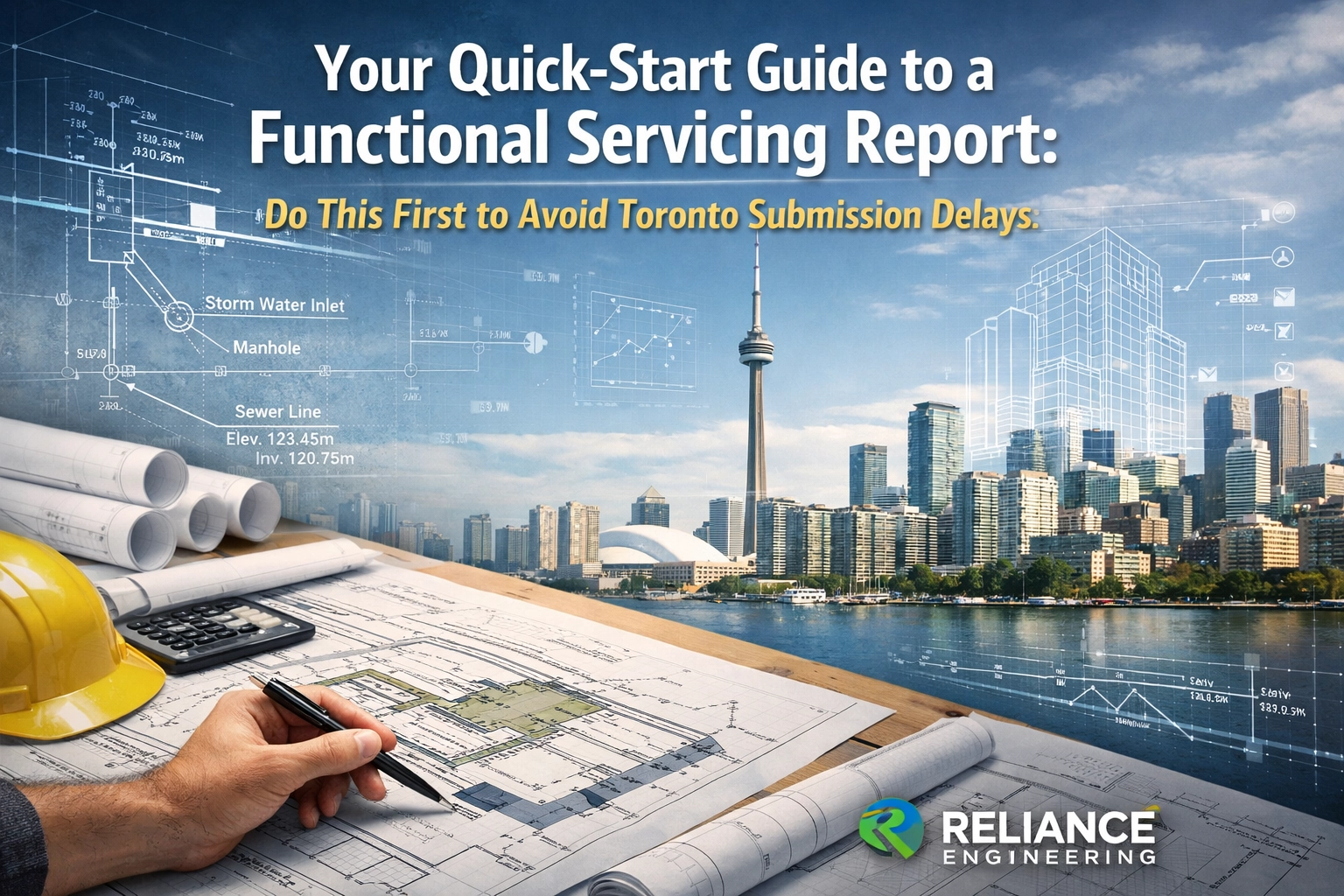
In the high-stakes world of Toronto real estate development, momentum is everything. Whether you are planning a mid-rise residential complex in Etobicoke or a commercial expansion in North York, the path from concept to construction is paved with regulatory requirements. Among the most critical: and often misunderstood: documents in this process is the Functional Servicing Report (FSR).
At Reliance Engineering, we have seen firsthand how a well-prepared functional servicing report can expedite a project’s approval, while a poorly executed one can stall a development for months. If you are looking to secure your permits quickly and navigate the complexities of municipal infrastructure, this guide will outline the essential first steps to take and how to avoid the common pitfalls that lead to submission delays.
What is a Functional Servicing Report?
A functional servicing report is a comprehensive technical document that demonstrates how a proposed development will be serviced by municipal infrastructure. It evaluates the capacity of existing watermains, sanitary sewers, and storm systems to ensure they can accommodate the added demand of your project.
In Toronto and the Greater Toronto Area (GTA), the FSR is a mandatory component of the Site Plan Approval (SPA) process and Plan of Subdivision applications. Without a stamped and signed FSR from a licensed Professional Engineer, your application is effectively "dead on arrival" at the city clerk’s desk.
The "Do This First" Checklist: Avoiding Initial Delays
The most common reason for submission delays isn't a lack of engineering skill; it is a lack of complete information at the start of the project. To hit the ground running, you must gather your "Due Diligence Package" before the engineering analysis even begins.
1. Hire a Qualified Professional Engineer Immediately
An FSR must be prepared by a licensed Professional Engineer (P.Eng.) in Ontario who possesses specific experience in municipal infrastructure. Engaging an expert like Naresh Ochani and the team at Reliance Engineering ensures that your report meets the strict standards of the City of Toronto and local Conservation Authorities.
2. Compile Your Documentation
Before your engineer can run a single calculation, they need the following:
- Architectural Site Plan: Showing the building footprint, number of units, and gross floor area.
- Topographic Survey: A detailed survey of the current land elevations.
- Utility Locates: Mapping of existing underground infrastructure.
- Traffic Impact Assessment: To understand how site access might affect servicing routes.
- Land Use Statistics: Essential for calculating water and sewage demand.
Once this data is provided to us, a standard functional servicing report typically takes 10 business days to prepare. For projects on a tight deadline, Reliance Engineering offers expedited reports within 5 business days to keep your project moving.
The Core Components of a Successful FSR
To pass municipal scrutiny, your report must address three primary pillars of infrastructure. Failing to provide detailed analysis in any of these areas will result in a "Notice of Incomplete Application."
Water Supply and Fire Protection
Your engineer must prove that there is sufficient water pressure and flow to serve the daily needs of the building’s occupants and, more importantly, to provide adequate fire protection. This often requires a Hydrant Flow Test to be conducted on-site to verify real-world pressure rather than relying on outdated city maps.
Sanitary Sewer Capacity
The City of Toronto is protective of its sanitary sewer network. Your FSR must include detailed demand calculations based on the Ontario Building Code. We analyze the pipe capacity of the existing street sewers to ensure your development won't cause backups or overflows in the surrounding neighborhood. For more complex designs, you may also need a dedicated sanitary sewer design.
Stormwater Management (SWM)
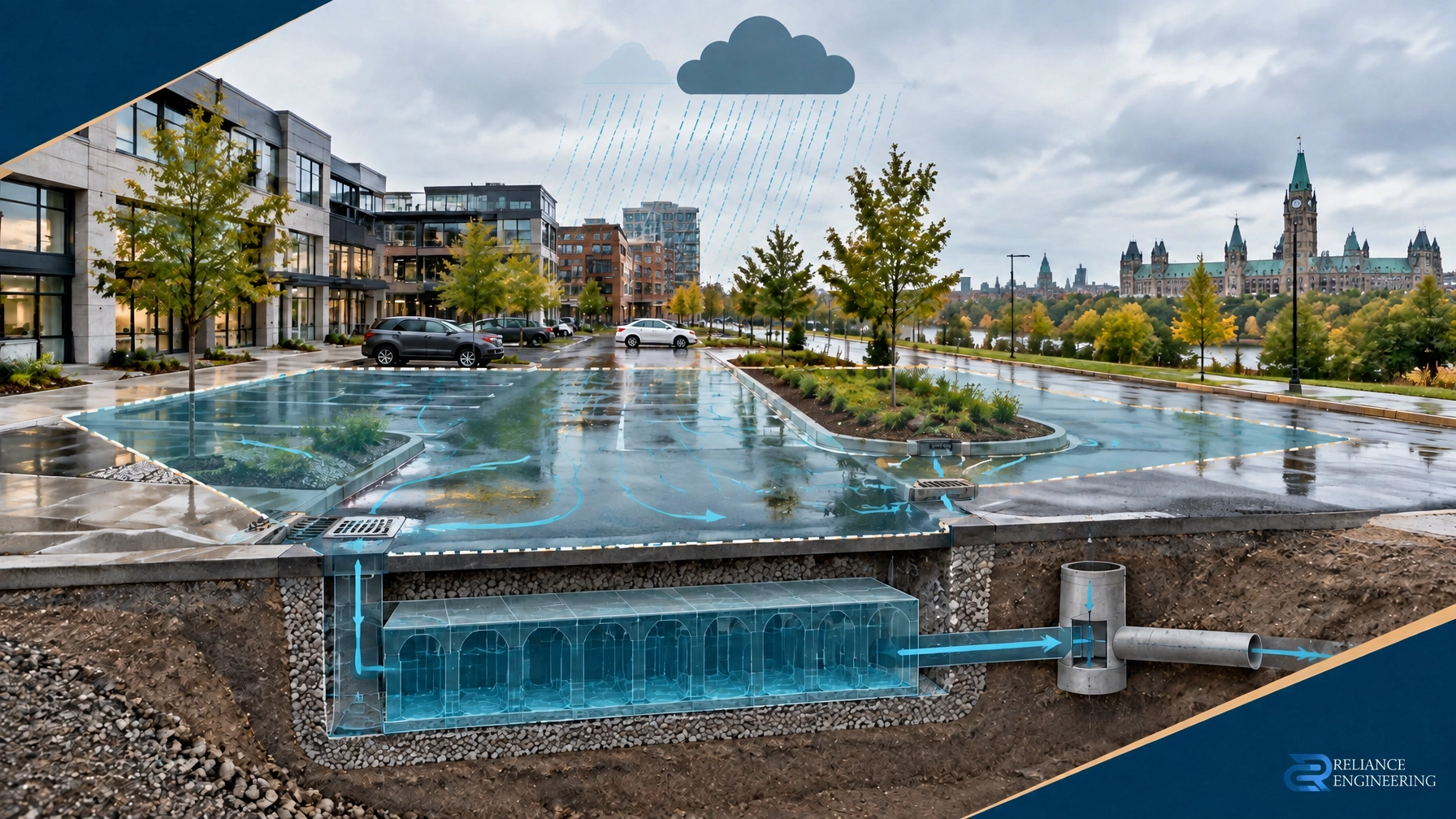
This is often the most scrutinized portion of the report. Toronto’s Wet Weather Flow Management Guidelines are some of the strictest in the country. Your report must outline how you will manage rainfall on-site, typically through a combination of green roofs, underground storage tanks, or LID (Low Impact Development) features. A robust stormwater management plan is non-negotiable for approval.
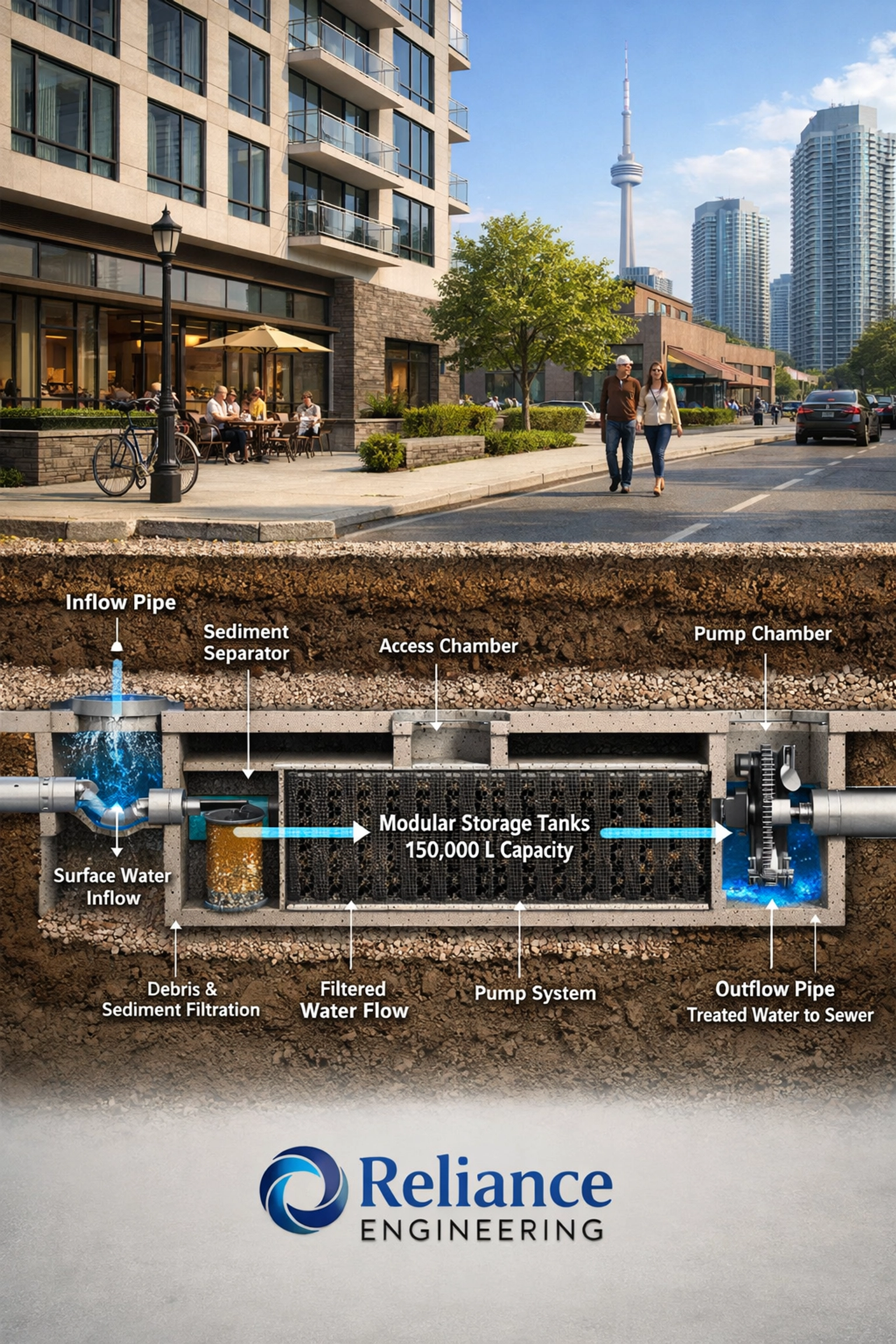 An engineering rendering of an underground stormwater detention system being integrated into a tight urban site, featuring the Reliance Engineering logo.
Navigating Toronto-Specific Challenges
The GTA is a patchwork of different municipal standards. While the City of Toronto has its own set of rules, projects in areas like Vaughan, Mississauga, or Markham may have different requirements regarding pipe materials, safety factors, and climate change resiliency.
Furthermore, if your site is near a ravine or a watercourse, you will likely need to deal with the Toronto and Region Conservation Authority (TRCA). They have their own set of fees and environmental standards that must be reflected in your FSR and your site grading plan.
Our expertise at Reliance Engineering lies in knowing these local nuances. We don’t just write reports; we provide solutions that anticipate the comments of municipal reviewers, effectively "pre-clearing" your application for a smoother approval.
Why Quality Matters: The Cost of a "Cheap" Report
It can be tempting to choose the lowest bidder for your engineering reports. However, in land development, you get what you pay for. A "budget" FSR often lacks the detail required by city reviewers. When the city returns the report with a long list of "Reasons for Rejection," you end up paying more in the long run through:
- Resubmission Fees: Every time you go back to the city, it costs money.
- Carrying Costs: Interest on land loans adds up every day your project is stalled.
- Contractor Delays: If you don't have your site servicing plan approved, you can't break ground.
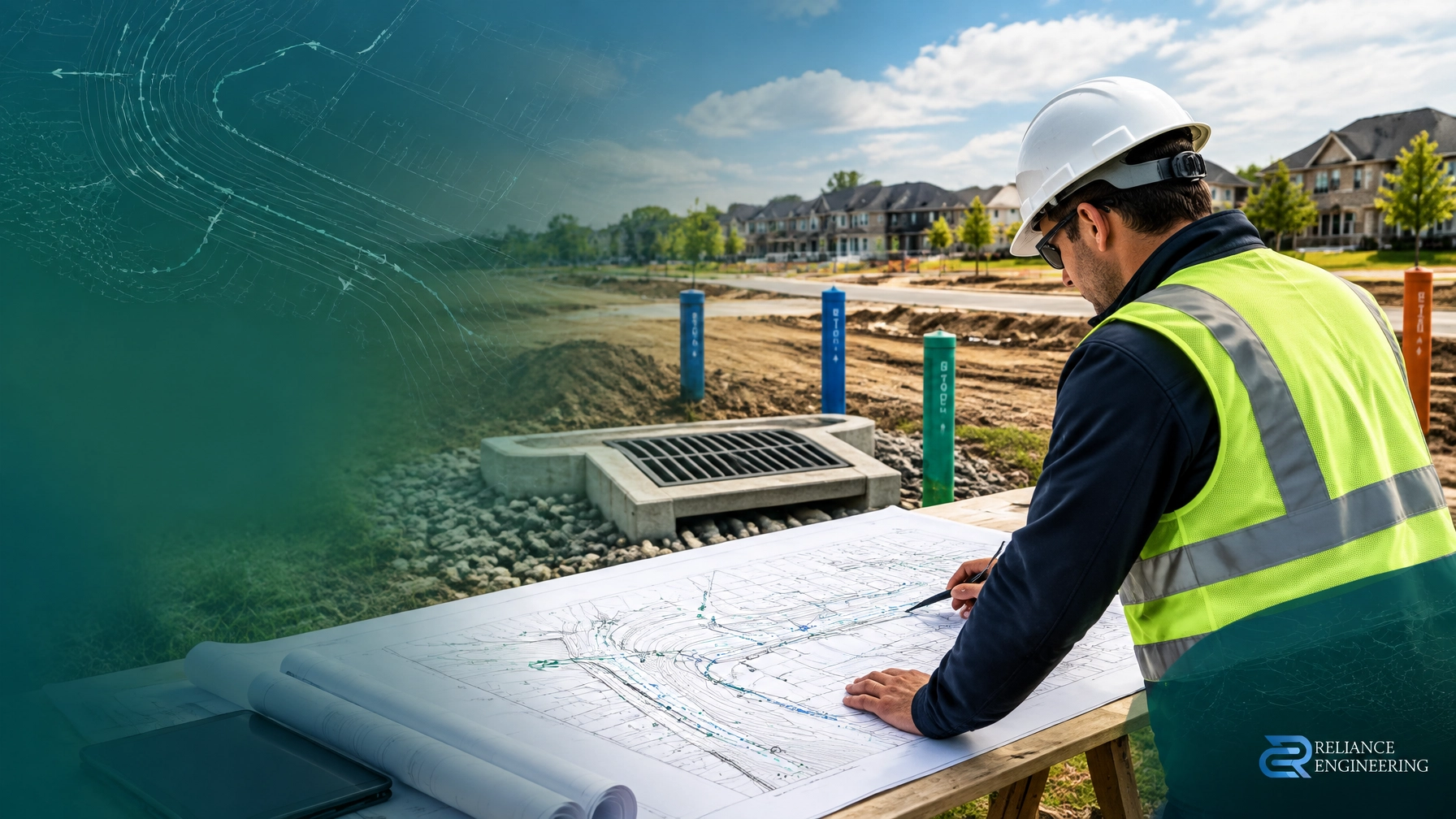
 A professional engineer reviewing technical drawings on a tablet at a busy construction site in downtown Toronto, with the Reliance Engineering logo visible.
Summary of the FSR Process at Reliance Engineering
To give you a clear roadmap, here is how we typically handle a functional servicing report for our clients:
- Discovery & Data Collection: We review your site goals and gather necessary surveys and architectural plans.
- Infrastructure Analysis: We contact the municipality for records of existing services and perform necessary site tests.
- Modeling & Calculation: We calculate the peak water, sanitary, and storm demands.
- Design Integration: We work with your architect to ensure the storm system design works with the building’s aesthetics and footprint.
- Final Stamping & Submission: We provide a professional, stamped report ready for the City of Toronto submission.
Secure Your Permit with Confidence
The development landscape in 2026 is faster and more complex than ever. Don't let a missing document or a miscalculated sewer flow hold back your vision. By following this quick-start guide and ensuring your "First Step" documents are ready, you position yourself for a successful, delay-free submission.
If you are ready to move your project forward, Reliance Engineering is here to help. We specialize in providing permit-ready engineering solutions for a variety of industries. Our deep knowledge of Toronto’s municipal requirements means we get it right the first time.
Ready to start your Functional Servicing Report?
Contact Us Today for a consultation on your next project.
Reliance Engineering
Civil Engineering & Land Development Consulting
www.relianceengineering.ca
Hours: Monday – Friday, 9:00 AM – 5:00 PM
Location: Serving Toronto, the GTA, and all of Ontario.
 The Reliance Engineering office header featuring their core services: Land Development, Grading, Servicing, and Stormwater solutions.