So, you’re thinking about building a garden suite? You’re not alone. Across the Greater Toronto Area (GTA), homeowners are looking at their backyards and seeing more than just a spot for a BBQ: they’re seeing a way to house aging parents, give adult kids a head start, or generate some serious rental income.
But here’s the reality check: building a garden suite isn't like putting up a pre-fab shed from a big-box store. Because these are livable, permanent dwellings, the "Site Plan Approval Process in Ontario" is rigorous. From the city's perspective, your backyard is now a construction site that needs to be integrated into the existing municipal infrastructure.
At Reliance Engineering, we’ve spent over 20 years helping property owners navigate these waters. We know that the difference between a permit and a "back to the drawing board" notice often comes down to the quality of your technical drawings.
In this guide, we’re going to break down the heavy hitters: the site grading plan, the site servicing plan, and why your stormwater management report is actually the most important document in your application.
1. The Foundation: Understanding the Site Plan Approval Process in Ontario
Before you pick out the kitchen tiles, you need to know if you’re even allowed to build. In Toronto, garden suites are generally permitted in most residential zones (R, RD, RS, RT, and RM), but the rules change the moment you cross the border into Vaughan, Mississauga, or Markham.
The first step is always a zoning review. You need to confirm your "setbacks" (how far the suite sits from the property line) and your "lot coverage" (how much of your yard is being taken up). If your design doesn't fit the cookie-cutter rules, you'll find yourself at the Committee of Adjustment asking for a Minor Variance.
This is where your building permit drawings come into play. These aren't just floor plans; they are a comprehensive package that tells the city exactly how this new structure will interact with the environment.
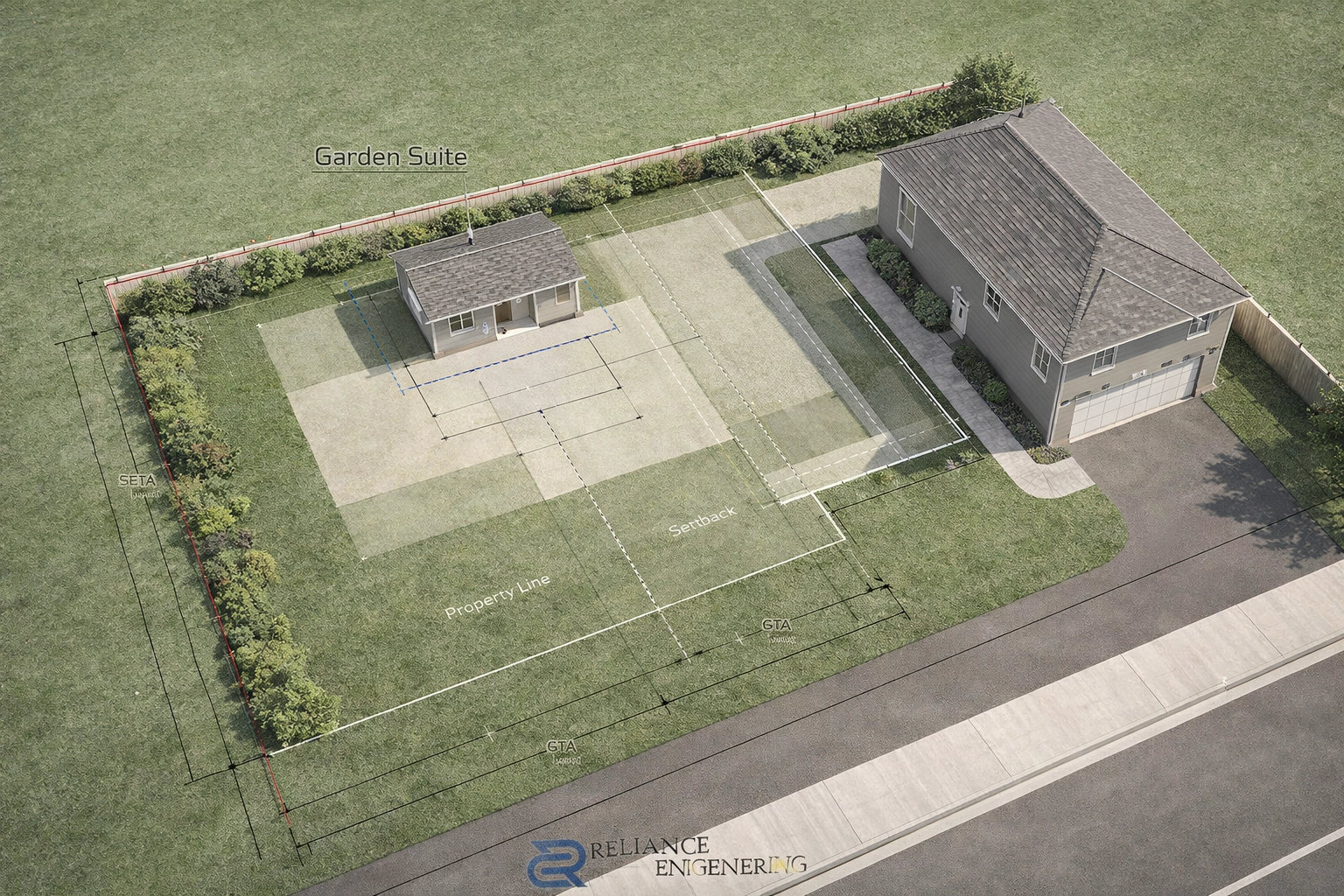
Visual: A detailed 3D site plan overview of a GTA backyard garden suite, clearly showing property boundaries and setbacks, with the Reliance Engineering logo placed at the bottom.
2. Why the Site Grading Plan is Non-Negotiable
If you ask a municipal reviewer what their biggest concern is with garden suites, they’ll probably say "drainage." When you add a building to a backyard, you’re replacing grass (which absorbs water) with a roof and a foundation (which don't).
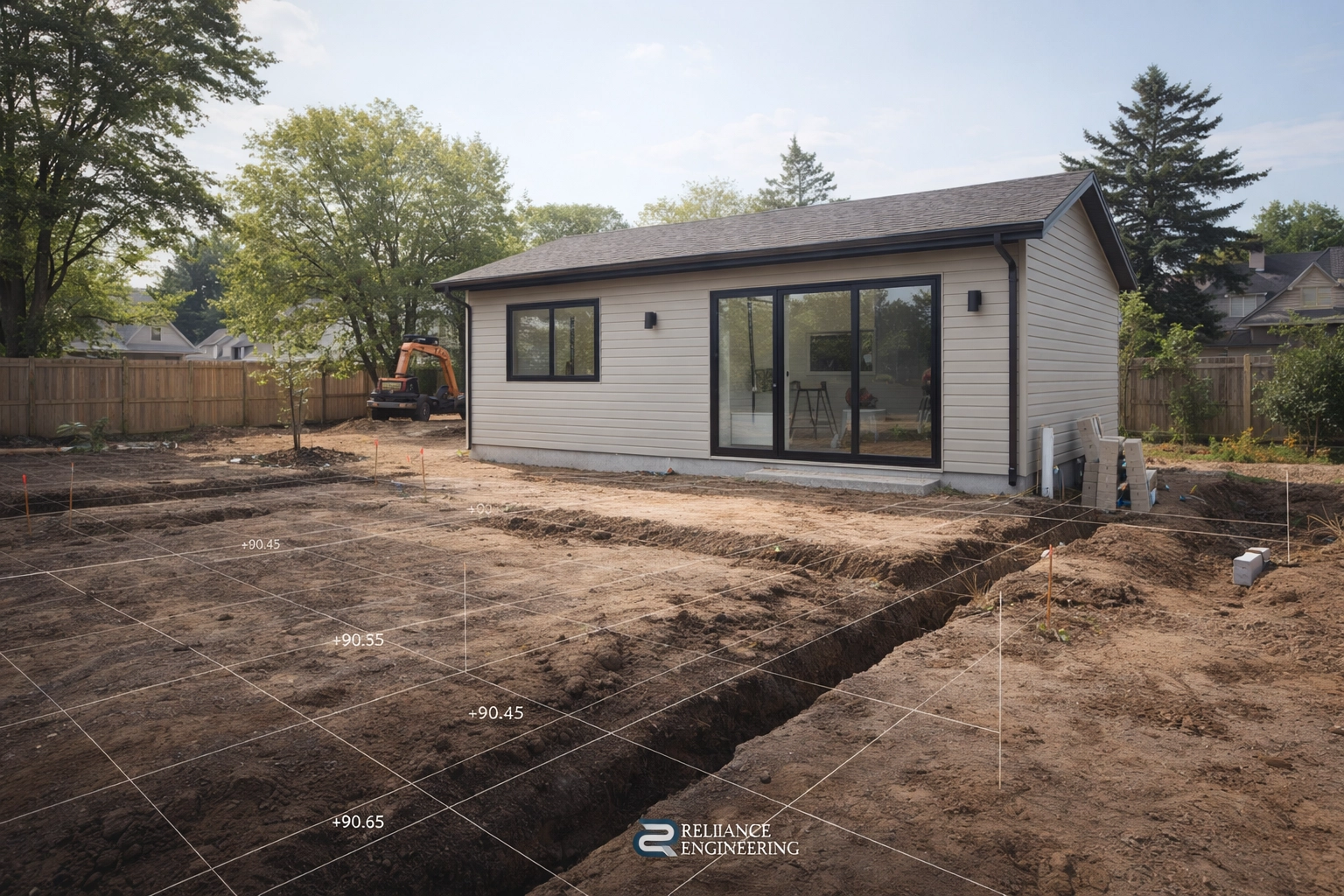
A site grading plan (sometimes called a lot grading plan) is a professional drawing that shows the existing and proposed elevations of your land. Its job is to prove that rainwater will flow away from your new suite: and more importantly, away from your neighbor’s yard.
In the GTA, "thou shalt not flood thy neighbor" is the golden rule. If your project causes ponding on the property next door, the city will reject your permit immediately. At Reliance Engineering, we use precision surveying to ensure your site grading plan meets municipal standards while keeping your construction costs down.
Check out our specialized site grading plan services to see how we handle these complexities.
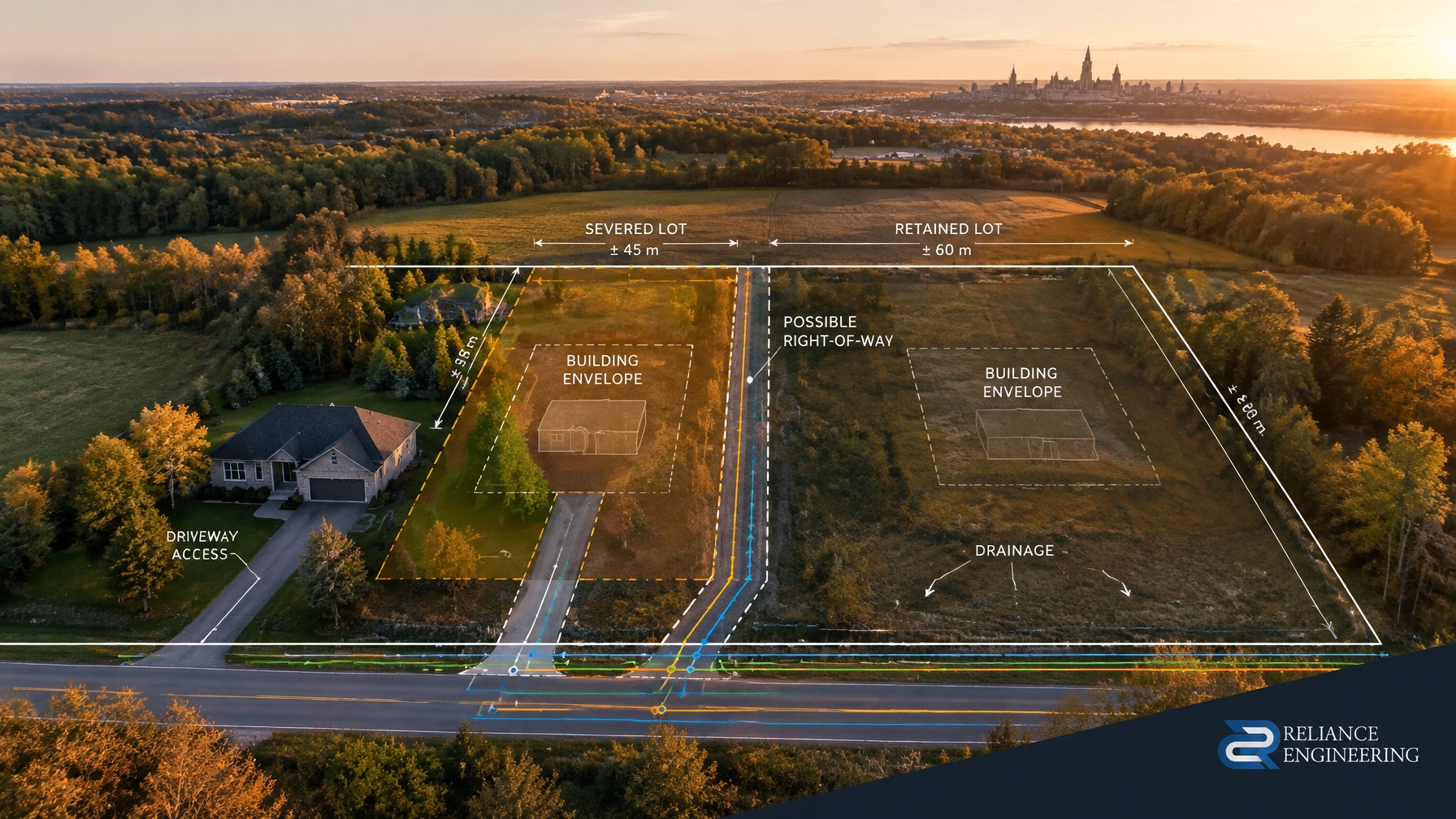
3. The Lifelines: Your Site Servicing Plan
Your garden suite needs water, it needs a place for sewage to go, and it needs a way to manage roof and surface drainage. A site servicing plan outlines how these services get from the municipal system (typically at the street) and/or the primary dwelling to the suite, and it confirms that the proposed layout is buildable with proper slopes, cover, and clearances.
In many GTA municipalities, you have two common servicing approaches:
- Serviced via the main house (most common for garden suites): New water, sanitary, and (where permitted) storm connections are extended from the existing dwelling’s services across the rear yard.
- Direct municipal connection (less common, higher cost): New laterals are routed to the municipal mains, typically requiring boulevard work, road cuts, additional permits/fees, and more coordination.
A permit-ready servicing plan goes beyond “a line on a drawing.” It typically includes: pipe sizes/materials, invert elevations, proposed slopes/grades, minimum burial/cover, horizontal/vertical separation, cleanouts, manholes/catchbasins (if applicable), and tie-in details.
Water service layout (garden suites)
For water, the servicing plan should clearly show:
- Point of connection: typically downstream of the existing meter inside the main house, or at an approved exterior location (municipality-dependent).
- Routing and depth: the water line must maintain adequate cover to protect against freezing; the plan shows alignment to avoid large trees, foundations, and other utilities.
- Sizing and pressure considerations: the plan confirms the proposed line sizing and that available pressure is reasonable for the additional unit (especially where long rear-yard runs are required).
- Backflow and shutoff strategy: indicate valves/shutoffs and any required backflow prevention measures (as required by local standards/inspections).
Handling existing limitations: If the existing domestic service is undersized or already near capacity, we typically evaluate service size, meter configuration, and practical routing. When upgrades are required, the servicing plan shows the proposed changes and any municipal coordination items (permits, inspections, restoration notes).
Sanitary sewer layout (garden suites)
For sanitary, layout is driven by gravity. The plan should demonstrate:
- Tie-in location: often the existing building sewer leaving the house (or a suitable internal/external connection point).
- Slope verification: show pipe inverts at key points and confirm continuous positive slope to the connection.
- Cleanouts and maintenance access: locate cleanouts at appropriate points, especially for long runs to the rear yard.
- Conflict avoidance: routing to avoid footings, retaining walls, significant tree roots, and existing underground utilities.
Handling existing limitations: The most common issue is insufficient fall (not enough vertical drop) to run a gravity sanitary line to a rear suite at a practical depth. In those cases, the servicing plan needs to address one of the typical solutions:
- Re-routing to a better tie-in point (shorter run, improved slope, or a different connection location where permitted).
- Raising internal sanitary elevations where possible (coordination with architectural/mechanical layout).
- Sanitary pumping/grinder system as a last-resort option where gravity is not feasible (subject to municipal acceptance and detailed mechanical design/notes).
Storm servicing and roof drainage (garden suites)
Stormwater requirements vary significantly across the GTA. Your servicing plan should show:
- Roof leader discharge method: to splash pads, rear-yard infiltration features (where suitable), or other approved outlets.
- On-site infiltration / LID features (where required): drywell/soakaway, infiltration trench, or permeable surfaces tied to a defined storage volume.
- Overflow route: a safe, visible overland flow path that does not impact adjacent properties.
Handling existing limitations: Many older homes have combined or constrained storm connections, and some municipalities restrict new storm tie-ins. Where an additional storm connection is not feasible or not permitted, the servicing plan typically demonstrates on-site retention/infiltration with a controlled overflow route and grading coordination so runoff is managed on the lot without adverse impact.
Because these constraints are highly site-specific, a professional site servicing plan is a mandatory part of a strong permit application—and it’s often what prevents “revise and resubmit” comments from engineering review.

Visual: A technical blueprint highlighting underground water, sanitary, and storm layouts for a secondary dwelling, with the Reliance Engineering logo placed at the bottom.
4. Managing the Rain: Stormwater Management and Erosion Control
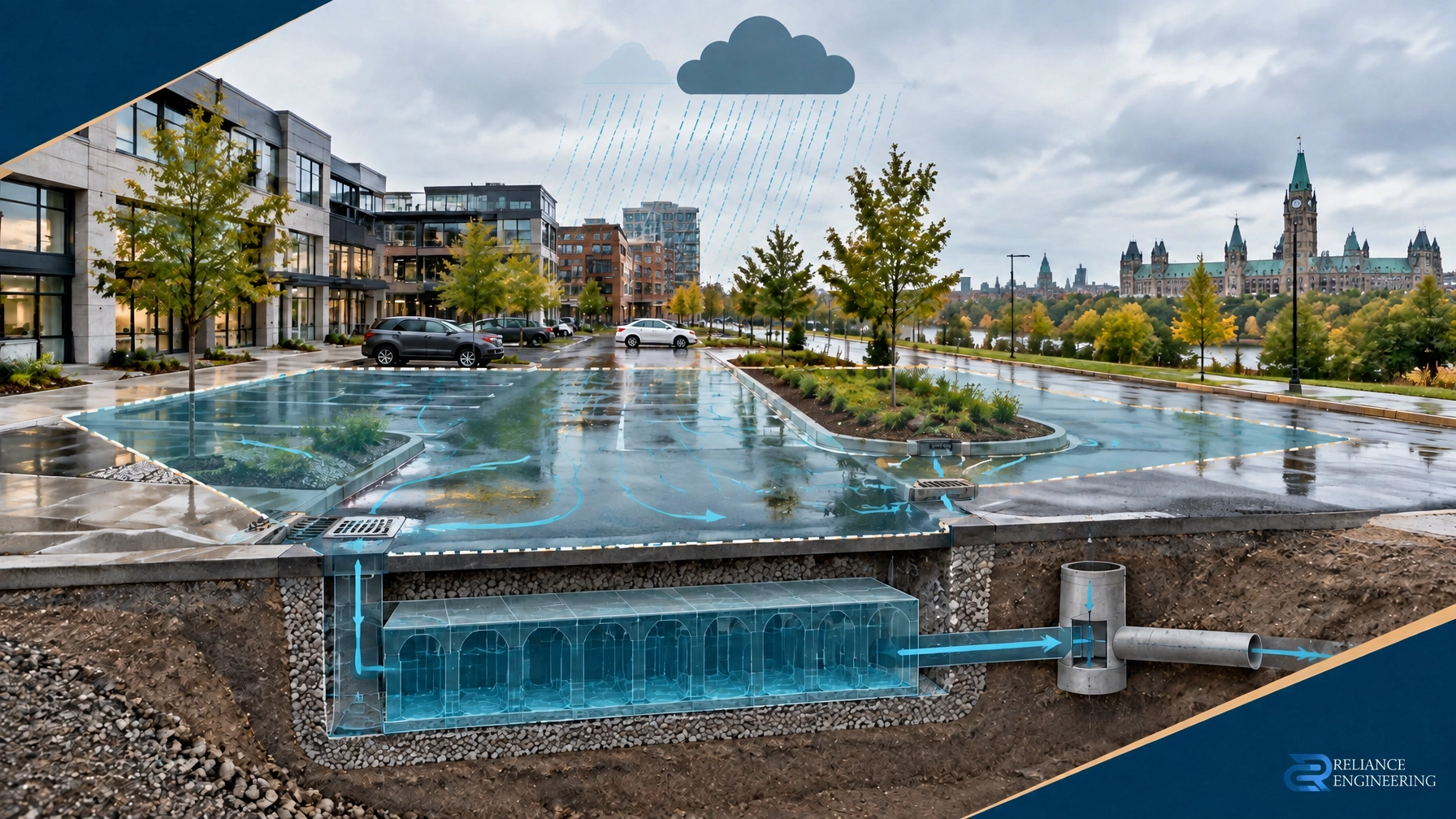
As the GTA becomes more "paved over," municipalities are getting stricter about runoff. For many garden suite projects, you may be required to submit a stormwater management plan or even a full stormwater management report.
The goal here is simple: keep as much water on your property as possible. This might involve:
- Dry wells: Underground pits that catch rainwater and let it soak into the soil slowly.
- Permeable pavers: Driveways or paths that allow water to pass through.
- Infiltration galleries: Advanced systems for larger lots.
Parallel to this is the erosion and sediment control plan. During construction, the city wants to make sure that dirt and silt from your backyard don't wash into the municipal storm sewers. It sounds like a small detail, but a missing sediment control plan can stall a permit for weeks.
For projects that are more complex, a functional servicing report might be requested to prove that the existing city infrastructure can handle the extra load of your new unit.
5. Navigating GTA Municipalities: It’s Not One-Size-Fits-All
While Toronto has led the way with its Garden Suite Bylaw, other areas are catching up. However, each has its own quirks:
- Vaughan: Has specific requirements regarding the architectural "character" of the suite.
- Mississauga: Is very focused on tree protection and "soft landscaping" percentages.
- Brampton: Often requires more detailed stormwater management data due to local flooding concerns.
No matter where you are, you will likely need to submit a Tree Declaration Form. If there is a "City Tree" or a large private tree nearby, you’ll need an arborist report alongside your engineering plans.
6. How Reliance Engineering Speeds Up the Process
Let’s be honest: the municipal permit office isn't known for its speed. The fastest way to get your permit is to submit a "clean" application the first time. When a city engineer sees a package from a firm they recognize and trust, the review process tends to go much smoother.
With over 20 years of experience in Land Development Consulting, Reliance Engineering knows exactly what the reviewers are looking for. We don't just draw lines on a map; we provide practical, cost-effective engineering solutions.
We specialize in:
- Quick Turnarounds: We understand that time is money, especially with high interest rates.
- Permit-Ready Drawings: Our building permit drawings are designed to pass inspection without the back-and-forth "requests for information" (RFIs).
- Comprehensive Support: From sanitary sewer design to storm system design, we handle the technical heavy lifting.

Visual: A professional engineering workstation showing a clean Reliance Engineering CAD grading/drainage drawing, with the Reliance Engineering logo placed at the bottom.
Final Thoughts: Don't Let the Paperwork Stop You
A garden suite is one of the best investments you can make in the GTA today. It adds value to your property, provides housing flexibility, and contributes to a more sustainable city. But the technical requirements: the servicing plan, the lot grading plan, and the stormwater management report: are the hurdles you have to clear first.
Don't let the "site plan approval process in Ontario" intimidate you. Partnering with the right engineering firm can turn a year-long headache into a streamlined, successful project.
Ready to get started on your Garden Suite?
Whether you’re in the early planning stages or you’ve been told by the city that you need a functional servicing report, we’re here to help.
Contact Reliance Engineering today:
- Visit us: www.relianceengineering.ca
- Explore our services: Our Services Page
- Get a quote: Contact Us
Let’s get that permit in your hands so you can get shovels in the ground.
Reliance Engineering
Founder & Principal: Naresh Ochani
Expertise you can trust. Drawings you can build on.