Article type: Expert guide and municipal-policy comparison
Audience: Developers, builders and project owners in Ontario
Focus: Trunk infrastructure oversizing, front-ending and cost recovery
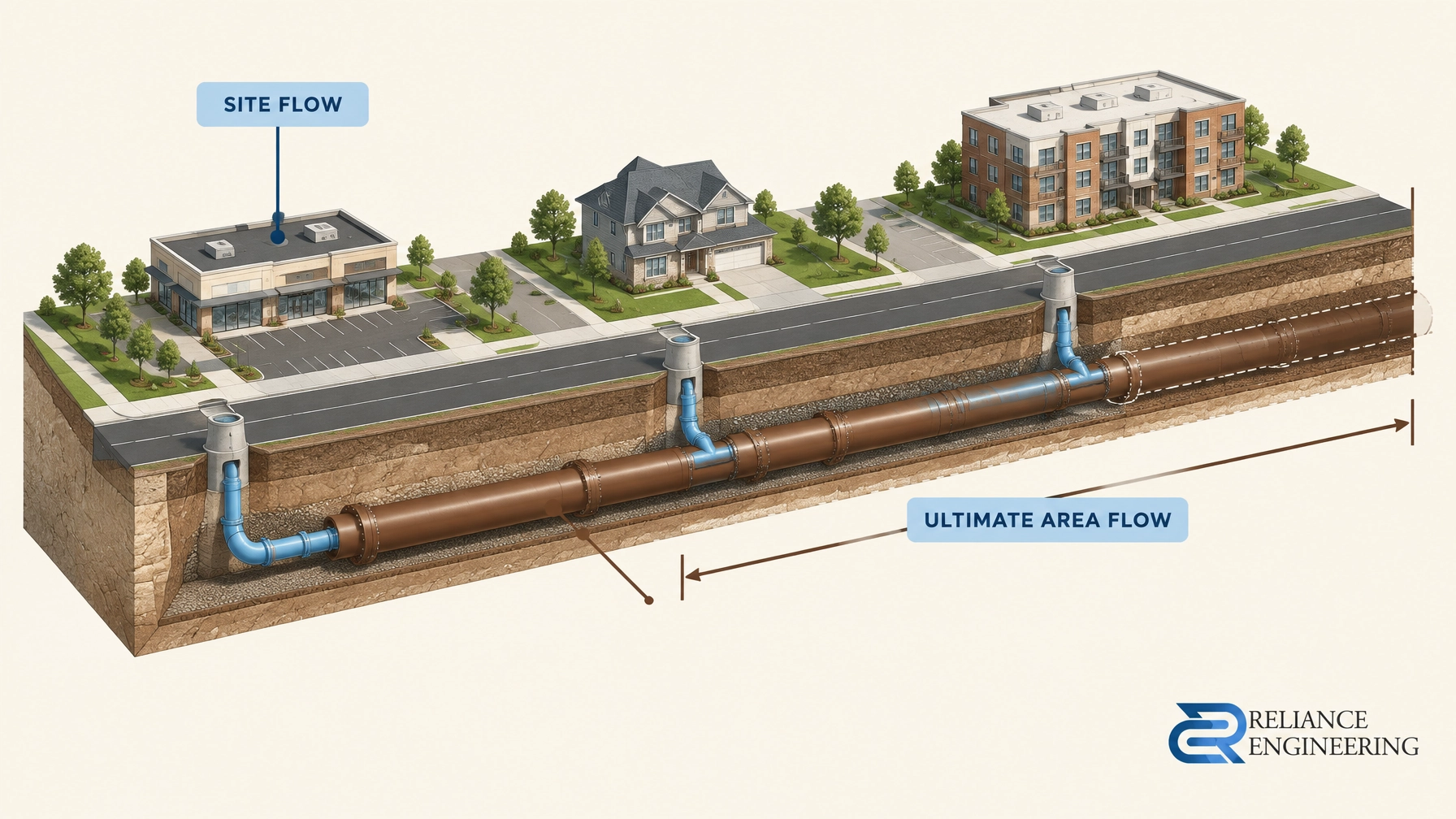
A developer budgets for the pipe their site needs. Then municipal review comes back with a different requirement: the trunk sewer or watermain at the property line must accommodate the ultimate drainage area or pressure zone, not just this development.
The project is now funding capacity that may serve other lands later. Ontario municipalities may have ways to share or recover eligible oversizing costs, but the thresholds, calculations and agreement terms vary. Nothing is automatic. The cost-sharing mechanism needs to be established in the development agreement before construction.
Start with the local-service share
Section 59 of Ontario’s Development Charges Act, 1997 addresses local services required through subdivision and consent approvals. Municipal policies commonly treat infrastructure internal to a development, or external works needed to support it or connect it to the system, as local services. The developer is generally responsible for those local-service costs.
The question is what portion is genuinely beyond the project’s local servicing need. A trunk component identified for a broader growth area through a servicing study, Class Environmental Assessment or master plan may be eligible for development-charge funding or another cost-sharing mechanism, subject to municipal policy and the applicable development-charge background study.
The Town of The Blue Mountains’ Local Service Policy and Guidelines, POL.COR.14.02 and Oxford County’s Local Services Policy 6.23, revised March 13, 2024, both set out local-service principles. Each municipality assesses projects under its own policy. A pipe serving more than one development does not automatically qualify for full development-charge funding.

The size threshold and cost formula are local
Policies may set a baseline diameter below which the developer pays the full local-service cost. Beyond that baseline, an eligible oversize share may be calculated or recovered. These examples illustrate why neighbouring municipalities’ numbers should not be assumed to apply to your project. Confirm locally.
- City of Hamilton: Its development guidelines and financial policies identify developer-paid local sizes of sanitary sewers up to 450 mm, storm sewers up to 1,200 mm and watermains up to 300 mm. Eligible oversizing may receive a City contribution, generally based on flat rates. The City’s financial policies page notes that oversizing rates are updated annually on June 1. Check the current policy and rates for the application.
- Oxford County: Under Policy 6.23, watermains and sanitary sewer collectors or forcemains 250 mm and under are local services. For eligible larger pipes serving upstream properties, the contribution is based on tendered unit prices: actual pipe diameter cost less the cost of a 250 mm pipe, plus a 10% engineering fee. Oxford County includes pipe and valves in this calculation; depth-related costs remain with the developer.
- Town of The Blue Mountains: Under POL.COR.14.02, the baseline is a 300 mm watermain and a 450 mm sanitary sewer. Eligible larger watermains and sanitary sewers serving upstream properties are calculated against the relevant baseline, using tendered unit prices and a 12% engineering fee. The developer remains responsible for depth-related costs and other specified items.
The baseline diameter, eligible components and engineering-fee adder are municipality-specific. Ask for the applicable calculation before the design and estimate are finalized.
Pumping stations need a separate conversation
Oxford County treats local booster pumping stations and local sewage pumping stations serving a small area as direct developer responsibilities. The policy says these local stations are not included in the development-charge background study, so they do not receive development-charge funding or credits. Oversizing costs for other developers are negotiated through the development agreement.
The Blue Mountains’ policy identifies a development cost-sharing agreement among benefiting landowners as its preferred approach for certain shared pumping-station works. A Town-facilitated arrangement, including front-end financing by one or more benefiting landowners, is an alternative.
If your site needs a pumping station, do not assume a pipe-size rate table will settle the allocation. Confirm who benefits, how each share is calculated and how payment is secured.
Front-ending means carrying cost and timing risk
Markham provides an example of how detailed a credit or reimbursement process can be. Its Development Charge Credit and Reimbursement Policy, adopted in 2010, sets out requirements for advancing eligible public works. Treat the document as a historical policy example and confirm current rules and fees with the municipality.
Under the Markham policy, recovery is capped at the lesser of the eligible project component in the development-charge by-law and the actual cost of the works. Where Council approval is required, it must be obtained before construction starts. The application was to be submitted at least six months before the expected construction start, and the developer had to provide a letter of credit equal to 115% of estimated works cost.
The policy’s stated administration fee was a minimum of $1,500 plus 1.0% of the works’ value, to a maximum of $10,000. It excluded HST costs and provided no interest. Where multiple developers were involved, an agreement schedule could set out proportional shares or name a trustee to distribute recoveries.
Non-growth components cannot be funded from development charges. In some arrangements, excess costs are recovered as benefiting lands develop. That can leave the developer waiting years for payment. Recoverable is not the same as recovered. Include the timing and financing risk in the project proforma.

“Best efforts” is not a payment guarantee
The City of Hamilton’s Comprehensive Development Guidelines and Financial Policies Manual describes a “Best Efforts” approach to recovering adjacent owners’ shares when a developer fronts eligible works beside other properties. The City may seek recovery through later development approvals or other applicable municipal mechanisms. That is not a guarantee of when payment will arrive or how much will be collected. The cited manual is a 2012 edition; confirm current policy and rates rather than assuming its financial details remain current.
Consent and site-plan projects have their own agreement gates
Subdivision is not the only route to servicing agreements. Consent applications and commercial site plans can also require agreements for municipal works.
Durham Region’s By-law 36-2018 and standard-form servicing agreement for non-subdivision developments place the full cost of the works on the owner and state that the Region makes no financial commitment. The agreement requires a letter of credit for the full estimated value of the works at execution. Durham Region’s engineering fee is tiered, from 3% on smaller jobs down to 1.2% on the largest works covered by the form.
The owner maintains the works for two years before final acceptance. The Region will not issue connection approvals to the new sewers and watermains until it has issued the Completion Acceptance Letter. These are schedule and cash-flow gates to plan around, not details to leave until tender.
Design the work and the recovery record together
When trunk sizing is driven by ultimate area flows, the design must reflect the relevant master-plan or Class EA assumptions, not only the development’s own flows. Municipal reviewers will check the supporting calculations against their criteria and assumptions.
A functional servicing report can set out the servicing strategy and identify required upgrades early. Coordinated site servicing plans should clearly show the trunk alignment, easements, future connection points and the boundary between local and oversize components. That makes constructible routing easier to review and helps drawings align with the agreement’s cost-sharing schedule.
Keep tendered unit prices, invoices and certified cost records from the start. Oxford County’s formula relies on tendered unit prices. Reimbursement and front-ending files may also require actual-cost documentation. If drawings and agreement schedules do not identify what was oversized and why, the recovery file can stall.
For storm infrastructure, Oxford County generally treats storm sewer oversizing associated with local drainage areas and local stormwater facilities as local services. Review the policy for the project’s circumstances, and coordinate any local works with stormwater management reports in Ontario.

Six pre-application questions
- Confirm your municipality’s local-service size thresholds and engineering-fee adder.
- Ask whether the trunk is eligible for development-charge funding through a master plan or Class EA, or requires a negotiated agreement.
- Identify every benefiting property and the basis for each share.
- Confirm Council approval requirements and lead times before construction.
- Price the required letter of credit and administration fees.
- Include recovery timing risk, including no-interest or pay-as-lands-develop terms, in the proforma.
Five key takeaways
- Local servicing is generally the developer’s responsibility; eligible capacity beyond the local baseline may be treated differently.
- Pipe thresholds, formulas and eligible costs vary by municipality.
- Pumping-station oversizing often needs a project-specific agreement.
- Front-ending puts cash-flow and timing risk on the developer.
- Agree on the oversize scope, cost allocation and recovery mechanism in writing before construction.
If your project requires trunk infrastructure larger than your own flows justify, settle the cost-sharing structure in the agreement before the work starts. Reliance Engineering brings more than 20 years of principal-engineer municipal experience across Ontario approvals. We scope servicing questions early and prepare functional servicing reports and site servicing plans with clear calculations, clean layouts and coordinated design.
Request a consultation or expert advice through Reliance Engineering.
Contact and credentials
Naresh Ochani, P.Eng. M.Eng.
Principal Engineer, Reliance Engineering Canada Limited
PEO Certificate of Authorization: 100548882
6850 Millcreek Dr, Mississauga, ON L5N 2H4
Phone: 647-385-6418
Email: [email protected]
Website: www.relianceengineering.ca
Office hours: Monday to Friday, 9:00 AM–5:00 PM; Saturday, 12:00 PM–2:00 PM; Sunday, Closed.