Article type: Practical drainage guide
Topic: Parking lot ponding solutions and commercial property grading fixes across Ontario
Published: November 4, 2026
Prepared by: Reliance Engineering
Professional credentials and contact
Naresh Ochani, P.Eng. M.Eng.
PEO Certificate of Authorization: 100548882
Reliance Engineering Canada Limited
6850 Millcreek Dr, Mississauga, ON L5N 2H4
Phone: 647-385-6418
Email: [email protected]
Office hours: Monday to Friday 9:00 AM–5:00 PM; Saturday 12:00 PM–2:00 PM; Sunday Closed
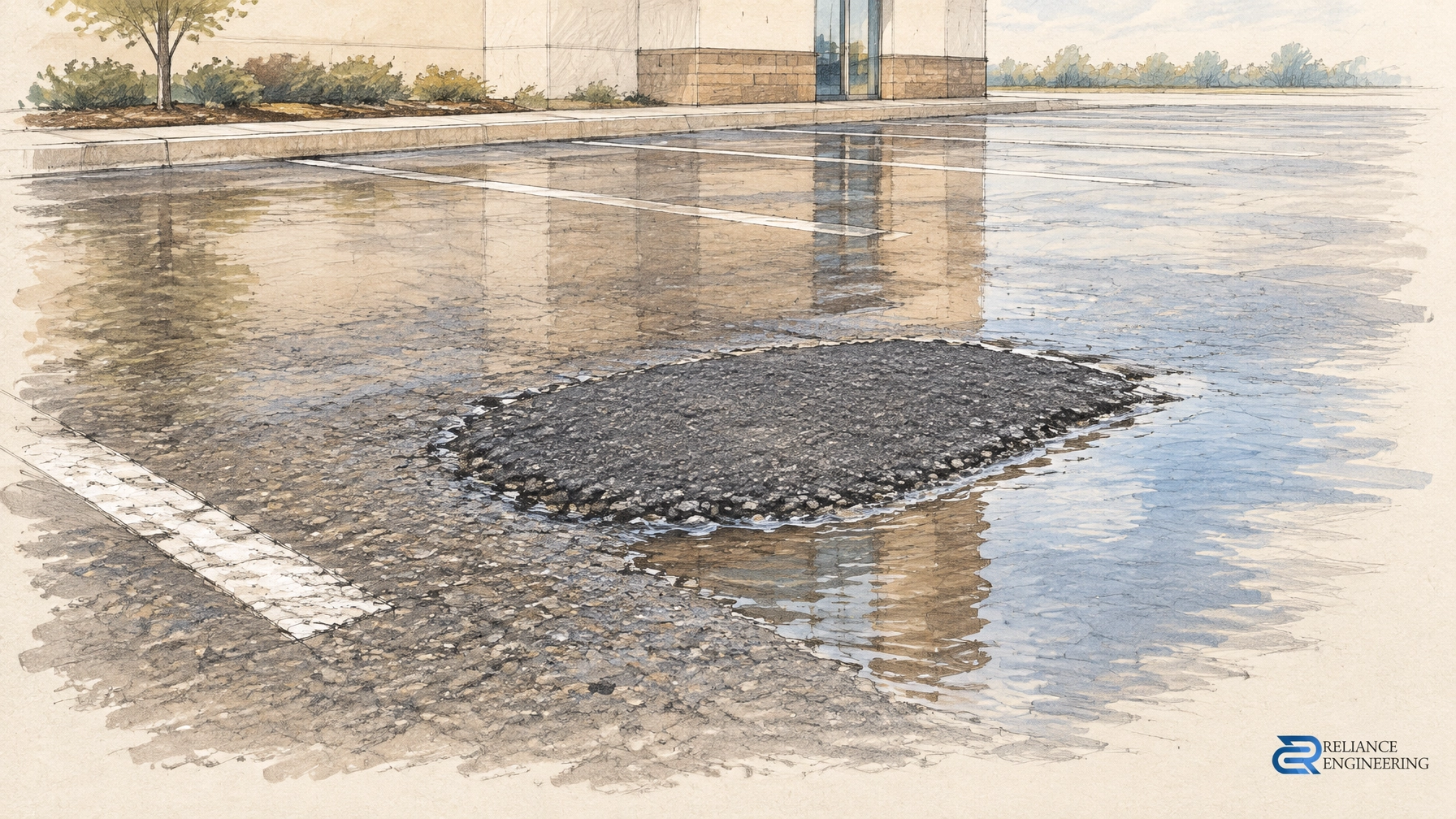
A low spot in a parking lot looks like a small pavement defect. Filling or patching it may seem like a quick repair. But if the surrounding grades still direct water to that area, the patch has not fixed the drainage. It has only changed where the water collects.
For property owners dealing with parking lot ponding in Ontario, a lasting repair begins by finding out why the low spot formed and where runoff is supposed to go. A drainage-focused approach restores positive drainage and preserves safe overland flow routes, rather than simply raising the pavement surface.
Why the low spot forms
A depression can result from the original grading, later movement of the ground or pavement, or a combination of these conditions.
- Grading that does not provide positive drainage: The pavement may have a shallow basin, or its slopes may not lead continuously to a catchbasin, swale or other approved outlet. Water then has nowhere to go.
- Settlement around trenches or buildings: Backfill placed beside utility trenches or building foundations can settle if it was not properly compacted. Pavement over that fill may sink over time.
- Inadequate compaction below the pavement: Uncompacted or poorly supported fill and granular material can compress under traffic and create differential settlement. The surface may dip again even after a repair.
- Changes to the drainage path: Previous paving, curbs or other site work can change surface elevations and create a new low point or block an existing route for runoff.
If settlement or weak support is the cause, filling the surface depression does not stabilize the underlying pavement structure. The area can settle again, and the pond can return.
What happens when the depression is patched
Water still follows the surrounding grades after a patch is placed. If the new fill does not re-establish a continuous slope to an outlet, runoff may collect beside the patch, at its edge or in another low point. The patch can also create a raised edge that blocks the route water used to follow.

The consequences can extend beyond the original puddle. A changed slope may direct water toward a building, doorway, sidewalk or neighbouring property. Ponding can also refreeze in winter, creating slippery conditions for pedestrians and vehicles. If the pavement base is still settling, repeated patches can become a cycle of repair and recurring ponding.
That is why commercial property grading fixes should address the surface and the conditions beneath it. The question is not simply whether the asphalt has been filled. It is whether the finished grades direct water safely and continuously to an outlet.
What a drainage-focused repair involves
A practical design starts with the site as a connected drainage system. Depending on the cause and extent of the problem, the work may include:
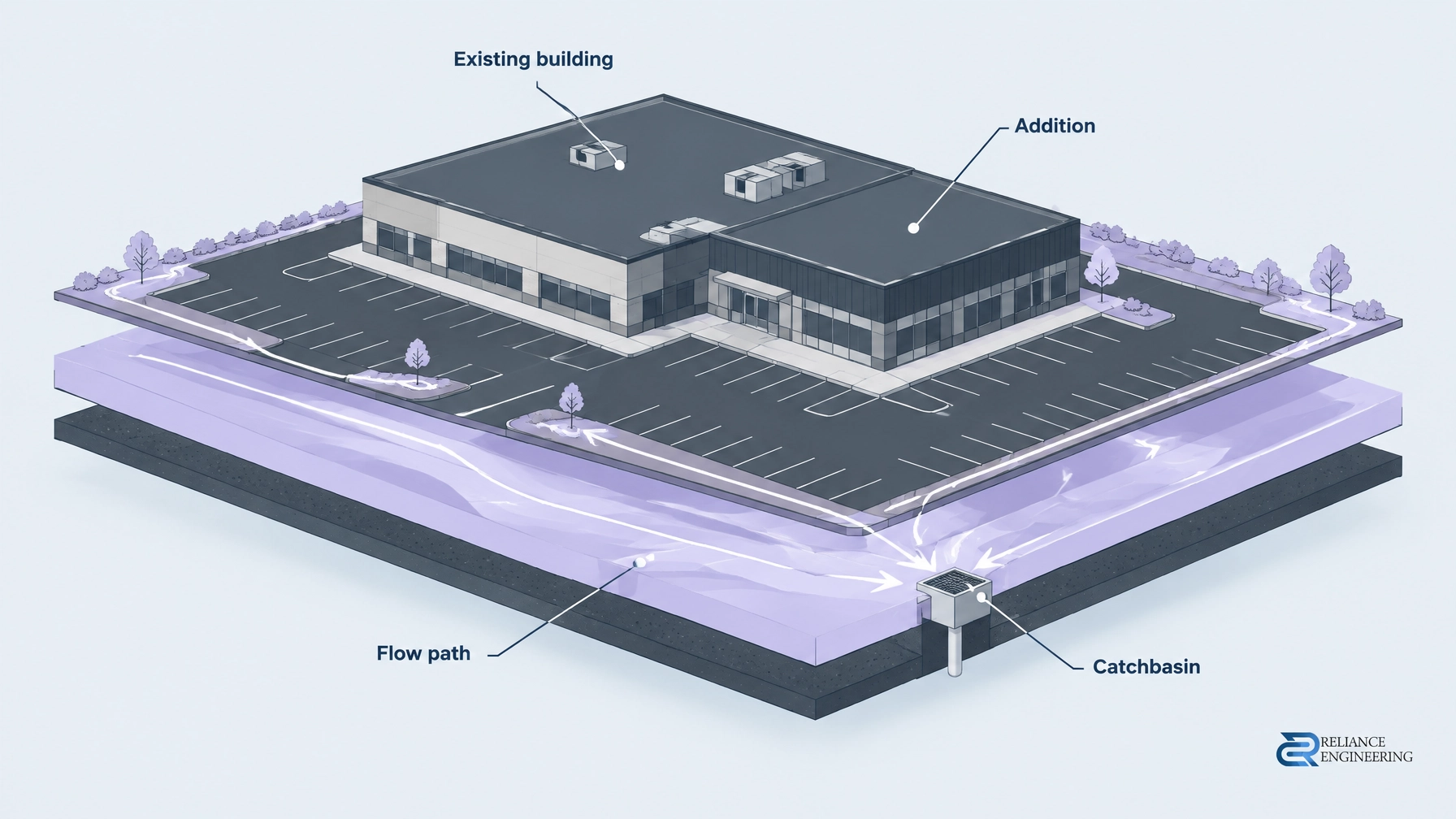
- Reviewing existing elevations. A survey can show how the pavement, curbs, catchbasins, building entrances, walks and property boundaries relate to one another.
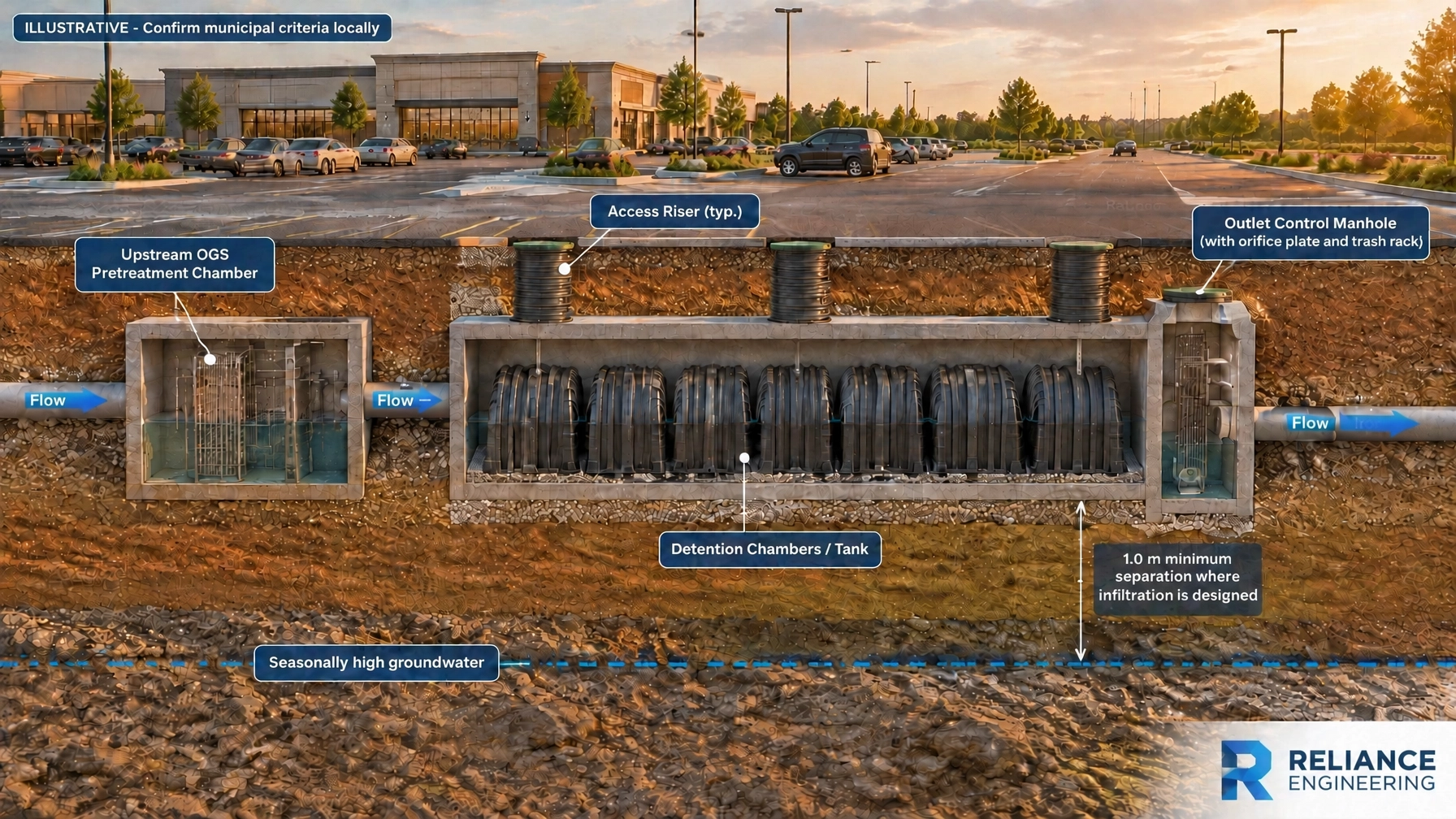
- Checking the outlet and flow route. Confirm that the proposed drainage path reaches a suitable outlet, such as a catchbasin, swale or municipal system, and does not send runoff toward buildings or adjacent properties.
- Re-establishing positive drainage. Proposed slopes should carry water away from the low area and along intended overland flow routes. Those routes need to remain functional, including when the minor drainage system cannot accept all runoff.
- Repairing the pavement structure if it has settled. Where investigation confirms poor support, the affected pavement and granular material may need to be excavated and rebuilt with properly compacted granulars. A surface patch alone will not correct settlement below it.
- Coordinating the details. Catchbasin rims, pavement transitions, entrances and tie-ins to existing grades all need to work together. Clear drawings help communicate a buildable grading design for construction and review.

The appropriate repair depends on the site. Some stable, shallow surface irregularities may be corrected with designed paving work. Recurring settlement, failed pavement support or an ineffective outlet may require reconstruction or a broader grading redesign.
How grading changes are reviewed in Ontario
Municipal requirements vary across Ontario. Before changing site elevations, curbs or drainage infrastructure, confirm whether the work requires a revised grading plan, a site alteration or grading permit, or another municipal approval. Requirements can depend on the municipality, property and scope of work.
Municipal standards also address how routine runoff is collected through the minor system and how larger flows move overland. A local grading plan may need to demonstrate both systems and show that runoff will not create a hazard or drain onto neighbouring lands. Requirements for ponding, flow routes and submissions are not identical province-wide. For examples of local criteria, refer to the City of Mississauga’s Grading Plan Terms of Reference and the City of Barrie’s Lot Grading and Drainage Infrastructure Design Standard. These are municipal documents, not universal Ontario rules.
Conservation Authority involvement may also apply where regulated features or regulated areas are involved. Confirm the applicable requirements for the specific property before starting work.
Start with the drainage, not another patch
If ponding returns after paving repairs, reassess the grades and pavement support before authorizing more fill. Reliance Engineering prepares Site Grading Plans with clear elevations, drainage routes and buildable grading. Where needed, our work can be coordinated with Erosion and Sediment Control Plans and Stormwater Management Reports.
Contact us for advice on ponding solutions, municipal requirements and permit-ready drawings for your property. Request a consultation.
Professional credentials and contact
Naresh Ochani, P.Eng. M.Eng.
PEO Certificate of Authorization: 100548882
Reliance Engineering Canada Limited
6850 Millcreek Dr, Mississauga, ON L5N 2H4
Phone: 647-385-6418
Email: [email protected]
Office hours: Monday to Friday 9:00 AM–5:00 PM; Saturday 12:00 PM–2:00 PM; Sunday Closed