Prepared under the direction of Naresh Ochani, P.Eng., M.Eng.
Reliance Engineering Canada Limited | Mississauga, Ontario
Published: October 14, 2026
A site can be properly zoned, well located and carefully designed, and still face a serious obstacle: the surrounding infrastructure may not be able to support the development.
“Capacity” is not a single yes-or-no measure. It refers to whether water, sanitary sewer and stormwater systems can serve a proposed project under the applicable municipal criteria, including the demands of existing and planned development. A constraint may emerge during municipal review, after land has been purchased and the design is underway.
Early investigation gives developers more options. A functional servicing report tests the servicing strategy before major project decisions are locked in. Paired with site servicing plans and stormwater management reports Ontario municipalities can review, it helps identify constraints, practical responses and potential upgrades.
What infrastructure capacity means
Water supply
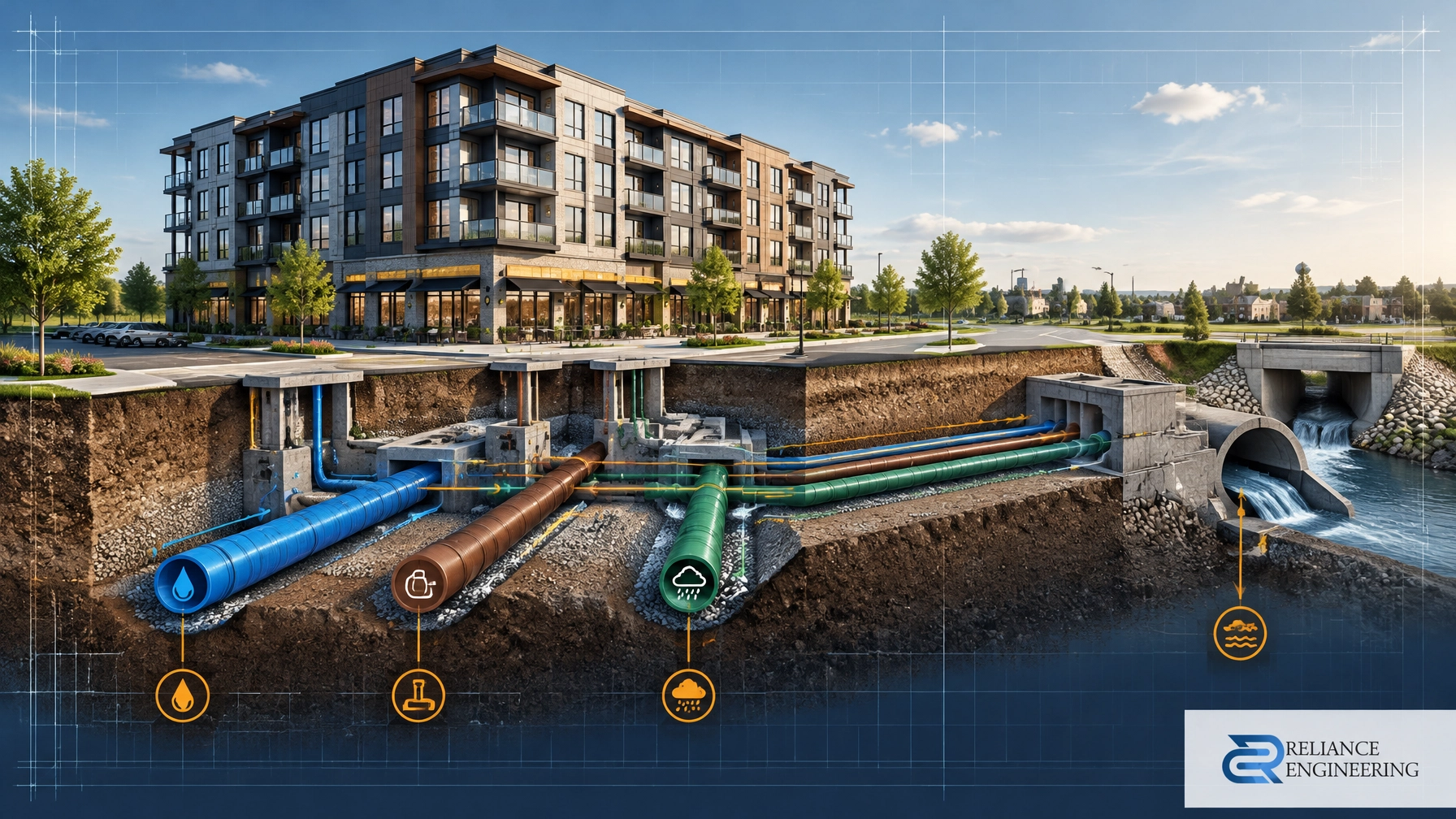
Water capacity means more than having a watermain near the property. The system must be able to provide the required flow and pressure for the proposed use. Depending on the project and municipal criteria, the review may consider domestic demand, fire flow, watermain size, pressure conditions and available system supply.
A nearby connection point does not, by itself, confirm that the system can serve a larger or more intensive development.
Sanitary sewer
Sanitary capacity considers the wastewater generated by the proposed development and the ability of the collection system to convey it. The review may extend beyond the sewer beside the property to downstream sewers, pumping stations and treatment facilities.
A local sewer connection may be technically possible while a downstream segment or facility is constrained. The municipality determines which parts of the system must be assessed and what information is required.
Storm sewer and outlet
Stormwater capacity concerns how runoff moves across and off the site, and whether the receiving sewer, channel or other outlet can accept the proposed discharge. The analysis considers the site’s drainage strategy and the applicable municipal and watershed requirements.
The outlet is critical. On-site controls may manage runoff, but they do not automatically establish that a downstream system can accept the release. The connection, allowable release and receiving conditions need to be assessed.

Why capacity problems often appear late
Municipal review is often when a project’s proposed demands are assessed against current servicing information and system requirements. A pre-application concept may show a nearby watermain or sewer, but that does not amount to confirmation of capacity.
Capacity information can also be spread across record drawings, engineering studies, master plans and municipal review. As a result, a constraint may only become clear once the proposed use, unit count, flow calculations and connection strategy are defined.
This timing matters. If the issue surfaces after design or purchase, the available responses may involve redesign, phasing, added on-site controls or infrastructure upgrades. Each can affect project cost, schedule and feasibility.
Ontario’s provincial planning framework addresses reserve capacity at sewage and water treatment plants. However, treatment-plant reserve capacity is not the same as confirming that a local watermain, sanitary sewer or stormwater outlet can serve a particular site. See the province’s guidance on planning for sewage and water services and calculating uncommitted reserve capacity.
Early signs worth investigating
These conditions are not proof that a site lacks capacity. They are reasons to investigate before committing to a servicing concept:
- Older surrounding sewers or watermains. Their location and apparent size do not establish their remaining capacity or current condition.
- A change from industrial or commercial use to residential. A new use can change demand, fire-flow needs, wastewater flows and stormwater behaviour.
- A significant increase in units, floor area or site coverage. A larger project can create demands beyond those assumed for the existing site.
- A constrained or uncertain stormwater outlet. Limited outlet options, downstream drainage concerns or the need for controlled release deserve early review.
- Incomplete servicing information. Missing record drawings or unclear connection details can make assumptions risky.
The purpose of early review is to replace assumptions with evidence and identify what remains to be confirmed with the municipality.
What a capacity constraint can mean for the project
A constraint does not always mean the project cannot proceed. It may mean the proposal needs to fit within a defined servicing limit or address an identified system issue. Depending on the site and municipal direction, responses may include:
- limits on the size or timing of a connection;
- reduced allowable peak water, sanitary or storm flows;
- on-site detention or storage to control stormwater discharge;
- monitoring or other operating requirements;
- phasing tied to infrastructure availability; or
- upgrades to municipal infrastructure, subject to approval, design, cost and timing.
The appropriate response depends on the type and location of the constraint. On-site detention, for example, can control a stormwater release where required, but it does not add capacity to a downstream sewer. Similarly, a connection design cannot resolve a treatment or system-wide supply limitation by itself.

Test capacity before buying or submitting
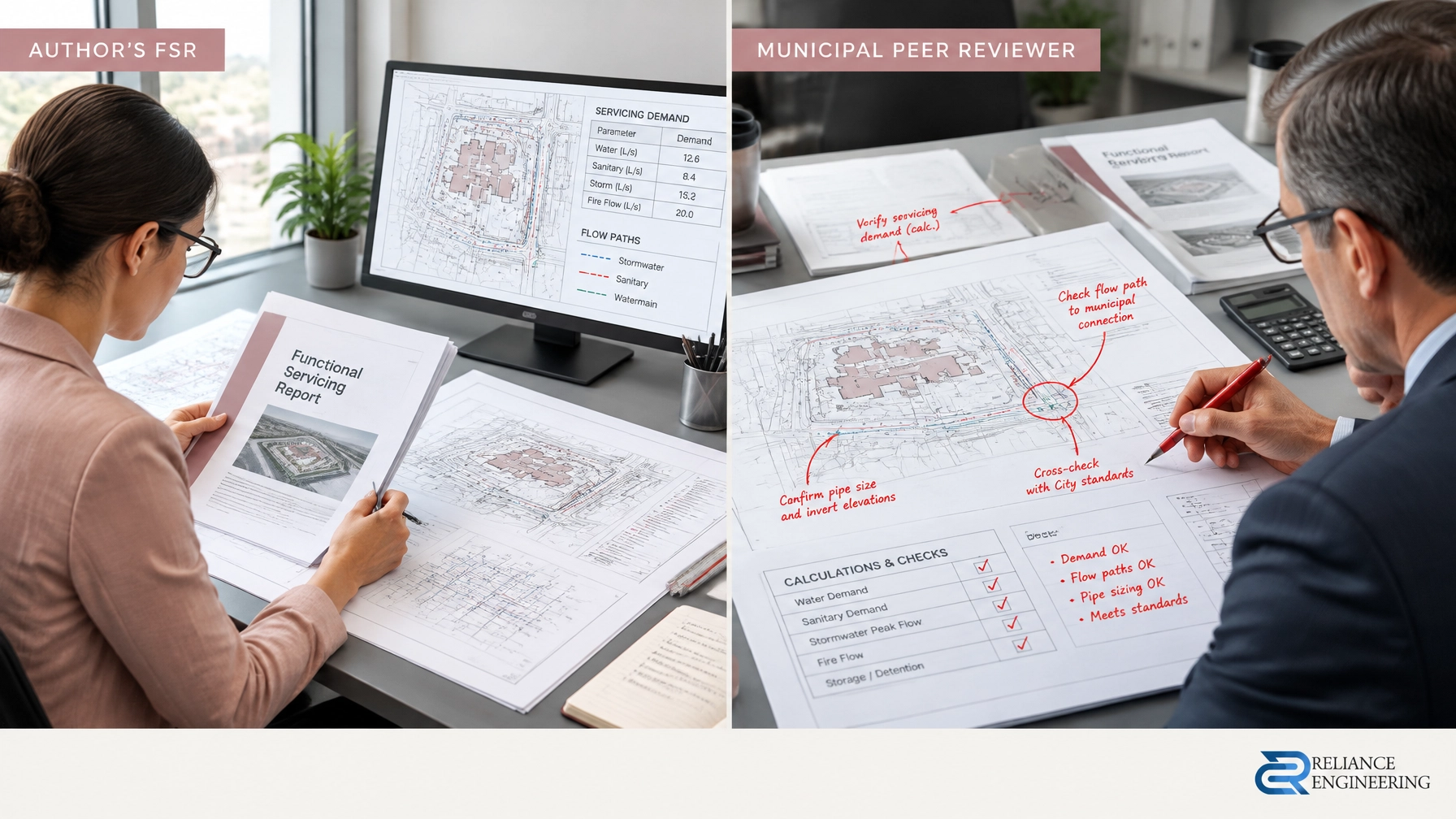
A functional servicing report (FSR) provides an early technical assessment of how a proposed development could connect to water, sanitary and storm infrastructure. It reviews existing conditions, estimates proposed demands and outlines the servicing approach for discussion with the municipality.
Depending on the project, the report may include background information, demand and flow calculations, proposed connections, infrastructure review, storm drainage strategy and recommendations. The scope should reflect the municipality’s current requirements and the information available for the site.
For acquisition decisions, an FSR can help identify which assumptions need confirmation and whether potential constraints could require design changes or upgrades. Before submission, it helps establish a coherent basis for municipal review. It cannot guarantee approval or replace municipal confirmation, but it can surface issues earlier, when project decisions may still be adjusted.
For an overview of our approach, see Functional Servicing Reports.
Coordinate the drawings and stormwater strategy
Once the servicing approach is understood, the engineering drawings and reports need to work together. Site servicing plans show the proposed water, sanitary and storm connections, routing, sizes and relevant elevations. Clear layouts and constructible routing help reviewers assess the proposal and help contractors understand the design.
A stormwater management report assesses how runoff will be controlled and discharged. Depending on municipal criteria and site conditions, measures may include reduced release rates, on-site detention, storage, erosion and sediment controls, and other practical controls. The report should explain the calculations and how the proposed system relates to the available outlet.

The goal is a coordinated design: servicing, grading and stormwater controls should be considered together, not treated as separate fixes. That coordination supports clear calculations, permit-ready drawings and a more efficient municipal review.
Municipal engineering standards and watershed requirements govern the criteria for each project. Where a Conservation Authority regulates the site or proposed works, its review and any permit requirements may also apply. Ontario’s Stormwater Management Planning and Design Manual provides provincial technical context; it does not replace applicable municipal criteria. For regulated-area permits, consult Ontario Regulation 41/24 and the relevant Conservation Authority.
Make capacity an early project question
For developers, the practical question is not simply whether infrastructure is present. It is whether the proposed development can be serviced under the applicable requirements, and, if not, what would need to change.
Early capacity review can clarify the water, sanitary and stormwater strategy before design and approval work advances too far. Reliance Engineering brings municipal experience to functional servicing reports, site servicing plans and stormwater management reports, with a focus on coordinated design and approval support across Ontario.
Discuss your site with our team. We can help identify the information needed to assess servicing capacity and prepare a practical path toward municipal approvals.
- Phone: 647-385-6418
- Email: [email protected]
- Address: 6850 Millcreek Dr, Mississauga, ON L5N 2H4
- Office hours: Saturday 12:00 PM–2:00 PM; Sunday Closed
- Professional credentials: Prepared under the direction of Naresh Ochani, P.Eng., M.Eng. Reliance Engineering Canada Limited is authorized by PEO, Certificate of Authorization 100548882.
Request a consultation | Explore our site servicing plans | Learn about stormwater management