Published: October 6, 2026
Service focus: Ontario Site Servicing & Stormwater
Reading time: 7 minutes
A Functional Servicing Report (FSR) demonstrates whether a proposed development can be properly serviced by existing and planned municipal infrastructure. It evaluates water, sanitary, and storm systems before a municipality approves the application.
For site plan control, rezoning, subdivision, consent, and larger development applications, an FSR gives municipal reviewers the technical information needed to assess servicing feasibility. It should not simply describe where pipes are located. It must prove that the proposed development can connect safely, operate reliably, and meet applicable municipal and provincial requirements.
Reliance Engineering prepares practical FSRs across Ontario with clear calculations, coordinated design, and direct approval support.
What a Functional Servicing Report Must Prove
A complete FSR should answer a basic question:
Can the proposed development be serviced by the available infrastructure without creating unacceptable capacity, drainage, or connection problems?
To answer this question, the report typically includes:
- Existing municipal water, sanitary, and storm infrastructure review
- Water demand calculations
- Fire flow review, where required
- Sanitary flow calculations
- Storm drainage strategy
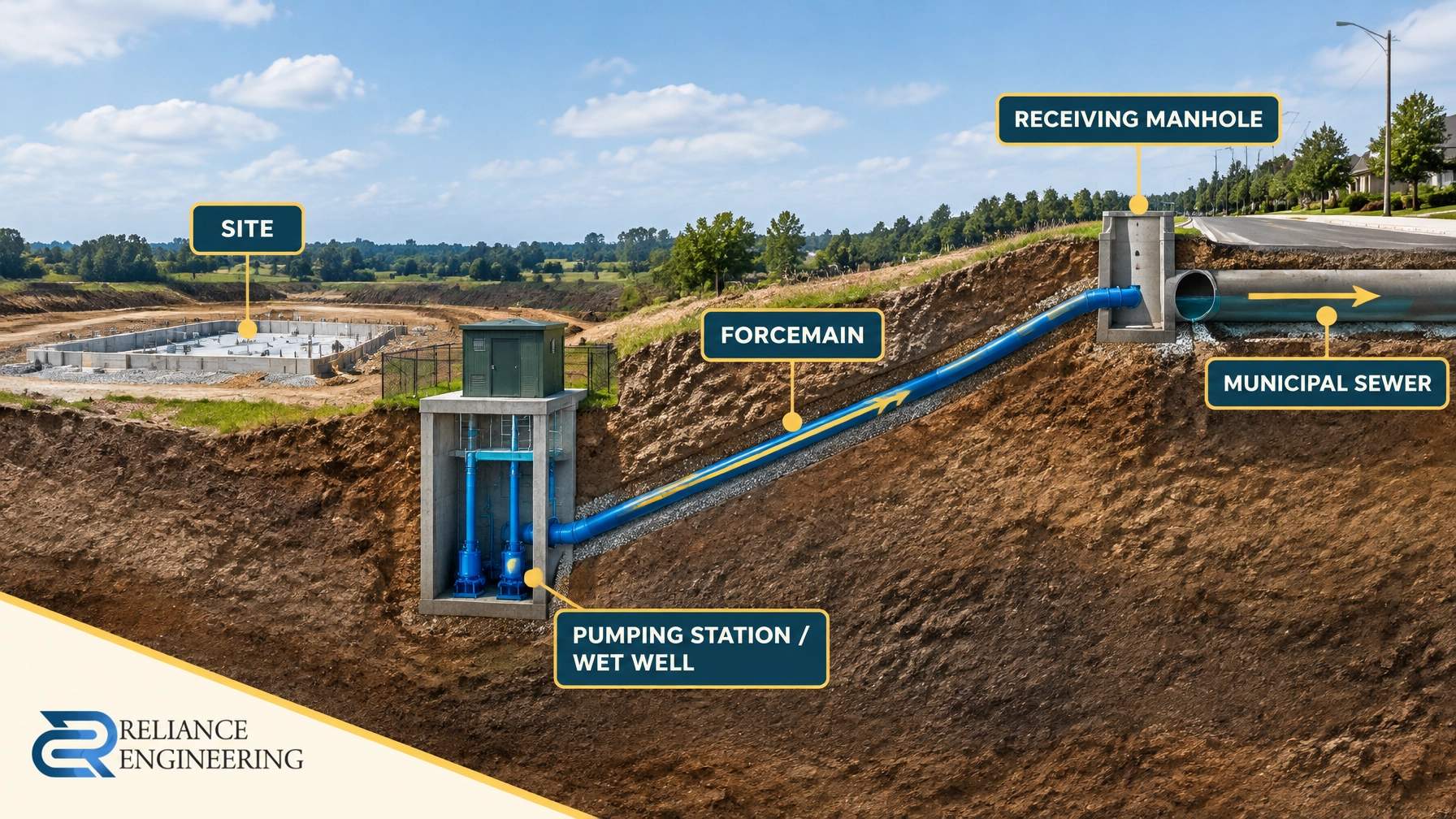
- Proposed servicing connections
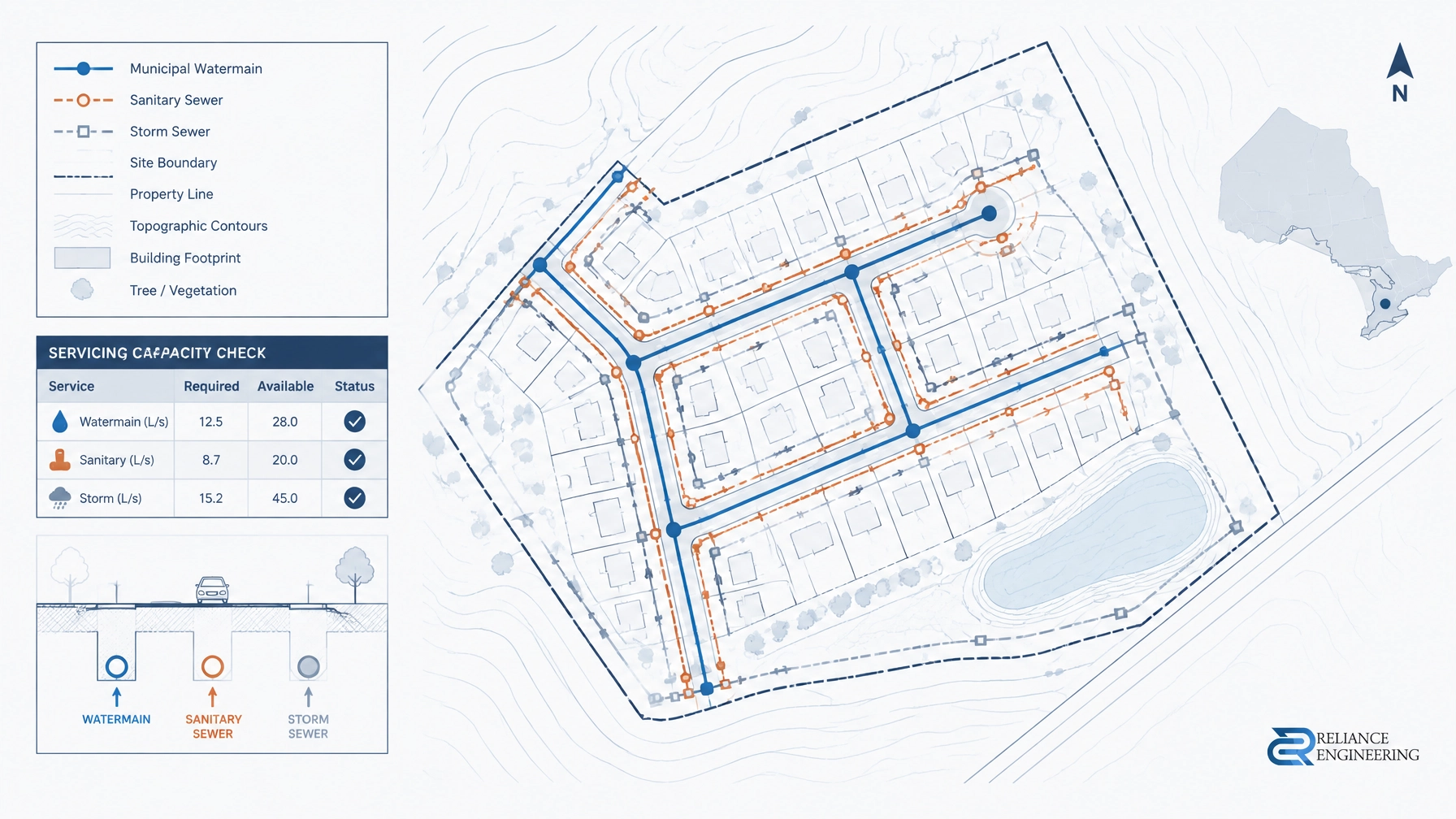
- Infrastructure capacity discussion
- Service sizing recommendations
- Coordination with site servicing drawings
- Clear conclusions for municipal review
The level of detail varies by municipality, project size, and application type. Regional and local requirements should be confirmed at the beginning of the project.
An FSR should also identify any required upgrades, additional modelling, municipal approvals, environmental permissions, or Conservation Authority requirements.
Water Capacity and Fire Flow Review
Water servicing analysis confirms whether the existing municipal water system can support the proposed development.
The review may consider:
- Existing watermain size and location
- Available static and residual pressure
- Average and peak water demand
- Proposed service size
- Number and type of proposed units
- Fire protection requirements
- Hydrant locations and fire access
- Connection limitations or municipal servicing conditions
Fire flow is a separate and important consideration. A site may have adequate domestic water demand but still require additional analysis to confirm that fire flow can be met.
Where necessary, the FSR should identify whether hydrant testing, hydraulic modelling, pressure confirmation, or municipal capacity information is required. Service sizing recommendations must then be coordinated with the Site Servicing Plans, building layout, fire access route, and applicable fire protection criteria.
A clear water servicing strategy helps prevent late-stage comments, undersized connections, and redesign during building permit review.

Sanitary Flow and Outlet Capacity
Sanitary analysis determines whether the proposed development can discharge wastewater to the available municipal system.
A strong FSR should review:
- Existing sanitary sewer size and location
- Proposed sanitary service connection
- Average sanitary flow
- Peak sanitary flow
- Population or occupancy assumptions
- Sanitary sewer slopes and invert conditions
- Available outlet capacity
- Downstream sewer conditions
- Pumping station or trunk sewer limitations, where applicable
- Potential need for upgrades or flow monitoring
The report should distinguish between the proposed site connection and the broader downstream system. A connection may be physically possible but still require confirmation that downstream infrastructure has adequate available capacity.
Sanitary flow calculations must be based on the proposed use and development intensity. Residential, commercial, industrial, institutional, and mixed-use projects can have different demand assumptions and peaking factors.
The final conclusion should clearly state whether the proposed sanitary flow can be accommodated, whether municipal confirmation is required, and whether upgrades or mitigation measures are necessary.
Storm Drainage and Downstream Capacity
Storm servicing is often the most detailed part of an FSR. Development changes site coverage, drainage patterns, runoff rates, and the amount of water entering municipal infrastructure.
The stormwater review should address:
- Existing and proposed drainage areas
- Pre-development and post-development runoff
- Storm sewer connection location
- Allowable release rate
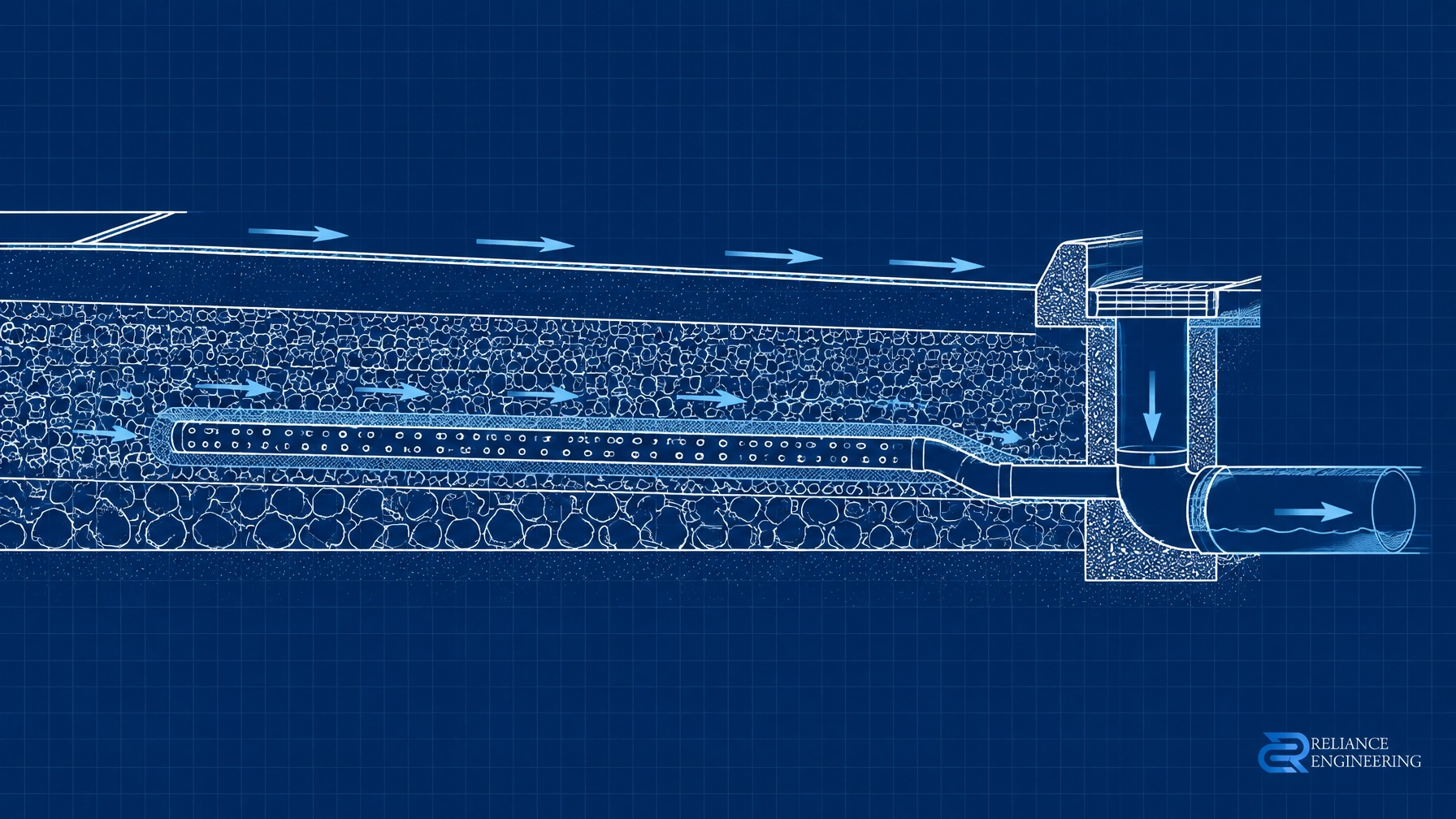
- Quantity control storage
- Outlet and orifice control
- Overland flow routes
- Minor and major system performance
- Downstream storm sewer capacity
- Receiving system or watercourse conditions
- Water quality and water balance, where required
A storm connection is not automatically acceptable because a municipal storm sewer is nearby. The available capacity of the receiving sewer and downstream system must be considered.
Where the municipal criteria require quantity control, the FSR should establish the allowable release rate and identify the storage volume and controls needed to achieve it. The strategy may include detention storage, flow control devices, grading measures, or Low Impact Development features.
Reliance Engineering prepares Stormwater Management Reports in Ontario with clear calculations and practical controls that support a buildable site design. The FSR and SWM report should be coordinated rather than prepared as separate, disconnected documents.

Coordination With Site Servicing Plans
The FSR establishes the servicing strategy. The site servicing drawings show how that strategy will be built.
The two must agree on:
- Service locations
- Pipe sizes
- Pipe slopes
- Inverts
- Manholes and cleanouts
- Water service and hydrant locations
- Storm connections
- Sanitary outlet points
- Easements and utility corridors
- Grading and drainage patterns
- Building entrances and fire access
Reliance Engineering’s Site Servicing Plans use clean layouts, constructible routing, and coordinated connection details. This reduces conflicts with foundations, retaining walls, landscaping, utilities, and access routes.
The FSR should not recommend a servicing route that cannot be shown on the site plan. Similarly, the site servicing plan should not introduce a connection, size, or outlet that is unsupported by the FSR calculations.
This coordinated design approach helps produce clear drawings, practical designs, and permit-ready drawings.
Municipal Requirements Across Ontario
FSR requirements are not identical across Ontario. Each municipality and region may apply its own engineering standards, submission checklists, connection procedures, and capacity review requirements.
Depending on the project, the FSR may need to address:
- Municipal engineering standards
- Site plan control requirements
- Regional water and wastewater requirements
- Local sanitary and storm connection standards
- Fire flow criteria
- Ontario Building Code considerations
- Municipal servicing agreements
- Environmental Compliance Approval or registration requirements
- Conservation Authority requirements
- Floodplain, watercourse, or cut-and-fill restrictions
- Phasing and infrastructure upgrade requirements
The Ontario government provides information on environmental permissions for sewage and stormwater management works. Regional authorities may also require written confirmation or capacity review before approving water, wastewater, or storm connections. For example, project teams should review applicable Peel Region water and wastewater service connection requirements when working within that service area.
An FSR should identify relevant approvals early. This allows the design team to plan for municipal comments, regulatory submissions, and construction requirements before the application is submitted.
Problems Caused by Weak FSRs
An incomplete or poorly coordinated FSR can cause:
- Delayed planning approvals
- Avoidable municipal comments
- Unresolved capacity concerns
- Repeated technical submissions
- Changes to proposed building layouts
- Undersized or oversized services
- Stormwater redesign
- Conflicts between grading and servicing
- Additional survey, modelling, or testing costs
- Construction changes after approval
The most common issue is a conclusion that is too general. Statements such as “capacity is available” are not enough without supporting assumptions, calculations, infrastructure review, and a clear connection strategy.
Municipal reviewers need to understand what was reviewed, how demand was calculated, what capacity was confirmed, and what conditions apply to the proposed development.

A Clear FSR Supports Faster Review
A practical FSR should be concise, technical, and easy to verify. It should include:
- A description of the proposed development
- Existing infrastructure information
- Water demand and fire flow analysis
- Sanitary flow and outlet capacity analysis
- Storm drainage and release-rate strategy
- Proposed connection locations and service sizes
- Downstream capacity discussion
- Required upgrades or conditions
- Coordination notes for site servicing and grading
- Clear conclusions for municipal review
Reliance Engineering brings more than 20 years of principal engineer experience, municipal experience, and approval-focused civil design to land development projects across Ontario. Our FSRs are coordinated with site servicing, grading, stormwater management, and other approval drawings.
Request an FSR Consultation
If your project requires a functional servicing report, site servicing strategy, or stormwater management report in Ontario, contact Reliance Engineering before submitting your application.
We provide practical designs, clear drawings, approval support, and permit-ready drawings for residential, commercial, industrial, institutional, infill, severance, OPA/ZBA, and site plan approval projects.
Request a consultation with Reliance Engineering.
Contact and Professional Credentials
Naresh Ochani, P.Eng. M.Eng.
Principal Engineer
PEO Certificate of Authorization: 100548882
Address: 6850 Millcreek Dr, Mississauga, ON L5N 2H4
Phone: 647-385-6418
Email: [email protected]
Office hours: Saturday 12:00 PM–2:00 PM; Sunday Closed.