Ottawa Grading & Drainage Series : 8:00 AM Post 3
Topic: Ottawa ponding solutions for commercial properties
Standing water in a commercial parking lot is rarely just a pavement problem. It may indicate settlement, insufficient slope, misplaced catch basins, blocked drainage infrastructure, or a poor connection between the parking area and the municipal storm system.
The correct solution begins with a site-specific investigation and a coordinated grading design. For Ottawa commercial properties, targeted regrading must also consider City of Ottawa requirements, road and driveway tie-ins, approved drainage patterns, site alteration rules, and Conservation Authority requirements where applicable.
Reliance Engineering prepares practical designs, clear drawings, and permit-ready drawings for commercial parking lot drainage and grading improvements across Ontario.
Why commercial parking lots pond
Ponding commonly develops when one or more of the following conditions exist:
- Asphalt has settled or deteriorated.
- The parking lot was constructed with flat or inconsistent grades.
- Catch basins are not located at the actual low points.
- Catch basin grates are blocked by sediment, ice, or debris.
- Storm connections are undersized, damaged, or surcharged.
- Snow storage blocks the intended drainage path.
- A driveway or road tie-in directs water back into the property.
- New curbs, landscaping, or pavement changes have interrupted an existing swale.
- Construction work has changed the approved drainage pattern.
A maintenance review should always be completed first. Cleaning catch basins and removing obstructions may correct a temporary problem. If ponding continues after rainfall or snowmelt, the site likely requires a grading assessment.

Ottawa requirements affect the corrective design
The City of Ottawa expects grading and drainage designs to protect buildings, adjacent properties, public infrastructure, and approved drainage routes.
The City’s lot grading guidance states that property grading is intended to direct water toward appropriate drainage areas. Owners should not alter a property in a way that negatively affects the intended drainage pattern or directs water onto neighbouring properties, sidewalks, rights-of-way, or easements.
For a commercial parking lot, this means asphalt regrading should not be treated as an isolated paving decision. The proposed work may affect:
- Municipal storm sewer inflows
- Roadway and driveway drainage
- Adjacent properties
- Pedestrian routes
- Fire access
- Snow storage
- Catch basin and maintenance hole elevations
- Overland flow routes
- Site plan or site alteration approvals
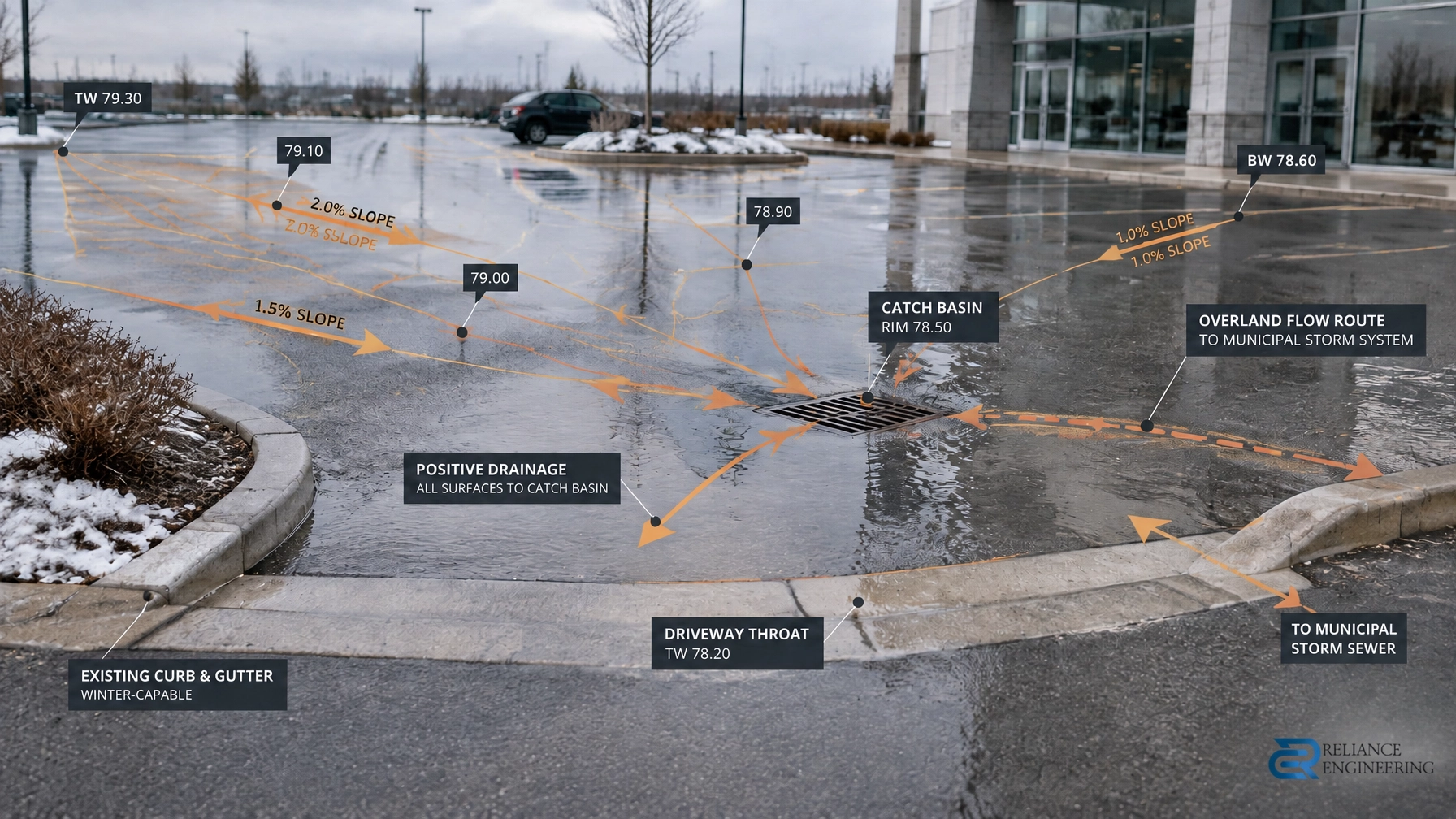
The City’s servicing and grading plan requirements identify the information expected on a grade control and drainage plan. This includes existing and proposed elevations, slope gradients, drainage arrows, parking lot grades, road centreline information, driveway tie-ins, catch basin elevations, stormwater ponding limits, surface water outlets, and erosion and sediment control measures.
The corrective grading process
A reliable Ottawa ponding solution follows a defined process.
1. Review the existing conditions
The first step is to obtain current survey information for the parking lot, building entrances, curbs, sidewalks, road frontage, catch basins, maintenance holes, property lines, and adjacent grades.
The survey should identify:
- Existing spot elevations
- Pavement edges and curb lines
- High points and low points
- Catch basin rim and invert information
- Driveway and road elevations
- Building entrance elevations
- Drainage easements
- Existing swales or ditches
- Nearby municipal storm infrastructure
Photographs taken during or shortly after rainfall can also help confirm the location, depth, and frequency of ponding.
2. Identify the real cause
The lowest visible area is not always the root cause. A parking lot may pond because the water cannot reach the intended catch basin, or because the storm system cannot accept the design flow.
A drainage-focused approach evaluates:
- Whether the pavement has sufficient slope
- Whether flow reaches a defined inlet
- Whether catch basins are at true low points
- Whether the storm sewer connection is functioning
- Whether the outlet is blocked or surcharged
- Whether the lot drains toward the building or public sidewalk
- Whether the driveway throat creates a reverse grade
- Whether snow storage blocks surface drainage
- Whether the existing overland flow route remains available
This distinction matters. Repaving a low area without correcting the drainage pattern may produce the same ponding problem within a short time.
3. Design positive drainage
The objective is continuous positive drainage toward an approved outlet. Depending on site constraints, the solution may include:
- Targeted asphalt regrading
- Milling and resurfacing
- New curb or gutter elevations
- Additional catch basins
- Relocated catch basins
- Area drains
- Swales or shallow drainage channels
- Storm sewer upgrades
- Adjusted driveway grades
- Pavement reconstruction over settled subgrade
- Defined emergency overland flow routes
The design must remain practical to construct. Grades should be coordinated with accessibility, vehicle circulation, loading areas, fire routes, building entrances, and winter maintenance.
Ottawa’s Access Design Requirements include requirements for vehicular access grades, locations, drainage between properties, and access to parking lots. A parking lot access generally must be designed with a grade that descends toward the roadway and remains within the City’s stated limits, subject to the specific site and approval pathway.

Overland flow routes must be shown
Catch basins and storm sewers manage frequent runoff. During larger storms, blocked grates, frozen inlets, or system capacity limitations can cause water to move across the surface.
A safe design therefore includes defined overland flow routes.
These routes should:
- Direct excess runoff toward an approved outlet
- Avoid building entrances and loading doors
- Protect pedestrian and accessible routes
- Avoid neighbouring properties
- Avoid creating unsafe conditions at the driveway
- Remain functional during snow and ice conditions
- Be shown clearly with arrows and elevations on the grading plan
The Ontario Stormwater Management Planning and Design Manual recognizes the importance of coordinating lot-level controls, conveyance systems, minor systems, and major overland flow routes.
A commercial parking lot should not rely on an accidental flow path through a neighbouring property or toward a building entrance. The route must be deliberate, coordinated, and documented.
When stormwater management and ESC plans are required
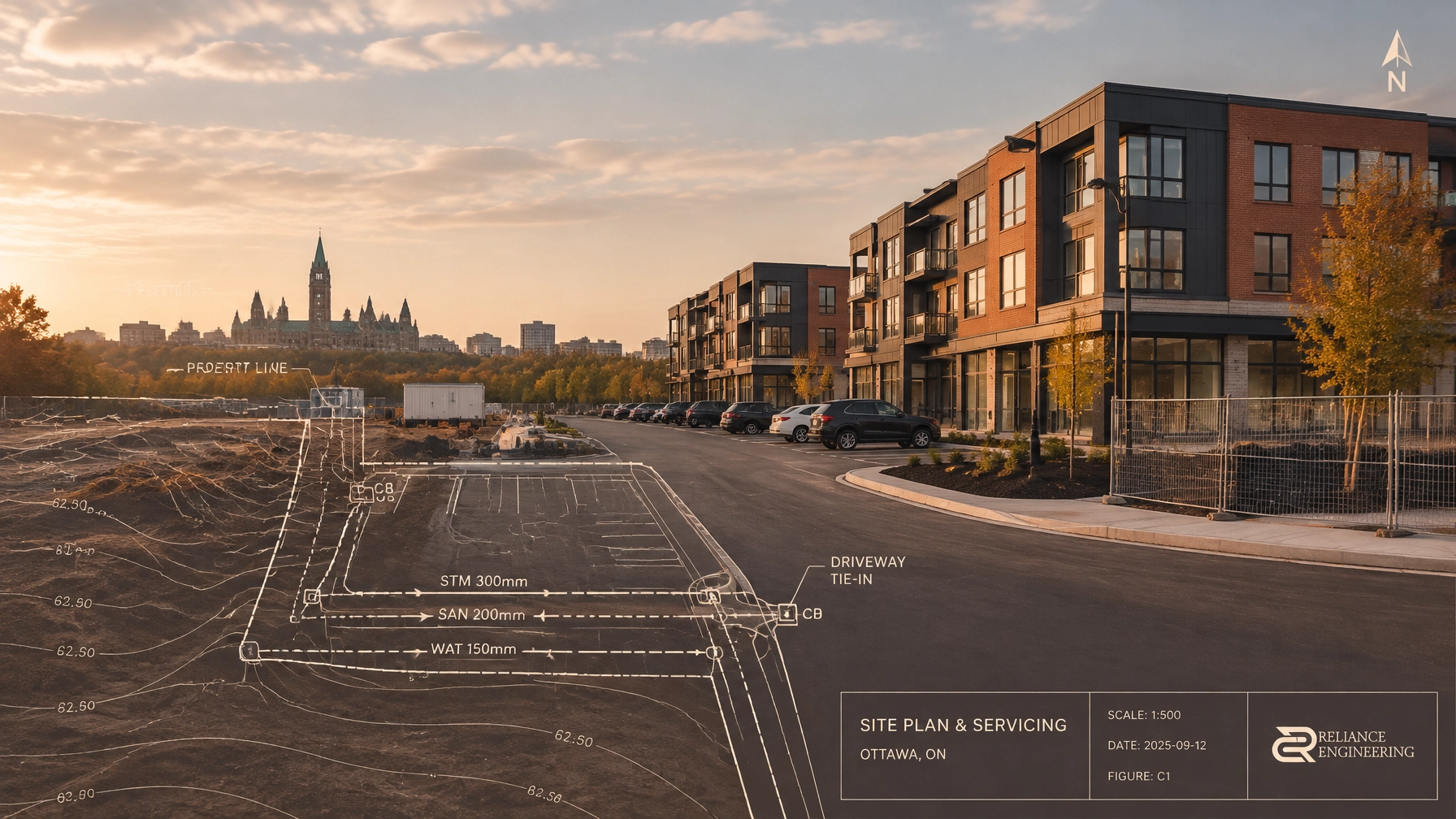
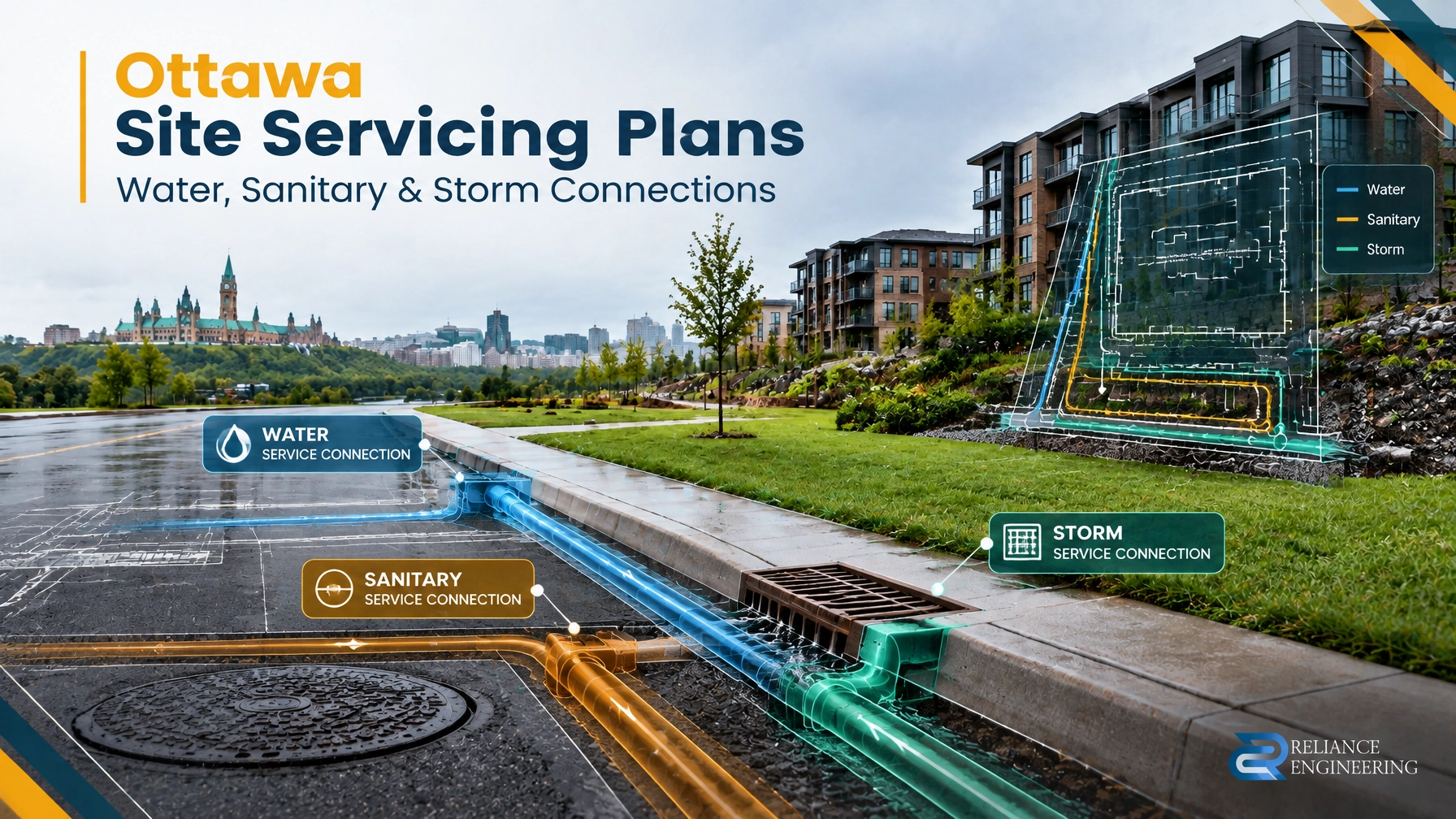
Ponding corrections may require more than a grading plan. If the proposed work adds or relocates storm infrastructure, changes the drainage area, increases impervious coverage, or affects the municipal storm system, a Site Servicing Plan may also be required.
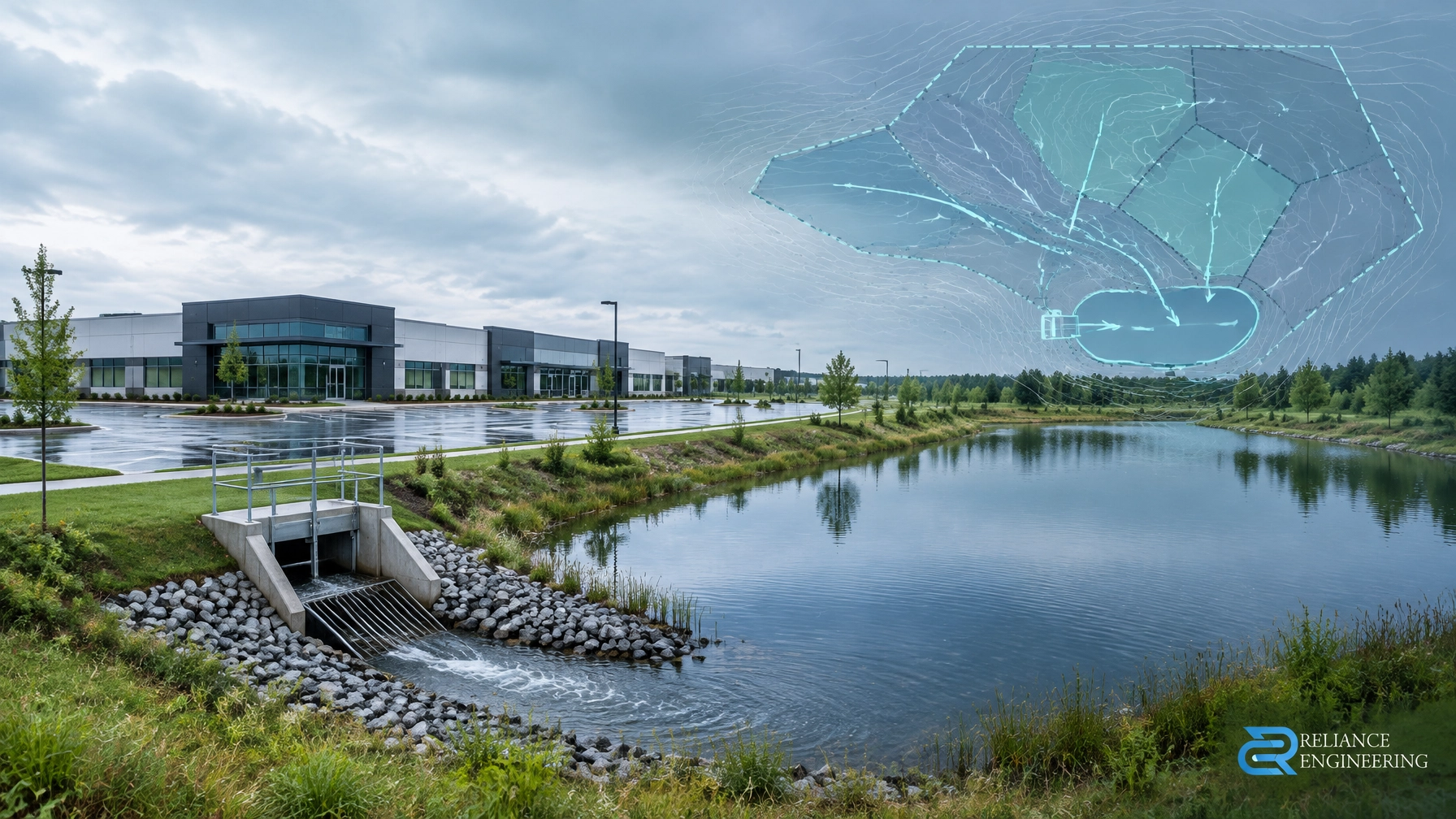
A Stormwater Management Report may be necessary where the project affects runoff quantity, quality, storage, or discharge rates.
Construction activity can also expose soil and create sediment runoff. Where grading, excavation, pavement removal, or utility work is proposed, an Erosion and Sediment Control Plan should be coordinated with the final grading design.
ESC measures should not block the permanent drainage system. Sediment fencing, inlet protection, temporary swales, construction entrances, and stabilized outlets must be located so that they control sediment without creating new ponding or diverting runoff onto adjacent lands.
Conservation Authority and site alteration review
Some Ottawa-area properties may fall within the regulated area of a Conservation Authority, including the Rideau Valley Conservation Authority, Mississippi Valley Conservation Authority, or South Nation Conservation.
Additional review may apply where a property is near:
- A watercourse
- Wetland
- Floodplain
- Valley or ravine
- Erosion hazard
- Regulated shoreline
- Natural heritage feature
Before changing grades, filling depressions, redirecting runoff, or constructing new drainage outlets, the applicable Conservation Authority requirements should be confirmed. City approval and Conservation Authority permission may both be required, depending on the location and scope of work.
What a permit-ready grading package should include
A commercial ponding correction package may include:
- Existing condition survey
- Proposed grade control and drainage plan
- Site servicing plan
- Catch basin and storm sewer details
- Driveway and municipal road tie-in details
- Pavement or asphalt reconstruction limits
- Overland flow route arrows
- Ponding limits and emergency overflow information
- Building entrance and finished floor elevations
- Erosion and sediment control notes
- Construction details and specifications
- Professional Engineer’s seal and signature
- Response to City or Conservation Authority comments
The final design should communicate the solution clearly to the owner, contractor, reviewer, and paving team. Clear drawings reduce field confusion and help prevent rework.

A practical solution starts with accurate grading
Ottawa commercial property owners should not rely on repeated patching when standing water continues to return. A successful repair addresses the grading, outlet, pavement, and approval requirements together.
Reliance Engineering provides Ottawa commercial property grading fixes, commercial parking lot drainage design, and Ottawa asphalt regrading support using a coordinated design process. With more than 20 years of principal engineer experience, Naresh Ochani, P.Eng. M.Eng. brings practical engineering knowledge to grading, servicing, stormwater, and municipal approvals.
Request an Ottawa ponding assessment
Contact Reliance Engineering for a consultation regarding commercial parking lot drainage Ottawa, asphalt regrading, ponding, or corrective grading.
Call: 647-385-6418
Email: [email protected]
Consultation: Request a consultation
Professional credentials and office information
Naresh Ochani, P.Eng. M.Eng.
PEO Certificate of Authorization: 100548882
Authorized by the Association of Professional Engineers of Ontario to offer professional engineering services.
Reliance Engineering
6850 Millcreek Dr, Mississauga, ON L5N 2H4
Phone: 647-385-6418
Email: [email protected]
Office hours: Saturday 12:00 PM–2:00 PM; Sunday Closed.