Article type: Technical guide
For: Property developers, architects, planners, builders, engineers, and project owners
Focus: Functional Servicing Reports, site servicing plans, stormwater management, and municipal approvals
Service area: Ontario
A Functional Servicing Report (FSR) demonstrates whether a proposed development can be supported by available municipal infrastructure. It reviews water supply, sanitary collection, storm drainage, proposed connections, and infrastructure capacity before a municipality approves the project.
For many development applications, an FSR is not simply a supporting document. It is the technical basis for determining whether the proposed land use, building area, density, and servicing approach are feasible.
A clear FSR identifies capacity concerns early. It also helps define upgrades, phasing, service sizing, and design changes before they become approval or construction problems.
Learn more about Reliance Engineering’s Functional Servicing Reports.
What a Functional Servicing Report Reviews
An FSR connects the proposed development to the existing municipal servicing system. The report typically includes:
- Existing watermains, sanitary sewers, storm sewers, and available record information
- Proposed water, sanitary, and storm connections
- Water demand and service sizing
- Fire flow review, where required
- Sanitary flow calculations
- Storm drainage and outlet strategy
- Available downstream infrastructure capacity
- Coordination with grading and stormwater management
- Required upgrades, phasing, easements, or municipal conditions
- Clear conclusions for municipal review
The report must reflect the actual project. Population, unit count, building use, floor area, site coverage, parking, grading, and drainage all affect the servicing strategy.
An FSR should not rely on general assumptions when project-specific information is available. Municipal reviewers need clear calculations, traceable criteria, and a practical explanation of how the proposed development will function.
Existing Municipal Infrastructure Must Be Confirmed Early
The first step is an existing conditions review. This includes available municipal mapping, surveys, record drawings, servicing information, municipal standards, and relevant planning documents.
The review may identify:
- Watermain size and location
- Available water pressure and system constraints
- Sanitary sewer size, depth, slope, and receiving system
- Storm sewer or drainage outlet limitations
- Existing easements and utility corridors
- Pumping station or treatment plant considerations
- Known servicing restrictions or planned infrastructure upgrades
This information establishes the baseline for the proposed design. It also helps determine whether the preferred connection point is practical.
A property may be located beside a municipal main, but that does not automatically confirm that the system has sufficient capacity. The service may require a larger connection, a different tie-in point, looping, an upgrade, or coordination with planned municipal works.
Ontario’s D-5 Planning for Sewage and Water Services guideline emphasizes the importance of confirming that development can be supported by appropriate sewage and water services and available reserve capacity.
Water Demand and Fire Flow
The water servicing section of an FSR estimates the demand created by the proposed development. The calculations are based on the applicable municipal design criteria and the project’s land use.
Depending on the application, the review may include:
- Average day demand
- Maximum day demand
- Peak hour demand
- Domestic water use
- Number of residents, employees, or occupants
- Commercial, institutional, or industrial demand
- Service and watermain sizing
- Fire flow requirements, where applicable
- Available pressure and flow at the connection point
Fire flow must be assessed using the applicable municipal or recognized fire protection criteria. The requirement may affect watermain sizing, hydrant locations, looping, building separation, and site layout.
A good FSR does not only present a calculated demand. It explains whether the municipal system can support that demand and identifies the next step if the available capacity is uncertain.
Sanitary Flow and Wastewater Capacity
Sanitary servicing must demonstrate how wastewater will move from the development to the receiving municipal system.
The FSR may evaluate:
- Average sanitary flow
- Peak sanitary flow
- Residential or non-residential generation rates
- Sanitary service and sewer sizing
- Proposed connection locations
- Downstream sewer capacity
- Trunk sewer and pumping station constraints
- Treatment plant or reserve capacity considerations
- Phasing or flow restrictions
Sanitary design must also coordinate with grading. A proposed connection that appears available on a plan may not be feasible if the required slope, invert, or depth cannot be achieved.
Reliance Engineering develops constructible routing for sanitary and other underground services. This means the proposed system is reviewed against grades, building elevations, road access, utility conflicts, easements, and actual construction conditions.
Storm Drainage and Stormwater Management
Storm servicing is closely linked to the FSR, site grading, and stormwater management design.
A complete review considers:
- Existing drainage patterns
- Pre-development and post-development runoff
- Minor system capacity
- Major overland flow routes
- Proposed storm sewer connections
- Downstream outlet capacity
- Required storage and release rates
- Water quality treatment
- Erosion control
- Low-impact development measures, where required
- Protection of adjacent properties
A dedicated Stormwater Management Report provides the detailed hydrologic and hydraulic analysis. The FSR summarizes the stormwater strategy and confirms that it can be integrated with the overall servicing concept.
The stormwater design must also work with the grading plan. Catchbasin locations, pipe inverts, surface slopes, building entrances, accessible routes, retaining walls, and emergency overland routes all affect the final design.
Reliance Engineering uses clear calculations and practical controls to develop stormwater strategies that support both municipal review and construction. The goal is not only to meet a release-rate target, but to create a drainage system that fits the site and can be maintained.

How the FSR Coordinates with Site Servicing Plans
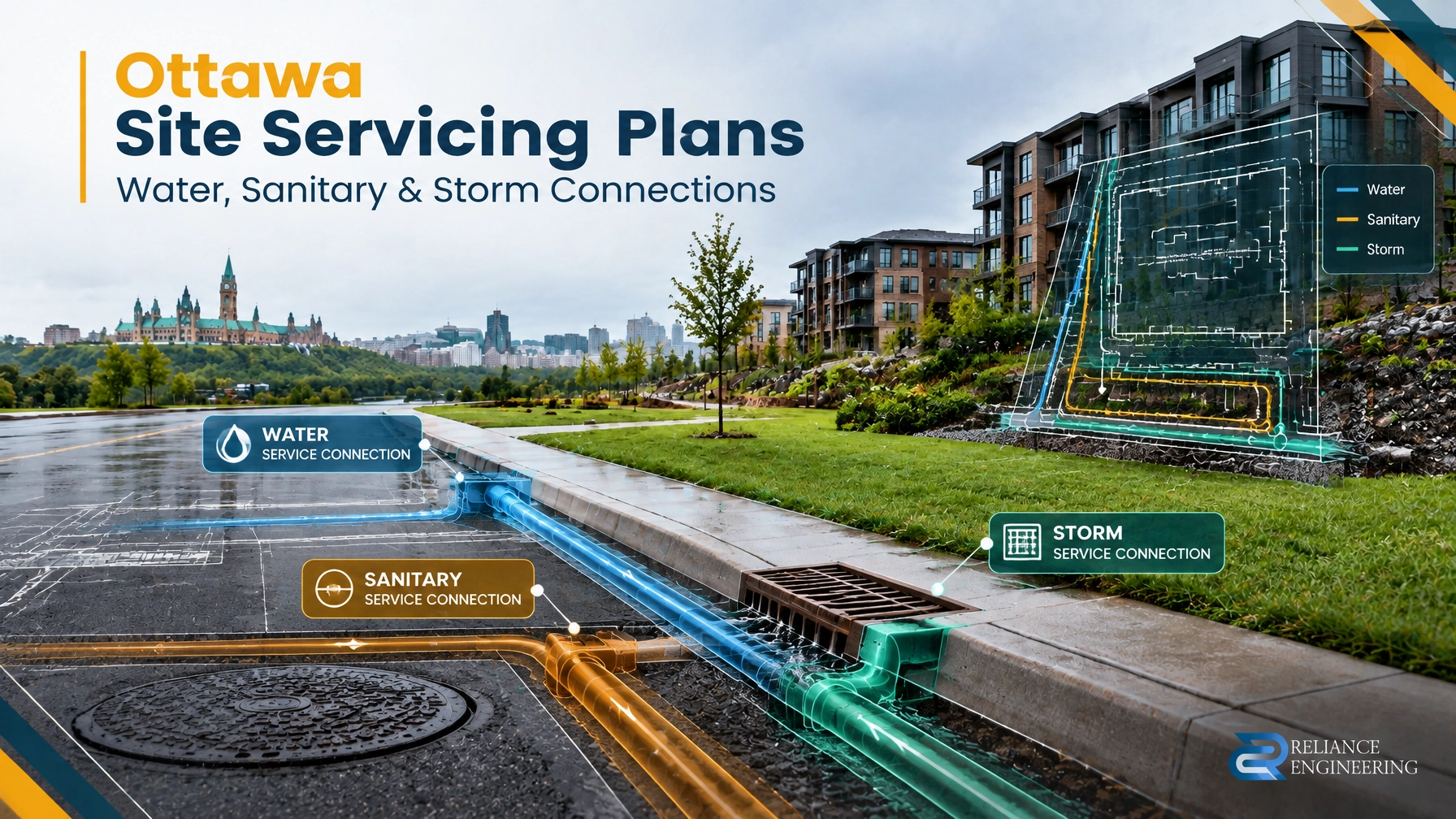
The FSR provides the servicing strategy. The site servicing plans translate that strategy into detailed drawings.
Site servicing plans typically show:
- Water services and connections
- Valves, meters, and hydrants
- Sanitary laterals and manholes
- Storm sewers and catchbasins
- Pipe sizes, slopes, and inverts
- Maintenance access
- Utility crossings
- Connection details
- Construction notes
- Easements and service corridors
The FSR, servicing plans, grading plans, and SWM report must agree. Inconsistent pipe sizes, connection points, drainage areas, or design assumptions can result in municipal comments and redesign.
A coordinated design reduces this risk. It creates clean layouts for reviewers and contractors, while ensuring that the proposed servicing system fits the building, road, parking, landscape, and grading design.
Identify Capacity Concerns Before Approval
The primary value of an FSR is early risk identification.
If capacity is limited, the report can recommend:
- Municipal infrastructure upgrades
- Larger or relocated service connections
- Sewer or watermain improvements
- On-site stormwater storage
- Alternative drainage outlets
- Phased construction
- Development restrictions
- Coordination with planned capital works
- Additional municipal modelling or confirmation
Identifying these requirements before approval is more efficient than discovering them during detailed design or construction.
An FSR also gives the municipality a clear basis for review. It allows staff to understand the proposed servicing demand, assess the connection strategy, and determine whether the project can proceed under the applicable standards.
When an FSR May Be Required
An FSR or equivalent servicing study may be requested for:
- Major site plan applications
- Plan of subdivision applications
- Large residential developments
- Commercial, industrial, and institutional projects
- Apartment and townhouse developments
- Infill and redevelopment projects
- OPA and ZBA applications
- Projects involving increased density or land-use change
- Sites near constrained municipal infrastructure
- Applications requiring regional or conservation authority review
Requirements vary by municipality and project scale. Pre-consultation can help confirm the required terms of reference, modelling expectations, submission format, and supporting drawings.
Why Municipal Experience Matters
A technically correct report must also be prepared for the way municipalities review development applications.
Reliance Engineering brings more than 20 years of principal engineer experience to land development projects across Ontario. Our approach combines:
- Municipal experience
- Practical designs
- Approval support
- Coordinated civil design
- Constructible routing
- Clear calculations
- Responsive comment resolution
We prepare FSRs that are concise, technically complete, and coordinated with the civil drawing package. Where capacity concerns exist, we explain the issue and identify practical next steps.

Prepare Your FSR Before Municipal Submission
A strong Functional Servicing Report helps establish that a proposed development can be serviced safely, efficiently, and in accordance with municipal requirements.
It also gives the project team an opportunity to resolve water, sanitary, storm, grading, and capacity issues before they delay municipal approvals.
If you are preparing a site plan, subdivision, OPA, ZBA, severance, consent, or building permit application, contact Reliance Engineering for a review of your servicing requirements.
Request a consultation:
- Phone: 647-385-6418
- Email: [email protected]
- Address: 6850 Millcreek Dr, Mississauga, ON L5N 2H4
- Office hours: Saturday 12:00 PM–2:00 PM; Sunday Closed
- Principal Engineer: Naresh Ochani, P.Eng. M.Eng.
- Professional credential: PEO Certificate of Authorization: 100548882
Contact Reliance Engineering for expert advice.