Published: September 4, 2026 at 8:00 AM
Category: Grading & Drainage
Service area: Ontario
Repaving a commercial parking lot without reviewing its grading can leave the original drainage problem in place. New asphalt may improve the surface appearance, but it will not correct reverse grades, settled catch basin rims, blocked drainage paths, or low points that were never properly identified.
Before approving asphalt resurfacing or asphalt regrading, complete a professional review of the existing grades and drainage system. This step helps determine whether the solution requires milling, an asphalt overlay, catch basin adjustments, new drainage structures, or full-depth reconstruction.
For commercial owners and property managers looking for commercial parking lot drainage Ontario solutions, the correct sequence is straightforward:
Survey the existing conditions, prepare practical designs, coordinate drainage infrastructure, and then repave to a clear grading plan.
Why Ponding Returns After Repaving
Ponding is usually a grading or drainage coordination problem. It can return after repaving when the underlying cause has not been addressed.
Common causes include:
- Reverse slopes that direct water away from catch basins
- Depressed areas created by settlement or repeated heavy vehicle loading
- Catch basin rims that are too high, damaged, or no longer aligned with the pavement
- Blocked catch basins, area drains, trench drains, or storm connections
- Curbs, islands, sidewalks, or landscape features that interrupt drainage
- Asphalt overlays that raise the pavement around, but not at, drainage structures
- Poor transitions at loading areas, entrances, ramps, or building doors
- Runoff that is directed toward a building, adjacent property, or inaccessible route
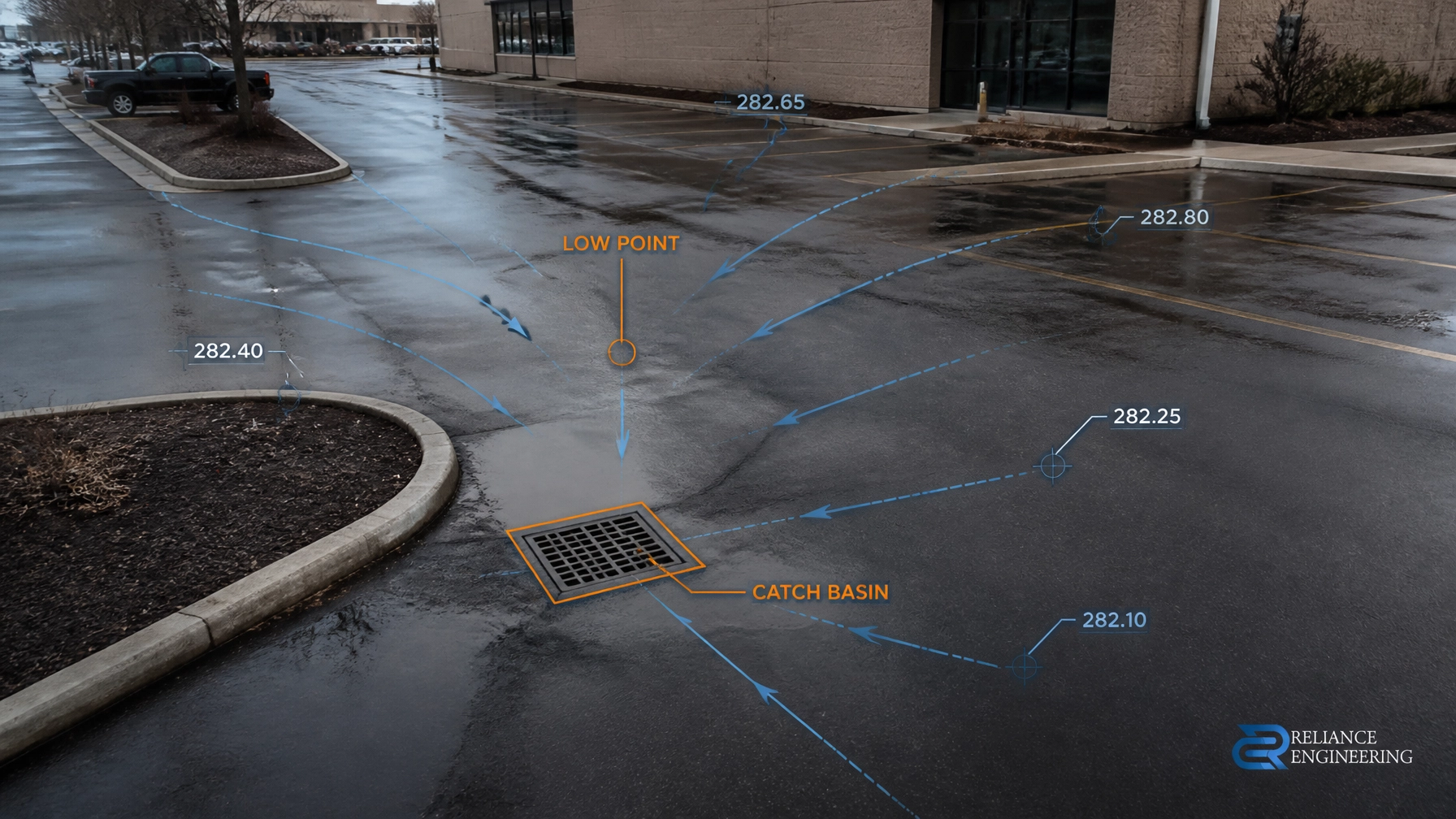
Cleaning a catch basin may improve the problem temporarily, but cleaning alone will not fix a low point several metres away from the inlet. Similarly, adding asphalt to a depression without checking the surrounding grades may simply move the ponding to another location.
Reliable ponding solutions begin with a drainage-focused assessment.

What a Site Grading Plan Identifies
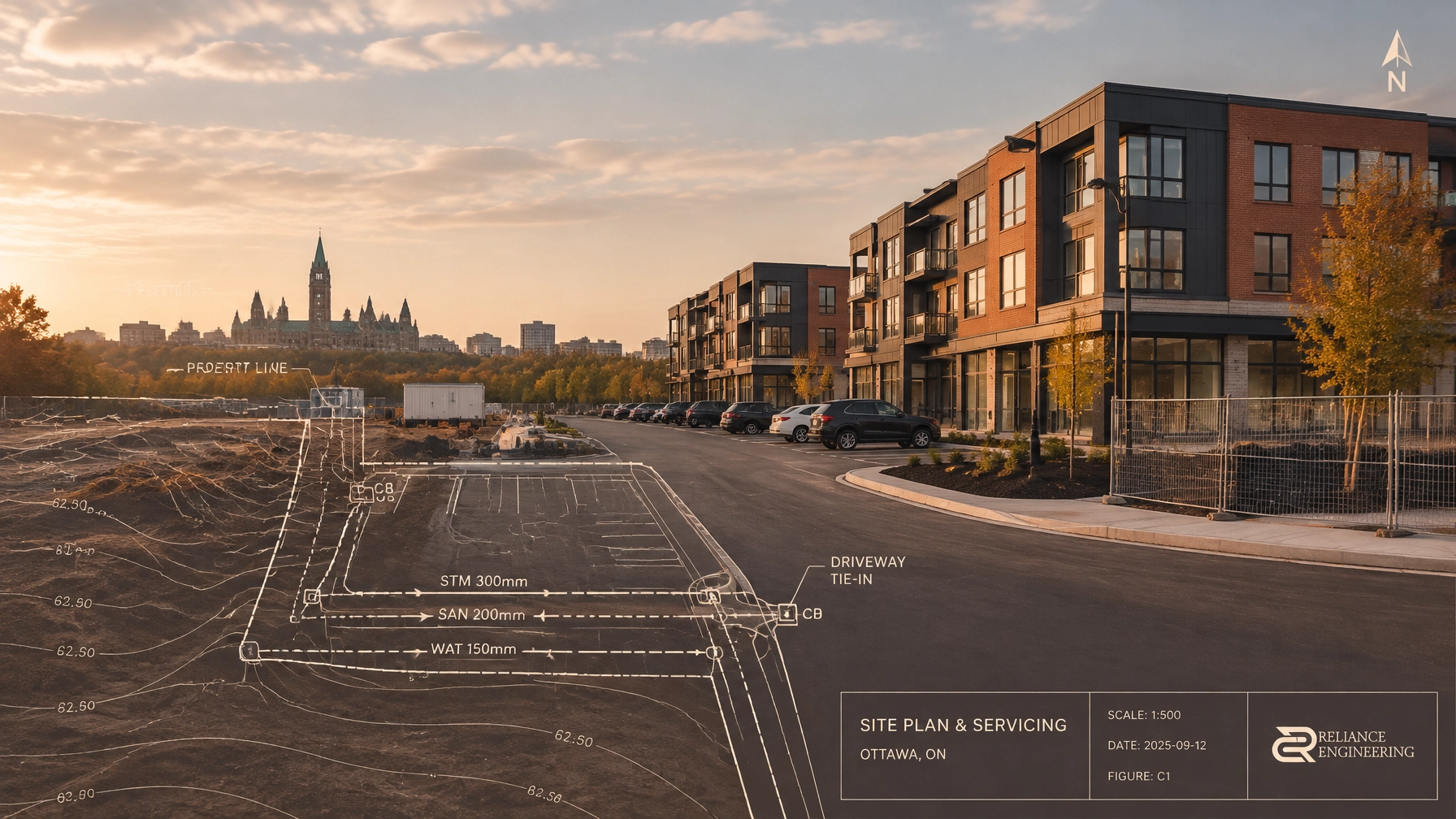
A Site Grading Plan provides the existing and proposed elevations needed to understand how water moves across the property.
For a commercial parking lot, the review should consider:
- Existing and proposed pavement elevations
- Parking stalls and drive aisle grades
- Catch basin and area-drain rim elevations
- Storm sewer connection points and outlets
- Curbs, islands, sidewalks, ramps, and loading areas
- Finished floor and entrance elevations
- Property boundaries and adjacent grades
- Swales, landscape areas, and perimeter drainage routes
- Safe overland flow routes for major storm events
- Tie-ins to roads, ditches, and existing storm systems
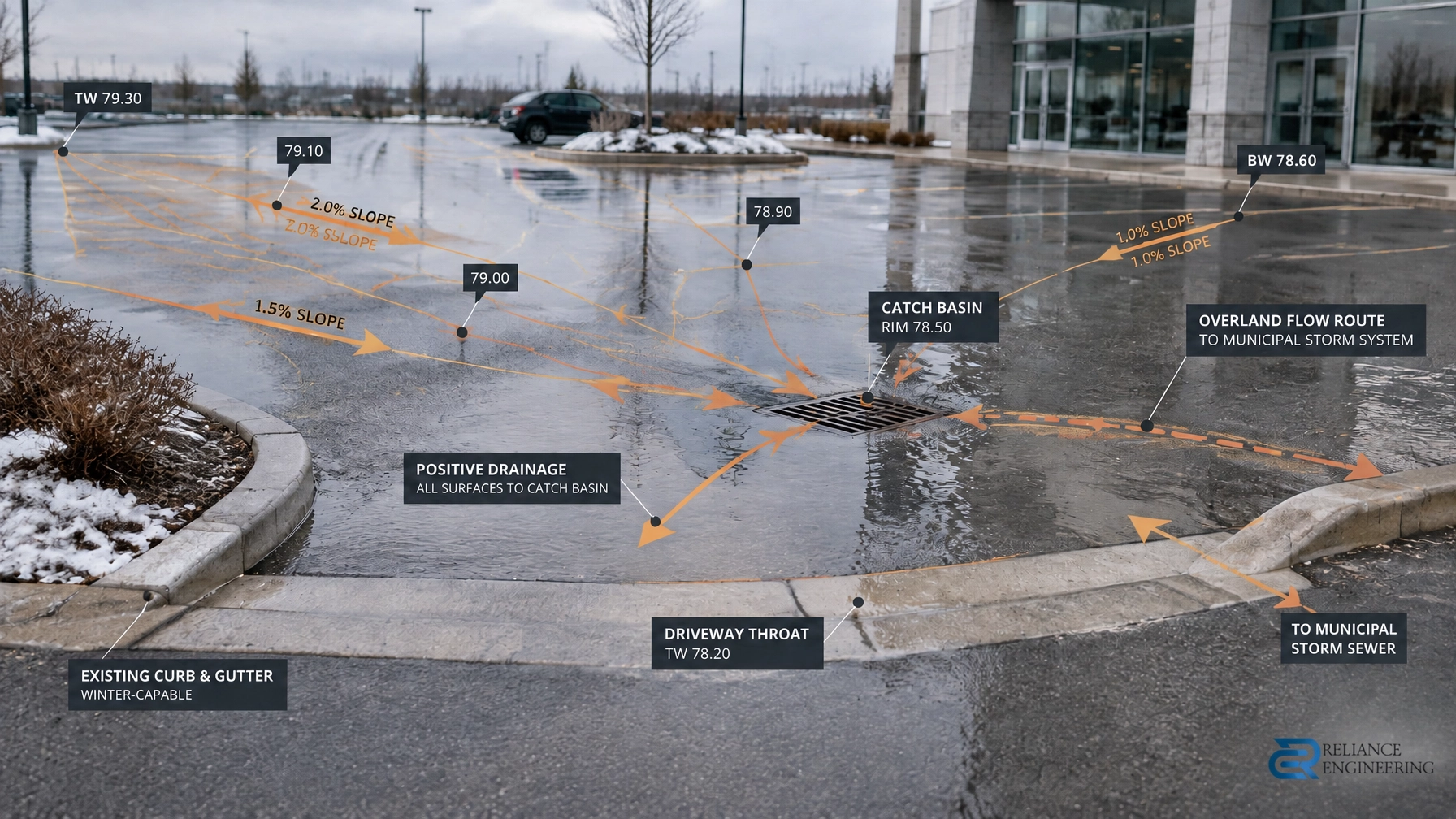
The plan should clearly show slope arrows, low points, drainage directions, spot elevations, and relevant construction notes. This allows the paving contractor to understand how the asphalt must be placed: not simply where new pavement is required.
At Reliance Engineering, grading is designed around practical field conditions. Our objective is buildable grading that protects buildings, supports safe access, and directs stormwater toward designated drainage points without creating new problems.
Review the Catch Basins Before Setting New Asphalt Grades
A catch basin can fail to perform even when the connected storm sewer is functioning.
Before repaving, each catch basin should be checked for:
-
Rim elevation
The rim must align with the proposed pavement low point. A raised or settled rim can prevent water from entering the structure. -
Frame and grate condition
Broken frames, damaged grates, and deteriorated concrete collars can create both drainage and safety concerns. -
Structural settlement
Settlement around the structure may indicate base failure, poor compaction, or water infiltration. -
Hydraulic condition
Sediment, debris, and blocked outlets reduce the basin’s ability to receive runoff. -
Location relative to flow
A basin that is not located at a true low point may not capture the water it was intended to receive.
Depending on the findings, the appropriate correction may include cleaning, rim adjustment, structural repair, basin replacement, or installation of an additional inlet. The grading design should be coordinated with the selected repair so the final asphalt surface drains correctly to the structure.

Design for Positive Drainage and Safe Overland Flow
The purpose of asphalt regrading is positive drainage. Water should move consistently from higher areas to designated low points without becoming trapped in isolated depressions.
The final design must also account for practical site constraints, including:
- Door thresholds and finished floor elevations
- Accessible parking spaces and pedestrian routes
- Vehicle clearance at ramps and drive aisles
- Loading dock elevations
- Existing curbs and sidewalks
- Landscape grades and retaining conditions
- Connections to municipal roads and storm systems
- Drainage impacts on neighbouring properties
There is no single slope that suits every commercial site. Proposed grades must be checked against the existing survey, municipal engineering standards, accessibility requirements, pavement limitations, and the contractor’s construction methods.
A complete grading review should also identify a safe major-storm route. If surface inlets become overwhelmed during an intense rainfall event, water must still have a controlled path away from buildings, entrances, loading areas, and neighbouring lands. These overland flow routes are an important part of a resilient drainage design.
Coordinate Grading with Construction Controls
Parking lot rehabilitation can expose granular base, create temporary low points, and generate sediment during excavation and paving. Drainage controls must therefore be coordinated with construction staging.
An Erosion and Sediment Control Plan may include:
- Catch basin protection
- Silt fencing
- Mud mats and stabilized construction access
- Construction limit fencing
- Stockpile protection
- Sediment traps or check dams
- Dewatering notes where required
- Inspection and maintenance requirements
The ESC design should follow the actual grading and runoff patterns. Standard notes are not enough when water is flowing toward a storm inlet, public road, ditch, or neighbouring property.
A coordinated plan helps keep sediment on site, protects existing infrastructure, and reduces the risk of blocked catch basins during construction. It also gives contractors clear drawings and practical controls they can install and maintain.

A Pre-Repaving Drainage Review Checklist
Before authorizing commercial parking lot repaving, confirm that the project team has reviewed:
- Recent topographic survey and site measurements
- Existing ponding locations, including observations after rainfall
- Low points, reverse grades, and isolated depressions
- Catch basin, area-drain, and storm outlet conditions
- Proposed pavement elevations and slope directions
- Building entrances, loading docks, ramps, and accessible routes
- Curbs, islands, sidewalks, swales, and landscape tie-ins
- Safe overland flow routes
- Municipal grading and stormwater criteria
- Required drainage repairs or new structures
- Construction sequencing and ESC measures
- Final inspection and elevation checks during paving
The result should be a coordinated set of permit-ready drawings and construction information: not a paving instruction based only on visual inspection.
Choose Commercial Property Grading Fixes That Can Be Built
The most cost-effective solution is not always full lot reconstruction. Depending on the survey and drainage review, commercial property grading fixes may include:
- Milling high areas to correct reverse grades
- Installing a controlled asphalt overlay
- Combining milling and overlay for precise transitions
- Reconstructing failed sub-base areas
- Adjusting catch basin rims
- Repairing or replacing damaged drainage structures
- Adding a relief catch basin or trench drain
- Correcting perimeter swales, curbs, or landscape grades
The right choice depends on elevations, pavement condition, stormwater capacity, access requirements, and municipal criteria. A professional grading review allows the owner to compare these options before construction begins.
Complete the Review Before You Repave
Repaving is an opportunity to correct drainage: not just cover the existing pavement. A properly prepared Site Grading Plan gives the owner, engineer, contractor, and municipality a shared understanding of the proposed grades and drainage strategy.
Reliance Engineering provides practical designs, clear drawings, approval support, and coordinated design for commercial parking lots and land development projects across Ontario. We can review existing conditions, prepare buildable grading, coordinate catch basins and storm drainage, and support the project through municipal review where required.
Do not repave a ponding problem. Contact Reliance Engineering for a grading and drainage consultation before your paving contractor starts work.
Request a Consultation or call 647-385-6418 to discuss your project.
Contact Reliance Engineering
Reliance Engineering
6850 Millcreek Dr
Mississauga, ON L5N 2H4
Phone: 647-385-6418
Email: [email protected]
Office hours:
Saturday 12:00 PM–2:00 PM
Sunday Closed
Naresh Ochani, P.Eng. M.Eng.
PEO Certificate of Authorization: 100548882