Published: August 31, 2026
Category: Grading & Drainage
Service area: Ontario
Estimated reading time: 6 minutes
Focus: Ponding solutions and commercial property grading fixes
Standing water in a commercial parking lot is rarely just a maintenance issue. If ponding returns after cleaning catchbasins, patching asphalt, or applying a new surface layer, the underlying grades may be directing water to the wrong locations.
Catchbasins can collect water only when the surrounding pavement slopes toward them. If asphalt has settled, a low point has developed away from the inlet, or a tie-in was built incorrectly, water will remain trapped. The result is recurring ponding, pavement damage, safety concerns, municipal complaints, and repeated repair costs.
A durable solution requires a drainage-focused approach. At Reliance Engineering, we prepare practical designs, buildable grading, and permit-ready drawings for commercial sites across Ontario.
Why standing water keeps returning
Recurring ponding usually results from one or more of the following conditions.
Settlement and pavement deformation
Commercial parking lots and drive lanes are exposed to heavy vehicles, repeated turning movements, snow removal, freeze-thaw cycles, and changing subgrade conditions. Over time, the granular base or subgrade may settle.
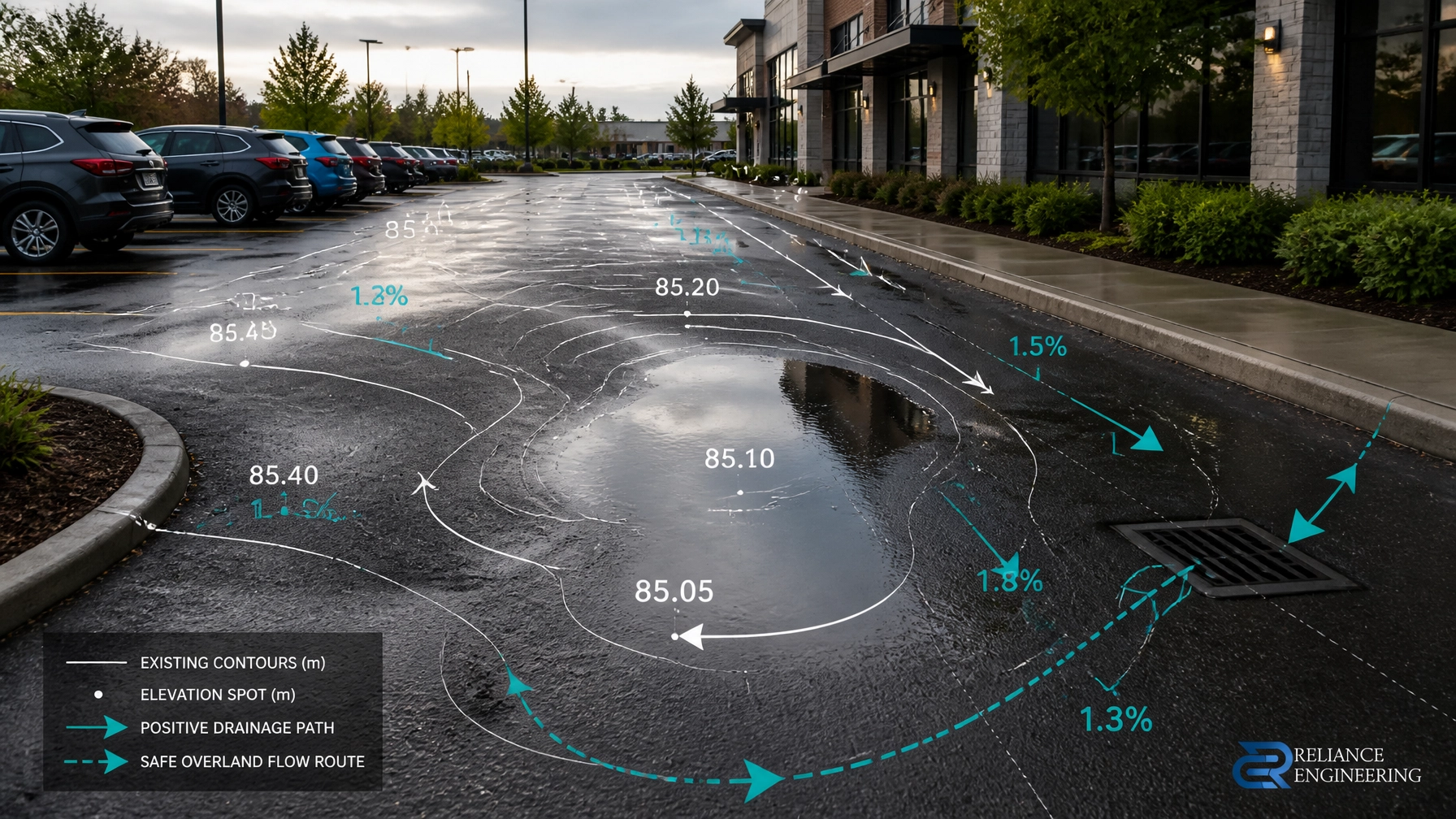
Asphalt can also rut or deform under traffic. These changes create depressions that were not part of the original design. Even when a catchbasin is nearby, water follows the lowest available path and remains in the depression.
Incorrect low-point locations
A catchbasin may be correctly shown on an older drawing but no longer be located at the actual low point of the finished pavement. Construction changes, asphalt overlays, curb modifications, or settlement can shift the surface drainage pattern.
A basin that is several metres away from the new low point cannot remove water efficiently. Cleaning the grate may help briefly, but the ponding will return because the geometry has not changed.
High or poorly coordinated catchbasin rims
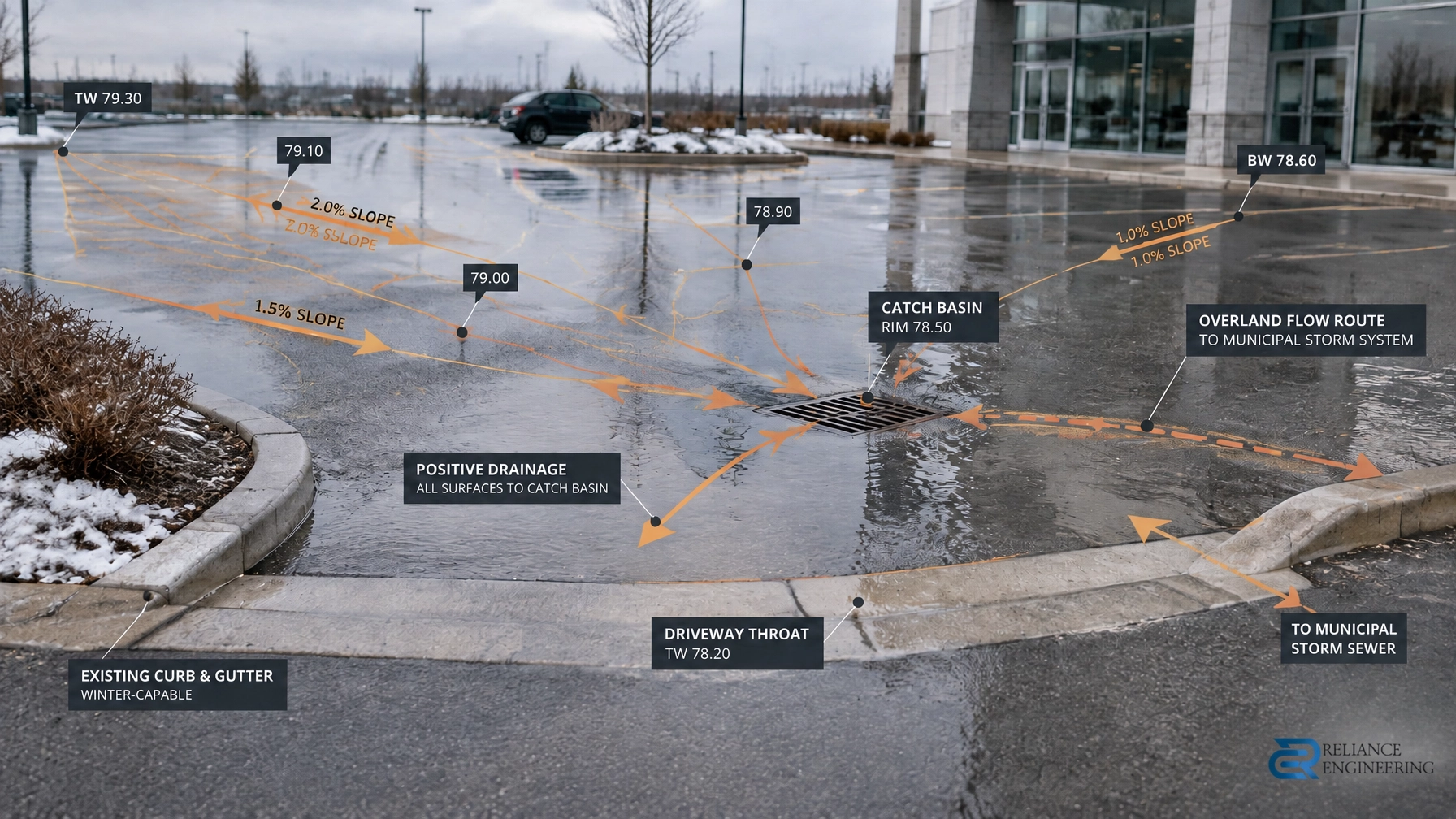
Catchbasin rims must be coordinated with the proposed finished asphalt elevations. If the grate is higher than the surrounding pavement, runoff cannot enter the structure.
This issue often appears after resurfacing. New asphalt may raise the pavement around the inlet, reduce the effective slope, or create a high spot that redirects water away from the drainage system.
Reverse grades and failed tie-ins
A small reverse grade can interrupt an otherwise functional drainage path. Common problem areas include:
- Driveway connections
- Loading areas
- Curb transitions
- Sidewalks and accessible routes
- Building entrances
- Landscape islands
- Road and property-line tie-ins
- Areas beside retaining walls
These features must be coordinated as part of the complete grading design. A local patch cannot correct a broader drainage pattern.

Ponding damages asphalt and increases site risk
Standing water is not only an appearance problem. It contributes directly to pavement deterioration.
Water enters cracks and joints, weakens the asphalt and granular base, and accelerates settlement. In Ontario, freeze-thaw cycles can expand cracks and create potholes, raveling, and additional depressions. Each new depression creates another location where water can collect.
This creates a cycle:
- Poor grades trap water.
- Water weakens the pavement structure.
- Freeze-thaw and traffic enlarge the depression.
- The depression holds more water.
- Patching temporarily hides the defect.
- Ponding returns because the grade remains incorrect.
Standing water also creates operational and liability concerns. Wet pavement can affect vehicle movement, pedestrian access, and visibility of pavement markings. During winter, ponded water may freeze into hazardous ice patches near entrances, accessible parking spaces, and drive aisles.
Recurring ponding can also lead to complaints from tenants, customers, neighbouring owners, and municipal staff. Water directed toward a sidewalk, road, building entrance, or adjacent property may create additional drainage concerns.
Patching and resurfacing do not always solve the problem
Patching is appropriate for isolated pavement defects when the surrounding grade remains functional. It is not a substitute for correcting an entire drainage pattern.
Resurfacing can also fail when the existing slopes are wrong. An asphalt overlay may follow the same depressed areas, raise pavement against catchbasin rims, and preserve the original low points. In some cases, it can make the problem worse by reducing available elevation at doors, curbs, ramps, or drainage structures.
Asphalt regrading addresses the problem differently. It establishes new finished elevations so water can move toward catchbasins, swales, area drains, or an approved outlet.
Depending on site conditions, the work may include:
- Milling existing asphalt
- Excavating and rebuilding settled areas
- Replacing unsuitable granular material
- Adjusting catchbasin frames and grates
- Reconstructing curbs
- Installing additional drainage structures
- Correcting storm service connections
- Placing asphalt to proposed grades
The objective is positive drainage: a continuous and controlled path for runoff, without trapped water in parking stalls, drive lanes, pedestrian routes, or beside buildings.
How a Site Grading Plan provides the correct ponding solution
A professional Site Grading Plan begins with an understanding of the existing site. The design should not rely only on the location of existing catchbasins or visual observations.
1. Review the existing site
A current topographic survey and site review help identify:
- Existing pavement elevations
- Catchbasin and area drain rims
- Curbs, sidewalks, and driveway grades
- Building entrances and finished floor elevations
- Loading docks and service areas
- Property boundaries and adjacent grades
- Road, ditch, and storm system tie-ins
- Existing swales and overland flow routes
- Observed ponding locations
Photographs taken after rainfall can also help confirm the extent and duration of standing water.
2. Identify drainage breaks and low points
The grading analysis maps how water currently moves across the site. It identifies low points, high points, reverse grades, drainage divides, and areas where runoff approaches a building or property boundary.
This analysis determines whether the appropriate ponding solution is:
- Localized asphalt regrading
- Catchbasin rim adjustment
- A relocated catchbasin
- An additional area drain
- A new swale
- Storm servicing improvements
- A defined overland flow route
- Full or partial pavement reconstruction
3. Design buildable grading
The proposed plan must work in the field, not only on paper. A buildable grading design considers pavement slopes, construction tolerances, access requirements, snow operations, accessibility, fire routes, and fixed building elevations.
The plan may show:
- Existing and proposed elevations
- Slope arrows
- Swales and drainage routes
- Catchbasin and area drain locations
- Finished floor and entrance elevations
- Parking lot and drive lane grades
- Tie-ins to roads, ditches, and storm systems
- Retaining wall coordination, where required
- Safe overland flow routes
The design should establish positive drainage while avoiding abrupt grade changes, unsafe pedestrian slopes, or water directed toward neighbouring properties.

Coordinate grading with servicing and stormwater design
A grading plan should be coordinated with the entire civil design. Catchbasins, storm leads, curbs, landscape features, entrances, and pavement grades must work together.
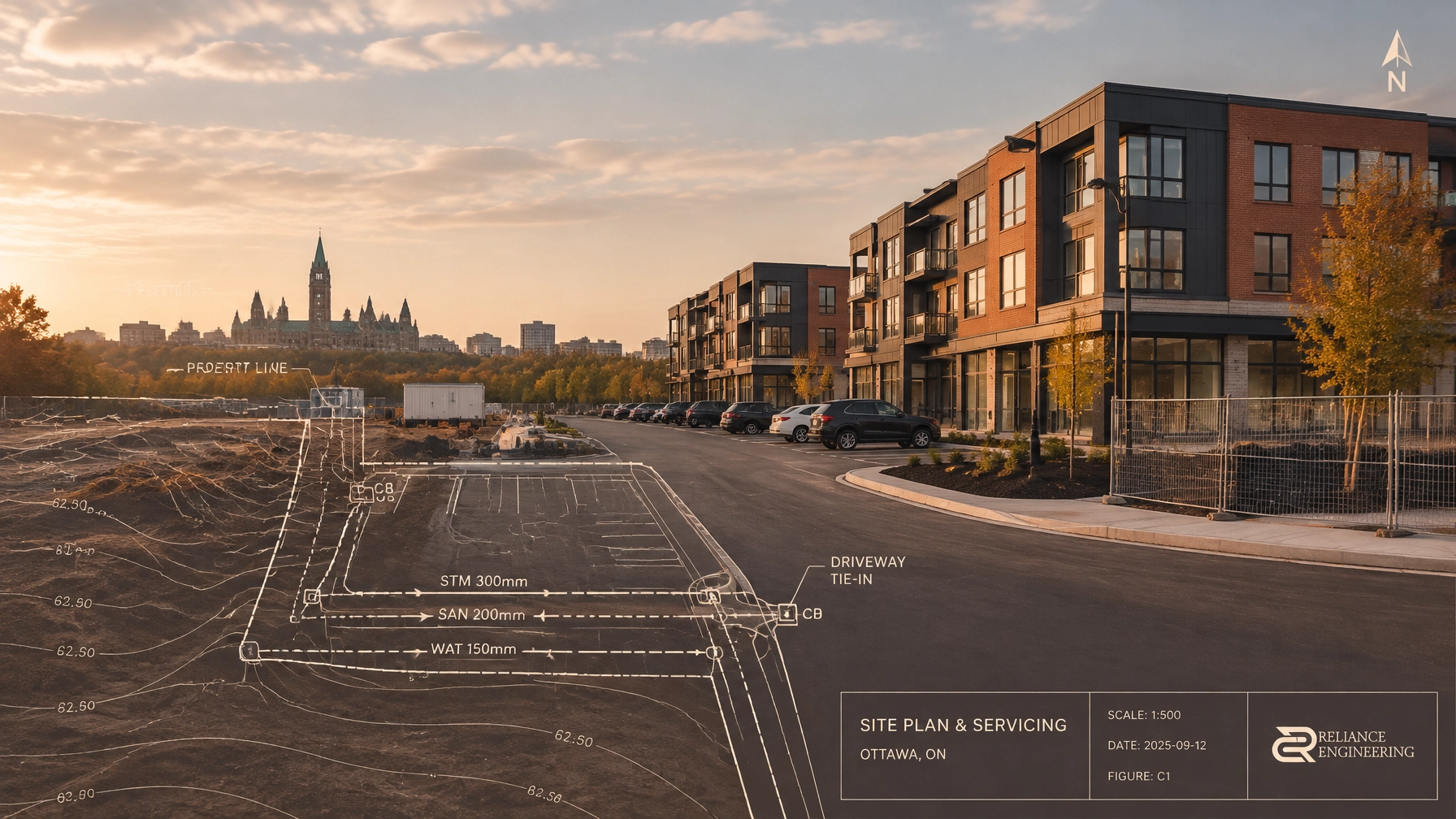
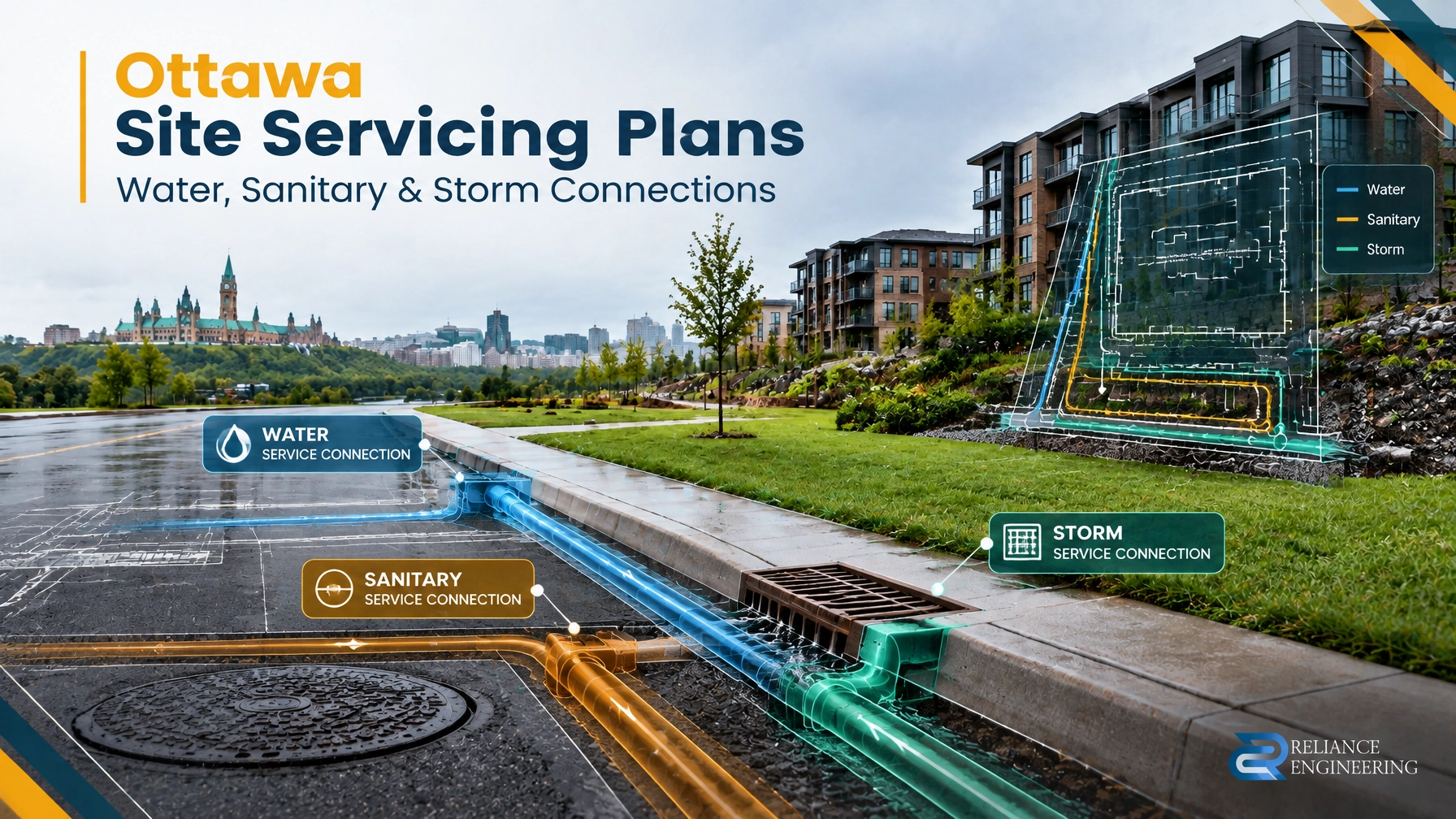
A Site Servicing Plan confirms the connection between surface drainage structures and municipal or private storm infrastructure. It also helps identify whether existing pipes, inverts, and outlets can support the proposed arrangement.
For larger or more complex sites, a Stormwater Management Report or Functional Servicing Report may be required. These documents can address runoff, peak flows, storage, water quality, downstream impacts, and municipal servicing criteria.
This coordinated design approach prevents a common mistake: adding a catchbasin after the pavement grades have already been established. The drainage structure, surface elevations, and downstream system should be designed as one system.
ESC measures protect the site during regrading
Regrading involves excavation, exposed granular material, asphalt removal, stockpiling, and construction traffic. Without proper controls, sediment can enter catchbasins and storm sewers, creating the same blockage the project is intended to eliminate.
An Erosion and Sediment Control Plan should be coordinated with the construction sequence and temporary drainage conditions.
Typical measures include:
- Catchbasin inlet protection
- Silt fencing at down-gradient limits
- Stabilized mud mats and construction access
- Stockpile protection
- Sediment traps and check dams
- Dewatering procedures
- Construction limit fencing
- Inspection and maintenance notes
These are not generic additions. Controls should reflect the site layout, grading pattern, construction limits, nearby roads, storm infrastructure, ditches, watercourses, and neighbouring properties.

When municipal approval support is required
Commercial property grading fixes can affect approved elevations, storm connections, drainage to adjacent lands, road allowances, and municipal infrastructure. Depending on the scope and municipality, engineered drawings or additional approval may be required.
Reliance Engineering provides coordinated civil documentation for:
- Site Grading Plans
- Site Servicing Plans
- Erosion and Sediment Control Plans
- Stormwater Management Reports
- Functional Servicing Reports
- Site Plan Approval Drawings
- OPA/ZBA Drawings
- Severance/Consent Application Drawings
- Building Permit Drawings
Clear drawings and approval support help municipal reviewers, contractors, property owners, and project consultants work from the same information. Where comments are issued, revisions and responses can be coordinated efficiently.
Request a ponding review before repaving
If standing water returns after every rainfall, the problem may be the grade: not the catchbasin.
Before approving another patching or resurfacing program, arrange a drainage review that examines the surveyed elevations, low points, pavement slopes, catchbasin rims, storm connections, building entrances, and overland flow routes.
Reliance Engineering provides practical designs, coordinated grading, and permit-ready drawings for ponding solutions, commercial parking lot drainage in Ontario, asphalt regrading, and commercial property grading fixes.
Request a consultation or contact us directly for expert advice.
Contact and professional credentials
Reliance Engineering
6850 Millcreek Dr, Mississauga, ON L5N 2H4
Phone: 647-385-6418
Email: [email protected]
Office hours: Saturday 12:00 PM–2:00 PM; Sunday Closed
Naresh Ochani, P.Eng. M.Eng.
PEO Certificate of Authorization: 100548882
Authorized by the Association of Professional Engineers of Ontario to offer professional engineering services.