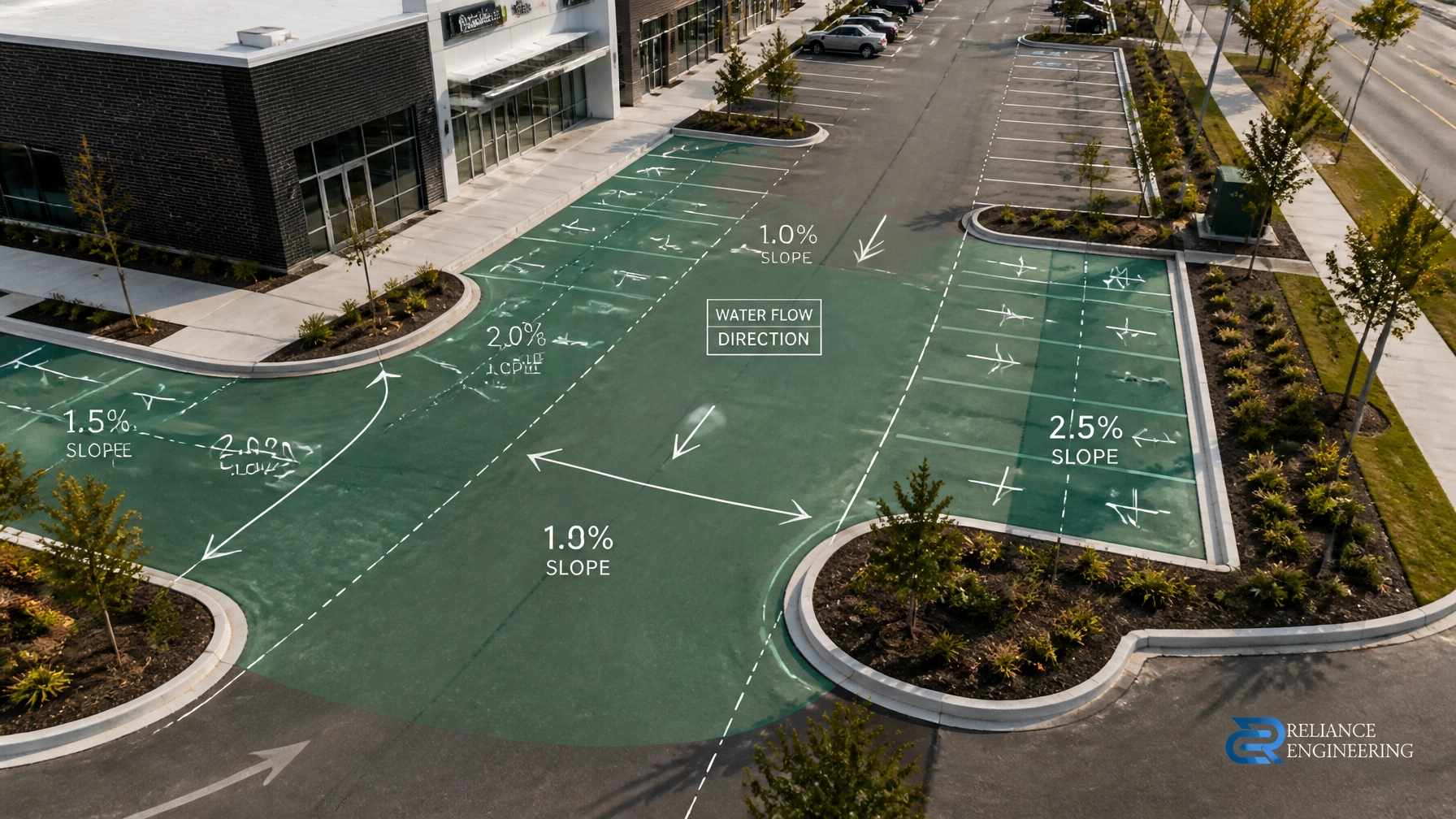
For commercial property owners in Ontario, a parking lot is often one of the largest physical assets on the site. However, it is also one of the most vulnerable to the province's harsh freeze-thaw cycles. When water sits on your asphalt, it isn't just a nuisance for tenants or customers, it is actively destroying your investment.
At Reliance Engineering, we specialize in providing practical designs and buildable grading solutions that solve these issues at the source. The key to long-term pavement health is a drainage-focused approach centered on one critical engineering principle: positive drainage.
What is Positive Drainage?
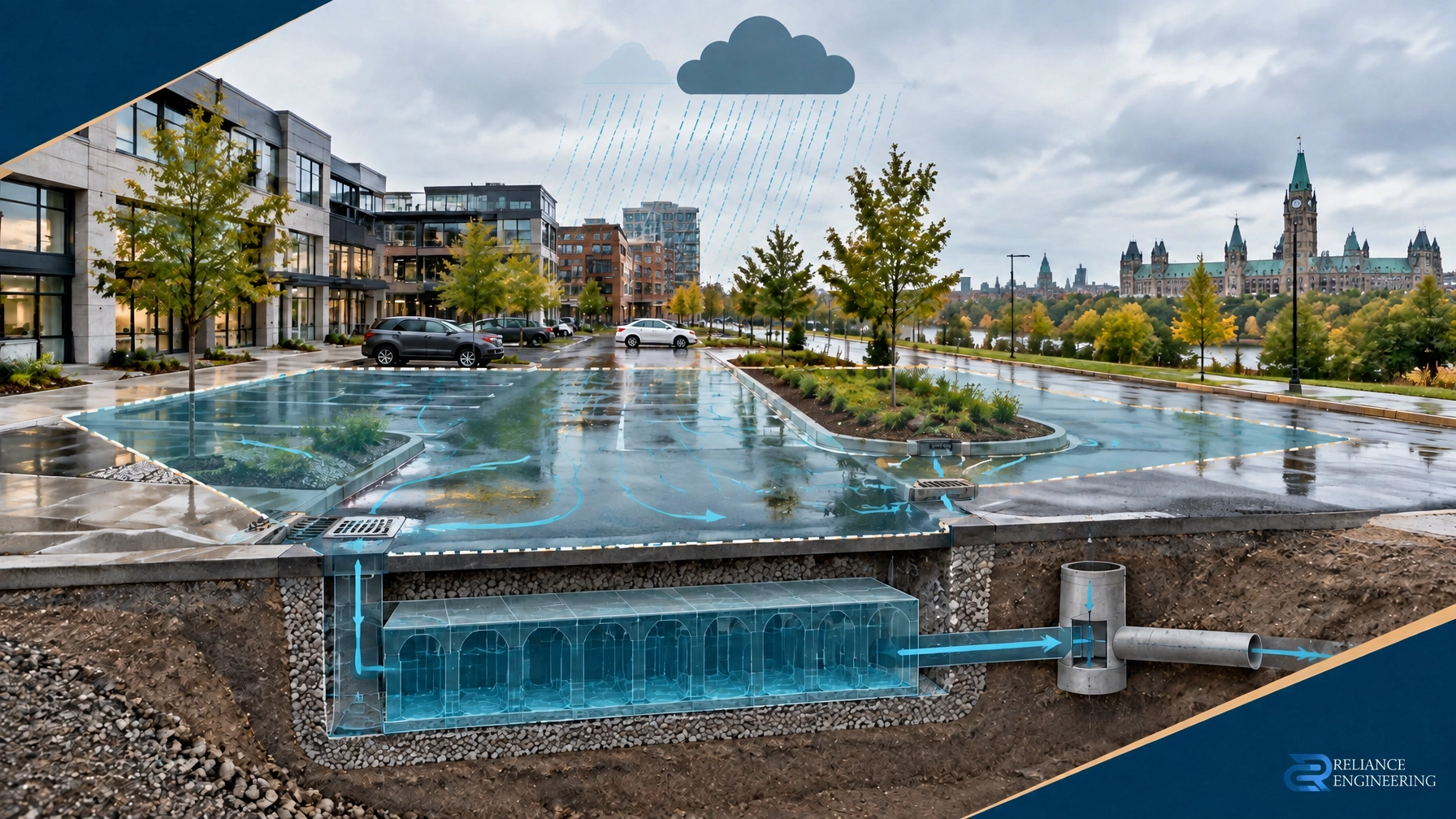
Positive drainage is the intentional design of a surface to ensure that water always moves away from structures and toward a designated collection point, such as a catch basin or a swale. In Ontario, achieving this requires precision.
Standard engineering practices dictate that a parking lot should maintain a minimum slope of 1% to 2%. Anything less leads to "birdbaths", small pools of standing water that eventually seep into the sub-base. Once water enters the sub-base, winter temperatures cause it to freeze and expand, leading to the cracks, heaving, and potholes that plague many commercial properties.

The Hidden Costs of Poor Drainage
Commercial property grading fixes are often viewed as a maintenance expense, but they should be seen as a risk management strategy. Poor drainage leads to several high-cost problems:
- Liability Risks: Standing water in the summer becomes a slip-and-fall hazard. In the winter, these areas turn into ice patches that are nearly impossible to manage with salt alone.
- Structural Damage: When water is allowed to pond, it saturates the asphalt. This softens the surface, making it prone to "alligator cracking" and rutting under the weight of heavy delivery trucks.
- Shortened Lifespan: A well-drained parking lot can last 20 to 25 years. A lot with poor drainage may require a complete replacement in as little as 10 years.
Engineering Solutions: Site Grading Plans
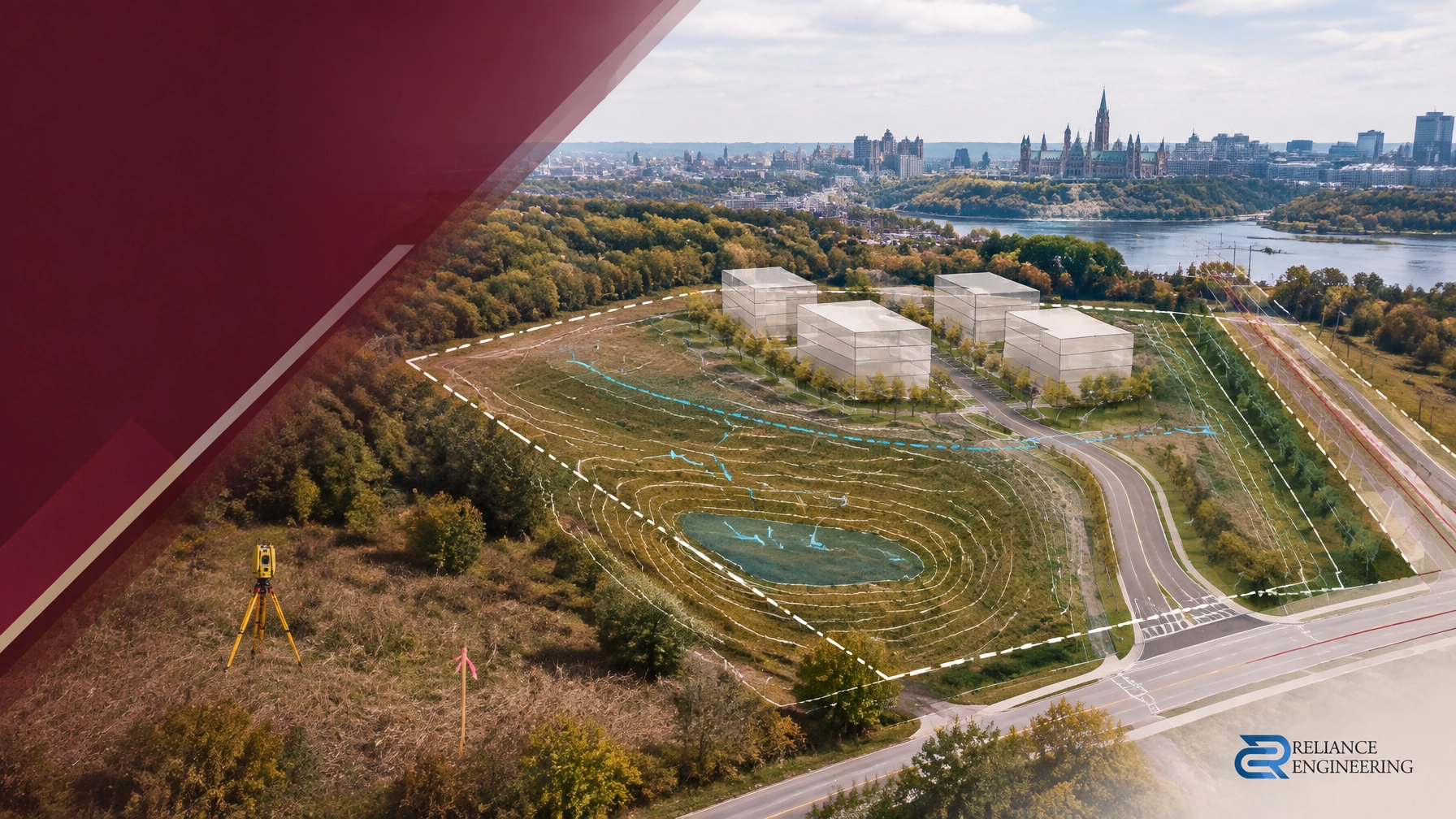
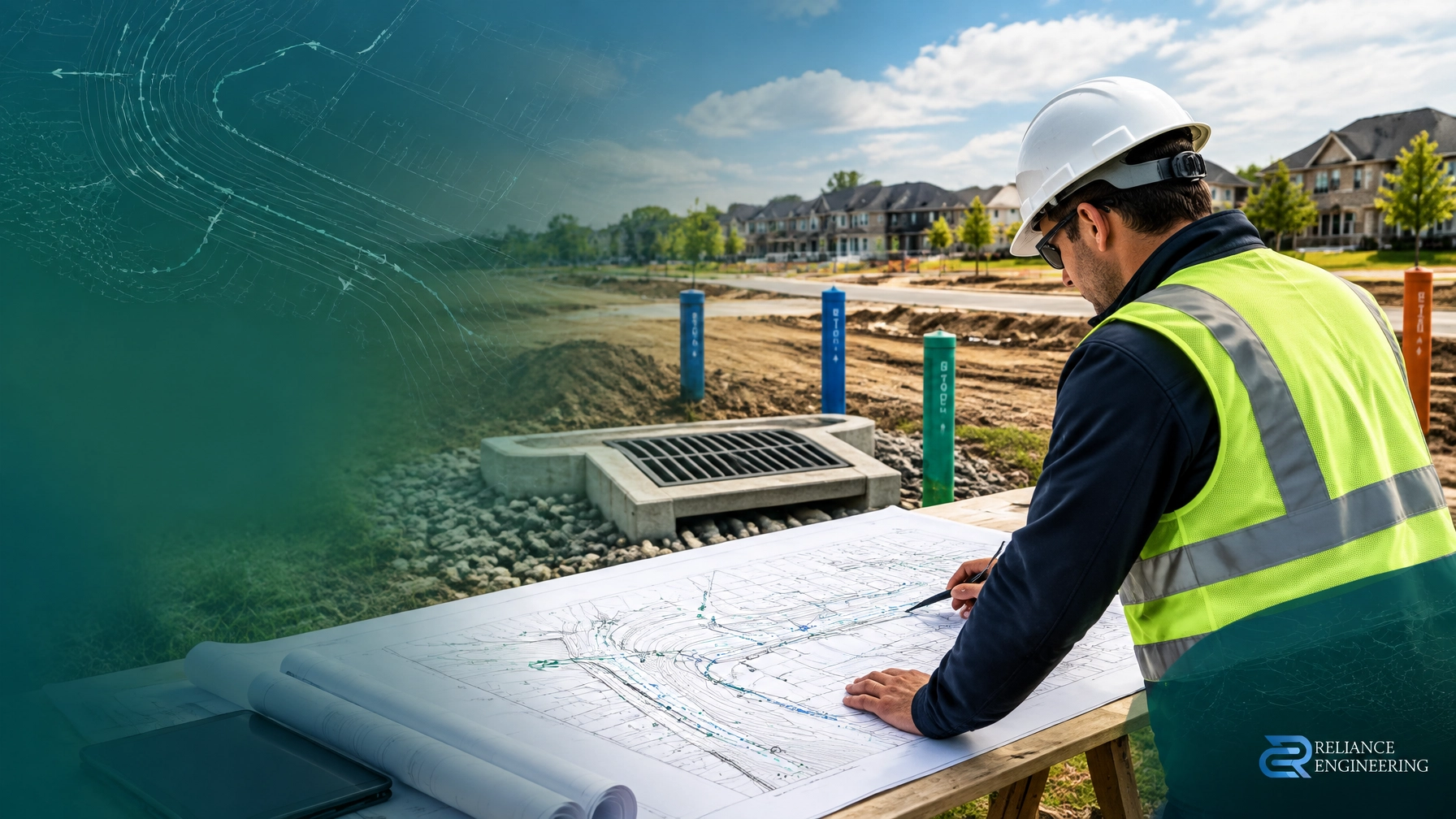
The most effective way to fix chronic ponding is to start with a professional Site Grading Plan. Unlike a simple paving patch, a grading plan uses topographic data to identify exactly where the "low spots" are and how to redirect them.
Our approach at Reliance Engineering involves creating permit-ready drawings that satisfy municipal requirements across Ontario. We don't just look at the surface; we analyze the entire site to ensure that our practical designs are easy for contractors to build on the ground.
Asphalt Regrading and Milling
For existing lots, we often recommend "milling and overlay." This involves grinding down high spots and using new asphalt to raise low areas, effectively re-sculpting the lot to restore that vital 2% slope. This is a surgical approach to parking lot drainage fixes that avoids the cost of a full excavation.

Managing Stormwater and Overland Flow Routes
In Ontario, we are seeing more frequent and intense storm events. A modern drainage system must do more than just manage a light rain; it must handle extreme weather. This is where overland flow routes come into play.
When a storm exceeds the capacity of the underground pipes, the parking lot itself acts as a secondary channel to move water safely away from buildings. Our Stormwater Management Reports ensure that your property is resilient. By designing clear overland flow routes, we protect your building foundations from flooding during the "100-year storm" scenarios often required for Site Plan Approval (SPA).
Environmental Protection: Erosion and Sediment Control
When performing drainage repairs, it is essential to protect the local environment. Any construction that disturbs the soil or involves heavy machinery requires Erosion and Sediment Control (ESC) Plans.
During a parking lot regrading project, we implement measures such as silt fences and catch basin filters. These prevent construction debris and sediment from entering the municipal storm sewer system. This is not just a best practice; it is a legal requirement in most Ontario municipalities.

Why "Permit-Ready Drawings" Matter
Many property owners attempt to fix drainage issues with a simple paving contractor. However, without a drainage-focused approach backed by engineering, these fixes are often temporary.
When you work with Reliance Engineering, you receive drawings that are ready for municipal submission. Whether you are dealing with a Building Permit (BP) or a more complex Official Plan Amendment (OPA) or Zoning Bylaw Amendment (ZBA), our documentation is designed for fast approval. We understand the local regulations across Ontario and ensure your project stays on track.
Summary of Solutions for Commercial Properties
- Ponding Solutions: Adding "relief" catch basins at the lowest points of the lot.
- Linear Drainage: Installing trench drains across drive aisles to intercept sheet flow.
- Subsurface Fixes: Installing French drains or sub-drains to manage groundwater that migrates under the pavement.
- Positive Drainage Restoration: Re-sloping the lot to a minimum of 1-2% toward inlets.

Expert Consulting for Your Property
Investing in proper drainage today saves tens of thousands of dollars in emergency repairs and liability tomorrow. At Reliance Engineering, we take full ownership of your project, guiding you from the initial topographic survey to the final municipal approval.
If your commercial parking lot is suffering from ponding or ice build-up, it’s time for a professional assessment.
Contact Information
Reliance Engineering
Address: 6850 Millcreek Dr, Mississauga, ON L5N 2H4
Phone: 647-385-6418
Email: [email protected]
Principal: Naresh Ochani, P.Eng. M.Eng.
PEO Certificate of Authorization: 100548882
Office Hours
- Saturday: 12:00 PM – 2:00 PM
- Sunday: Closed
- Monday – Friday: (Please call for appointment)