
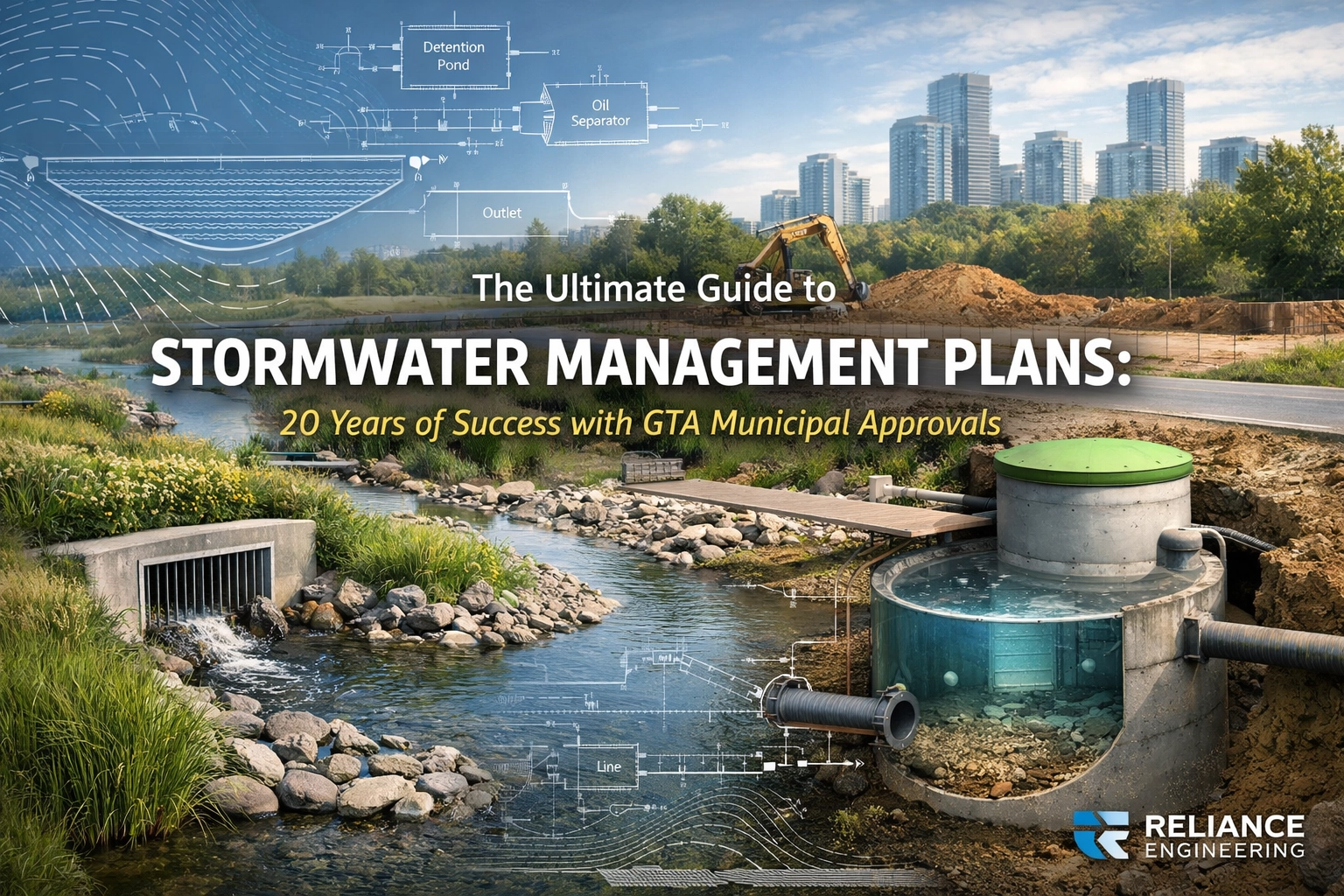
In the current landscape of land development within the Greater Toronto Area (GTA), the regulatory environment has shifted from advisory to strictly mandatory. For property developers, builders, and commercial project owners, the stormwater management report (SWMR) has evolved into one of the most critical components of the site plan approval process in Ontario.
Years ago, stormwater management was often viewed as a secondary consideration: a technicality addressed after the primary architectural and site layouts were finalized. Today, in municipalities such as Toronto, Mississauga, Vaughan, and Oakville, an inadequate stormwater management plan is a primary cause for project delays, increased capital costs, and permit denials.
At Reliance Engineering, we bring over two decades of principal engineering experience to the table. We understand that a successful project isn't just about drawing pipes; it is about navigating a complex web of municipal bylaws and conservation authority mandates to secure a "one-submission approval."
The Shift Toward Stringent Municipal Requirements
The intensification of urban development in the GTA, coupled with increasingly volatile weather patterns, has forced municipalities and agencies like the Toronto and Region Conservation Authority (TRCA) and the Credit Valley Conservation (CVC) to implement rigorous standards.
Whether you are working on a mid-rise development like 35 Wabash Avenue or a large-scale institutional project like the redevelopment of Etobicoke General Hospital, the requirements are non-negotiable. Municipalities now demand detailed evidence that a development will not negatively impact the existing municipal infrastructure or the local ecosystem.
Why the SWMR is Critical for Site Plan Approval
A Stormwater Management Report is more than a technical document; it is a legal and environmental assurance. Without a signed and sealed SWMR from a licensed Professional Engineer, a project cannot move forward. This report confirms to the city that:
- The post-development runoff will not exceed pre-development levels (Quantity Control).
- The runoff leaving the site is treated to remove pollutants (Quality Control).
- The surrounding watercourses are protected from erosion.
- The local groundwater table is maintained (Water Balance).
The Four Pillars of a Compliant Stormwater Management Plan
To secure approval in the GTA, your stormwater management plan must address four specific technical criteria. Failure to meet even one of these often results in a "Request for Revision," which can set a project back by months.
1. Water Quantity Control (Flood Prevention)
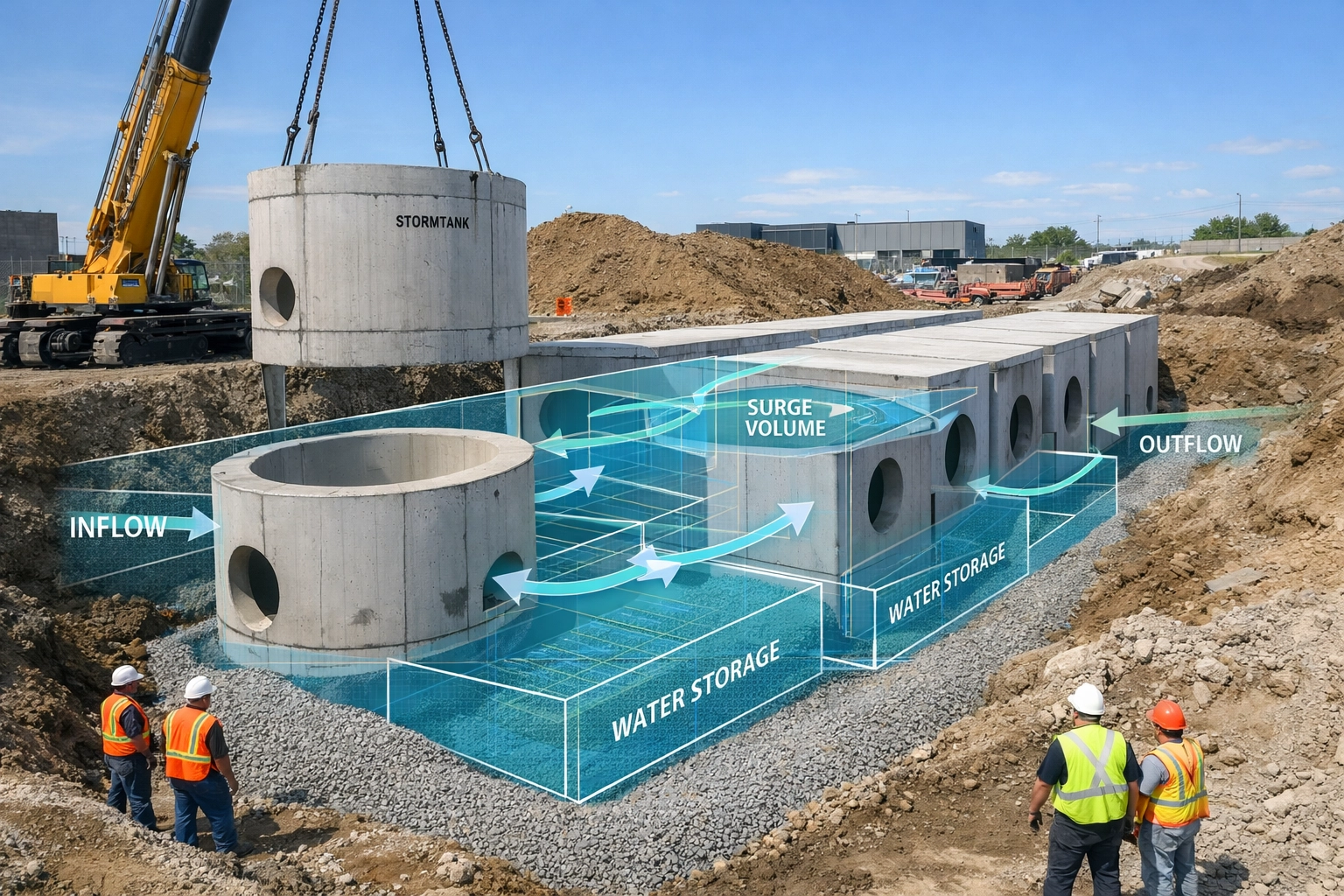
Urbanization replaces natural, porous soil with impermeable surfaces like asphalt and concrete. This leads to a massive increase in the volume and speed of water runoff. Municipalities require that the peak flow rate of runoff leaving the site after development does not exceed the flow rate that existed before development. This often involves the design of detention systems, such as underground storage tanks, oversized pipes, or rooftop ponding.
2. Water Quality Treatment (Pollutant Removal)
Runoff from parking lots and roadways carries oils, heavy metals, and suspended solids. Most GTA municipalities require an "Enhanced" level of protection, which typically means removing 80% of Total Suspended Solids (TSS) before the water enters the municipal sewer system or a natural watercourse. We specialize in selecting the most cost-effective treatment units: whether they are Oil-Grit Separators (OGS) or Low Impact Development (LID) features: to meet these standards.
3. Erosion Control
Rapidly flowing water can devastate local stream banks. A comprehensive SWMR calculates the duration and intensity of runoff to ensure that the downstream environment is not subjected to erosive forces. This is particularly vital in projects near sensitive zones monitored by the TRCA or CVC.
4. Water Balance and Recharge
This is often the most challenging requirement for developers. Agencies now demand that a portion of rainfall be "recharged" into the ground to mimic the natural hydrological cycle. In areas with poor soil permeability (like the clay soils common in parts of Vaughan and Brampton), this requires innovative engineering solutions to prevent the water table from dropping.
Navigating the GTA Regulatory Maze: TRCA, CVC, and CLI-ECA
Navigating the various jurisdictions in Southern Ontario requires a nuanced approach. A strategy that works in St. Catharines may not be acceptable for a project in Oakville.
Furthermore, the introduction of the Consolidated Linear Infrastructure Environmental Compliance Approval (CLI-ECA) has changed the way storm and sanitary sewers are approved. This framework allows certain "pre-authorized" designs to bypass traditional Ministry approvals, provided they are designed by experts who understand the rigorous provincial standards.
Reliance Engineering acts as the bridge between the developer's vision and the agency's requirements. Our 20 years of experience allows us to anticipate the concerns of municipal reviewers before they even open the file. We know the specific preferences of local reviewers in Toronto, Mississauga, and Newmarket, which is why we are able to maintain a high rate of first-submission approvals.
The Financial Impact: Why Experience Saves You Money
For a developer, time is quite literally money. Every week spent in a "back-and-forth" with city engineering departments adds to the interest on land loans and pushes back the start of construction.
When you hire an inexperienced firm, you often face:
- Over-designed systems: An engineer who doesn't understand the nuances of the site may specify a $200,000 detention tank when a more efficient grading strategy or a smaller pipe network could have sufficed.
- Approval Delays: Incomplete reports lead to multiple rounds of comments from the city, adding 3–6 months to your timeline.
- Conflict with Site Plans: If the site grading plan and site servicing plan are not perfectly synchronized with the SWMR, the entire package will be rejected.
At Reliance Engineering, our principal-led approach ensures that the SWMR is integrated with the Functional Servicing Report from day one. We look for "value engineering" opportunities at every stage, ensuring your project remains compliant without unnecessary capital expenditure.

Case Study: Precision in Practice
Consider our work on high-density urban infill projects. In these scenarios, space is at a premium. There is no room for massive surface ponds. Our team excels at designing compact, high-efficiency underground storm system designs that satisfy the city's volume requirements while leaving the maximum possible area for building footprints and parking.
Our track record includes a wide variety of successful approvals, from residential townhomes to complex commercial redevelopments. You can explore our portfolio of projects to see how we have successfully managed stormwater challenges across the province.
Why Choose Reliance Engineering for Your SWMR?
With 20+ years of expertise, Reliance Engineering provides more than just a report; we provide a clear path to construction.
- Principal Involvement: Every report is overseen by our Founder and Principal, Naresh Ochani, ensuring decades of high-level expertise are applied to your project.
- Holistic Integration: We handle the grading, servicing, and stormwater as a single, cohesive package.
- Speed and Accuracy: We pride ourselves on delivering draft plans in days, not weeks, and pursuing a "one-submission approval" goal.
- Agency Relationships: We speak the language of the TRCA, CVC, and municipal engineers, facilitating smoother negotiations and faster permits.

Conclusion: Don't Let Stormwater Stall Your Project
As municipalities in the GTA continue to tighten their environmental and infrastructure standards, the margin for error in your Stormwater Management Report has vanished. A mediocre report is no longer an option: it is a liability.
Whether you are in the early stages of due diligence or are ready to submit for Site Plan Approval, ensure your engineering partner has the experience to navigate the complexities of 2026's regulatory landscape.
Ready to move your project forward?
Contact Reliance Engineering today for a consultation on your Stormwater Management Plan. Let our two decades of experience be the foundation of your next successful development.
Reliance Engineering
Practical. Compliant. Cost-Effective.
www.relianceengineering.ca
About Our Expertise




Leave A Comment